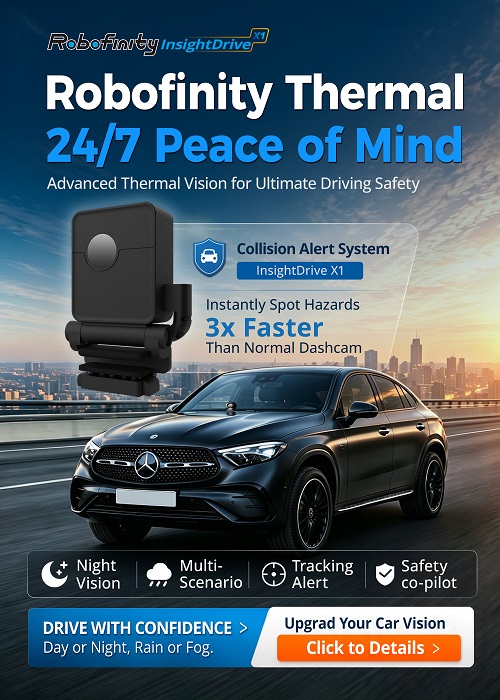


Car night vision systems can detect pedestrians, but the real answer depends on the specific technology behind the product, the environment you drive in, and how the system is designed to alert you. In other words, night-vision marketing doesn’t automatically mean “person detected every time.” This guide breaks down how pedestrian detection works, where it tends to perform well, where it struggles, and how to use car night vision responsibly so you stay in control of your driving decisions.
- How car night vision detects pedestrians
- Thermal imaging and pedestrian detection
- Visible-light night vision and enhancement cameras
- How detection becomes an alert
- Why pedestrians are sometimes easier to detect than other objects
- Where pedestrian detection helps most
- Unlit rural roads
- Highway shoulders and rest areas
- Fog, rain, and headlight glare
- Urban streets with weak lighting
- Where the technology struggles
- Partial occlusion
- Similar background heat
- Small or distant targets
- Unexpected movement
- Sensor quality and software design
- What car night vision is good for, and what it is not
- What to look for if pedestrian detection is the priority
- Thermal sensing rather than simple image enhancement
- Real-time alerts
- Practical display size and clarity
- Weather and visibility resilience
- Installation and placement
- Integration with other driver-assistance features
- How drivers should use night vision responsibly
- Keep your driving habits unchanged
- Scan the whole road, not just the display
- Treat alerts as prompts, not final decisions
- Remember that weather still matters
- Use it to improve planning, not just reaction
- FAQ
- Do car night vision systems detect pedestrians automatically?
- Are thermal night vision systems better than regular cameras at seeing people?
- Can night vision detect pedestrians in rain or fog?
- Does night vision replace the need for headlights?
- Can night vision detect every pedestrian in time?
- Is night vision useful in city driving?
- Conclusion
Table of Contents
- How car night vision detects pedestrians
- Why pedestrians are sometimes easier to detect than other objects
- Where pedestrian detection helps most
- Where the technology struggles
- What car night vision is good for, and what it is not
- What to look for if pedestrian detection is the priority
- How drivers should use night vision responsibly
- FAQ
How car night vision detects pedestrians
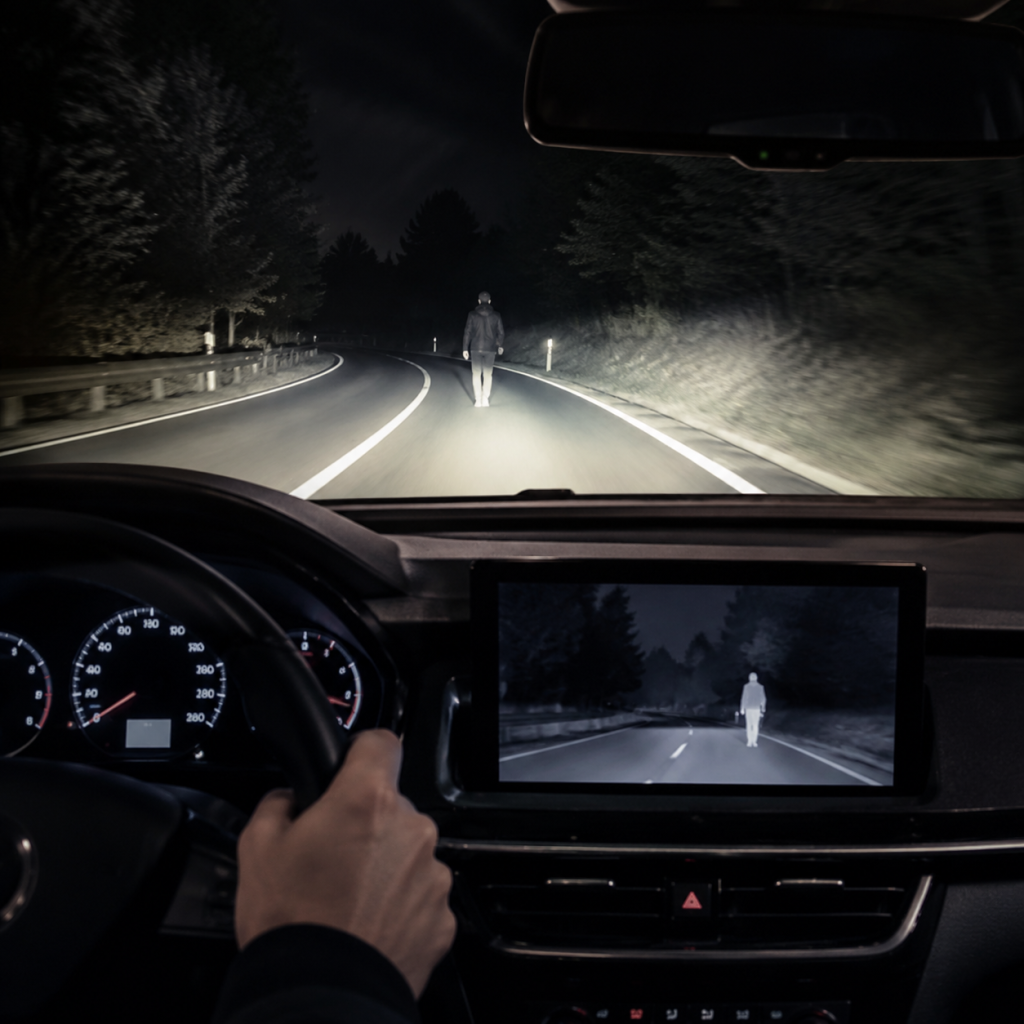
Not all car night vision systems work the same way. The term is often used loosely, but the underlying technology can be very different—especially when it comes to identifying people. Some systems provide a view that helps you “see” better, while others also run software that attempts to recognize hazards like pedestrians or animals.
Thermal imaging and pedestrian detection
Thermal imaging looks for heat differences, not visible light. A person usually stands out against cooler backgrounds such as pavement, grass, or roadside structures. That makes pedestrians easier to detect in darkness, on rural roads, and in other low-light situations where visible-light cameras struggle.
With thermal-based car night vision, the system doesn’t “see” a person the way your eyes do. Instead, it detects a heat pattern and then uses software to interpret what that heat signature likely represents. In a well-integrated setup, this interpretation can help identify a pedestrian, vehicle, animal, or obstacle before it is obvious to the driver.
Because thermal imaging depends on temperature contrast rather than lighting alone, it can be helpful when headlights don’t reach far enough to reveal details. In practice, this often means earlier awareness—especially at the point where drivers would otherwise notice a figure too late to react comfortably.
Visible-light night vision and enhancement cameras
Some systems rely on infrared illumination or low-light image enhancement rather than true thermal sensing. These can brighten the scene, but they depend more on available light and surface detail. They may help a driver see lane edges, signs, road texture, and obstacles more clearly, yet they are not always as strong at isolating a person from the background.
More EV News
That distinction matters when shopping for a system or reading product claims. A camera that simply makes the image brighter is not the same as thermal imaging designed for hazard detection.
How detection becomes an alert
Even when a sensor can “see” something, pedestrian detection depends on multiple layers working together. Most systems run several steps:
- Capture: The sensor collects a thermal or infrared/visible image of the scene.
- Processing: Software analyzes shapes, motion cues, and heat signatures to estimate what the object might be.
- Classification: The system decides whether the object is likely a pedestrian versus another target.
- Alerting: The system notifies the driver through a display and/or audio cue.
That pipeline is why two products marketed as “night vision” can behave very differently, particularly in edge cases like partial occlusion, unusual clothing, or objects blending into background heat.
Why pedestrians are sometimes easier to detect than other objects
A person is often one of the easier targets for thermal detection because the human body gives off heat. A pedestrian also tends to have a shape and movement pattern that software can recognize. That said, easy does not mean guaranteed—car night vision still has limitations.
Several factors influence whether the system will spot someone:
- The pedestrian’s distance from the vehicle
- Whether the person is partially hidden by another object
- The temperature of the surroundings
- The weather conditions
- The driver’s viewing angle relative to the sensor placement
- The quality of the sensor and the alert software
This is why car night vision should be treated as a driver-assistance tool, not a replacement for attention. It can extend awareness, but it cannot remove all uncertainty from the road.
Where pedestrian detection helps most
Car night vision systems are most useful in situations where normal headlights and mirrors are at a disadvantage. Pedestrians can be difficult to see when lighting is uneven, backgrounds blend, or weather reduces contrast. The best results usually come from situations where your baseline visibility is “just not good enough,” and the system’s sensor can provide meaningful improvement.
Unlit rural roads
On dark country roads, pedestrians may be walking near the edge of the lane, crossing unexpectedly, or standing where headlights have not fully reached yet. Thermal-based car night vision can make heat signatures visible earlier than standard lighting alone.
This earlier awareness can be especially valuable when you’re driving at night without streetlights, because your perception relies heavily on whatever light your headlights can deliver. A thermal view can help you spot movement or a human shape sooner, even if you can’t clearly identify details.
Highway shoulders and rest areas
Pedestrians near highway shoulders can be hard to notice, especially if they are wearing dark clothes or moving between vehicles. Car night vision may help bring that risk into view earlier, giving the driver more reaction time.
It may also help in scenarios like roadside construction zones or temporary changes in traffic flow, where you may not be expecting pedestrians to appear. Still, your best practice is to treat alerts as “pay closer attention now,” not as proof that the person is safe and will remain visible.
Fog, rain, and headlight glare
Poor weather can reduce contrast and make reflective surfaces confusing. Fog and rain scatter light, and oncoming headlights can hide a person rather than reveal them. Car night vision thermal imaging is often more useful than regular visible-light cameras in these conditions because heat is less affected by glare.
In practice, thermal sensing doesn’t eliminate visibility challenges like wet road reflections or wet clothing blending into the environment. It can, however, improve the odds that you’ll detect a human presence when conventional cameras and human vision struggle with scattered light.
Urban streets with weak lighting
Even in cities, there are plenty of places where visibility is weak: side streets, construction zones, temporary lane changes, alleys, and parking lots. Car night vision can help when pedestrians blend into backgrounds surprisingly well due to uneven illumination.
Street lighting can create strong shadows, bright patches, and uneven color/brightness. A sensor that relies on thermal contrast can sometimes cut through those lighting inconsistencies better than a purely visible-light system.
Where the technology struggles
The fact that car night vision can detect pedestrians does not mean it will do so in every case. Understanding common failure modes helps you avoid over-reliance.
Partial occlusion
If a pedestrian is behind a parked car, shrub, guardrail, or other obstruction, the system may only see part of the body or may miss the person entirely. Thermal car night vision can help, but it cannot look through solid objects.
Occlusion is one of the most common “reality checks” for any detection system. If you can’t clearly see the person in your own view, the sensor may also struggle—especially if only a small portion of the heat signature is visible.
Similar background heat
Thermal systems work best when a person stands out clearly from the background. On a very hot day, pavement, engine compartments, and some roadside surfaces may warm up enough to reduce contrast. That can make pedestrian detection less clean than drivers expect.
Even on normal days, heat patterns change over time (for example, after heavy sun exposure). That means performance can vary throughout the day, not only from “clear weather” to “night.”
Small or distant targets
The farther away a pedestrian is, the smaller and less detailed the heat signature becomes. Good car night vision systems can still help at useful distances, but they are not magic. Drivers should not assume every distant figure will be recognized perfectly.
Distance is not just about detection; it’s also about decision time. Even if a sensor can detect something at range, the system needs time to classify it and the driver needs time to respond. Higher detection sensitivity is not the same as safe braking distance.
Unexpected movement
A person stepping suddenly from a driveway, bus stop, or crosswalk can be difficult for any system to interpret quickly enough. Alerts are useful, but physics still matters. Reaction time and braking distance remain your responsibility.
Movement patterns also matter. A person moving erratically, standing still then stepping forward, or blending into background motion can challenge classification logic—especially if the scene is busy.
Sensor quality and software design
A thermal camera is only part of the system. Detection accuracy also depends on the processing chip, display quality, image refresh rate, and how alerts are tuned. A car night vision setup that shows a heat image but does not interpret hazards well may be less useful than a better-integrated design.
Alert behavior matters too. Systems that alert too aggressively can cause distraction or alarm fatigue, while systems that alert too late provide limited value. The “best” system is often the one that alerts clearly and at the right moment for the speed you drive.
What car night vision is good for, and what it is not
The most practical way to think about car night vision is this: it improves awareness, not certainty. When car night vision detects pedestrians, it’s usually because the technology made the person easier to notice earlier than standard vision could.
It is good for:
- Spotting heat signatures in darkness
- Highlighting pedestrians and animals earlier than normal vision might
- Reducing the strain of driving in poor visibility
- Supporting decision-making on unfamiliar roads
It is not good for:
- Replacing headlights
- Eliminating the need to scan the road
- Guaranteeing that every pedestrian will be detected
- Removing the need for safe speed and following distance
That distinction matters because some drivers misunderstand the purpose of car night vision. It works best as an extra layer of awareness, not as the main reason you feel safe behind the wheel.
What to look for if pedestrian detection is the priority
If your main goal is seeing people earlier at night, a few system characteristics matter more than marketing language.
Thermal sensing rather than simple image enhancement
A true thermal imaging system is generally better suited to detecting pedestrians than a basic low-light camera. Car night vision with thermal sensing is built to identify heat differences, which is often the key advantage in darkness.
If a product focuses mainly on brightening a view, ask whether it’s actually detecting thermal contrast or primarily improving image visibility through illumination and processing. For pedestrian detection, thermal sensing typically provides more consistent cues across lighting conditions.
Real-time alerts
A good car night vision system should do more than display a scene. It should help call attention to possible hazards in a way that is useful while driving. Visual or audio alerts can be valuable if they are timely and not overly distracting.
When evaluating alerts, consider how they appear at driving speed. A useful system catches your attention without forcing you to take long glances away from the road.
Practical display size and clarity
If the display is too small, laggy, or hard to interpret, the technology becomes less useful. Drivers need a picture they can scan quickly without taking attention away from the road.
Also look at how the system presents the image. Some displays use overlays or bounding indicators that make it easier to understand where the system is “looking.” That can reduce cognitive load during stressful situations.
Weather and visibility resilience
Look for systems designed for use in rain, snow, fog, and glare, because those are exactly the conditions where car night vision is most likely to matter. If the manufacturer describes performance characteristics for poor weather, those details can help you match the product to your typical routes.
Installation and placement
A system only helps if the camera has a clear view of the road. Placement, angle, and lens protection all affect how usable the image will be in real driving.
For example, some aftermarket thermal setups are designed to support pedestrian awareness in low-light and poor-visibility conditions—useful if your routes frequently involve dark shoulders or uneven lighting.
To understand how thermal imaging differs from other camera-based approaches, see Vehicle thermal imaging: How It Helps Drivers See Pedestrians and Animals at Night.
Integration with other driver-assistance features
Pedestrian detection doesn’t exist in a vacuum. Some cars integrate night-vision inputs with other safety functions, such as collision warning or automatic braking systems. When systems work together, they may use sensor data to improve timing and reduce false alarms.
If your vehicle includes advanced driver-assistance features, it can help to review how those features interact with nighttime detection and how the warnings are presented to you.
How drivers should use night vision responsibly
Even a strong car night vision system should be used with the same discipline as any other safety technology. The goal is better awareness—not automatic avoidance.
Keep your driving habits unchanged
Do not drive faster just because the screen shows more of the road. Visibility support is not the same as extra stopping distance.
If you tend to rely on night vision to feel confident, practice maintaining your usual safe speeds and headway. That simple habit helps offset detection limits like distance, occlusion, and sensor processing time.
Scan the whole road, not just the display
The display should support your eyes, not replace them. Continue checking mirrors, lane position, intersections, sidewalks, and roadside activity.
If you notice an alert, use it as an instruction to improve your situational awareness—then return your attention to the driving path ahead.
Treat alerts as prompts, not final decisions
If car night vision flags a pedestrian or object, use that information to look more carefully and slow down if needed. The alert is a cue, not a verdict.
False positives happen with any detection system, especially in complex scenes. Likewise, false negatives can occur when the person is occluded, too far away, or blends into background heat patterns. Your job is to drive as if either outcome is possible.
Remember that weather still matters
Rain, fog, and snow can affect sensors, roads, and braking distance. Car night vision may help with detection, but it does not improve traction.
When visibility is reduced, consider combining night vision use with additional caution: reduce speed, increase following distance, and avoid sudden steering or braking.
For a practical safety reference on pedestrian risks and visibility factors, consult the U.S. National Highway Traffic Safety Administration (NHTSA) Pedestrian Safety guidance.
Use it to improve planning, not just reaction
Detection is most helpful when it gives you time to adjust. Instead of focusing only on whether the system “found” a person, think about how it changes your plan for the next few seconds: where you position the vehicle, whether you expect movement near shoulders or crossings, and how smoothly you prepare to slow down.
If you frequently drive in poor weather, you may also want to review Night Driving Safety in Fog: Key Tips for additional visibility and risk-reduction habits.
FAQ
Do car night vision systems detect pedestrians automatically?
Some do. Thermal imaging systems and advanced driver-assistance setups can recognize pedestrians and highlight them, but not every car night vision product has the same capability or alert logic.
Are thermal night vision systems better than regular cameras at seeing people?
In many nighttime situations, yes. Car night vision thermal systems are often better at separating a person from a dark background because they detect heat rather than visible detail.
Can night vision detect pedestrians in rain or fog?
It can help in many poor-visibility conditions, but performance varies by system and environment. Car night vision thermal imaging often handles glare and darkness better than visible-light systems, though heavy weather can still reduce overall clarity.
Does night vision replace the need for headlights?
No. Headlights remain necessary, and car night vision should be used as a support tool, not a replacement for safe driving practices.
Can night vision detect every pedestrian in time?
No system can guarantee that. Distance, occlusion, weather, background heat, and software limits can all affect pedestrian detection results and alert timing.
Is night vision useful in city driving?
Yes, especially on darker streets, in parking areas, near construction zones, and in places where pedestrians are hard to see against the background.
Conclusion
Car night vision systems can detect pedestrians, but the real value depends on the type of system, the driving conditions, and how carefully the driver uses the alerts. Thermal imaging is often the strongest option for low-light pedestrian awareness because it helps people stand out when visible-light cameras and human vision struggle. Even then, car night vision has clear limits and works best as an added layer of awareness rather than a replacement for good driving habits.
For drivers who often face dark roads, weak street lighting, fog, rain, or glare, understanding those limits matters as much as understanding the benefits. If car night vision is part of your plan, treat it as support that can improve detection—then keep your speed controlled, scan the road, and drive with care.