

Night driving can be stressful, especially on dark rural roads, highways with limited lighting, or in fog, rain, and snow. Even careful drivers can struggle to spot pedestrians, animals, and other hazards in time. That is where vehicle thermal imaging enters the conversation. By detecting heat instead of relying only on visible light, thermal night vision can improve road awareness in conditions where headlights and human vision may fall short.
- What Is Car Thermal Night Vision?
- Why Night Driving Safety Matters More Than Many Drivers Realize
- How Vehicle Thermal Imaging Helps Detect Pedestrians
- How Vehicle Thermal Imaging Helps Detect Animals
- What Thermal Night Vision Can and Cannot Do
- How Thermal Night Vision Works in Poor-Visibility Conditions
- Where Thermal Night Vision Fits in Modern Vehicle Safety
- A Closer Look at Robofinity InsightDrive
- Practical Tips for Drivers Using Thermal Night Vision
- Keep your attention on the road
- Drive at a speed that matches visibility
- Pay attention to weather and road conditions
- Learn how the display looks in different situations
- Use it with other safety upgrades
- Who Benefits Most from Car Thermal Night Vision?
- Rural and suburban drivers
- Highway commuters
- Professional and long-distance drivers
- Drivers in challenging climates
- FAQ: Car Thermal Night Vision and Night Driving Safety
- What is vehicle thermal imaging in simple terms?
- Can thermal night vision help with pedestrian detection?
- Is thermal imaging useful for animal detection?
- Does thermal night vision replace headlights?
- Is thermal imaging useful in fog, rain, or snow?
- How is Robofinity InsightDrive relevant to this topic?
- Conclusion
Table of Contents
- What Is Car Thermal Night Vision?
- Why Night Driving Safety Matters More Than Many Drivers Realize
- How Vehicle Thermal Imaging Helps Detect Pedestrians
- How Vehicle Thermal Imaging Helps Detect Animals
- What Thermal Night Vision Can and Cannot Do
- How Thermal Night Vision Works in Poor-Visibility Conditions
- Where Thermal Night Vision Fits in Modern Vehicle Safety
- A Closer Look at Robofinity InsightDrive
- Practical Tips for Drivers Using Thermal Night Vision
- Who Benefits Most from Car Thermal Night Vision?
- FAQ: Car Thermal Night Vision and Night Driving Safety
What Is Car Thermal Night Vision?
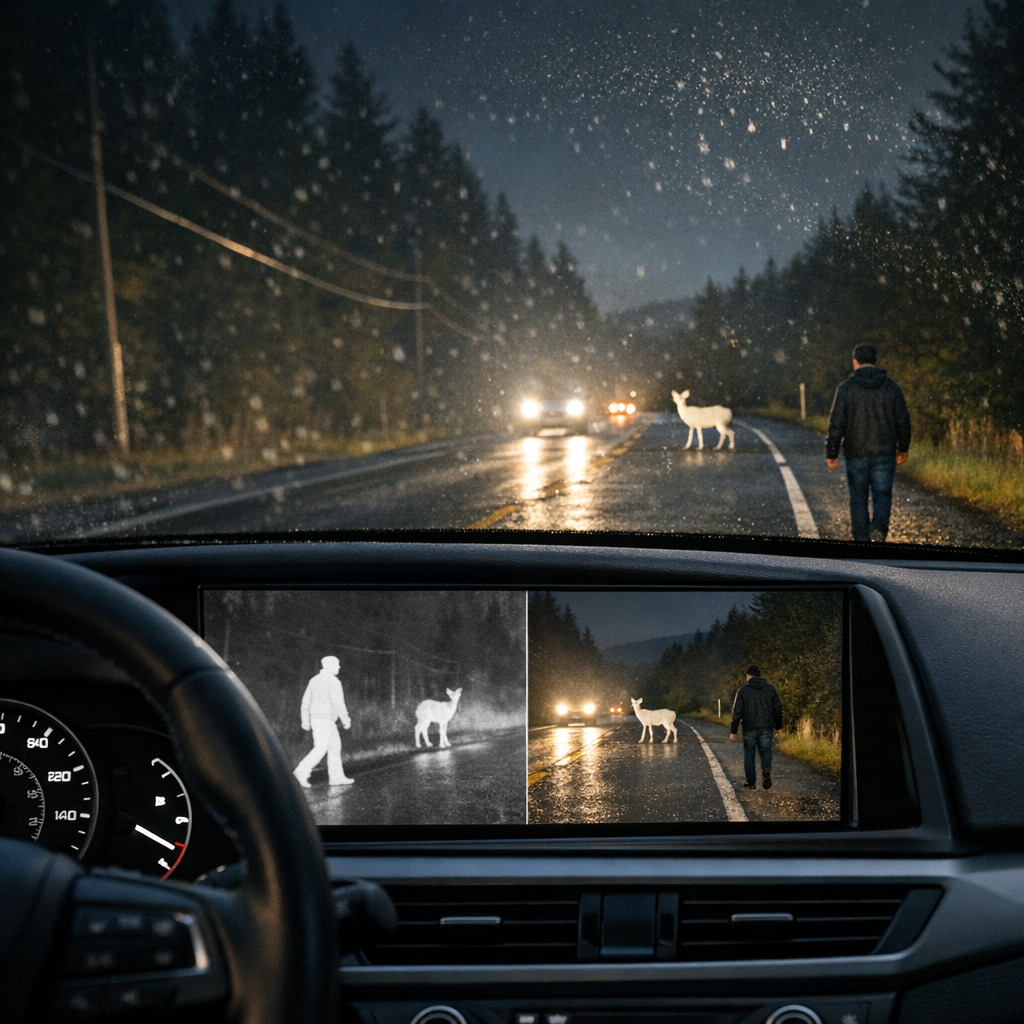
Car thermal night vision is a driver-assistance technology that uses infrared thermal imaging to show heat signatures from people, animals, vehicles, and other objects. Unlike a standard camera, which depends on visible light, thermal imaging can detect differences in temperature. That makes it useful in darkness, fog, light rain, snow, and glare-heavy conditions.
In simple terms, the system helps turn hard-to-see hazards into visible thermal shapes on a screen. This does not replace normal driving habits, but vehicle thermal imaging can add another layer of awareness when visibility is limited.
How thermal imaging is different from regular cameras
A regular dash cam or front camera captures what the lens can see in the environment. If there is very little light, the image may be dark or noisy. Thermal systems work differently. They read the heat emitted by objects and create a thermal picture based on temperature contrast.
That difference matters in situations such as:
- A pedestrian wearing dark clothing on a rural road
- A deer crossing from the roadside shoulder
- A cyclist with poor reflective visibility
- A parked vehicle partly hidden by shadows or weather
- A person stepping into the roadway beyond headlight range
Because heat stands out more clearly than darkness, the driver may notice a hazard sooner—especially when vehicle thermal imaging is calibrated for long-range awareness.
Why Night Driving Safety Matters More Than Many Drivers Realize
Night driving brings several visibility challenges at once. Darkness reduces the distance drivers can see. Headlights help, but they only illuminate a limited area and can be affected by weather, curves, hills, and reflective glare.
Common night driving hazards
Some of the most common nighttime risks include:
- Pedestrians crossing outside well-lit areas
- Animals entering the road unexpectedly
- Reduced contrast on black pavement and dark clothing
- Headlight glare from oncoming traffic
- Fog, rain, and snow reducing visibility
- Roadside obstacles that are difficult to notice until the last moment
These issues are not limited to rural roads. Urban drivers can also face hazards near crosswalks, bus stops, side streets, and construction zones. On highways, the concern shifts to higher speed and shorter reaction windows—where vehicle thermal imaging may help improve early warning time.
Why human vision struggles after dark
Human eyes are not equally effective in all lighting conditions. At night, it becomes harder to judge distance, identify objects at the edge of the road, and distinguish movement from shadows. Vision also becomes more strained when drivers are tired or facing glare from oncoming headlights.
That is why technologies designed to improve road awareness have become part of the broader vehicle safety conversation, including vehicle thermal imaging for both pedestrians and animals.
How Vehicle Thermal Imaging Helps Detect Pedestrians
Pedestrian detection is one of the most valuable uses of thermal imaging. People usually give off enough body heat to stand out against the cooler background of roads, buildings, trees, and pavement. With vehicle thermal imaging, a person may appear as a distinct heat signature even when visible light is poor.
Why pedestrians can be hard to see
A pedestrian may be difficult to detect at night for several reasons:
- Dark clothing blends into the road environment
- They may be partially blocked by parked cars or roadside objects
- They can appear unexpectedly outside the beam of the headlights
- Weather and glare can reduce contrast
- Movement can be subtle until they are already close
Vehicle thermal imaging helps by highlighting body heat, which may make a person more visible even before traditional headlights fully illuminate them. That extra visibility can be especially useful near crosswalks, residential streets, trail crossings, and roadside areas where pedestrians may appear without warning.
Real-world situations where thermal imaging helps
Examples include:
- A pedestrian walking along the shoulder of a poorly lit road
- A child crossing between parked vehicles
- A jogger in dark clothing at dawn or dusk
- A road worker in a dim construction area
- A person waiting near a bus stop with limited street lighting
In each case, the value is not that the system drives for you. It is that vehicle thermal imaging can improve warning time and give the driver more opportunity to slow down, scan, and respond.
How Vehicle Thermal Imaging Helps Detect Animals
Animal detection is another major reason drivers look into thermal night vision. Wildlife collisions are a serious concern in many regions, especially where roads pass through wooded areas, farmland, open plains, or mountain routes. With vehicle thermal imaging, animals may stand out based on heat contrast even when their shapes are hard to see.
Why animals are difficult to spot at night
Animals can be especially hard to detect because they often:
- Move quickly from the roadside into the lane
- Blend into dark surroundings
- Appear suddenly from behind trees or vegetation
- Stand low to the ground, making them harder to see at a distance
- Cross in groups, creating multiple hazards at once
Deer, moose, wild boar, coyotes, dogs, and other animals can all create dangerous situations. Smaller animals may seem less dangerous but can still cause sudden braking or swerving. Larger animals can be devastating at highway speeds.
How thermal imaging supports faster recognition
Vehicle thermal imaging can make animals stand out more clearly than the background environment, especially when their body heat contrasts with cool pavement, grass, or roadside terrain. That may give the driver a better chance to notice movement earlier and reduce speed in time.
This can be especially helpful on:
- Rural roads
- Forest roads
- Highway stretches near wildlife corridors
- Mountain roads
- Long-distance routes with limited lighting
For drivers who regularly travel in these areas, vehicle thermal imaging can be a meaningful vehicle safety technology upgrade.
What Thermal Night Vision Can and Cannot Do
It is important to understand the limits of this technology. Thermal imaging can improve awareness, but it is not magic, and it should never be treated as a replacement for safe driving. Vehicle thermal imaging is best thought of as additional information for decision-making—not as collision prevention on its own.
What it can do
A thermal night vision system may help drivers:
- Spot heat signatures in low light
- Identify pedestrians, animals, vehicles, and some obstacles sooner
- Improve awareness in fog, rain, snow, and glare
- Add another visual reference during dark driving conditions
- Support earlier reaction time
What it cannot do
Thermal imaging cannot:
- Replace headlights
- Replace mirrors or direct observation
- Eliminate the need for braking distance
- Guarantee collision prevention
- Substitute for careful speed control
- Compensate for distracted or fatigued driving
This distinction matters. The best way to think about it is as a driver-assistance layer, not a substitute for responsible driving. Even with strong vehicle thermal imaging performance, you still must adapt speed and follow safe driving procedures.
How Thermal Night Vision Works in Poor-Visibility Conditions
Thermal systems are often valued because they continue to perform when visible-light cameras struggle. That is useful in weather and lighting conditions where the human eye and a standard camera both have limitations.
Fog, rain, and snow
Fog, rain, and snow can scatter light and reduce how far headlights reach. A person or animal may still be physically there, but much harder to distinguish.
Vehicle thermal imaging can help because it focuses on heat contrast rather than brightness alone. While heavy weather can still affect performance, thermal systems often remain useful when regular visibility drops sharply.
Headlight glare and shadows
Glare from oncoming vehicles is a common nighttime problem. It can temporarily obscure the road ahead or wash out detail in a visible-light camera. Thermal imaging can help preserve some sense of what is in front of the vehicle even when the scene is affected by glare or shadows.
Dark roads and unlit shoulders
On roads without streetlights, the shoulder, ditch, or roadside edge may disappear into darkness. That is where thermal vision can be especially valuable, because hazards often emerge from the side rather than directly ahead.
In these scenarios, vehicle thermal imaging can support earlier attention to where pedestrians and animals typically appear.
Where Thermal Night Vision Fits in Modern Vehicle Safety
Thermal imaging is part of a broader trend in ADAS and driver-assistance technology. Many drivers already use backup cameras, blind-spot monitoring, lane alerts, or dash cams. Thermal night vision adds a different capability: seeing heat in the dark. For deeper context on improving night driving awareness, you may also find this helpful: Night Vision Driving: 7 Powerful Safety Tips.
A useful addition for certain drivers
This technology may be especially useful for drivers who:
- Commute in the early morning or late at night
- Drive rural or mountain roads regularly
- Travel long distances on highways
- Encounter wildlife often
- Face fog, rain, or snow frequently
- Want additional awareness beyond standard headlight illumination
For those scenarios, vehicle thermal imaging can be a practical supplement to other safety tools.
How it compares with a dash cam
A dash cam records what happens. A thermal night vision system helps the driver see what may happen next. That is a key difference.
A dash cam is useful for documentation and incident review. Thermal imaging is designed more for real-time hazard detection. The two can complement each other, but they serve different roles.
A Closer Look at Robofinity InsightDrive
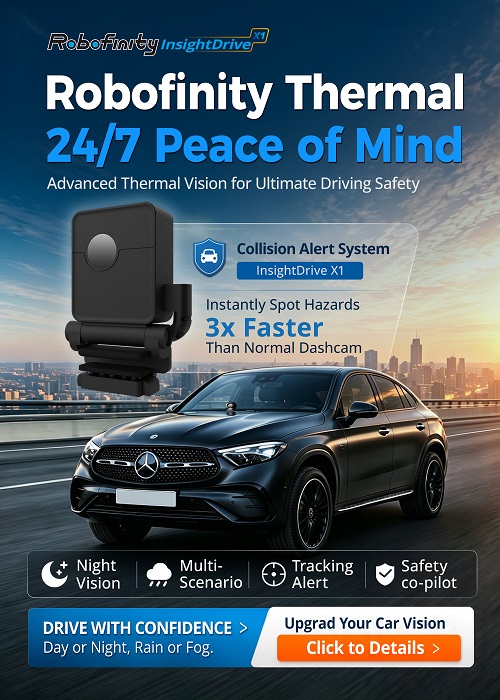
One example of this category is Robofinity InsightDrive Car Thermal Night Vision, which uses AI-powered thermal imaging to help drivers detect pedestrians, animals, vehicles, and obstacles in darkness and poor-visibility driving conditions. In other words, it pairs vehicle thermal imaging with computer-assisted interpretation to support road awareness.
According to the product details, it is designed to support real-time collision risk alerts and provides up to 200 meters / 656 feet of detection range. For drivers who often travel at night, on rural roads, or in weather that reduces visibility, that kind of system may help improve awareness without replacing normal safe-driving practices.
Robofinity positions InsightDrive as a driver-assistance technology, which is the right way to think about thermal night vision in general: helpful, practical, and supplementary, but not a substitute for attentive driving.
For deeper reading on the role of roadway lighting and visibility, see the Federal Highway Administration’s overview of roadway lighting and visibility.
Practical Tips for Drivers Using Thermal Night Vision
If you are considering thermal imaging for your vehicle, it helps to understand how to use it well.
Keep your attention on the road
Thermal displays are useful, but they are still only one input. Drivers should continue scanning mirrors, the road ahead, shoulders, and intersections. The system may help identify a hazard, but the driver still makes the decision to slow down or maneuver safely.
Drive at a speed that matches visibility
Even with enhanced detection, it is smart to reduce speed when visibility is poor. No system removes the need for safe stopping distance. Vehicle thermal imaging is most valuable when paired with cautious driving.
Pay attention to weather and road conditions
Wet roads, blowing snow, and thick fog can still create risk even if a thermal image looks clear. Use the system as one source of information, not the only one.
Learn how the display looks in different situations
Every thermal system presents the image differently. Spend time understanding how pedestrians, animals, vehicles, and roadside objects appear on the display. Familiarity can help you interpret hazards more quickly when driving at night.
Use it with other safety upgrades
Thermal detection works best when it complements other tools. If you want related improvements, you can also explore Vehicle Mounted Thermal Camera for Night Vision for more on practical setup and benefits.
Who Benefits Most from Car Thermal Night Vision?
Not every driver needs thermal imaging, but certain groups may find it especially useful.
Rural and suburban drivers
Drivers in areas with wildlife crossings or limited lighting can benefit from earlier detection of animals and pedestrians near the roadway. When it comes to vehicle thermal imaging, earlier recognition is often the biggest advantage.
Highway commuters
At highway speeds, even a brief warning can matter. On long dark stretches, thermal imaging may help drivers notice something ahead sooner than they otherwise would.
Professional and long-distance drivers
Truck drivers, delivery drivers, and anyone who spends long hours on the road at night may appreciate an added layer of awareness during routine routes. With vehicle thermal imaging, hazard detection can feel more consistent when visibility is low.
Drivers in challenging climates
If you regularly encounter fog, rain, snow, or headlight glare, thermal imaging can complement your existing visibility tools and support more confident driving with vehicle thermal imaging as an additional reference.
FAQ: Car Thermal Night Vision and Night Driving Safety
What is vehicle thermal imaging in simple terms?
Vehicle thermal imaging is a system that detects heat signatures from people, animals, and objects on or near the road. It helps make hazards more visible in dark or poor-visibility conditions.
Can thermal night vision help with pedestrian detection?
Yes. Since people give off body heat, thermal imaging can help identify pedestrians more clearly than visible-light cameras in some nighttime situations, improving vehicle thermal imaging-supported awareness.
Is thermal imaging useful for animal detection?
Yes. Thermal imaging can make animals stand out against cooler surroundings, which may help drivers notice them sooner on rural roads, highways, or wooded routes through vehicle thermal imaging.
Does thermal night vision replace headlights?
No. It is a driver-assistance tool and should not replace headlights, mirrors, safe speed, or driver attention—even when vehicle thermal imaging provides early warnings.
Is thermal imaging useful in fog, rain, or snow?
It can be helpful in poor-visibility conditions because it does not depend on visible light alone, but weather can still affect overall driving conditions and safety when using vehicle thermal imaging.
How is Robofinity InsightDrive relevant to this topic?
Robofinity InsightDrive is a vehicle thermal night vision system that uses AI-powered thermal imaging to support road awareness and detection of pedestrians, animals, vehicles, and obstacles in low-light conditions.
Conclusion
Vehicle thermal imaging is becoming an important topic for drivers who want better awareness after dark. By using vehicle thermal imaging to highlight heat signatures, these systems can improve pedestrian detection, animal detection, and general night driving safety in conditions where headlights and standard cameras may not be enough.
The technology is most useful as an added layer of caution for rural roads, highways, poor-visibility weather, and other low-light driving scenarios. It does not replace attentive driving or safe road habits, but it can help drivers see potential hazards earlier and respond with more confidence through vehicle thermal imaging.
If you often drive at night or in low-visibility conditions, learning more about Robofinity InsightDrive may help you better understand how thermal imaging technology can support smarter, more aware driving with vehicle thermal imaging.