


Off-Road Night Safety starts before your headlights ever reach the trail. Driving after sunset changes how you assess terrain, control speed, and plan for emergencies—so you need more than brighter lights. You need a dependable lighting setup, vehicle readiness, conservative driving technique, reliable navigation, and a clear plan for hazards that darkness can hide or distort.
- Why Off-Road Driving Becomes More Difficult at Night
- Begin With Route and Timing Decisions
- Create a Useful Lighting System
- Keep the Factory Lighting in Good Condition
- Match Auxiliary Lights to the Terrain
- Use Light Modes Deliberately
- Drive to the Visible Terrain
- Control Dust and Convoy Risk
- Prepare the Vehicle Before Darkness
- Improve Awareness Beyond Conventional Headlights
- Protect Night Vision Inside the Cabin
- Manage Fatigue and Human Error
- Account for Weather and Seasonal Conditions
- Use a Simple Night-Driving Decision Framework
- Common Mistakes That Reduce Nighttime Safety
- Installing the Brightest Possible Lights
- Driving at Daytime Pace
- Looking Only at the Center of the Trail
- Relying on One Navigation Device
- Continuing to Avoid Delays
- Treating Technology as a Permission to Go Faster
- Frequently Asked Questions
- What is the most important rule for off-road driving at night?
- Are LED light bars enough to make night trail driving safe?
- Do yellow or amber lights work better in fog and dust?
- Can thermal imaging see through complete obstructions?
- Should tire pressure be reduced for night off-roading?
- Is it safer to travel alone or in a convoy at night?
- Conclusion
- Why Off-Road Driving Becomes More Difficult at Night
- Begin With Route and Timing Decisions
- Create a Useful Lighting System
- Drive to the Visible Terrain
- Control Dust and Convoy Risk
- Prepare the Vehicle Before Darkness
- Improve Awareness Beyond Conventional Headlights
- Protect Night Vision Inside the Cabin
- Manage Fatigue and Human Error
- Account for Weather and Seasonal Conditions
- Use a Simple Night-Driving Decision Framework
- Common Mistakes That Reduce Nighttime Safety
- Frequently Asked Questions
- Conclusion
Why Off-Road Driving Becomes More Difficult at Night

Nighttime removes much of the visual information drivers use to judge an unpaved route. Headlights illuminate only a limited area, while shadows can exaggerate shallow depressions or conceal deep washouts. Dust, fog, rain, and snow may reflect light toward the driver, further reducing contrast.
Peripheral vision also becomes less useful. An animal approaching from the side, a branch projecting into the trail, or a sharp drop beyond the beam pattern may remain unnoticed until the vehicle is close. Even when a hazard is visible, darkness makes it harder to estimate its distance, height, and shape.
Off-road conditions add several problems not normally encountered on a paved highway:
- Loose rocks can redirect the wheels or damage a tire.
- Ruts may be deeper than they appear.
- Water can hide holes, soft ground, or a strong current.
- Steep crests can prevent headlights from illuminating the descent.
- Dust from another vehicle can create an opaque reflective cloud.
- Wildlife may stand still at the trail edge before moving suddenly.
- Narrow tracks may leave little room for correction.
The practical response is to drive only as fast as you can safely stop within the area you can clearly see and evaluate. A powerful vehicle, high ground clearance, or advanced lighting does not change that basic limit—this is the foundation of Off-Road Night Safety.
Begin With Route and Timing Decisions
The best Off-Road Night Safety improvement may be avoiding an unfamiliar technical section after dark. Before departure, review the route, expected terrain, legal access, weather, sunset time, and likely turnaround points. Identify steep climbs, water crossings, exposed edges, and areas where navigation could become difficult.
More EV News

Download maps for offline use because mobile service is often unreliable in remote areas. A dedicated GPS device, paper map, or second offline navigation source provides useful redundancy. Mark your starting point, destination, alternate exits, fuel stops, and any known obstacles.
Tell a responsible person where you are going, who is traveling with you, and when to expect an update. A useful trip plan includes:
- Vehicle description and registration details
- Planned route and destination
- Number of occupants
- Expected departure and return times
- Intended check-in schedule
- Instructions for what to do if you miss a check-in
Build extra time into the schedule. Off-Road Night Safety suffers when drivers feel pressure to reach camp or finish a trail. Turning around before a difficult obstacle is often the more competent choice, especially when visibility, weather, or fatigue is deteriorating.
Create a Useful Lighting System
Good off-road lighting is about beam placement and control, not simply maximum brightness. Excessive foreground light can cause the pupils to contract, making the area beyond the bright zone appear darker. Glare reflected by dust, rain, fog, snow, or a pale hood can also reduce usable vision.
Keep the Factory Lighting in Good Condition
Start with the vehicle’s normal headlights. Clean the lenses, inspect them for haze or damage, and confirm that low and high beams operate correctly. Headlights that are aimed too high can obscure terrain close to the vehicle and create glare for other road users. Lights aimed too low may not provide enough distance on faster, open sections.
Clean the windshield inside and out. A thin film on the interior glass can scatter light from auxiliary lamps, dashboard displays, and vehicles ahead. Replace worn wiper blades and keep the washer reservoir filled with fluid appropriate for the climate.
Match Auxiliary Lights to the Terrain
Different beam patterns serve different purposes:
- Spot beams project farther ahead and suit open tracks where greater forward reach is useful.
- Driving beams provide a balanced combination of distance and width.
- Flood beams illuminate the immediate work area, trail edges, and slow technical terrain.
- Wide cornering or ditch lights help reveal animals, branches, junctions, and the direction of a tight turn.
- Rock lights can illuminate the area near the tires during very slow maneuvering, but they should not distract the driver.
More lights do not automatically produce better driving visibility. Position and aim them so the beam reveals relevant terrain without reflecting strongly from the hood, mirrors, dust, or moisture. This is critical for Off-Road Night Safety because the goal is usable contrast, not just brightness.
Auxiliary lighting must also be installed with suitable wiring, fuses, relays, switches, weather-resistant connections, and cable protection. Poor electrical work can cause intermittent failures, overheating, or battery drain. Have a qualified installer inspect the system if you are uncertain about load capacity, grounding, or local requirements.
Use Light Modes Deliberately
Bright forward lights can be counterproductive in fog, snowfall, or heavy dust. In those conditions, lower-mounted and less intense illumination may create less backscatter. Slow down, increase spacing behind other vehicles, and experiment carefully with the available legal light settings to find the clearest view.
Switch off rear-facing or work lights whenever they could affect another driver. Auxiliary lamps that are appropriate on a private trail may be restricted on public roads. Check the rules that apply in the country, state, or region where the vehicle is used.
Drive to the Visible Terrain
The most important technique is to keep stopping distance comfortably shorter than the distance over which you can identify a hazard. That distance changes constantly. It shrinks on curves, near crests, in dust, and when the trail surface blends into the surroundings.
Reduce speed before entering an uncertain section rather than braking sharply once you are committed. Smooth steering, braking, and throttle inputs preserve traction on loose surfaces and make the vehicle more predictable—an everyday requirement for Off-Road Night Safety.
Read Shadows Carefully
A shadow may indicate a harmless dip, a large boulder, or the edge of a washout. If its shape cannot be understood, stop and inspect it. A passenger can act as a spotter, but the driver and spotter should agree on clear hand signals or radio instructions first.
The spotter must remain visible to the driver and stay away from the vehicle’s path, downhill roll zone, and potential tire-ejection areas. Stop immediately if visual or radio contact is lost.
Approach Crests and Descents Slowly
Headlights may point into the sky as the vehicle climbs, leaving the far side of a crest invisible. Do not assume the track continues straight or that the descent is clear. Ease forward until the route becomes visible, or stop and inspect on foot where doing so is safe.
Select an appropriate gear before a steep descent. Controlled engine braking can reduce reliance on the service brakes, but the correct technique depends on the vehicle, drivetrain, surface, and manufacturer guidance. Avoid sudden inputs that could break traction. For Off-Road Night Safety, slow preparation beats rushed control at the edge of visibility.
Treat Water as an Unknown Obstacle
Headlight reflections do not reveal water depth, current, bottom condition, or hidden debris. Never enter simply because another vehicle crossed earlier; conditions can differ by wheelbase, weight, tire placement, and changing water levels.
Check the crossing only when it can be done without exposing a person to moving water or unstable ground. If depth, current, entry, or exit cannot be assessed confidently, turn around. No lighting or driver-assistance technology can make an unverified crossing safe—this is non-negotiable for Off-Road Night Safety.
Control Dust and Convoy Risk
Convoy travel can provide support, but it creates additional visibility problems. Following too closely places the second vehicle in suspended dust and reduces the time available to react if the lead driver stops.
Increase the gap until the dust has settled enough to maintain a clear view. Use radios for concise warnings about obstacles, junctions, oncoming traffic, and stops. Radio communication should supplement visual awareness, not distract from driving.
Agree on a few simple procedures before departure:
- Stop at junctions until the following vehicle confirms the correct direction.
- Announce major obstacles and safe pull-off areas.
- Avoid unnecessary high beams or rear work lights around other vehicles.
- Report mechanical concerns early.
- Confirm that the final vehicle has cleared each difficult section.
When vehicles meet on a narrow trail, slow down early and identify a safe passing point. Do not force a wheel toward an unseen edge merely to keep moving—Off-Road Night Safety depends on avoiding “momentum decisions.”
Prepare the Vehicle Before Darkness
Night is a poor time to discover a weak battery, damaged tire, or loose recovery point. Complete a basic inspection in daylight whenever possible to keep Off-Road Night Safety on track.
Check tire pressure against the vehicle load, terrain, and tire manufacturer guidance. Examine tread and sidewalls for cuts, bulges, exposed cords, or embedded objects. Carry a correctly sized spare and confirm that the jack, wheel tools, and locking-wheel-nut key are present and usable.
Inspect fluid levels, visible leaks, coolant hoses, drive belts, battery security, and underbody components. Verify that brake lights, indicators, hazard lamps, reverse lights, and interior controls work. Secure all cargo because loose equipment can become dangerous on steep or rough terrain.
A pre-trip check should also cover:
- Adequate fuel plus a sensible reserve
- Rated front and rear recovery points
- Recovery equipment suitable for the vehicle
- Tire repair and inflation equipment
- Spare fuses and essential electrical supplies
- A headlamp or handheld flashlight for each occupant
- Extra batteries or charging options
- First-aid supplies and necessary medication
- Drinking water, food, and weather-appropriate clothing
- Fire extinguisher appropriate for vehicle use
- Emergency shelter or blankets
- Communication and navigation devices
Recovery equipment must be compatible, undamaged, and used by people who understand its limits. Stand clear of loaded straps, winch lines, and connection points. Never attach recovery equipment to an unrated tie-down, suspension part, or tow ball.
If you’re optimizing Off-Road Night Safety for a specific vehicle type, review this guide on Truck Night Vision Systems: Why Trucks Are Ideal for Night Vision Systems to better understand how lighting and visibility needs differ by platform.
Improve Awareness Beyond Conventional Headlights
Headlights primarily reveal surfaces that reflect visible light toward the driver. Thermal imaging works differently: it displays temperature differences in the scene. This can make warm pedestrians or animals more distinguishable from some backgrounds, even when darkness or headlight glare makes visual recognition difficult.
That distinction can be useful on forest tracks, agricultural roads, and remote trails where wildlife may enter the vehicle’s path. Thermal imaging may also support awareness in certain poor-visibility conditions, but its display still requires correct interpretation. Terrain, weather, environmental temperature, installation position, and screen placement can influence practical usefulness.
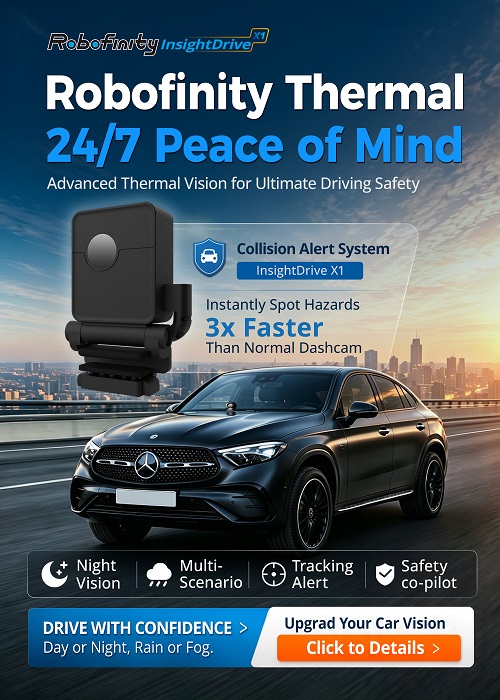
Robofinity InsightDrive is one example of a vehicle thermal imaging night vision system designed to support awareness of pedestrians, animals, vehicles, and obstacles in low-light or poor-visibility environments. It should be treated as supplementary driver-assistance technology, not as a substitute for headlights, direct observation, safe speed, braking distance, or attention to the trail.
Any additional display must be positioned so it does not block the windshield or demand prolonged glances away from the route. Alerts should be understandable without becoming distracting. Before relying on a new system during a demanding trip, learn how it represents objects and where its limitations become apparent. This helps maintain real-world Off-Road Night Safety rather than relying on tech alone.
For more context on how thermal night vision helps with detection, see Vehicle Mounted Thermal Camera for Night Vision.
Protect Night Vision Inside the Cabin
A bright cabin can make the dark trail beyond the windshield harder to see. Dim the instrument panel and infotainment screen to the lowest practical level. Use a dark interface or night mode where available, and avoid unnecessary overhead lighting while moving.
Passengers should keep phones and tablets out of the driver’s direct view. A sudden bright screen can temporarily reduce dark adaptation. Mount navigation devices where they can be checked with a brief glance without obstructing the road.
Clean glasses or protective eyewear before departure. Scratched or dirty lenses can increase halos around lights. Drivers who experience persistent glare, difficulty focusing at night, or unusually poor low-light vision should seek appropriate professional advice and reconsider nighttime trail driving until the issue is addressed.
Off-Road Night Safety is not only about illumination outside—the cabin lighting choices directly influence how quickly the driver regains usable vision after bright headlamps pass.
Manage Fatigue and Human Error
Fatigue reduces attention, reaction quality, and judgment. Rough terrain compounds the problem because the driver must continuously scan the route, monitor wheel placement, and respond to vibration and movement.
Plan rest stops before concentration deteriorates. Switch qualified drivers where practical, but allow the new driver time to adjust to the vehicle, controls, route, and lighting. Caffeine may temporarily increase alertness, but it does not replace sleep.
Watch for warning signs such as:
- Missing radio calls or navigation prompts
- Repeatedly drifting toward one side of the trail
- Fixating on the area immediately in front of the hood
- Difficulty remembering the previous section
- Late braking or abrupt steering corrections
- Irritability and rushed decisions
- Frequent yawning or heavy eyelids
When these signs appear, stop in a secure location. Off-Road Night Safety depends on not “pushing through” when concentration is breaking down. A slower pace is not enough if the driver can no longer maintain focus.
If you’re driving with others, clarify who is responsible for radios, spotter roles, and turnaround calls. Clear roles reduce hesitation and help prevent human error from turning into a trail incident.
Account for Weather and Seasonal Conditions
Night weather affects both visibility and traction. Rain can fill ruts, soften shoulders, and create reflections that hide surface texture. Fog reduces contrast and may make powerful lights less useful. Snow covers trail edges and obstacles, while cold conditions reduce battery performance and can turn wet surfaces into ice.
Check the forecast for the route and surrounding high ground, not just the departure point. Mountain and forest conditions can vary significantly over a short distance. Establish clear turnaround criteria before leaving, such as worsening snowfall, rising water, dense fog, or a temperature drop beyond the vehicle and occupants’ preparation.
Do not treat four-wheel drive as protection from every condition. It can help the vehicle move, but it does not eliminate limited tire grip during steering or braking. Appropriate tires, smooth control inputs, and conservative decisions remain essential for Off-Road Night Safety.
Use a Simple Night-Driving Decision Framework
When visibility or terrain becomes uncertain, use a repeatable process rather than relying on momentum:
- See: Identify what is clearly visible and what remains hidden.
- Slow: Reduce speed before entering the uncertain area.
- Space: Preserve enough room to stop, reverse, or choose another line.
- Scan: Check the trail center, edges, mirrors, instruments, and surrounding terrain.
- Stop: Exit and inspect only when it is safe to do so.
- Select: Choose the lowest-risk line, alternate route, or turnaround option.
- Reassess: Confirm that weather, fatigue, vehicle condition, and time still support continuing.
This framework is particularly useful at water crossings, steep crests, fallen trees, washed-out sections, and confusing junctions. It gives every occupant a shared expectation: uncertainty triggers assessment, not acceleration. Off-Road Night Safety improves when the group consistently chooses the safest decision loop instead of “guess-and-commit” driving.
Common Mistakes That Reduce Nighttime Safety
Several popular upgrades or habits can create false confidence and undermine Off-Road Night Safety.
Installing the Brightest Possible Lights
High output cannot compensate for a poor beam pattern or incorrect aim. Too much near-field brightness can reduce distance vision, while reflected glare may become severe in dust or fog. Aim and placement matter more than raw output for Off-Road Night Safety.
Driving at Daytime Pace
A familiar trail can change after rain, erosion, fallen branches, or other vehicles. Memory is not a reliable substitute for current visibility. Slow speed is a core Off-Road Night Safety practice because it preserves decision time.
Looking Only at the Center of the Trail
Hazards often begin at the edges. Scan for animals, branches, unstable shoulders, and signs that the route narrows or turns.
Relying on One Navigation Device
Batteries fail, screens break, and map data can be incomplete. Carry an independent backup and understand the broad route before departure. Redundancy supports better Off-Road Night Safety.
Continuing to Avoid Delays
Schedule pressure can turn a manageable inconvenience into a recovery or medical emergency. Reaching the destination late is usually preferable to taking an obstacle that cannot be evaluated.
Treating Technology as a Permission to Go Faster
Cameras, alerts, thermal imaging, traction systems, and navigation tools can support road awareness. They cannot guarantee detection, create traction, shorten physical braking distance, or make an unsafe route suitable for travel. Off-Road Night Safety still requires conservative driving and realistic stopping distance.
Frequently Asked Questions
What is the most important rule for off-road driving at night?
Drive slowly enough to stop within the distance you can clearly see and assess. If a crest, curve, dust cloud, or weather condition reduces that distance, reduce speed immediately. This rule is at the heart of Off-Road Night Safety.
Are LED light bars enough to make night trail driving safe?
No. A light bar may improve illumination, but safety also depends on beam aim, vehicle condition, route knowledge, tire grip, speed, fatigue management, navigation, and emergency preparation. Some auxiliary lights may also be restricted on public roads.
Do yellow or amber lights work better in fog and dust?
Some drivers find that lower-intensity or selectively colored lighting produces less perceived glare in certain conditions, but color alone does not overcome dense fog or dust. Beam position, output, speed, and following distance are equally important.
Can thermal imaging see through complete obstructions?
No. A vehicle thermal imaging system detects thermal patterns within its field of view; it does not see through solid objects such as trees, rocks, or embankments. Environmental conditions and object temperature can also affect how clearly a hazard appears.
Should tire pressure be reduced for night off-roading?
Pressure decisions should be based on the vehicle, load, tire construction, terrain, speed, and manufacturer guidance, not on darkness alone. Lower pressure can improve performance on some surfaces but may also increase heat, sidewall damage, or wheel-separation risk if used incorrectly. Carry an accurate gauge and inflation equipment.
Is it safer to travel alone or in a convoy at night?
A well-managed convoy can provide communication and recovery support, but close following creates dust and collision risk. Maintain generous spacing, agree on radio procedures, and ensure every vehicle and driver is independently prepared.
Conclusion
Off-Road Night Safety begins with restraint. Plan the route, inspect the vehicle in daylight, create a balanced lighting setup, protect the driver’s night vision, and carry enough equipment to handle a delay without taking unnecessary risks. On the trail, keep speed below the limits of visibility and traction, inspect anything you cannot confidently interpret, and turn back when weather, fatigue, or terrain exceeds the plan.
Driver-assistance technology can add another layer of awareness, particularly where wildlife and low-light hazards are common. It remains only one layer. Sound judgment, clear stopping distance, dependable headlights, appropriate tires, careful spotting, and a realistic emergency plan are what allow the entire system to work. For additional general guidance on nighttime driving risk, read Nighttime Driving Risk: Why Night Driving Increases Accident Risk (and How to Reduce It). Before the next after-dark trip, review the vehicle, equipment, route, and turnaround criteria as one complete Off-Road Night Safety plan.
For broader road safety principles related to visibility and risk, see the U.S. National Highway Traffic Safety Administration (NHTSA) Road Safety resource.