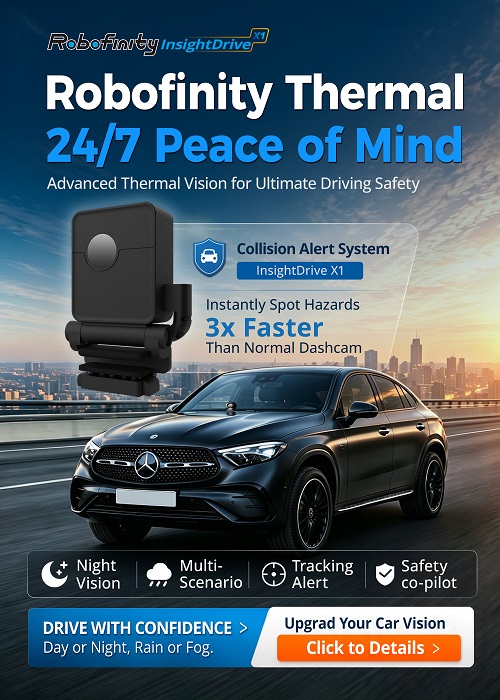



A thermal imaging dash cam is a vehicle camera system that turns infrared heat differences into a view you can use while driving. Instead of relying only on visible light like a traditional dash cam, it helps you spot people, animals, and other warm objects by detecting emitted infrared energy and showing a thermal image. Depending on the product, it may also record footage and trigger driver alerts when software detects relevant hazards.
- How Thermal Imaging Works in a Vehicle
- Is It Really a Dash Cam?
- Thermal Imaging vs. Ordinary Night Vision
- Where a Thermal Dash Cam Can Be Most Helpful
- What Thermal Imaging Can and Cannot Tell You
- Detection, Recognition, and Alerts Are Different
- A Practical Example of an Aftermarket System
- Benefits Worth Considering
- Earlier Awareness of Warm Road Users
- Operation Without Visible Illumination
- Less Dependence on Clothing Color
- Additional Evidence When Recording Is Included
- A Complement to Existing Safety Features
- Limitations Every Driver Should Understand
- How to Evaluate a Thermal Imaging Dash Cam
- Define the Main Job
- Examine Sensor and Display Performance
- Clarify Range Claims
- Review Recognition and Warning Behavior
- Check Installation Requirements
- Consider Camera Maintenance
- Review Recording and Storage
- Who Is Most Likely to Benefit?
- Safe Use After Installation
- Frequently Asked Questions
- Can a thermal dash cam see in complete darkness?
- Can thermal imaging see through fog or heavy rain?
- Does a thermal camera replace a regular dash cam?
- Can it detect deer and other animals?
- Can a thermal camera be mounted behind the windshield?
- Is thermal night vision worth the cost?
- Conclusion
- How Thermal Imaging Works in a Vehicle
- Is It Really a Dash Cam?
- Thermal Imaging vs. Ordinary Night Vision
- Where a Thermal Dash Cam Can Be Most Helpful
- What Thermal Imaging Can and Cannot Tell You
- Detection, Recognition, and Alerts Are Different
- A Practical Example of an Aftermarket System
- Benefits Worth Considering
- Limitations Every Driver Should Understand
- How to Evaluate a Thermal Imaging Dash Cam
- Who Is Most Likely to Benefit?
- Safe Use After Installation
- Frequently Asked Questions
- Conclusion
How Thermal Imaging Works in a Vehicle

People, animals, engines, tires, roads, trees, and buildings emit infrared radiation. A thermal camera senses that energy and converts the differences into an electronic image called a thermogram.
The display may use grayscale or a color palette. In a common grayscale view, relatively warm objects appear brighter and cooler surroundings appear darker, although the palette can be reversed. The image is based on thermal contrast, not on the colors or visible details that a normal camera records.
This distinction matters on an unlit road. A pedestrian wearing dark clothing may blend into the background for a visible-light camera, especially beyond the strongest part of the headlight beam. A thermal imaging dash cam may show the person’s body heat as a contrasting shape. An animal near the shoulder can be visible for the same reason.
The camera alone does not necessarily know what an object is. Systems advertised with pedestrian detection, animal detection, or vehicle recognition use software to interpret shapes and movement in the thermal feed. If a recognized object enters a defined area, the system may highlight it or provide an audible or visual warning.
Is It Really a Dash Cam?
A conventional dash cam has a straightforward purpose: it records visible-light video through the windshield. Drivers commonly use the footage to document journeys, incidents, or road conditions.
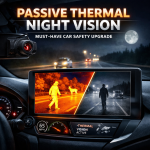
A vehicle thermal imaging system may serve a different primary purpose: helping the driver notice heat-producing hazards ahead. Some products also record the thermal feed, which is why they may be described as thermal dash cams. Others are better understood as aftermarket thermal night-vision systems.
Before comparing models, determine whether a thermal imaging dash cam provides the functions you actually need:
- Live thermal display: Shows heat signatures while the vehicle is moving.
- Thermal video recording: Saves footage from the infrared camera.
- Object recognition: Attempts to classify pedestrians, animals, vehicles, or obstacles.
- Real-time alerts: Warns the driver about recognized hazards.
- Standard visible-light recording: Captures ordinary road video suitable for reviewing signs, lane markings, colors, and other visual details.
- Combined operation: Uses more than one sensor or provides both driving assistance and recording functions.
A thermal recorder is not automatically a complete replacement for a standard dash cam. Thermal footage may make a person or animal conspicuous while failing to preserve details such as vehicle color, traffic-light state, road-sign text, or a license plate. Drivers who want both incident documentation and improved nighttime road awareness may need complementary systems.
Thermal Imaging vs. Ordinary Night Vision
“Night vision” is a broad label covering technologies that work in different ways. Vehicle systems generally fall into three categories.
Standard Low-Light Cameras
A visible-light camera collects the same general part of the spectrum that human eyes see. A larger sensor, suitable lens, image processing, and high dynamic range can improve its performance at night.
These cameras can capture familiar road details, but they still require some usable light. Darkness, glare, fog, and reflective surfaces can reduce image quality.
Active Infrared Systems
An active infrared system illuminates the scene with infrared light and uses a compatible camera to capture the reflection. It works somewhat like headlights operating outside the normally visible spectrum.
Its range and clarity depend partly on the illuminator, and rain, fog, dust, or reflective objects may affect the returned signal. Because the image is based on reflected energy, active infrared is not the same as thermal imaging.
Thermal Cameras
Thermal cameras detect emitted infrared energy rather than illuminating the road. They do not need visible light to reveal a warm pedestrian or animal against a cooler background.
Their strength is heat contrast, not visual detail. A thermal image may show that something warm is present without clearly showing clothing color, facial details, signage, or the exact appearance of the surrounding scene.
Where a Thermal Dash Cam Can Be Most Helpful
The value of a thermal imaging dash cam depends on the driving environment. It is most relevant where potential hazards are difficult to see early enough with headlights alone.
Dark Rural Roads
Rural routes often combine limited street lighting, higher speeds, narrow shoulders, and wildlife activity. An animal standing beside the pavement can be difficult to distinguish from vegetation. A person walking in dark clothing may also remain inconspicuous until the vehicle is relatively close.
Thermal contrast can provide another source of information. The driver still needs to decide whether the detected shape is near the vehicle’s path and respond appropriately.
Unlit Highways
On a highway, a disabled vehicle, a person outside a car, or wildlife near the carriageway can become dangerous quickly because of closing speed. A thermal imaging dash cam may make a warm object easier to notice, but warning range should always be evaluated against speed and stopping distance.
Detection is not the same as having enough space to stop. Reaction time, tires, brakes, road surface, weather, vehicle load, and speed all affect the outcome.
City Traffic at Night
Urban roads usually offer more lighting, but they also contain pedestrians emerging between parked vehicles, cyclists, delivery workers, and complex visual clutter. Thermal detection can potentially make warm road users stand out.
City environments can also produce many heat sources and overlapping objects. Reliable classification and well-designed alerts are especially important because excessive warnings can distract the driver.
Fog, Rain, Snow, and Glare
Thermal technology may retain useful contrast in some conditions that challenge visible-light cameras, including headlight glare and certain poor-visibility situations. However, it does not see perfectly through every form of bad weather.
Water droplets, dense fog, heavy precipitation, snow accumulation, atmospheric conditions, and contamination on the camera housing can reduce effective range or image clarity. A realistic buyer should treat poor-weather performance as conditional, not absolute.
What Thermal Imaging Can and Cannot Tell You
Thermal cameras are useful because temperature differences reveal information that ordinary cameras may miss. That same operating principle creates important limitations.
A pedestrian or animal often has a recognizable heat signature. A recently operated vehicle may show warm tires, brakes, exhaust components, or an engine area. By contrast, a cold stationary object could be less conspicuous if its temperature is close to the background.
Thermal imaging also does not identify every type of road hazard equally well. Debris, fallen cargo, potholes, lane markings, road signs, and icy patches may not create a distinct or reliably interpretable thermal signature. Temperature contrast changes with weather, season, sunlight, surface materials, and time of day.
Glass introduces another complication. Long-wave thermal cameras generally cannot view a scene through ordinary windshield glass in the same way a visible-light camera can. A dedicated automotive thermal camera is therefore commonly mounted outside the passenger compartment or otherwise positioned so that the windshield does not block the relevant infrared energy. Installation instructions and camera placement are critical.
Detection, Recognition, and Alerts Are Different
Product descriptions sometimes use “detection” broadly, but buyers should separate three functions.
Detection means that the sensor can register an object or temperature contrast. Recognition means that software can classify the object as a pedestrian, animal, or vehicle. Alerting means the system decides that the recognized object is relevant enough to bring to the driver’s attention.
A manufacturer’s maximum detection distance should not be interpreted as a guaranteed recognition or warning distance in every situation. A large warm vehicle may be detectable farther away than a small animal. Weather, angle, background temperature, sensor resolution, lens choice, mounting position, and software can all affect performance.
Alert quality matters as much as camera range. A thermal imaging dash cam that warns about every harmless heat source can encourage the driver to ignore alerts. A system that is too conservative may not flag a genuine concern. Useful driver-assistance technology needs to deliver understandable warnings without demanding constant visual attention.
A Practical Example of an Aftermarket System
Some vehicle thermal systems combine AI-powered thermal imaging with recognition of pedestrians, animals, and vehicles. In that approach, the system supports road awareness through real-time information and alerts in low-light or poor-visibility driving, not to replace attentive driving or the vehicle’s required lighting and safety equipment.
That distinction applies to any thermal imaging dash cam you install after purchase. Added information can be valuable, but only when the installation, display location, alert behavior, and driver’s expectations are appropriate.
Benefits Worth Considering
A suitable thermal imaging dash cam can provide several practical benefits.
Earlier Awareness of Warm Road Users
The principal advantage is the ability to distinguish people and animals by heat rather than visible color. This can be particularly useful beyond brightly lit urban streets.
Operation Without Visible Illumination
A thermal sensor does not depend on a headlight or infrared illuminator to reveal emitted heat. That makes it relevant to genuinely dark environments.
Less Dependence on Clothing Color
Dark clothing can be difficult to see against a dark roadside. Thermal contrast is not based on whether the clothing is black, gray, or brightly colored, although clothing and environmental conditions can still influence the apparent heat signature.
Additional Evidence When Recording Is Included
Recorded thermal footage can preserve information about heat signatures around an event. Its evidentiary usefulness will depend on the circumstances and local requirements, and it may be less informative than standard footage for identifying visual details.
A Complement to Existing Safety Features
Thermal imaging may add a different sensing method to headlights, mirrors, a visible-light dash cam, and factory driver-assistance systems. Sensor diversity can improve situational information, but the systems should be viewed as complementary rather than interchangeable.
Limitations Every Driver Should Understand
Thermal imaging is not a view through walls, dense obstacles, or all weather. Trees, barriers, parked cars, buildings, and terrain can block a hazard just as they block ordinary sight.
It also does not solve the core constraints of driving. A warning is useful only if the driver notices it, understands it, and has sufficient time and distance to respond safely. Looking repeatedly at a separate display can create its own distraction risk.
Other limitations include:
- Reduced visual detail compared with a normal camera
- Variable contrast as ambient temperatures change
- Possible missed or incorrect object classifications
- Reduced performance when the lens is dirty, wet, iced over, or obstructed
- Installation complexity for an externally mounted sensor
- Added wiring and display placement considerations
- Potential alert fatigue from frequent or poorly prioritized warnings
- Possible limitations on recording retention, depending on storage capacity and settings
No thermal imaging dash cam should be treated as permission to drive faster than conditions allow. Headlights, mirrors, safe following distance, braking distance, traffic laws, and full driver attention remain essential.
How to Evaluate a Thermal Imaging Dash Cam
Specifications matter, but they should be connected to real driving needs. Use the following framework before choosing a system.
Define the Main Job
Decide whether your priority is incident recording, nighttime hazard awareness, or both. A strong thermal imaging dash cam display may not provide the visual evidence expected from a standard dash cam. Conversely, an excellent 4K visible-light dash cam may not reveal a warm animal beyond effective headlight visibility.
Examine Sensor and Display Performance
Thermal resolution affects how much shape information the system can capture. Frame rate influences how smoothly moving objects appear. Display size, contrast, and brightness determine whether the image can be interpreted quickly without becoming distracting.
Avoid judging a thermal imaging dash cam only from promotional images. Look for a clear explanation of what is shown on the display, what is recorded, and how performance changes by conditions.
Clarify Range Claims
Ask what a stated range represents. Is it the distance at which the sensor can detect a heat source, the distance at which software can recognize a pedestrian, or the distance at which the system will issue an alert? These are not equivalent.
Consider the roads you travel. At highway speeds, meaningful warning distance is more important than it may be in slow urban traffic.
Review Recognition and Warning Behavior
Check which object types the software is designed to recognize and how it communicates a hazard. Audible alerts can attract attention without requiring constant monitoring, but they need suitable volume and prioritization. Visual highlighting should be easy to understand at a glance.
The ability to adjust warnings can be useful, provided the settings do not make the thermal imaging dash cam unnecessarily complex.
Check Installation Requirements
Confirm where the thermal camera must be mounted, whether it needs a clear external view, and how the cable reaches the cabin. The camera should not obstruct airflow, interfere with sensors, block a license plate, or sit in a position vulnerable to routine impact.
An exterior camera needs appropriate environmental protection. Installation should also preserve the vehicle’s electrical reliability and avoid interfering with airbags, controls, or driver sightlines. Professional installation may be sensible when routing through the firewall or integrating with vehicle power.
Consider Camera Maintenance
A road-facing thermal sensor is exposed to mud, salt, insects, water, snow, and ice. Even a technically capable sensor cannot provide a clear image through a contaminated lens or housing.
Drivers should inspect and clean the thermal imaging dash cam camera using the manufacturer’s recommended method. Mounting alignment should also be checked after bodywork, bumper contact, or service near the installation area.
Review Recording and Storage
If the system records video, determine whether it uses loop recording, removable storage, or another method. Check how protected clips are saved and how footage can be reviewed or exported.
Privacy and recording rules vary by country and jurisdiction. Drivers should consider applicable laws, particularly where audio recording, public video recording, or the use of screens within the driver’s field of view is regulated.
Who Is Most Likely to Benefit?
A thermal imaging dash cam is most compelling for drivers whose normal routes create a recurring visibility problem.
Strong use cases include rural commuters traveling before dawn, families returning on unlit roads after evening activities, commercial drivers operating overnight, motorists in wildlife-heavy regions, and long-distance travelers who frequently encounter dark highways.
It may offer less value to a driver who travels almost exclusively in well-lit urban areas at low speeds. That driver might gain more practical benefit from high-quality headlights, correct headlamp aim, a clean windshield, updated corrective lenses, or a conventional dash cam.
The decision should be based on exposure, not novelty. Consider how often you drive after dark, how frequently pedestrians or animals appear near your route, whether roadside lighting is limited, and whether the thermal imaging dash cam’s alerts fit your driving habits.
If you want a deeper look at how this type of system is positioned for driver awareness, see Vehicle thermal imaging: How It Helps Drivers See Pedestrians and Animals at Night.
Safe Use After Installation
The display should be positioned where it can be checked briefly without blocking the road view or forcing a long downward glance. Brightness should be appropriate for nighttime use; an overly bright screen can impair dark adaptation.
Before relying on alerts, learn how the thermal imaging dash cam represents people, animals, and vehicles under ordinary conditions. Confirm that the camera has an unobstructed view and that warnings are audible without being startling.
Thermal information should be treated as an additional cue. If the display indicates a potential hazard that is not yet visible through the windshield, reduce risk in a controlled way: ease off the accelerator, increase space, scan the road and shoulders, and prepare to brake. Sudden steering based solely on an uncertain screen image can create a new hazard.
Frequently Asked Questions
Can a thermal dash cam see in complete darkness?
It can detect thermal energy without visible light, so a thermal imaging dash cam can form an image in complete darkness when objects have sufficient temperature contrast. Performance still depends on the sensor, distance, environment, mounting, and weather.
Can thermal imaging see through fog or heavy rain?
It may preserve useful contrast in some poor-visibility conditions, but it cannot see perfectly through all fog, rain, or snow. Moisture and atmospheric conditions can absorb or scatter infrared energy and reduce usable range.
Does a thermal camera replace a regular dash cam?
Usually not. Thermal footage emphasizes heat signatures, while a regular camera is generally better for visible details such as signs, signals, road markings, vehicle color, and sometimes license plates. Some drivers may benefit from using both a thermal imaging dash cam and a conventional dash cam together.
Can it detect deer and other animals?
A thermal camera can detect an animal’s heat when there is adequate contrast and a clear line of sight. Whether a thermal imaging dash cam recognizes and alerts for the animal depends on its software, distance, angle, size, and environmental conditions.
Can a thermal camera be mounted behind the windshield?
Many long-wave thermal cameras cannot image the road effectively through normal automotive glass. The sensor may need an external mounting position with an unobstructed thermal view. Always follow the product’s installation requirements.
Is thermal night vision worth the cost?
It may be worthwhile for drivers who routinely use dark rural roads, travel in wildlife-prone areas, or spend substantial time driving at night. For mainly daytime or well-lit city driving, maintenance and conventional safety improvements may offer greater value.
Conclusion
A thermal imaging dash cam uses heat differences to reveal people, animals, vehicles, and other objects that may be hard to distinguish with visible-light cameras alone. Its greatest value is additional road awareness in darkness and certain challenging visibility conditions. Weaknesses include limited visual detail, variable environmental performance, installation demands, and the possibility of imperfect alerts.
Before buying, establish whether you need recording, live thermal assistance, object recognition, or all three. Then compare meaningful recognition distance, alert behavior, mounting requirements, display usability, storage, and maintenance rather than relying on a single range claim. Used with realistic expectations, a thermal imaging dash cam can be a practical layer of driver-assistance technology, but it remains a supplement to responsible speed, effective headlights, adequate stopping distance, and continuous attention.
You can also explore how different thermal night vision approaches work in real driving by reading Thermal Night Vision Technology for Night Driving.
For a reputable overview of how infrared heat relates to thermal imaging principles, see NIST: Infrared Thermometry.