

Passive Thermal Night Vision: Must-Have Car Safety Upgrade
Passive thermal night vision is becoming one of the most valuable safety technologies available for modern drivers. While headlights, fog lamps, and driver assistance systems all play an important role on the road, they still have limitations in darkness, bad weather, and low-visibility environments. That is where thermal imaging stands out. By detecting heat signatures instead of relying only on visible light, this technology helps drivers identify people, animals, and potential hazards much earlier than they might with the naked eye alone.
- What Is Passive Thermal Night Vision?
- Why Night Driving Is More Dangerous
- How Passive Thermal Night Vision Improves Driver Awareness
- Passive Thermal Night Vision for Rural Roads
- Urban and Suburban Pedestrian Detection
- Adverse Weather and Low-Contrast Conditions
- Key Benefits of Passive Thermal Night Vision
- 1. Earlier Hazard Recognition
- 2. Better Detection of People and Animals
- 3. Reduced Dependence on Visible Light
- 4. Increased Driver Confidence
- 5. Enhanced Safety Integration
- Is Passive Thermal Night Vision Better Than Standard Night Vision?
- Who Should Consider This Upgrade?
- Things to Keep in Mind Before Choosing a System
- Final Thoughts
For anyone who regularly drives at night, travels through rural areas, or faces unpredictable road conditions, this upgrade offers more than convenience. It adds an extra layer of awareness that can make a meaningful difference in reaction time and accident prevention.
What Is Passive Thermal Night Vision?
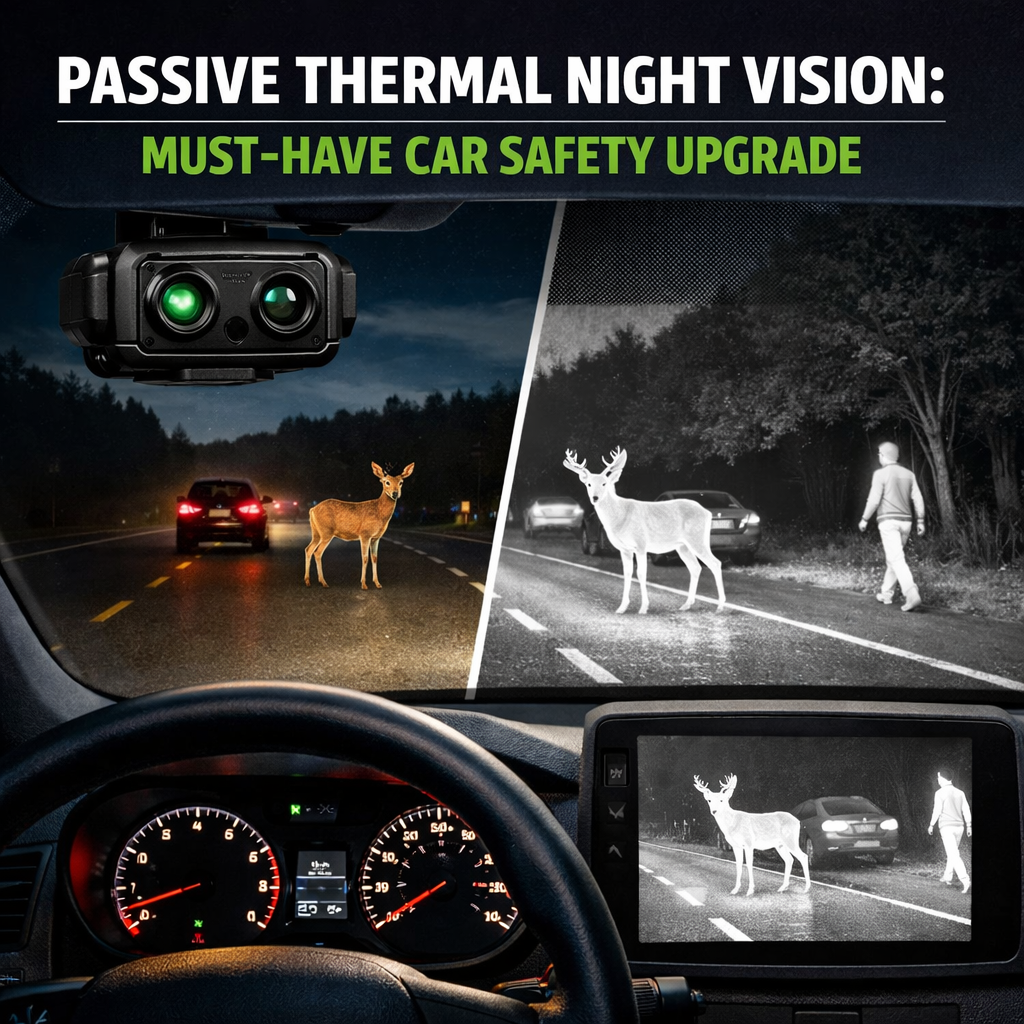
Passive thermal night vision is a vehicle imaging system that detects infrared radiation naturally emitted by objects, people, and animals. Unlike active night vision systems, which may use infrared illuminators to light up the road ahead, passive systems do not need to project additional light. Instead, they read temperature differences and display those variations through a thermal image.
This approach gives passive thermal systems several practical advantages. Because they do not rely on visible light, they can work effectively in complete darkness. They can also remain useful in situations where headlights are less effective, such as light fog, smoke, or glare from oncoming vehicles.
In a vehicle, the thermal camera is typically mounted near the grille, front emblem, or windshield area. The image is then shown on a screen in the dashboard, digital cluster, or head-up display, depending on the vehicle and system design.
Why Night Driving Is More Dangerous
Driving after dark introduces several risks that are easy to underestimate. Visibility drops significantly at night, and the human eye simply does not perform as well in low-light conditions. Depth perception becomes weaker, contrast is reduced, and it takes longer to identify objects on or near the road.

That challenge becomes even greater when combined with factors such as:
– Rural roads with no street lighting
– Sharp curves and narrow lanes
– Pedestrians wearing dark clothing
– Wildlife crossing unexpectedly
– Rain, mist, or road spray
– Driver fatigue and slower reaction time
Traditional headlights can only illuminate so far ahead, especially at higher speeds. By the time a driver sees a deer, cyclist, or stalled vehicle in the beam of the headlights, there may be very little time left to respond safely.
How Passive Thermal Night Vision Improves Driver Awareness
One of the biggest advantages of passive thermal night vision is early detection. Since warm objects often stand out clearly against cooler surroundings, drivers may be able to notice hazards long before they become visible in headlight range.
For example, a pedestrian walking near an unlit roadside may be difficult to see in standard conditions. A thermal system can highlight that person’s heat signature, allowing the driver to become aware earlier and react more calmly. The same is true for large animals such as deer, elk, or livestock, which are common causes of nighttime accidents in many regions.
This technology is especially useful in the following scenarios:
Passive Thermal Night Vision for Rural Roads
Rural driving presents unique challenges because roads are often darker, less predictable, and more likely to involve wildlife movement. Passive thermal night vision can help identify heat-emitting objects beyond the reach of standard headlights, giving drivers added confidence on isolated routes.
Urban and Suburban Pedestrian Detection
Even in developed areas, poor lighting and visual clutter can make it difficult to spot pedestrians quickly. Thermal imaging can separate a human figure from the background, especially near intersections, sidewalks, and parking areas.
Adverse Weather and Low-Contrast Conditions
Although no system is perfect in every environment, thermal imaging can still offer better object visibility in certain low-contrast situations than traditional optics alone. It can be an important support tool when headlights reflect poorly or when visibility is inconsistent.
Key Benefits of Passive Thermal Night Vision
There are several reasons why more drivers and automakers are paying attention to this technology.
1. Earlier Hazard Recognition
Seeing a potential danger sooner gives a driver more time to brake, steer, or reduce speed safely. Even a few extra seconds of awareness can have a major impact.
2. Better Detection of People and Animals
Because the system tracks heat signatures, it can make pedestrians, cyclists, and wildlife easier to notice in darkness.
3. Reduced Dependence on Visible Light
Unlike conventional systems that rely heavily on illuminated conditions, passive thermal imaging remains useful even when lighting is limited or uneven.
4. Increased Driver Confidence
Night driving can be stressful, especially in unfamiliar areas. An added layer of visual information can help drivers feel more prepared and less surprised by sudden hazards.
5. Enhanced Safety Integration
In some advanced vehicles, thermal night vision can work alongside warning systems that detect and highlight pedestrians or large animals, making the feature even more practical.
Is Passive Thermal Night Vision Better Than Standard Night Vision?
The answer depends on how the system will be used. Active night vision systems can produce detailed images in certain situations, but passive thermal night vision offers a clear advantage when it comes to detecting living beings and heat-producing obstacles at longer distances in darkness.
Since passive systems do not require supplemental illumination, they can operate discreetly and efficiently. They are particularly effective when the goal is to identify risk rather than simply brighten the visual scene. For safety-focused driving, that distinction matters.
It is also worth noting that thermal imaging does not replace headlights, mirrors, cameras, or driver attention. Instead, it complements them. The best results come when thermal night vision is treated as an additional support system rather than a substitute for safe driving habits.
Who Should Consider This Upgrade?
Passive thermal night vision is especially beneficial for drivers who:
– Frequently travel at night
– Drive in wildlife-prone areas
– Use rural highways or back roads
– Commute in low-light winter conditions
– Want advanced safety features beyond the basics
– Operate luxury, commercial, or long-distance vehicles
For these drivers, the technology can offer real-world safety value rather than just premium appeal.
Things to Keep in Mind Before Choosing a System
Before investing in a passive thermal night vision system, it is important to consider display quality, detection range, integration with other safety features, and system reliability. A well-designed interface matters because the information must be easy to interpret without distracting the driver.
It is also wise to review whether the system includes intelligent alerts, object recognition, or seamless dashboard integration. These features can improve usability and help make the technology more effective in everyday driving.
Final Thoughts
As roads become busier and drivers demand more advanced protection, thermal imaging is moving from niche innovation to practical safety solution. Passive thermal night vision offers a smarter way to monitor what lies ahead when visibility is poor and reaction time is limited.
For drivers who value safety, awareness, and modern vehicle technology, this upgrade is more than impressive—it is genuinely useful. In the right conditions, it can provide the crucial early warning that helps prevent accidents and makes nighttime travel safer for everyone on the road.