


SEO Title: Is an Automotive Thermal Night Vision System Worth It? A Practical Buyer’s Guide
- What Is an Automotive Thermal Night Vision System?
- The Direct Answer: When Is Thermal Night Vision Worth It?
- Where Thermal Imaging Can Help Most
- Dark Rural Roads
- Animal-Crossing Areas
- Highway and Long-Distance Night Driving
- Poorly Lit Suburban Roads
- Fog, Rain, Snow, and Glare
- The Main Benefits
- Earlier Awareness of People and Animals
- Less Dependence on Visible Light
- Recognition and Alerts
- Support for Older Drivers and Drivers With Reduced Nighttime Confidence
- Important Limitations Before You Buy
- A Thermal Image Is Not the Road Itself
- Not Every Object Has a Strong Thermal Contrast
- Weather and Contamination Affect Performance
- Screens Can Become a Distraction
- Detection Does Not Equal Braking
- The Camera Has a Limited Field of View
- Factory Systems Versus Aftermarket Thermal Night Vision
- A Practical Buying Checklist
- Detection and Recognition
- Alert Quality
- Display Placement and Brightness
- Camera Position
- Compatibility and Electrical Installation
- Recording and Data Handling
- Ownership Costs
- Who Is Most Likely to Benefit?
- Rural Commuters
- Night-Shift Workers
- Long-Distance Drivers
- Families Traveling on Dark Roads
- Motorhome, Van, and Utility-Vehicle Drivers
- Who May Not Need It?
- How It Compares With Other Night-Driving Upgrades
- A Simple Decision Framework
- Safe Use After Installation
- Frequently Asked Questions
- Can thermal night vision see through fog?
- Does thermal night vision work in complete darkness?
- Can it detect pedestrians and animals?
- Is factory-installed night vision better than an aftermarket system?
- Will an automotive thermal camera prevent a collision?
- Is thermal night vision legal to install?
- Conclusion
Meta Description: Is an automotive thermal night vision system worth it? Compare real-world benefits, limitations, costs, and use cases for rural, highway, and city driving.
Driving after dark creates a simple but serious problem: a vehicle can travel farther than its headlights clearly reveal in time to react. Pedestrians in dark clothing, animals near rural roads, stopped vehicles, and debris may blend into the background until they are uncomfortably close. If you are asking, “is automotive thermal night vision system worth it?”, the short answer is: it can be a valuable awareness upgrade for drivers who regularly face dark roads or poor visibility, but it is not equally useful for everyone.
The decision depends less on novelty and more on exposure. Where do you drive? How often are you on the road after sunset? Are pedestrians or large animals common along your route? Can the system present useful information without distracting you? Understanding those factors is more valuable than treating thermal imaging as either essential safety equipment or an unnecessary gadget.
What Is an Automotive Thermal Night Vision System?
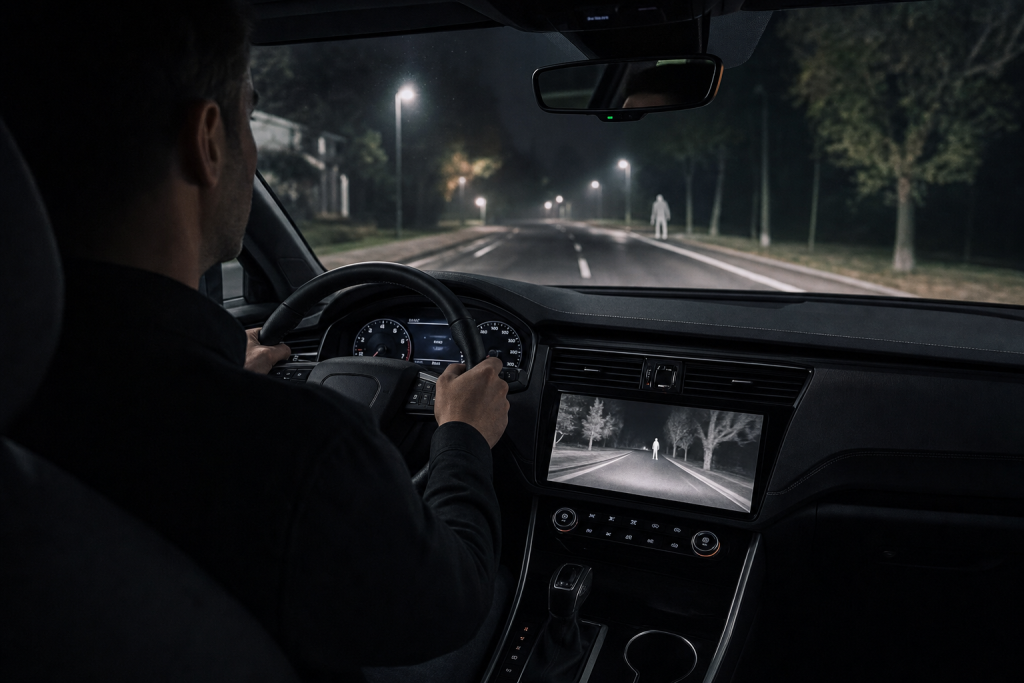
An automotive thermal night vision system uses an infrared camera to detect heat patterns in the road environment. Instead of relying entirely on visible light, it creates an image based on temperature differences between objects.
A person, animal, vehicle, road surface, tree, and building may appear as distinct shapes because they emit or retain different amounts of heat. The image is displayed on a dashboard screen, instrument panel, head-up display, or another compatible interface.
This is different from an ordinary low-light camera. A conventional night vision camera amplifies available light or uses near-infrared illumination. Its performance can still depend heavily on lighting, reflected glare, and the camera’s illumination range. Thermal imaging detects emitted infrared energy, so it can reveal heat-producing subjects that are difficult to distinguish with the naked eye.
Some systems go beyond displaying a thermal image. They may use software to recognize pedestrians, animals, vehicles, or other potential hazards and provide real-time visual or audible alerts. That turns the system from a passive viewing device into a form of driver-assistance technology, although its reliability and functions depend on the specific product.
The Direct Answer: When Is Thermal Night Vision Worth It?
A vehicle thermal imaging system is most likely to justify its cost when three conditions apply:
- You drive frequently at night.
- Your routes contain hazards that can be difficult to see with headlights alone.
- You are willing to use the display as a secondary awareness tool rather than watching it continuously.
It may be particularly worthwhile for rural commuters, long-distance drivers, people who work night shifts, drivers in areas with frequent animal crossings, and families who regularly travel on unlit roads.
The value is harder to justify for someone who drives mainly during daylight, uses well-lit urban streets, or rarely travels outside low-speed areas. In those circumstances, spending the same budget on better tires, headlight restoration, vision correction, windshield maintenance, or proven collision-avoidance features could produce a more immediate benefit.
The key distinction is between capability and usefulness. Thermal imaging has a real technical capability: it can reveal heat signatures without depending on headlight illumination. Whether that capability is worth paying for depends on how often it addresses a problem you actually encounter.
Where Thermal Imaging Can Help Most
Dark Rural Roads
Rural roads are one of the strongest use cases. Street lighting may be absent, road edges can be difficult to read, and animals may enter the lane with little warning. Pedestrians and cyclists can also be difficult to identify, particularly when they wear dark clothing or lack reflective equipment.
A thermal imaging system may reveal a warm figure near the roadside before the driver can confidently identify it through the windshield. That additional awareness can create more time to reduce speed, cover the brake, or prepare for unpredictable movement.
It is still important not to assume that every visible heat signature is a confirmed hazard. The display may show animals behind fences, people on paths that do not intersect the roadway, or harmless heat sources. The driver must interpret the information in the context of the road.
Animal-Crossing Areas
Deer and other large animals are difficult nighttime hazards because they can emerge suddenly and move unpredictably. Reflective eyes may be visible in headlights, but that clue depends on the animal’s position and direction.
Thermal cameras do not need an animal to face the vehicle. They detect its heat signature, which may make an animal near the road easier to notice. Systems with animal recognition and alerts can reduce the amount of time a driver must spend interpreting the screen.
However, recognition software is not perfect. An animal may be partly hidden by vegetation, too small to classify, outside the camera’s field of view, or difficult to distinguish under certain environmental conditions. Detection should be treated as an early cue, not a guarantee.
Highway and Long-Distance Night Driving
On a highway, the vehicle covers substantial distance every second. Seeing a potential hazard earlier can therefore matter more than it does at very low speeds.
Thermal night vision may help identify people near a disabled vehicle, animals approaching the carriageway, or vehicles farther ahead. It can be especially useful on long, unlit stretches where headlight glare, darkness, and fatigue reduce visual confidence.
The system does not solve fatigue, however. A driver who is sleepy needs to stop and rest. No display or alert system restores judgment, reaction time, or concentration to a fatigued driver.
Poorly Lit Suburban Roads
The usefulness of thermal imaging is not limited to isolated country roads. Suburban routes may include inconsistent lighting, unmarked crossings, joggers, cyclists, and pedestrians walking near the roadway.
These mixed environments can be visually demanding because the driver moves repeatedly between bright and dark areas. Thermal imaging may provide another source of information when a person is difficult to separate from the background.
Fog, Rain, Snow, and Glare
Thermal imaging can sometimes support road awareness in poor-visibility conditions because it does not depend on visible light in the same way as headlights or conventional cameras. It may help reveal heat-producing subjects through some glare or atmospheric obscuration.
That benefit has boundaries. Heavy rain, dense fog, falling snow, spray, dirt, ice, or condensation on the camera can reduce image quality and detection performance. Thermal vision also does not necessarily show lane markings, road texture, black ice, water depth, or every non-heat-producing obstacle clearly.
In severe weather, the correct response remains slower speed, greater following distance, clean lights and glass, and stopping when visibility is inadequate.
The Main Benefits
Earlier Awareness of People and Animals
The central advantage is the ability to identify warm subjects beyond or outside the most useful portion of the headlight beam. A driver may not immediately recognize what the subject is, but early awareness that something is present can support a more cautious response.
This is particularly relevant when clothing, vegetation, shadows, or background clutter make visual identification difficult.
Less Dependence on Visible Light
High beams can improve driving visibility, but they cannot always be used around other traffic. Their effectiveness also depends on road shape, weather, vehicle condition, and headlight alignment.
Thermal imaging provides information without projecting visible light onto the road. It therefore can remain useful when high beams are inappropriate or when oncoming headlights make visual contrast harder to judge.
Recognition and Alerts
A basic thermal camera requires the driver to notice and interpret the image. More advanced systems can highlight suspected pedestrians, animals, or vehicles and issue alerts.
This matters because a display alone creates a divided-attention problem. Effective hazard detection and clear alerts can reduce the need to scan the thermal view constantly. Even then, drivers should learn what each alert means and avoid becoming dependent on the system.
Support for Older Drivers and Drivers With Reduced Nighttime Confidence
Night vision commonly becomes more difficult with age due to increased sensitivity to glare, slower adaptation between bright and dark areas, and reduced contrast perception. Thermal imaging may provide useful supplementary information for some drivers.
It does not correct eyesight or make someone medically fit to drive. Anyone experiencing a significant change in night vision should obtain appropriate eye care and honestly assess whether nighttime driving remains appropriate.
Important Limitations Before You Buy
A Thermal Image Is Not the Road Itself
Thermal displays simplify the environment into heat patterns. They may show a person or animal clearly while providing less information about lane boundaries, road signs, potholes, cold debris, or surface conditions.
A driver cannot safely navigate by looking primarily at the thermal screen. The windshield view remains the main source of information, supported by headlights, mirrors, instruments, and other vehicle systems.
Not Every Object Has a Strong Thermal Contrast
Detection depends partly on temperature differences. A warm person may stand out clearly against a cold background, but contrast can be weaker when ambient conditions bring objects closer to similar temperatures.
Recently parked vehicles, heated buildings, exhaust systems, sun-warmed surfaces, and other heat sources can also make an image more complicated. Recognition software may help, but it cannot eliminate all ambiguity.
Weather and Contamination Affect Performance
The camera needs a clear view. Mud, road salt, snow, ice, insects, or water droplets can degrade the image. Camera placement therefore matters, as does access for routine cleaning.
Atmospheric conditions can also limit how much infrared energy reaches the sensor. A system that helps in light mist should not be assumed to see clearly through every fog bank or downpour.
Screens Can Become a Distraction
An additional display introduces another place for the driver to look. If it is mounted too far from the normal sightline, uses excessive brightness, or shows visually dense information, the safety benefit can be undermined by distraction.
A suitable installation should allow brief glances without blocking the road, instruments, airbags, or controls. Alerts should be noticeable without being so frequent that the driver begins to ignore them.
Detection Does Not Equal Braking
Some thermal night vision products provide information or warnings but do not control the brakes or steering. Even when a system integrates with other vehicle functions, drivers must understand exactly what it can and cannot do.
Do not assume that a highlighted pedestrian means the vehicle will stop automatically. Read the documentation, confirm the operating modes, and distinguish between detection, warning, and active intervention.
The Camera Has a Limited Field of View
A forward-facing thermal camera can only detect what falls within its view and is not blocked. Sharp bends, hills, parked vehicles, roadside barriers, vegetation, and other objects can conceal hazards.
A long quoted detection range can be useful on a straight, open road, but field of view, target size, environmental conditions, recognition performance, screen clarity, and alert timing are just as important.
Factory Systems Versus Aftermarket Thermal Night Vision
Factory-installed systems usually benefit from integration with the vehicle’s displays, controls, and electrical architecture. The camera position and interface are designed for that particular model. Some factory systems may also connect with other driver-assistance features.
The disadvantages are availability and cost. Thermal night vision may be limited to certain trims, option packages, or luxury vehicles. Repairing an integrated camera or display after damage may also be expensive.
Aftermarket systems can make thermal imaging available to a wider range of vehicles. They vary significantly in camera quality, processing, display design, mounting method, alert functions, and installation requirements.
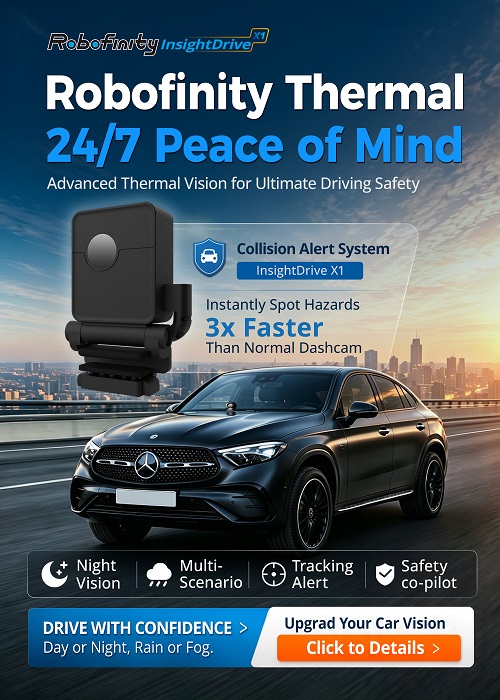
Robofinity InsightDrive is one example in this category. It combines AI-powered thermal imaging with recognition of pedestrians, animals, and vehicles, illustrating how an aftermarket system can provide more than a raw thermal video feed. As with any such product, its alerts should support observation rather than replace attention, headlights, or responsible speed.
Neither category is automatically better. A well-integrated factory system may provide the cleanest interface, while a carefully selected aftermarket unit may offer practical capability without replacing the vehicle.
A Practical Buying Checklist
Do not evaluate a system from a single specification. Consider the full driving experience.
Detection and Recognition
Ask what the system is designed to detect. Pedestrian, animal, and vehicle recognition may be more useful than a thermal image alone, especially for drivers who do not want to interpret unfamiliar shapes while moving.
Check whether stated distances refer to detecting an object, recognizing its category, or displaying it clearly enough for the driver to understand. These are not the same thing.
Alert Quality
Useful alerts should be timely, understandable, and selective. A system that warns constantly about harmless roadside heat sources can create alert fatigue.
Look for adjustable warning settings where available. The most appropriate sensitivity may differ between a rural road and a dense urban street.
Display Placement and Brightness
The display should be large enough to read at a glance but should not obscure the roadway or other controls. Brightness needs to be low enough to preserve night vision while maintaining usable contrast.
Consider how the screen behaves after startup, whether it has an automatic dimming function, and whether menus can be operated without prolonged attention.
Camera Position
The camera needs a stable, unobstructed forward view. Its location should minimize blockage from bodywork while allowing cleaning. It must not interfere with existing sensors, lights, or active grille components.
Poor alignment can make the displayed scene difficult to relate to the road. Installation quality is therefore part of system performance, not merely a cosmetic issue.
Compatibility and Electrical Installation
Confirm that the system is compatible with the vehicle’s voltage, cabin layout, windshield area, and available mounting points. Wiring should be protected, secured, and routed away from airbags, pedals, moving components, sharp edges, and hot surfaces.
Professional installation may be appropriate when wiring, exterior camera mounting, body-panel removal, or calibration is involved. A clean installation also reduces the chance of rattles, water intrusion, poor grounding, or battery drain.
Recording and Data Handling
Some systems may record video. If recording matters to you, check storage requirements, file management, loop recording behavior, and whether the system clearly indicates when it is recording.
Drivers should also consider applicable privacy and recording rules in their location. Regulations can vary, particularly for audio recording, windshield-mounted devices, and the handling of identifiable footage.
Ownership Costs
The purchase price is only part of the decision. Account for installation, replacement mounts, damaged wiring, screen or camera repair, and any storage media the unit requires.
Also consider whether the camera can be moved to another vehicle. Transferability may improve value for owners who change vehicles frequently, provided the new installation is compatible and properly completed.
Who Is Most Likely to Benefit?
Rural Commuters
Drivers who regularly encounter unlit roads, wildlife, cyclists, or pedestrians are strong candidates. Their exposure is frequent, and the hazards thermal imaging handles well are directly relevant.
Night-Shift Workers
People commuting before dawn or late at night may use the system on nearly every trip. That repeated use makes the cost easier to justify than it would be for an occasional nighttime journey.
Long-Distance Drivers
Drivers who spend hours on highways after dark may value earlier hazard awareness. The system should be combined with disciplined rest breaks and fatigue management, not used as permission to continue when tired.
Families Traveling on Dark Roads
Parents transporting children on rural or poorly lit routes may consider thermal night vision as one layer in a broader safety strategy. Tires, brakes, lights, child restraints, sensible speed, and an alert driver remain more fundamental.
Motorhome, Van, and Utility-Vehicle Drivers
Larger or heavier vehicles generally require more distance to slow down and can have different sightlines from passenger cars. Earlier awareness may be useful, but installation must suit the vehicle’s dimensions, electrical system, and camera position.
Who May Not Need It?
Thermal night vision may offer limited value to drivers who rarely travel after dark, remain mostly on illuminated city streets, or use a vehicle only for short daytime trips.
It may also be a poor priority when the vehicle has unresolved basics such as worn tires, cloudy headlight lenses, weak bulbs, damaged wipers, a cracked windshield, braking issues, or incorrect headlight aim. Addressing those problems should come first.
A driver who finds secondary displays distracting should also think carefully. Recognition alerts may reduce the need to watch the image, but no interface suits everyone.
How It Compares With Other Night-Driving Upgrades
Thermal imaging solves a specific problem: detecting heat signatures in darkness or difficult visual conditions. Other upgrades serve different purposes.
Improved road-legal headlights illuminate lane edges, signs, and non-thermal objects. Automatic high beams can make it easier to use available lighting appropriately. Adaptive headlights, where fitted, may direct illumination into bends or adjust the beam around traffic.
Clean glass, effective wipers, correct tire pressure, fresh tires, and properly functioning demisters improve safety in ordinary conditions. Blind-spot monitoring and forward collision warnings cover different hazard zones and should not be viewed as substitutes for thermal imaging.
For most owners, the sensible order is:
- Correct maintenance and visibility defects.
- Use suitable tires and maintain the braking system.
- Ensure headlights are legal, clean, and properly aimed.
- Learn and correctly configure existing safety features.
- Consider thermal night vision when regular driving conditions justify additional hazard awareness.
This order does not diminish the technology. It places it where it belongs: as an additional layer after essential vehicle condition and safe driving practices.
A Simple Decision Framework
Before buying, score your situation in four areas.
Exposure: How many hours per month do you drive in darkness or poor visibility?
Hazard profile: Are animals, pedestrians, cyclists, unlit roads, or roadside activity common?
Usability: Can the display be installed where it supports brief glances without obstructing your view or distracting you?
Budget priority: Have you already addressed tires, brakes, headlights, wipers, windshield condition, and other essential safety needs?
A driver with high nighttime exposure, frequent rural hazards, a suitable installation location, and a well-maintained vehicle has a strong case for thermal night vision. A driver with low exposure and unresolved maintenance needs has a weak case.
One more question helps clarify the purchase: “What specific event do I expect this system to help me notice earlier?” If the answer describes a recurring, realistic scenario, such as animals near an unlit commute, the system has a defined purpose. If the answer is only “more technology,” the value may not be there.
Safe Use After Installation
Learn the display and alerts while the vehicle is parked. Know how pedestrians, animals, vehicles, and stationary heat sources typically appear. Set screen brightness before driving and avoid exploring menus on the road.
Keep the camera lens clean and inspect its mounting periodically. After a minor impact, repair, or camera adjustment, confirm that the view still aligns logically with the roadway.
Most importantly, do not drive faster because the system appears to show a clear path. A cold object, road defect, or hidden hazard may not stand out. Maintain a speed that allows you to stop within the distance you can reliably see and assess through the windshield.
Frequently Asked Questions
Can thermal night vision see through fog?
It may provide useful thermal contrast in some fog or mist, but it cannot see clearly through every atmospheric condition. Dense fog, heavy rain, snow, spray, and contamination on the lens can significantly reduce performance.
Does thermal night vision work in complete darkness?
Yes, thermal cameras do not require visible light to detect heat differences. However, drivers still need legal, functioning headlights to see road markings, signs, surfaces, and objects that may not have a strong thermal signature.
Can it detect pedestrians and animals?
Thermal imaging can make warm people and animals more visible against cooler surroundings. Systems with recognition software may classify and highlight them, but obstructions, distance, weather, target size, and temperature contrast can affect detection.
Is factory-installed night vision better than an aftermarket system?
Factory systems usually offer stronger vehicle integration, while aftermarket systems provide access for vehicles that were not built with the feature. Quality, interface design, recognition capability, installation, and support matter more than the category alone.
Will an automotive thermal camera prevent a collision?
No. It may help a driver notice certain hazards earlier, but it cannot guarantee detection or prevent a crash. Safe speed, attention, headlights, mirrors, braking distance, vehicle maintenance, and compliance with traffic laws remain essential.
Is thermal night vision legal to install?
Requirements vary by location and installation method. Rules may apply to windshield obstructions, display placement, electrical modifications, exterior equipment, and recording. Check current local requirements and use a qualified installer when necessary.
Conclusion
Automotive thermal night vision is worth considering when nighttime or poor-visibility driving is a routine part of vehicle ownership, particularly on rural roads, wildlife corridors, and unlit highways. Its strongest benefit is earlier awareness of warm subjects such as pedestrians and animals that may be difficult to identify with headlights alone.
Its limits are equally important. It cannot show every hazard, see through all weather, correct driver fatigue, or replace the normal view of the road. The screen can also become a distraction if it is poorly positioned or used incorrectly.
Start with the fundamentals: maintain the vehicle, correct headlight and windshield problems, use suitable tires, and adjust speed to visibility. Then assess your actual routes and nighttime exposure. When the technology addresses a frequent, specific risk and is installed with a clear, low-distraction interface, it can be a practical addition to a layered nighttime road safety strategy.