

An automotive thermal night vision system is a driver-assistance technology designed to help you spot potential hazards in darkness and other low-visibility conditions. Instead of relying on visible light like headlights or standard cameras, it detects heat signatures and converts them into an image you can interpret. For drivers who regularly handle rural roads, fog, rain, snow, or unlit highways, this heat-based system adds an extra layer of awareness when sight lines are limited.
- How an Automotive Thermal Night Vision System Works
- What Problems Thermal Night Vision Helps Solve?
- Low-light driving on unlit roads
- Fog, rain, and snow
- Headlight glare and dark contrast
- Pedestrian and animal awareness
- What a Driver Sees on the Display
- Who Benefits Most from Thermal Night Vision?
- Night commuters
- Rural and highway drivers
- Truck and long-distance drivers
- Drivers in regions with harsh weather
- How Thermal Night Vision Compares with Other Safety Tech
- Compared with headlights
- Compared with dash cams
- Compared with ADAS features
- Compared with night-vision headlights or high-beam assist
- Key Features to Look For
- Real-World Use Cases
- A person crossing an unlit road
- A deer near a tree line
- A stalled car around a bend
- Fog on a mountain road
- Is Thermal Night Vision Worth It?
- Installation and Practical Considerations
- Placement and visibility
- Power and integration
- Maintenance
- Driver habits
- What to expect during setup and calibration
- Further reading on infrared and road safety
- FAQ
- What is the main purpose of an automotive thermal night vision system?
- Does thermal night vision work in complete darkness?
- Can thermal imaging see through fog, rain, or snow?
- Is thermal night vision the same as a normal night camera?
- Does it replace headlights or safe driving?
- Is thermal night vision useful for animal detection?
- Conclusion
At a practical level, the goal is straightforward: make hard-to-see road risks easier to notice sooner. That can include pedestrians, animals, stalled vehicles, or roadside obstacles that might otherwise blend into the background. It is not a replacement for careful driving, but it can support nighttime road safety in situations where human vision and conventional cameras have limits.
Table of Contents
- How an Automotive Thermal Night Vision System Works
- What Problems Thermal Night Vision Helps Solve?
- What a Driver Sees on the Display
- Who Benefits Most from Thermal Night Vision?
- How Thermal Night Vision Compares with Other Safety Tech
- Key Features to Look For
- Real-World Use Cases
- Is Thermal Night Vision Worth It?
- Installation and Practical Considerations
- FAQ
- Conclusion
How an Automotive Thermal Night Vision System Works
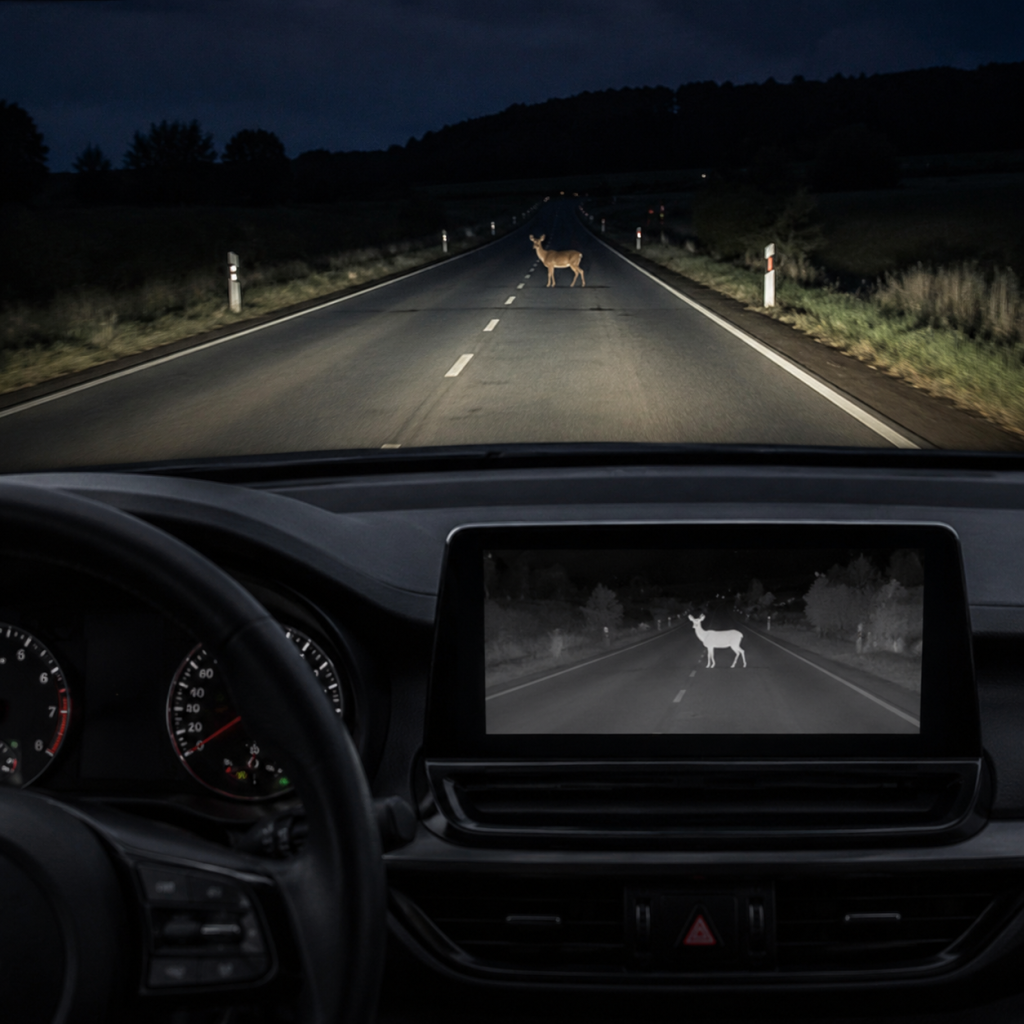
A thermal imaging system works by sensing infrared energy naturally emitted by warm objects. People, animals, engines, tires, and some roadside equipment all generate heat. The camera reads those differences and translates them into a thermal image on a dashboard screen or display.
Unlike a standard visible-light camera, a thermal camera does not need bright conditions to function well. It can detect heat in darkness and still provide useful information when visibility is reduced by fog, rain, snow, glare, or deep shadows. That is why thermal night vision is often discussed as part of nighttime road safety and poor-visibility driving awareness.
Thermal imaging versus visible-light cameras
A visible-light camera depends on illumination. If the road is dark, the camera needs headlights or other light sources to capture detail. In contrast, a thermal camera detects temperature differences, which means it can reveal a person crossing a road even when that person is nearly invisible to the naked eye.
That difference matters on rural roads, where a pedestrian or animal can emerge suddenly from the edge of the roadway, and on highways, where glare and darkness can reduce reaction time. A thermal system does not replace other sensors or mirrors, but it can offer a different view of the environment that may help you make faster, more confident decisions.
More EV News
Why heat signatures matter
Heat signatures create contrast. A person standing near a cooler road surface may show up clearly in a thermal image. A deer near a dark roadside area can stand out, especially when the system is tuned to highlight moving or warmer objects. Vehicles can be detected too, particularly when their engines and tires create noticeable thermal differences.
This is one reason an automotive thermal night vision system can be useful when visible detail is limited but your need for awareness is high—especially at the moment hazards begin to appear.
What Problems Thermal Night Vision Helps Solve?
The main search intent behind this topic is practical: drivers want to know whether thermal night vision solves real problems on the road. The answer is yes, within certain limits.
Low-light driving on unlit roads
On dark roads, the challenge is often not just seeing ahead—it is seeing far enough ahead to react. An automotive thermal night vision system can help reveal people, animals, or parked vehicles before they are fully clear in the headlight beam. That extra awareness can be especially valuable on country roads, mountain roads, and routes with limited lighting.
Fog, rain, and snow
Bad weather affects visible-light systems in different ways. Fog scatters light. Rain creates reflections. Snow can reduce contrast and wash out detail. Thermal cameras are not magic, and environmental conditions can still affect performance, but they often remain more useful than standard cameras when visibility drops.
For drivers who frequently encounter poor-visibility driving conditions, the added information can make it easier to identify hazards earlier—particularly when a thermal night vision system highlights warm targets against cooler backgrounds.
Headlight glare and dark contrast
A common problem at night is glare from oncoming headlights or reflective surfaces. Thermal night vision does not eliminate glare completely, but it can reduce your dependence on bright visible contrast. That matters because a hazard may be present even when your eyes are temporarily distracted by light blooms or deep shadows.
Pedestrian and animal awareness
Many nighttime collisions involve pedestrians or animals that are difficult to see in time. Thermal imaging can help highlight warm bodies against cooler backgrounds, making them easier to notice before they enter the vehicle’s path. It does not guarantee prevention of an incident, but it can improve reaction time when seconds matter.
If you want a deeper look at broader safety benefits, compare this guide with Far Infrared Automotive Night Vision: 7 Powerful Safety Benefits.
What a Driver Sees on the Display
Most automotive thermal night vision systems translate thermal data into a screen inside the car. The display may show bright objects against a darker background, or use color variations to emphasize temperature differences.
The exact presentation varies by model, but the objective is consistent: help you recognize hazards sooner. Some systems can overlay alerts or icons when they detect something important ahead. In a more advanced setup, the system may classify pedestrians, animals, vehicles, or obstacles and provide real-time collision-risk alerts.
That combination of visual display and warning support is one reason thermal imaging is often described as a driver-assistance technology rather than just a camera.
What the display can and cannot do
A thermal display can be helpful, but it is not a replacement for judgment. It cannot read road signs, interpret every object perfectly, or predict every movement. A warm object may stand out clearly, but the system still requires you to assess what it is and decide how to respond.
In short, the display is a tool for awareness—not an automatic solution.
Who Benefits Most from Thermal Night Vision?
Not every driver needs thermal imaging, but some groups are more likely to benefit from an automotive thermal night vision system.
Night commuters
Drivers who commute after sunset often deal with low-light roads, unexpected cross traffic, and fewer visual cues. An automotive thermal night vision system can add confidence in areas where street lighting is limited or inconsistent—so you can start reacting earlier.
Rural and highway drivers
Rural roads often have wildlife, curves, and fewer reflective markers. Highway drivers can face higher speeds, glare, and long stretches of darkness. Thermal night vision may help in both environments by making heat-emitting hazards visible earlier, including pedestrians and animals near the roadway.
Truck and long-distance drivers
Drivers who spend long hours on the road encounter changing conditions: darkness, weather shifts, fatigue, and unfamiliar routes. A thermal imaging system can support broader hazard awareness, especially when attention is stretched by long-distance travel—helpful for maintaining situational awareness at night.
Drivers in regions with harsh weather
In places where fog, snow, and rain are common, the ability to detect hazards in poor visibility can be valuable year-round. Thermal imaging is not a weather shield, but it can be one more layer of support when conditions deteriorate.
How Thermal Night Vision Compares with Other Safety Tech
It helps to understand where thermal night vision fits among other vehicle safety tools.
Compared with headlights
Headlights illuminate the road, but they do not make every hazard visible. Bright lights can also create glare or leave dark gaps outside the beam. Thermal imaging adds a separate detection method that does not depend on reflected light in the same way—so a thermal night vision system can complement what your headlights already show.
Compared with dash cams
Dash cams are mainly for recording events. Some advanced models support driver assistance, but many are still based on visible-light imaging. Thermal night vision is built around detection and awareness rather than documentation alone, although some systems include real-time video recording.
Compared with ADAS features
Modern ADAS features such as lane departure warnings, forward collision alerts, and pedestrian detection can be valuable. Thermal imaging differs because it focuses on heat signatures rather than visible detail alone. In some cases, the two approaches can complement each other well.
Compared with night-vision headlights or high-beam assist
High-beam assist helps you see farther when conditions allow. Thermal imaging helps identify warm objects that may remain difficult to discern even with lighting support. The best results often come from combining tools rather than relying on one system.
For more comparisons of system types and options, see What Are the Best Automotive Thermal Night Vision Systems in 2026?.
Key Features to Look For
If you are comparing automotive thermal night vision systems, certain factors matter more than marketing claims.
Detection range
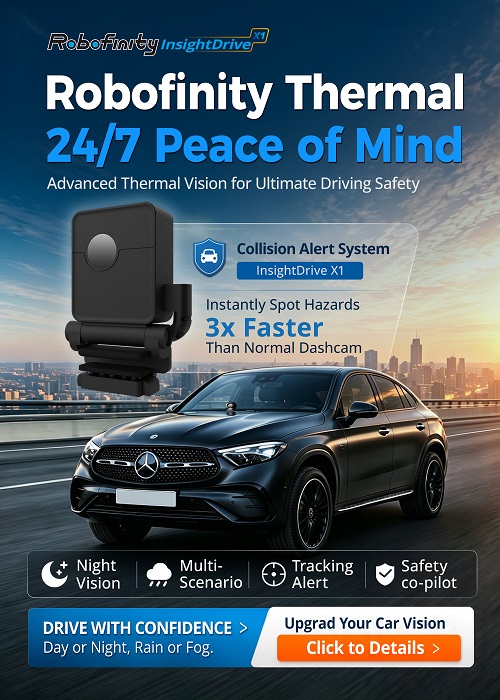
Range matters because reaction time matters. A system with a longer detection range may give you more time to respond to a pedestrian, animal, or stopped vehicle ahead. For example, Robofinity InsightDrive Car Thermal Night Vision is designed with up to 200 meters (656 feet) of detection range, which can support earlier awareness in dark or poorly lit conditions.
Recognition capabilities
Some models focus on raw heat imagery, while others use AI to recognize pedestrians, animals, vehicles, and obstacles. Recognition can make the display more useful by helping you separate critical hazards from general heat sources.
Alert behavior
A good automotive thermal night vision system should provide clear alerts without becoming distracting. Timely, understandable warnings are more helpful than frequent notifications that you cannot act on. If warnings are too frequent or vague, drivers tend to ignore them.
Display quality
A clear screen is important because you need to process the information quickly. Screen size, resolution, and layout affect usability. A well-designed display should be readable without forcing you to look away from the road for long.
Environmental durability
Outdoor vehicle hardware must handle vibration, heat, cold, moisture, and road grime. An IP-rated camera housing and a protective lens window are practical considerations, especially for drivers in climates with frequent weather changes.
Real-World Use Cases
Thermal night vision is easiest to understand when you picture actual driving situations.
A person crossing an unlit road
On a dark suburban edge road, a pedestrian may wear dark clothing and blend into the background. An automotive thermal night vision system can help that person stand out earlier than headlights alone would.
A deer near a tree line
On rural routes, animals can appear suddenly from vegetation or shoulder space. Because they are warm bodies against a cooler background, they may show up more clearly on thermal imaging than in a standard camera feed—making a thermal night vision system especially valuable for animal awareness.
A stalled car around a bend
A vehicle stopped ahead at night may not be obvious until you round a curve. Thermal imaging can help identify the presence of a vehicle sooner, especially if it is not well lit or is partially hidden by terrain.
Fog on a mountain road
Fog reduces contrast and makes depth harder to judge. A thermal system may not solve all visibility problems, but it can still make warm hazards more noticeable than they would be through the windshield alone.
Is Thermal Night Vision Worth It?
The value depends on how and where you drive. For a city commuter who rarely drives at night, the benefit may be limited. For someone who regularly drives dark rural roads, highways, or routes with animals and poor lighting, an automotive thermal night vision system can be a meaningful upgrade for earlier detection.
The key is to see it as an awareness tool. A thermal imaging system can support safer decisions by exposing hazards earlier, but it does not remove the need for defensive driving. Headlights, mirrors, lane discipline, braking distance, and full driver attention still matter.
If you are comparing options, it can also help to understand typical pricing. Review Car Night Vision Camera Price: What You’ll Pay in 2026 to plan your budget and evaluate what features you are actually getting.
Installation and Practical Considerations
Before you choose a system, think about how it will fit into your everyday routine.
Placement and visibility
The screen should be positioned so you can glance at it easily without creating distraction. The camera placement should support a stable forward view with minimal obstruction.
Power and integration
Some systems are designed for simpler aftermarket installation, while others require more involved vehicle integration. A practical setup should fit your car without adding unnecessary complexity or frequent setup steps.
Maintenance
A thermal camera lens should stay clean enough to function properly. Road film, ice, and dirt can reduce image quality. The protective housing and camera placement help, but regular care still matters for consistent performance of a thermal night vision system.
Driver habits
The best system is the one you use correctly. If the display is ignored, misunderstood, or treated as an optional feature, the benefit drops quickly. An automotive thermal night vision system works best when it supports your driving habits rather than replaces them—because the driver still controls speed, braking, and steering decisions.
What to expect during setup and calibration
After installation, give yourself time to learn the display style and warning logic. Different systems highlight heat in different ways, and alerts may vary based on motion, distance, and classification confidence. During early use, compare what you see on the screen with what the road looks like in normal driving to build correct expectations.
Further reading on infrared and road safety
If you want more context on the technology behind heat-based detection, the U.S. Department of Energy provides a clear overview of infrared radiation and how it is used. That background can make it easier to understand why thermal sensors can detect people, animals, and vehicles in low light.
FAQ
What is the main purpose of an automotive thermal night vision system?
Its main purpose is to help drivers detect people, animals, vehicles, and obstacles in darkness or poor-visibility conditions by using heat signatures instead of visible light.
Does thermal night vision work in complete darkness?
Yes. Because it detects heat rather than relying on light, an automotive thermal night vision system can still produce useful imagery in darkness.
Can thermal imaging see through fog, rain, or snow?
It can often perform better than standard cameras in those conditions, but it does not see through weather perfectly. Visibility and contrast can still be affected, especially when conditions are extremely dense.
Is thermal night vision the same as a normal night camera?
No. A normal night camera usually depends on light or infrared illumination, while thermal night vision detects heat patterns.
Does it replace headlights or safe driving?
No. It is a driver-assistance tool only and should be used alongside headlights, mirrors, traffic laws, braking distance, and full driver attention.
Is thermal night vision useful for animal detection?
Yes. Warm animals often stand out well in thermal imagery, which can help with earlier awareness on rural or wooded roads—one of the most common reasons people choose a thermal night vision system.
Conclusion
An automotive thermal night vision system is a practical piece of driver-assistance technology that helps make hidden road risks easier to see in low-light and poor-visibility situations. By detecting heat signatures, it can improve awareness of pedestrians, animals, vehicles, and obstacles when regular visibility is limited.
That makes it especially relevant for night driving, rural roads, highway travel, and bad-weather conditions. Systems such as Robofinity InsightDrive show how AI-powered thermal imaging and real-time alerts can support safer awareness without claiming to replace careful driving. If you frequently drive at night or in low-visibility conditions, learning more about a thermal imaging system can help you decide whether an automotive thermal night vision system fits your driving needs.