


- Table of Contents
- FWD vs RWD vs AWD: What the Drivetrains Mean
- Front-Wheel Drive: Practical and Efficient
- Rear-Wheel Drive: Balanced Handling and Strong Capability
- All-Wheel Drive: Extra Traction With Added Complexity
- Which Drivetrain Is Best in Snow and Rain?
- Handling and Performance Differences
- Fuel Economy, Maintenance, and Ownership Costs
- Towing, Family Driving, and Real-World Use
- City Commuting
- Family Transportation
- Rural Roads and Long-Distance Travel
- Towing and Hauling
- Performance Driving
- How Electric Vehicles Change the Comparison
- A Practical Drivetrain Decision Framework
- Common Drivetrain Buying Mistakes
- Frequently Asked Questions
- Is AWD always better than FWD?
- Is rear-wheel drive unsafe in the snow?
- Does AWD help a car stop faster?
- Which drivetrain gets the best fuel economy?
- Is AWD worth the extra cost?
- Which drivetrain is best for towing?
- Choose for the Roads You Actually Drive
Choosing between FWD vs RWD vs AWD affects how a vehicle accelerates, handles bad weather, uses fuel, and responds near its limits. No drivetrain is automatically best for every driver. Front-wheel drive is often practical and efficient, rear-wheel drive can provide balanced handling and strong towing capability, and all-wheel drive can improve acceleration on slippery surfaces.
The right FWD vs RWD vs AWD choice depends on where you drive, the weather you encounter, the vehicle’s intended use, and your ownership budget. Tires, stability control, suspension design, and driver behavior also matter, sometimes more than the drivetrain label itself. This guide explains the real-world trade-offs so you can make a more informed buying decision.
Table of Contents
FWD vs RWD vs AWD: What the Drivetrains Mean
A vehicle’s drivetrain determines which wheels receive power from the engine or electric motor. Understanding that basic distinction makes the FWD vs RWD vs AWD comparison easier to apply to everyday driving.
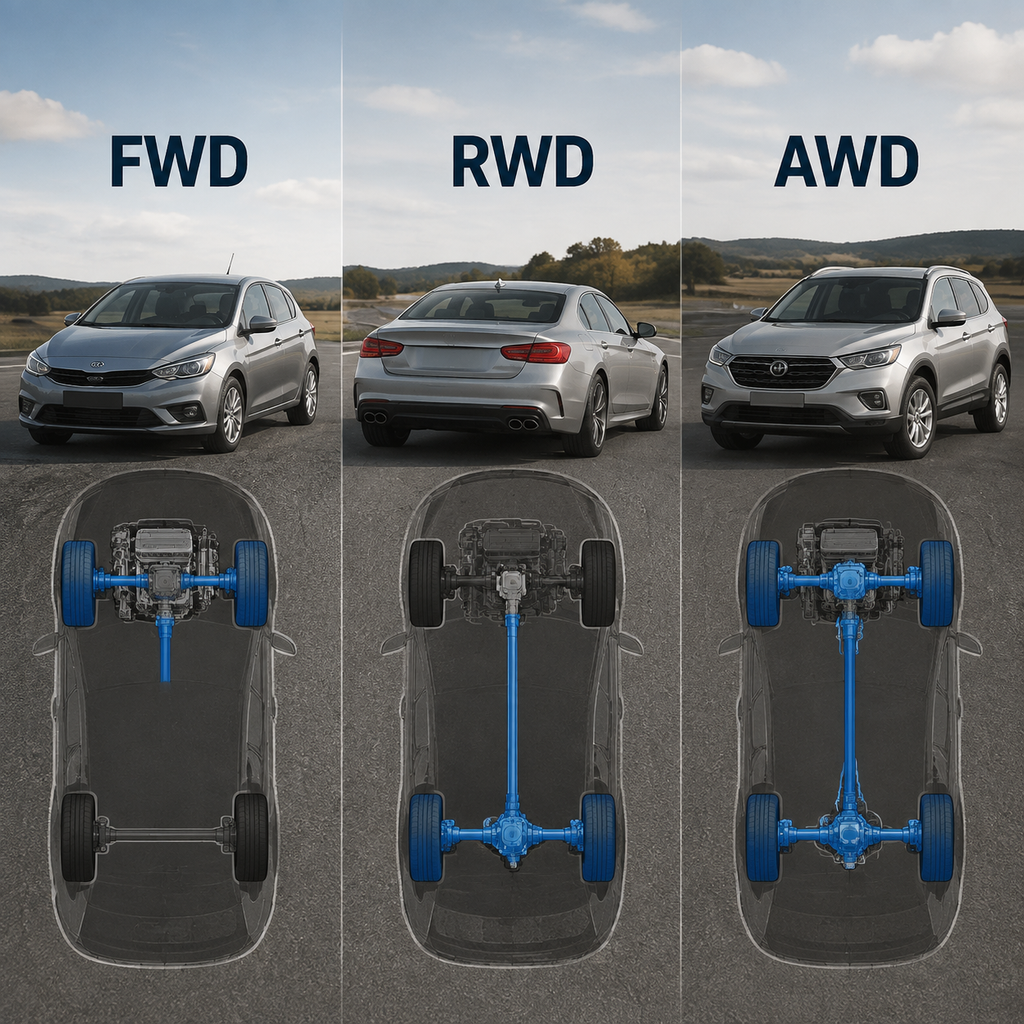
In a front-wheel-drive vehicle, the front wheels both steer and pull the car forward. In a rear-wheel-drive vehicle, the front wheels steer while the rear wheels provide propulsion. An all-wheel-drive system can send power to all four wheels, either continuously or when additional traction is needed.
These layouts influence traction during acceleration, packaging, handling balance, cost, and mechanical complexity. They do not determine every aspect of a vehicle’s behavior. Two cars with the same drivetrain can feel very different because of their tires, weight, suspension, electronic controls, and power delivery. A meaningful FWD vs RWD vs AWD comparison therefore requires looking beyond the drivetrain badge.
It is also important to distinguish AWD from four-wheel drive. Although manufacturers sometimes use the terms inconsistently, AWD is generally designed for automatic operation on paved roads in changing conditions. Traditional four-wheel drive is more common in trucks and off-road vehicles and may include selectable drive modes, low-range gearing, and hardware intended for rough terrain. That distinction should remain clear when evaluating FWD vs RWD vs AWD.
More EV News

Front-Wheel Drive: Practical and Efficient
In the FWD vs RWD vs AWD comparison, front-wheel drive is often the practical starting point. Commonly abbreviated as FWD, it is widely used in compact cars, family sedans, hatchbacks, crossovers, and some vans because of its efficient packaging and predictable everyday behavior.
Because the engine, transmission, and driven wheels are usually concentrated at the front, manufacturers can leave more room for passengers and cargo. This layout can also reduce the number of heavy components running toward the rear of the vehicle.
Advantages of Front-Wheel Drive
For many daily drivers considering FWD vs RWD vs AWD, FWD combines reasonable production cost, good interior space, and dependable traction in ordinary conditions.
Its main benefits include:
- Typically lower purchase prices than comparable AWD models
- Fewer drivetrain components than many AWD layouts
- Good traction in rain and moderate snow
- Efficient use of cabin and cargo space
- Predictable handling for routine commuting
- Often lower weight and fuel consumption than an equivalent AWD vehicle
The engine’s weight usually sits over the driven front wheels, helping them find traction when pulling away on a wet or lightly snow-covered road. For drivers in cities and suburbs where roads are regularly cleared, a FWD vehicle with suitable tires may be entirely adequate throughout the year.
Limitations of Front-Wheel Drive
The front tires must handle steering, acceleration, and a large share of braking. Under hard acceleration or demanding cornering, that workload can reduce grip and steering precision, a limitation worth considering when comparing FWD vs RWD vs AWD.
Powerful FWD vehicles may also exhibit torque steer, a pulling sensation through the steering wheel during heavy acceleration. Modern suspension design and electronic controls can reduce the effect, but they may not eliminate it.
When pushed too quickly into a corner, many FWD vehicles tend toward understeer, meaning the car follows a wider path than the driver intends. Understeer is generally considered predictable, but it still requires the driver to reduce speed rather than add more steering input.
FWD may also be less suitable for very high power outputs, serious towing, or performance driving where balanced weight distribution is a priority. These limitations help explain why the answer to FWD vs RWD vs AWD changes with the vehicle’s intended use.
Rear-Wheel Drive: Balanced Handling and Strong Capability
Rear-wheel drive offers the handling-focused alternative in the FWD vs RWD vs AWD decision. RWD is common in sports cars, performance sedans, pickup trucks, luxury vehicles, and some large SUVs. The rear wheels propel the vehicle while the front wheels focus on steering.
Separating those tasks can produce more natural steering feel and better balance during acceleration. It can also help a vehicle manage high power or heavy loads.
Advantages of Rear-Wheel Drive
When comparing FWD vs RWD vs AWD for dry-road acceleration, RWD benefits from the way weight naturally transfers toward the rear. That transfer can press the driven wheels more firmly against the road and improve traction.
Other potential advantages include:
- More balanced handling in many vehicle designs
- Better steering feel because the front wheels are not delivering power
- Effective management of high engine output
- Strong suitability for towing and hauling in trucks
- More predictable behavior for skilled performance driving
- Potentially tighter steering geometry in some applications
For a sports car, RWD allows the front tires to concentrate on turning while the rear tires manage propulsion. In a loaded pickup, the cargo or trailer tongue weight can increase pressure over the driven rear axle, which may support traction.
Limitations of Rear-Wheel Drive
RWD can be more challenging on snow or ice, especially when the vehicle has little weight over the rear axle. Applying too much power may cause the rear tires to lose grip, allowing the back of the vehicle to move outward.
Modern traction and stability control make current RWD vehicles much easier to manage than older models. However, electronics cannot create grip where the tires have none. Winter tires remain important in regions with prolonged freezing temperatures or regular snowfall.
RWD vehicles may also have a transmission tunnel and driveshaft running through the passenger compartment, which can reduce interior space. The additional hardware may increase weight and maintenance requirements compared with a simple FWD layout. These trade-offs matter when evaluating FWD vs RWD vs AWD for year-round ownership.
All-Wheel Drive: Extra Traction With Added Complexity
All-wheel drive is the traction-focused option in a FWD vs RWD vs AWD comparison. It sends torque to both axles. Some systems power all four wheels much of the time, while others operate primarily as front- or rear-wheel drive and engage the second axle when conditions require it.
Modern AWD systems vary considerably. A basic reactive system may transfer power after wheel slip is detected. A more advanced system may anticipate traction needs using steering angle, accelerator position, wheel speed, and other sensor data. Some performance-oriented designs can also distribute torque across an axle to influence cornering behavior. These differences can materially affect the outcome of a FWD vs RWD vs AWD comparison.
For that reason, the AWD badge alone does not reveal exactly how a vehicle will behave.
Advantages of All-Wheel Drive
The main AWD advantage in the FWD vs RWD vs AWD debate is improved traction while accelerating. By distributing power across more tires, the system can help a vehicle pull away on wet pavement, climb a snowy hill, or accelerate out of a loose gravel junction with less wheelspin.
Potential benefits include:
- Better acceleration on slippery surfaces
- Greater confidence on steep or poorly maintained roads
- Improved ability to put down high power
- Added versatility for changing weather
- More stable power delivery in some performance vehicles
- Useful traction for light-duty unpaved-road travel
AWD can be especially valuable for drivers who regularly face deep snow, steep driveways, muddy access roads, or rapidly changing winter conditions. It may also suit high-powered cars that would otherwise struggle to transfer torque through only two tires.
Limitations of All-Wheel Drive
AWD usually costs more to buy and maintain. Additional driveshafts, clutches, differentials, electric motors, or transfer components add weight and complexity. Depending on the vehicle, this may also increase fuel or energy consumption.
Tire replacement can become more demanding. Some AWD systems require all four tires to have closely matched circumference and tread depth. A single damaged tire may therefore lead to replacement of multiple tires, although the exact requirement depends on the manufacturer.
Most importantly, AWD does not shorten braking distance simply because four wheels receive power. Every modern passenger vehicle already brakes through all four wheels. On snow and ice, stopping and cornering depend heavily on tire grip, road conditions, speed, and vehicle weight.
AWD can help a driver accelerate confidently, but that confidence can become misleading if it encourages excessive speed before a turn or stop. In any FWD vs RWD vs AWD assessment, extra acceleration traction should not be mistaken for universally better grip.
Which Drivetrain Is Best in Snow and Rain?
Weather is often the deciding factor in a FWD vs RWD vs AWD comparison, but the drivetrain and tires must be considered together. The National Highway Traffic Safety Administration’s winter driving guidance also emphasizes preparation, tire condition, slower speeds, and greater following distance.
An AWD vehicle on inappropriate tires can struggle to stop or turn. A FWD or RWD vehicle equipped with quality winter tires may provide substantially better cold-weather control than the same vehicle on worn summer or all-season tires. Winter tires are designed to remain more flexible in low temperatures and provide tread patterns suited to snow and slush.
Front-Wheel Drive in Winter
Within the winter-focused FWD vs RWD vs AWD comparison, FWD is a sensible choice for moderate climates, particularly where roads are plowed and treated. The weight over the front axle can help with initial traction, and the vehicle’s tendency toward understeer is usually manageable when speed is appropriate.
However, deep snow can create problems if ground clearance is limited. A low FWD sedan may become stuck because its underside contacts the snow, regardless of available tire traction.
Rear-Wheel Drive in Winter
RWD requires more deliberate accelerator use on low-grip surfaces, which is an important distinction when judging FWD vs RWD vs AWD in winter. Winter tires can transform its usability, while traction and stability control provide additional support.
A RWD car may work well in winter when roads are maintained and the driver prepares properly. A lightly loaded RWD pickup can be more difficult because there may be relatively little weight over the driven axle. Any cargo added for traction must be secured properly and must not exceed the vehicle’s load limits.
All-Wheel Drive in Winter
For drivers focused on severe winter traction, FWD vs RWD vs AWD often favors AWD when starting on an incline, moving through deeper snow, or dealing with variable grip. It can reduce wheelspin and help the vehicle maintain momentum.
That does not make it immune to sliding. Drivers still need suitable tires, longer following distances, smooth control inputs, and lower speeds. AWD is a traction aid, not a substitute for winter-driving judgment. For more seasonal preparation advice, read this complete guide to winter driving best practices.
Handling and Performance Differences
On dry roads, the FWD vs RWD vs AWD decision changes how a vehicle deploys power and behaves near its handling limits.
FWD vehicles tend to be stable and predictable for daily use, but they can ask too much of the front tires during aggressive driving. This may lead to understeer and reduced steering feel.
RWD vehicles often provide the most traditional performance balance. Acceleration can shift weight onto the driven rear wheels, while the front tires retain more capacity for steering. If rear traction is exceeded, however, oversteer can occur. Stability control can intervene, but drivers should not depend on it to correct reckless inputs.
AWD can provide extremely effective acceleration, especially in powerful vehicles. Performance-oriented systems may also improve corner-exit traction. The drawbacks are additional weight and, in some vehicles, steering that feels less communicative.
For ordinary road driving, chassis quality matters more than a simple drivetrain category. A well-engineered FWD hatchback can be more enjoyable and composed than a poorly tuned RWD car. A heavy AWD crossover may offer excellent traction but feel less agile than either, so FWD vs RWD vs AWD should never replace a test-drive of the exact model.
Fuel Economy, Maintenance, and Ownership Costs
Cost can settle the FWD vs RWD vs AWD question even when more than one drivetrain meets a driver’s needs. The system should fit the ownership budget as well as the road conditions.
FWD is generally the simplest of the three layouts. It often uses fewer components, weighs less, and minimizes mechanical losses. The front tires may wear faster because they handle propulsion, steering, and much of the braking load, making regular tire rotation important.
RWD adds a driveshaft and rear differential in conventional combustion-engine vehicles. These components are durable when maintained correctly, but they introduce extra fluids, joints, seals, and bearings that may eventually require service.
AWD typically has the highest mechanical complexity. Maintenance may involve additional differential or coupling fluids, and repairs can be more expensive if a transfer unit, clutch pack, driveshaft, or related control component fails. Buyers should check the manufacturer’s maintenance schedule rather than assume the system is maintenance-free.
Fuel-economy differences are model-specific. AWD often adds weight and driveline resistance, but modern disconnect systems can reduce those penalties. When comparing vehicles, use official consumption or efficiency figures for the exact drivetrain and configuration under consideration.
Tire care is critical across all three layouts. Keep tires properly inflated, rotate them at the recommended intervals, and check alignment if wear becomes uneven. On AWD vehicles, follow the manufacturer’s guidance regarding tread-depth differences between tires. The full ownership-cost view of FWD vs RWD vs AWD should include tires, scheduled service, fuel or electricity, and likely repair costs.
Towing, Family Driving, and Real-World Use
The most useful way to resolve FWD vs RWD vs AWD is to match the drivetrain to a specific job rather than choosing the most capable-sounding label.
City Commuting
For paved urban and suburban travel, FWD is usually the most practical option. It provides efficient packaging, manageable operating costs, and adequate wet-weather traction. AWD may add little value if snow is rare and roads are consistently maintained.
Family Transportation
For family buyers, FWD vs RWD vs AWD is only one part of the vehicle assessment. Crash protection, tires, braking performance, visibility, seating, cargo capacity, and driver-assistance features also matter.
FWD is sufficient for many families. AWD becomes more useful for households that make regular winter trips, live on steep roads, or travel to areas where weather and road maintenance are unpredictable.
Rural Roads and Long-Distance Travel
Rural conditions add another dimension to FWD vs RWD vs AWD because they may involve mud, standing water, snow, wildlife, poor lighting, and longer emergency response times. AWD can help on loose or slippery surfaces, but tire condition, ground clearance, spare-tire provisions, and driving visibility may be equally important.
Drivetrain traction also does not address every low-light hazard. Drivers who frequently use dark rural roads may consider an aftermarket awareness upgrade such as Robofinity InsightDrive, which uses AI-powered thermal imaging to support awareness in poor-visibility conditions. Such driver-assistance technology should supplement, not replace, effective headlights, appropriate speed, mirrors, safe braking distance, and continuous attention.
Towing and Hauling
When towing shapes the FWD vs RWD vs AWD decision, RWD is common in trucks because it works well when weight is placed over the rear axle. For boat ramps, wet grass, snow, or loose surfaces, AWD or four-wheel drive may provide more dependable traction.
Do not choose a tow vehicle based on drivetrain alone. Confirm the rated towing capacity, payload limit, axle ratings, cooling equipment, hitch specification, and trailer-brake requirements for the exact model.
Performance Driving
For performance driving, FWD vs RWD vs AWD involves traction, steering feel, weight, and power delivery. RWD remains attractive for drivers who value adjustable handling, while AWD is useful for maximizing acceleration and deploying high power in varied conditions. FWD can still be entertaining and fast, particularly in a lighter car with a well-designed suspension and limited-slip differential.
Public-road safety should take priority over exploring a vehicle’s limits. Performance driving is more appropriately practiced in a controlled setting.
How Electric Vehicles Change the Comparison
Electric vehicles change the mechanical details of FWD vs RWD vs AWD because they can implement each layout differently from combustion-engine cars.
A single-motor EV may drive either the front or rear axle. A dual-motor model can place one motor at each axle to create AWD without a conventional driveshaft. Software can adjust torque delivery quickly, potentially improving traction and stability.
However, an AWD EV may be heavier, more expensive, and less efficient than a related single-motor version. It may also have more power than a typical driver needs. Buyers should compare the official driving range for each configuration rather than assuming the AWD version performs identically.
Regenerative braking adds another consideration. Depending on the vehicle and conditions, regeneration may occur through one or both axles. The car’s control systems generally manage this automatically, but tires remain the physical connection to the road. AWD hardware does not overcome poor tire grip during braking or turning. As a result, the EV version of FWD vs RWD vs AWD still requires a careful comparison of tires, efficiency, range, price, and intended use.
A Practical Drivetrain Decision Framework
Instead of asking which layout wins FWD vs RWD vs AWD in general, ask which one solves a recurring need.
Choose FWD when:
- Most driving takes place on paved, maintained roads
- Purchase price and operating efficiency are priorities
- Snowfall is light or occasional
- Interior space and straightforward ownership matter
- The vehicle will not regularly tow heavy loads
Choose RWD when:
- Balanced handling and steering feel are priorities
- You want a sports car or performance-oriented sedan
- The vehicle will tow or haul within its rated limits
- Winter conditions are limited or you are prepared to use appropriate tires
- You understand how rear-driven vehicles respond near the traction limit
Choose AWD when:
- Snow, ice, steep roads, or loose surfaces are routine
- You need confident acceleration in rapidly changing conditions
- The vehicle has enough power to benefit from torque at both axles
- You accept potentially higher purchase, maintenance, and tire costs
- The extra capability addresses a real use case rather than an occasional possibility
Before buying, test-drive the exact vehicle in conditions as close as possible to your normal use. Check outward visibility, low-speed response, ride quality, tire type, turning circle, and the behavior of traction-control systems. A real-world test is more informative than treating FWD vs RWD vs AWD as a comparison of badges alone.
Common Drivetrain Buying Mistakes
A common FWD vs RWD vs AWD mistake is assuming AWD makes a vehicle universally safer. It can improve acceleration on slippery roads, but it cannot repeal the limits of braking and cornering grip.
Another mistake is choosing RWD solely because it is associated with performance. Chassis tuning, power delivery, tires, weight, and suspension design determine whether a car actually feels engaging.
Buyers also sometimes dismiss FWD as a budget-only layout. In reality, it can be the most rational choice for commuting and family use, freeing money for better tires, safety equipment, or a newer vehicle in better condition.
Finally, do not overlook the tires fitted to a used vehicle. Premium AWD hardware cannot compensate for worn tread, incorrect tire pressure, mixed tire types, or rubber unsuitable for the season. A sound FWD vs RWD vs AWD decision always considers the condition and suitability of the tires.
Frequently Asked Questions
These answers address the most common FWD vs RWD vs AWD questions from drivers comparing traction, cost, efficiency, and towing ability.
Is AWD always better than FWD?
No. AWD can provide better acceleration on slippery surfaces, but it usually costs more, weighs more, and has additional components to maintain. FWD is often more efficient and entirely suitable for paved roads and moderate weather.
Is rear-wheel drive unsafe in the snow?
RWD is not inherently unsafe, but it can be more demanding when traction is limited. Appropriate winter tires, smooth accelerator inputs, stability control, and reduced speed make a major difference. Drivers facing frequent deep snow or steep roads may find AWD more convenient.
Does AWD help a car stop faster?
Not by itself. AWD distributes driving torque, while all four wheels already contribute to braking. Stopping distance is influenced by tires, road surface, speed, vehicle weight, brake condition, and electronic systems such as anti-lock braking.
Which drivetrain gets the best fuel economy?
FWD often has an efficiency advantage because it tends to be lighter and mechanically simpler. However, the result varies by model. Aerodynamics, engine or motor efficiency, transmission design, vehicle size, and driving style also affect consumption.
Is AWD worth the extra cost?
It may be worth paying for if you regularly drive in snow, on steep roads, over loose surfaces, or in rapidly changing weather. In the broader FWD vs RWD vs AWD calculation, drivers whose journeys occur mainly on maintained urban roads may get better overall value from a two-wheel-drive vehicle with high-quality seasonal tires.
Which drivetrain is best for towing?
RWD is effective for towing on dry pavement and is widely used in trucks. AWD or four-wheel drive can improve traction on slippery ramps, wet fields, snow, and loose ground. In every case, the vehicle’s specific towing and payload ratings are more important than drivetrain type alone.
Choose for the Roads You Actually Drive
The best answer to FWD vs RWD vs AWD comes from the roads and conditions you face regularly. FWD is the sensible default for many commuters and families because it combines efficiency, useful traction, and lower complexity. RWD suits drivers who prioritize handling balance, high-power capability, or towing. AWD earns its additional cost when slippery surfaces, steep roads, or severe weather are regular parts of the journey.
Treat drivetrain as one part of the vehicle rather than a complete safety verdict. Tires, brakes, visibility, ground clearance, stability control, maintenance, and driver judgment all influence real-world performance. Review your normal routes, climate, annual mileage, and ownership budget, then choose the system that addresses those conditions consistently rather than the one that sounds most capable on paper.