


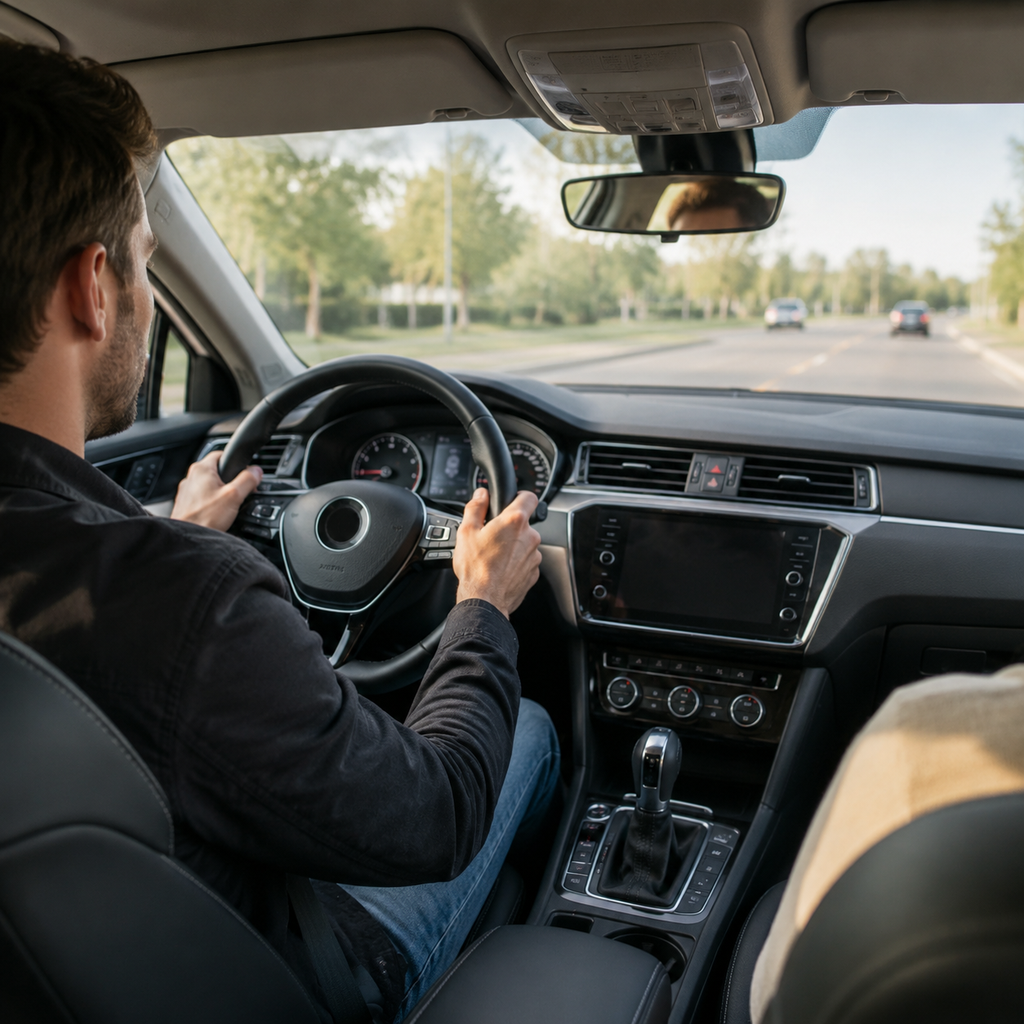
A test drive checklist helps you determine whether a vehicle is comfortable, safe, mechanically sound, and suitable for your daily life. It encourages you to look beyond clean paint, a detailed interior, and a persuasive sales presentation so you can test important features, identify warning signs, and understand how the vehicle behaves before making a financial commitment.
- Table of Contents
- Test Drive Checklist: Prepare Before You Start the Engine
- Inspect the Vehicle Before Driving
- Observe the Start-Up Sequence
- Evaluate Acceleration and Power Delivery
- Test the Steering, Suspension, and Handling
- Check the Brakes Carefully
- Listen for Noise and Vibration
- Assess Visibility and Everyday Practicality
- Test Comfort on More Than Smooth Roads
- Review Technology Without Letting It Distract You
- Use a Route That Reflects Real Driving
- Look for Used-Car Warning Signs
- Compare the Car After the Drive
- Questions to Ask Before Agreeing to Buy
- Frequently Asked Questions
- How long should a test drive take?
- Should I test-drive a car when the engine is cold?
- Is a test drive enough to judge a used car?
- What noises should concern me?
- Can I test driver-assistance features on public roads?
- Should I take a second test drive?
- Make the Decision Based on Evidence
Use the test drive checklist for new and used vehicles, while paying particular attention to noises, warning lights, inconsistent handling, and deferred maintenance on a used car. Include city streets, rough pavement, faster roads, parking maneuvers, and enough time to operate the controls without feeling rushed.
Table of Contents
Test Drive Checklist: Prepare Before You Start the Engine
The quality of your test drive checklist depends partly on what happens before the car moves. Arriving with a realistic understanding of your needs makes it easier to evaluate the vehicle objectively.
Consider how the car will normally be used. A compact vehicle may feel agile during a short urban drive but lack the cargo capacity needed for family trips. A large SUV may provide useful space but feel cumbersome in a narrow garage. Someone who regularly travels on rural roads should assess lighting, visibility, ride quality, and high-speed stability differently from a buyer who mainly drives in congested city traffic.
Bring the items that affect your decision, where practical:
- A child seat to check installation and rear-door access
- Regular passengers who can evaluate rear-seat comfort
- A phone and charging cable to test connectivity
- A tape measure if garage or cargo dimensions are critical
- A written list of essential features
- A flashlight for inspecting a used vehicle
- A copy of the advertisement or specification sheet
For a used car, ask the seller not to warm the engine before you arrive. A cold start can reveal weak starting performance, smoke, rattling, or uneven running that may be less obvious once the engine reaches operating temperature.
Inspect the Vehicle Before Driving
Begin this part of the test drive checklist by walking around the car in good daylight. Even when a separate inspection is planned, an initial check can reveal issues worth investigating during the drive.
More EV News

Body, Glass, and Tires
Look along the sides of the vehicle rather than only viewing each panel directly. Reflections can make dents, ripples, and mismatched paint easier to see. Uneven panel gaps or paint overspray may suggest previous body repairs, although cosmetic repair alone does not necessarily make a vehicle unsuitable.
Check the windshield for chips or cracks, especially in the driver’s field of view or around cameras and sensors. Damage near driver-assistance equipment may complicate replacement or require system calibration.
Inspect all four tires. Their brand and model should ideally match across each axle, and tread wear should be reasonably even. Excessive wear on one edge can point to alignment, suspension, or tire-pressure issues. Cracks, bulges, exposed cords, and very low tread are immediate concerns. On a used car, also check tire age because a tire can require replacement even when some tread remains. Record tire concerns on your test drive checklist so they are included in later cost comparisons.
Look beneath the vehicle for fresh fluid drips. Clear water from air-conditioning condensation is usually normal, but oily, colored, or strongly scented fluid deserves attention.
Cabin Condition and Driving Position
Open every door, including the tailgate or trunk. Check that hinges, handles, locks, windows, and seals operate properly. Water stains, damp carpets, musty odors, or condensation inside lights may indicate a leak.
Adjust the driver’s seat, steering wheel, mirrors, and head restraint before deciding whether the position is comfortable. Confirm that you can reach the pedals without stretching and hold the steering wheel while keeping a slight bend in your arms. Your view of the instrument panel should remain clear.
Do not dismiss minor discomfort on the assumption that you will adapt. Seat shape, pedal offset, steering-wheel reach, and restricted visibility can become more frustrating during a long commute than they appear during a five-minute demonstration.
Observe the Start-Up Sequence
The start-up portion of the test drive checklist begins when you turn on the ignition. Dashboard warning lights should illuminate briefly as the car performs its checks. After the engine starts, most warning lights should switch off. A warning light that never appears may be as suspicious as one that stays on, particularly in a used vehicle.
Listen during a cold start. The engine should start promptly and settle into a stable idle. A brief change in engine speed may be normal, but persistent shaking, knocking, squealing, heavy ticking, or uneven running needs investigation.
For an electric vehicle, there may be little mechanical noise at start-up. Confirm that the vehicle enters its ready-to-drive state normally and that no battery, charging, drive-system, or thermal-management warnings appear.
Before moving, use your test drive checklist to test this basic equipment:
- Headlights, high beams, turn signals, and hazard lights
- Windshield wipers and washers
- Heating, ventilation, and air conditioning
- Heated or ventilated seats, when fitted
- Cameras, parking sensors, and mirrors
- Infotainment, navigation, and audio
- USB ports, wireless charging, and phone pairing
- Electric windows, locks, and seat adjustments
A malfunctioning convenience feature may not make the vehicle unsafe, but it can affect the purchase price and future repair costs.
Evaluate Acceleration and Power Delivery
During the performance section of the test drive checklist, begin gently so you can become familiar with the accelerator and transmission. Power should arrive smoothly and predictably. Hesitation, surging, misfiring, or a significant delay between pressing the accelerator and receiving a response can indicate a mechanical or calibration issue.
Once conditions allow, test moderate acceleration. The vehicle should merge into traffic without strain and maintain speed on an incline. Judge performance according to your normal use rather than the impression of outright speed. A fully loaded family car or a vehicle used for frequent highway travel needs sufficient reserve power for safe merging and overtaking.
Automatic Transmissions
For an automatic, the test drive checklist should cover light and moderate acceleration and downshifts while slowing. The transmission should select gears without severe jolts, unusual flaring of engine speed, or long delays.
Some dual-clutch transmissions can feel different from conventional automatics at very low speeds, while continuously variable transmissions may allow engine speed to rise without conventional gear changes. Those characteristics can be normal. Repeated shuddering, harsh engagement, warning messages, or slipping should not be accepted without a qualified diagnosis.
Manual Transmissions
In a manual car, the clutch should engage progressively and allow smooth starts. A very high engagement point, burning smell, slipping under acceleration, or difficulty selecting gears may indicate wear or adjustment problems.
Test gear changes at different speeds. Listen for grinding and check whether the lever jumps out of gear. Make sure the clutch effort will remain comfortable in traffic.
Electric and Hybrid Vehicles
Electric vehicles generally provide immediate response, so abrupt surging or inconsistent power delivery is worth noting. In a hybrid, pay attention to transitions between electric and combustion power. Some change in sound and vibration is expected, but the transition should not produce severe jolts or warning messages.
Regenerative braking can feel unfamiliar. Test its available settings and determine whether the response feels predictable. A strong one-pedal mode may be useful in city traffic but should still allow smooth control.
Test the Steering, Suspension, and Handling
Add steering and suspension behavior to your test drive checklist. A vehicle does not need sporty handling to inspire confidence, but it does need to respond consistently, track predictably, and remain stable over the surfaces you regularly encounter.
On a straight, level road, observe whether the car requires constant steering correction or pulls strongly to one side. Road camber and crosswinds can influence direction, so repeat the observation elsewhere before assuming there is a fault.
Turn the wheel gradually through bends. The steering should respond without clunks, excessive looseness, or intermittent resistance. At low speed, perform several parking maneuvers and, where safe and permitted, turn close to full lock. Clicking during tight turns can indicate a worn driveline component, while groaning or heavy steering may point to a steering-system problem.
Drive over ordinary bumps rather than deliberately hitting potholes. Listen for rattles, knocks, squeaks, or metallic sounds. The suspension should control body movement without repeated bouncing. A soft ride is not automatically better because excessive pitching or leaning can become tiring on winding roads. Conversely, firm suspension that feels controlled on smooth pavement may become uncomfortable on broken urban streets.
Check the Brakes Carefully
The braking section of your test drive checklist should be completed progressively in a safe location with no vehicle following closely. The pedal should feel consistent rather than sinking, pulsing severely, or requiring excessive force. The car should slow in a straight line without pulling to either side.
A light vibration through the brake pedal may be normal when the anti-lock braking system activates during hard braking, but vibration during ordinary stops can indicate brake-disc or wheel-related problems. Grinding, scraping, or persistent squealing requires investigation.
Check low-speed behavior as well. Some vehicles, particularly hybrids and EVs, blend regenerative and friction braking. Make sure the transition feels controllable when approaching junctions, parking, or stopping in traffic.
Test the parking brake on a suitable incline if possible. Confirm that an electronic parking brake applies and releases correctly, including any automatic hold function.
Listen for Noise and Vibration
Complete the noise portion of the test drive checklist with the audio system switched off and the windows closed. Sales conversations, music, and open windows can hide important clues.
Notice whether noise changes with:
- Engine speed
- Road speed
- Gear selection
- Steering input
- Braking
- Road surface
- Air-conditioning operation
A vibration that increases with road speed may relate to wheels, tires, alignment, or driveline components. A vibration tied to engine speed may have a different source. Wind noise around a particular door or window could indicate poor adjustment or damaged seals.
Also judge normal refinement. Tire roar that seems acceptable during a brief drive may become exhausting on a two-hour highway journey. If long-distance driving matters, include several minutes at typical cruising speed.
Assess Visibility and Everyday Practicality
Visibility belongs on every test drive checklist. Check the size and position of the windshield pillars, rear window, mirrors, and head restraints. Look over each shoulder to assess blind spots, then evaluate how effectively cameras and sensors compensate for restricted sightlines.
Do not assume a camera solves every visibility problem. Lenses can become dirty, low-resolution images may be difficult to interpret, and glare or poor weather can reduce usefulness. Mirrors and direct observation remain essential.
Use the test drive checklist while trying common daily tasks:
- Reverse into a parking space
- Park close to a curb
- Join a faster road
- Navigate a roundabout or multilane junction
- Check visibility when turning across traffic
- Open the trunk and load a typical item
- Fold and raise the rear seats
- Enter and exit from each seating row
For family use, check whether doors open widely enough to install a child seat without awkward twisting. Confirm that passengers can reach seat belts and that rear visibility is not severely restricted when the seats are occupied.
Test Comfort on More Than Smooth Roads
A complete test drive checklist evaluates more than seat softness. Spend enough time in the vehicle to judge thigh support, lower-back support, headroom, pedal placement, armrest position, and cabin temperature.
Ask passengers for their impressions. A driver may enjoy the car while rear-seat occupants experience a harsh ride, poor ventilation, limited foot room, or a high window line. If the vehicle will regularly carry adults, test the rear seats with the front seats adjusted for actual occupants.
Pay attention to motion over undulating roads and speed humps. Some vehicles transmit sharp impacts, while others create excessive vertical movement. Neither characteristic will improve simply because the upholstery looks premium.
Climate control should deliver appropriate airflow without excessive fan noise. Test demisting functions because effective windshield clearing matters in rain and cold weather.
Review Technology Without Letting It Distract You
The technology portion of a test drive checklist can influence long-term satisfaction as much as mechanical performance. A feature-rich interface is not necessarily easy to use.
Try adjusting temperature, fan speed, audio volume, and navigation while parked first. Then consider whether basic functions can be operated with minimal visual attention. Controls buried in multiple touchscreen menus may prove distracting during routine driving.
Pair your phone and make sure the connection is reliable. Check whether the cable or wireless system works with your device, whether the screen is readable in sunlight, and whether important controls respond promptly.
Driver-Assistance Systems
Where fitted, the test drive checklist should cover adaptive cruise control, lane support, blind-spot monitoring, speed-limit display, parking assistance, and automatic emergency braking. Only test these features where conditions and the seller’s instructions allow.
Focus on usability as well as availability. Alerts that are unnecessarily loud, confusing, or frequent may encourage an owner to disable the system. Check whether settings are retained after restarting and whether the instrument panel clearly shows when assistance is active.
Drivers who regularly use dark rural routes may also evaluate aftermarket vehicle safety technology. Robofinity InsightDrive is one example of an AI-powered thermal imaging system intended to support awareness in low-light and poor-visibility conditions. Such technology remains supplementary: it does not replace functioning headlights, mirrors, appropriate speed, safe braking distance, traffic-law compliance, or attentive observation. For more context, review this vehicle thermal night vision buying guide for drivers.
Use a Route That Reflects Real Driving
A useful test drive checklist requires more than a short loop around a dealership. Ask for a route that includes several environments:
- Stop-and-go streets for low-speed response
- Rough pavement for suspension and cabin-noise checks
- A faster road for acceleration and cruising refinement
- Curves for steering and body-control assessment
- An incline for power delivery and hill-start behavior
- A parking area for maneuverability and camera testing
Whenever possible, drive long enough to move past the novelty of unfamiliar controls. The exact duration matters less than covering the situations relevant to your ownership.
Adapt the test drive checklist to conditions that matter to you. A daytime drive cannot fully reveal headlight quality, instrument glare, or low-light visibility, so request a second appointment after dark when night driving is important. A dry-weather drive also cannot fully demonstrate wet-weather traction, wiper performance, or demisting, so inspect the related equipment carefully and avoid assuming ideal performance.
Look for Used-Car Warning Signs
A used-car test drive checklist should assess the vehicle as a complete package. One minor imperfection may be manageable, but several unrelated symptoms can suggest poor maintenance or difficult previous use.
Warning signs include:
- Engine, transmission, battery, brake, or airbag warning lights
- Smoke or unusual exhaust odor
- Fluid leaks
- Overheating or unstable temperature readings
- Harsh transmission engagement
- Steering pull or persistent vibration
- Grinding, knocking, or heavy clunking
- Uneven tire wear
- Water damage or musty smells
- Electrical features that work intermittently
- Missing maintenance documentation
- A seller who restricts reasonable inspection or testing
Do not rely on a reset warning light or a seller’s verbal explanation. Modern vehicles can store diagnostic fault information even when no warning is currently visible, although interpreting that information properly may require professional equipment.
No test drive checklist is a substitute for a pre-purchase inspection. A qualified technician can examine corrosion, underbody damage, fluid condition, brake wear, suspension play, diagnostic codes, and evidence of previous repairs. An inspection is particularly valuable when buying privately, purchasing an older vehicle, or considering a model with complex powertrain or electrical systems.
Compare the Car After the Drive
After completing the test drive checklist, avoid making the final decision while still influenced by the excitement of driving an unfamiliar vehicle. Park, switch off the engine, and inspect the car again.
Look underneath for new leaks and check for hot, burning, or sweet odors. Confirm that cooling fans do not behave unusually, while remembering that fans can continue running normally on some vehicles after shutdown. Recheck warning messages and make notes before details fade.
Review your test drive checklist with this three-part decision framework:
Condition
Did the vehicle operate correctly, or were there symptoms that need diagnosis? Separate confirmed faults from characteristics you merely disliked.
Suitability
Does it fit your passengers, cargo, parking space, driving environment, and expected journeys? A mechanically sound vehicle can still be the wrong choice.
Cost
Account for more than the advertised price. Tires, brakes, scheduled servicing, insurance, taxes, registration, fuel or electricity, and immediate repairs all affect ownership costs. A lower purchase price is not necessarily better value if major maintenance is due.
When comparing several cars, use the same route and checks where possible. Consistent evaluation makes it easier to distinguish genuine differences from weather, traffic, or first impressions.
Questions to Ask Before Agreeing to Buy
Use notes from your test drive checklist to ask about service history, accident repairs, ownership history, included keys, charging cables for an EV, and recent replacement parts. You can also check the vehicle identification number using the official NHTSA recall lookup before buying a vehicle in the United States.
For a new vehicle, clarify the exact trim, included options, software features, warranty coverage, servicing requirements, and delivery condition. Do not assume the demonstrator’s features are included on the vehicle being purchased.
Important claims should be documented in the purchase agreement. If the seller promises to address a concern recorded on the test drive checklist, replace tires, provide an accessory, or complete servicing, obtain the commitment in writing before signing.
Frequently Asked Questions
How long should a test drive take?
Your test drive checklist should take long enough to cover city driving, faster roads, braking, parking, ride comfort, and controls. A rushed trip around one block is unlikely to reveal whether the vehicle suits long-term ownership.
Should I test-drive a car when the engine is cold?
Yes, include a cold start on a used-car test drive checklist because it may reveal starting problems, smoke, noises, or uneven running. Ask the seller in advance not to warm the vehicle before your appointment.
Is a test drive enough to judge a used car?
No. A test drive checklist can reveal drivability problems and help you assess suitability, but it cannot confirm the condition of every mechanical, structural, and electronic component. A professional pre-purchase inspection provides an important additional check.
What noises should concern me?
Record grinding brakes, heavy suspension knocks, repeated clicking while turning, engine knocking, transmission clunks, and speed-related humming or vibration on your test drive checklist. Some operating sounds are normal, so diagnosis should be based on the vehicle model and driving conditions.
Can I test driver-assistance features on public roads?
Only add on-road driver-assistance tests to the test drive checklist when they are permitted by local law, the vehicle manufacturer, and the seller. Remain responsible for steering, speed, observation, and braking. Never create a dangerous situation merely to see whether a safety system intervenes.
Should I take a second test drive?
A second test drive checklist review is sensible when you remain uncertain, need to test the car after dark, want another household member’s opinion, or need to verify that a reported fault has been repaired. It can also help separate lasting comfort concerns from unfamiliarity.
Make the Decision Based on Evidence
An effective test drive checklist combines mechanical observation with a realistic assessment of daily use. Check how the vehicle starts, accelerates, shifts, steers, brakes, rides, and responds at different speeds. Then evaluate visibility, seating, cargo access, controls, safety technology, and ownership costs.
Record anything unusual and resist pressure to explain away warning signs without evidence. For a used vehicle, make an independent inspection and documentation review part of the buying process. The completed test drive checklist should confirm that the car’s condition, capabilities, and costs match the way you will actually use it.