


SEO Title: Vehicle Thermal Night Vision Buying Guide: Features That Matter
- What Is a Vehicle Thermal Night Vision System?
- Who Is Most Likely to Benefit?
- Rural and Remote-Road Drivers
- Commuters Who Regularly Drive Before Dawn or After Dark
- Families and Long-Distance Travelers
- Drivers in Areas With Frequent Poor Visibility
- The Features That Deserve the Most Attention
- 1. Detection Range Must Be Meaningful at Road Speed
- 2. Hazard Recognition Is More Useful Than Raw Video Alone
- 3. Real-Time Alerts Need to Be Timely and Controlled
- 4. Display Quality Is About Legibility, Not Just Size
- 5. Frame Rate and Latency Affect Trust
- 6. Field of View Must Match the Driving Environment
- 7. Weather Resistance Matters Outside the Cabin
- 8. Installation Quality Can Determine System Performance
- 9. Recording and Storage Are Secondary but Useful
- A Relevant Example of an Aftermarket System
- What Thermal Night Vision Cannot Do
- It Does Not Replace Headlights
- It Cannot See Through Everything
- It Does Not Guarantee Correct Classification
- It Cannot Overcome Insufficient Braking Distance
- It Should Not Become a Second Road to Watch
- A Practical Buyer Decision Framework
- Step 1: Define the Recurring Problem
- Step 2: Rank Detection Priorities
- Step 3: Check Vehicle Compatibility
- Step 4: Evaluate Information Quality
- Step 5: Calculate the Installed Cost
- Step 6: Review Return and Support Terms
- Comparing Common Product Types
- Thermal Display-Only Systems
- Thermal Systems With Recognition and Alerts
- Visible-Light or Near-Infrared Night Cameras
- Installation and Ownership Checklist
- Safe Use After Installation
- Frequently Asked Questions
- Is thermal night vision useful in complete darkness?
- Can vehicle thermal imaging see through fog or rain?
- Is pedestrian detection the same as pedestrian recognition?
- Can I install a thermal night vision system myself?
- Does a thermal night vision system replace a dash camera?
- Is thermal night vision worth the cost for city driving?
- Making a Sensible Final Choice
Meta Description: Learn how to choose a vehicle thermal night vision system by comparing detection performance, alerts, displays, installation, durability, recording, and costs.
Driving after dark often means seeing a hazard only after it enters the reach of the headlights. Unlit pedestrians, animals near rural roads, disabled vehicles, and objects with poor contrast can be difficult to recognize early. This vehicle thermal night vision system buying guide explains which features genuinely matter, how to compare products, and what limitations everyday drivers should understand before purchasing an aftermarket system.
The short answer is to prioritize useful detection distance, reliable hazard classification, timely alerts, a clear display, low-latency video, durable hardware, and installation that does not obstruct the driver’s view. Specifications matter, but a system’s real value depends on whether it delivers understandable information without distracting the person behind the wheel.
What Is a Vehicle Thermal Night Vision System?
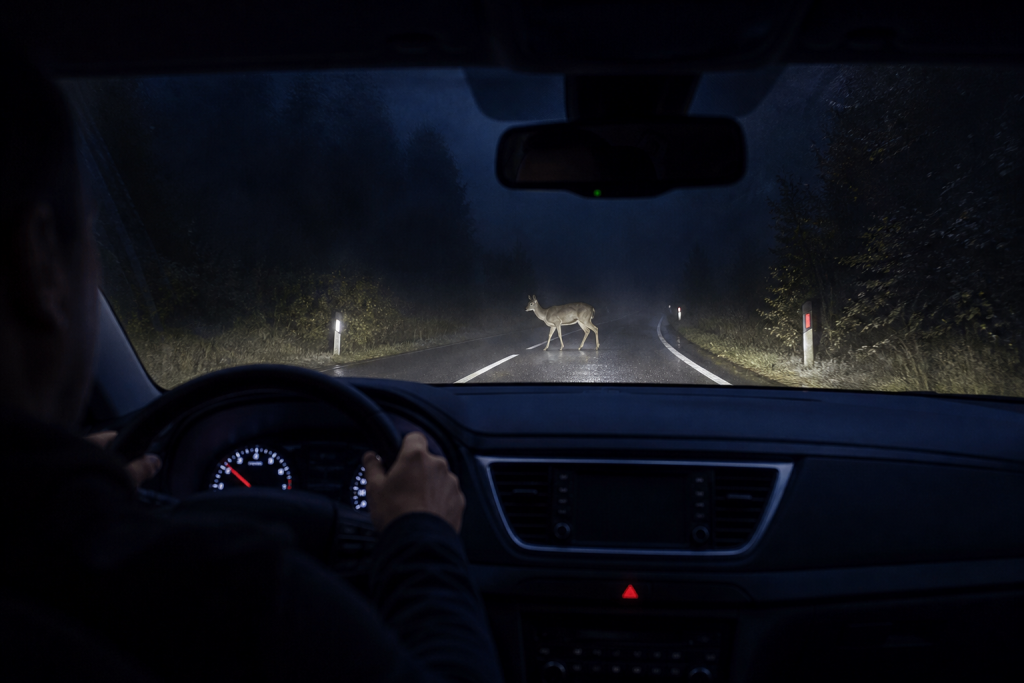
A vehicle thermal night vision system uses a thermal camera to detect differences in infrared radiation, commonly experienced as differences in heat. Its processor converts that information into a visible image displayed inside the vehicle.
Unlike an ordinary camera, a thermal imaging system does not depend entirely on visible light. A person or warm animal may therefore stand out against cooler surroundings even when the road is poorly lit. That distinction can be especially useful on dark rural routes, at unlit crossings, or around the edges of wooded roads.
Some systems provide only a thermal video feed. More advanced models use software to recognize or highlight potential hazards such as pedestrians, animals, and vehicles. They may also produce visual or audible warnings.
Thermal night vision is not the same as a traditional low-light camera. Low-light and near-infrared cameras amplify available light or use infrared illumination to create a familiar-looking scene. Thermal cameras visualize heat patterns instead. Each technology has advantages, but thermal imaging is often selected because warm road users can remain visible without conventional illumination.
Who Is Most Likely to Benefit?
Not every driver needs an aftermarket thermal camera. The purchase makes the most sense when the driver’s routine repeatedly includes conditions in which visible-light information is limited.
Rural and Remote-Road Drivers
Rural roads may combine poor lighting, higher travel speeds, narrow shoulders, wildlife activity, and limited separation between traffic and roadside areas. A thermal view can help the driver notice a warm shape near the road before its identity becomes obvious through the windshield.
That extra awareness can be useful, but it should not encourage higher speeds. On an unfamiliar or narrow road, speed must still reflect the visible stopping distance, surface conditions, and likelihood of animals or pedestrians entering the lane.
Commuters Who Regularly Drive Before Dawn or After Dark
Night-shift employees, early commuters, and delivery drivers may spend more time in darkness than occasional nighttime motorists. For these users, display ergonomics and alert quality are particularly important. A system that is tolerable for a short journey may become distracting or tiring during daily use.
Families and Long-Distance Travelers
A thermal system can be a practical safety-related upgrade for households that take frequent overnight trips. Long journeys can include unfamiliar interchanges, unlit rest areas, roadworks, and dark stretches between towns.
The technology does not address fatigue, however. A driver who is struggling to remain alert should stop safely and rest rather than depend on a warning system.
Drivers in Areas With Frequent Poor Visibility
Thermal imaging may preserve useful contrast in some darkness, haze, glare, or adverse-weather situations where a visible-light camera struggles. Performance can still deteriorate in heavy rain, dense fog, snow, spray, or when thermal contrast between an object and its surroundings is weak.
Treat poor-weather capability as a qualified benefit, not permission to continue at a speed that exceeds the conditions.
The Features That Deserve the Most Attention
Product pages often present a long list of specifications. For an everyday buyer, the following factors have the greatest influence on whether a system will be useful in actual traffic.
1. Detection Range Must Be Meaningful at Road Speed
A long detection range sounds reassuring, but the headline number needs context. Ask what the quoted figure refers to: detecting an unspecified warm object, recognizing a pedestrian, or reliably classifying a particular hazard.
Detection means that the sensor notices something. Recognition means the software or driver can identify its general category. These are not interchangeable capabilities.
Speed also changes the value of distance. At urban speeds, a moderate warning distance may provide useful additional awareness. On a highway, the vehicle covers the same distance much faster. The driver still needs time to notice the warning, interpret it, check surrounding traffic, and respond progressively.
When comparing products, look for clear answers to these questions:
- What can the system detect at the advertised maximum range?
- At what distance can it recognize pedestrians or animals?
- Does range decline significantly in rain, fog, or snow?
- Is the figure measured in favorable conditions?
- Does the warning arrive early enough to be useful at typical driving speeds?
Be cautious when a seller provides one impressive distance without explaining the target or conditions.
2. Hazard Recognition Is More Useful Than Raw Video Alone
A basic thermal feed makes heat differences visible, but the driver must repeatedly look at the screen and interpret the image. Recognition software can reduce that workload by marking a pedestrian, animal, or vehicle and drawing attention to a potential conflict.
For everyday road use, classification should be easy to understand at a glance. A bounding box, distinct symbol, or restrained color cue can be more useful than an interface crowded with labels.
False alerts matter as much as successful detections. Frequent warnings for roadside signs, exhaust systems, trees, or harmless objects can teach the driver to ignore the system. Conversely, software may miss a hazard because it is partly hidden, unusually positioned, thermally similar to its surroundings, or outside the camera’s field of view.
Look for adjustable alert settings, but avoid configurations that require extensive interaction while driving.
3. Real-Time Alerts Need to Be Timely and Controlled
An effective alert tells the driver that attention is needed without causing confusion or panic. Visual highlighting helps identify the hazard’s location, while an audible warning can prompt a driver who is looking at the road rather than the display.
Alert timing is crucial. A warning that arrives too late adds little value. One that sounds for every distant warm object becomes a distraction. Products should ideally distinguish between an object merely being present and one that may be relevant to the vehicle’s path.
Consider whether the system offers:
- Visual hazard highlighting
- Audible warnings with adjustable volume
- Sensitivity or warning-distance controls
- Different indicators for pedestrians, animals, and vehicles
- An easy way to mute unnecessary audio
- Settings that remain stored after restarting the vehicle
Alerts support decision-making; they should not command abrupt steering or braking. The driver must verify the road situation before responding.
4. Display Quality Is About Legibility, Not Just Size
A larger screen can make hazards easier to interpret, but size is only one part of display quality. Placement, brightness, contrast, viewing angle, and interface design all influence whether the display is useful.
The screen should be visible with a brief glance while remaining outside the primary view of the road. It must not block the windshield, mirrors, instruments, or airbag deployment zones. At night, excessive brightness can reduce dark adaptation and make the windshield view harder to read.
A good display should offer:
- Automatic or easily adjustable brightness
- Clear imagery without excessive visual effects
- Large, simple warning symbols
- A viewing angle suitable for the driver’s position
- Minimal menu interaction during a journey
- A stable mount that does not shake or move
Check the physical dimensions rather than judging from promotional images. A screen that looks compact on a product page may be intrusive on a small dashboard.
5. Frame Rate and Latency Affect Trust
Frame rate describes how frequently the displayed image updates. A smoother feed generally makes moving people, animals, and vehicles easier to track. Low frame rates may produce a visibly stepped or delayed image.
Latency is the delay between the camera seeing an event and the screen or alert presenting it. Even a high-resolution image is less useful if it arrives noticeably late. Unfortunately, latency is not always listed clearly, so buyers should look for transparent documentation about real-time processing and video performance.
Resolution also matters, but it should not be considered alone. A balanced system with adequate thermal resolution, smooth refresh, low latency, and effective processing can be more practical than one promoted mainly through a single large resolution number.
6. Field of View Must Match the Driving Environment
A wide field of view covers more roadside area and may help reveal pedestrians or animals approaching from the sides. The trade-off is that distant objects appear smaller. A narrower view can show more detail farther ahead but may miss activity near the road edges.
Drivers who mainly use winding rural roads may favor broader situational coverage. Those traveling on straighter, faster roads may place more emphasis on forward distance. The camera’s mounting position also changes the usable view, so installation instructions should be reviewed before purchase.
No single forward-facing camera sees every hazard. Curves, hills, parked vehicles, vegetation, and other obstructions can hide objects regardless of the sensor’s quality.
7. Weather Resistance Matters Outside the Cabin
The camera sits in a difficult environment. It may face rain, snow, road salt, dust, insects, vibration, heat, freezing temperatures, and pressure from washing. A stated ingress-protection rating is useful, but buyers should also examine the recommended operating-temperature range and installation method.
The lens must remain clean. Mud, ice, packed snow, or road film can degrade the image even when the camera housing itself is waterproof. Choose a location that offers a clear view and reasonable access for inspection and cleaning.
A recessed installation may provide physical protection but can restrict the field of view. A fully exposed mount may see more of the road but face greater impact and contamination risk. The best position depends on the vehicle’s grille, bumper, license-plate area, and local mounting rules.
8. Installation Quality Can Determine System Performance
A capable camera can perform poorly if mounted at the wrong height, pointed at the hood, offset from the vehicle’s direction of travel, or connected to an unstable power source.
Before buying, determine whether the package includes the required camera mount, display bracket, wiring, connectors, fuses, and calibration instructions. Check cable lengths against the intended route through the engine compartment and cabin.
Professional installation may be sensible when the job involves:
- Routing cables through the firewall
- Removing interior or exterior trim
- Making weatherproof electrical connections
- Connecting to ignition-switched power
- Working near airbags or vehicle control modules
- Aligning and calibrating recognition zones
A qualified installer should protect existing wiring, avoid water-entry points, use appropriate circuit protection, and leave serviceable connections. Buyers should also consider whether installation could affect vehicle warranty coverage or conflict with lease terms.
9. Recording and Storage Are Secondary but Useful
Some thermal night vision products can record real-time video. This may be useful for reviewing how the system behaved or retaining footage of a road event. It does not automatically replace a conventional dash camera, which may capture license plates, traffic signals, lane markings, and colors more clearly.
If recording matters, check:
- Whether storage is included or purchased separately
- Supported memory-card capacity and format
- Loop-recording behavior
- File length and overwrite settings
- Whether thermal detections appear in the saved video
- How footage is exported
- Whether time and date remain accurate
Privacy and recording laws differ by location. Drivers should understand applicable requirements, especially when audio, passengers, employees, or cross-border travel are involved.
A Relevant Example of an Aftermarket System
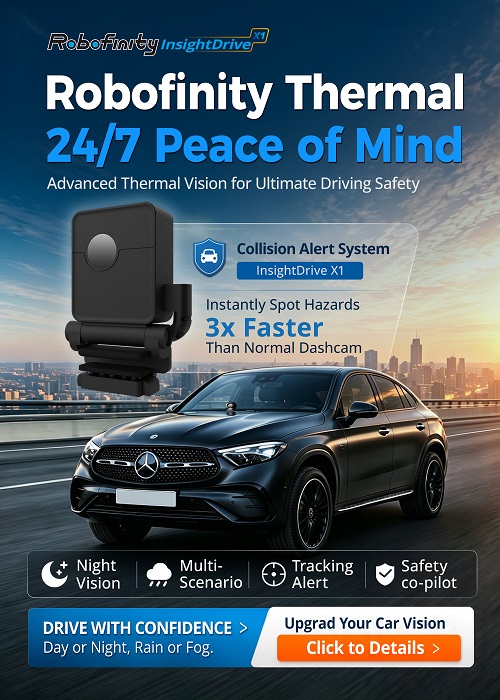
Robofinity InsightDrive illustrates how this product category can combine thermal sensing with software-assisted road awareness. It uses AI-powered thermal imaging to recognize pedestrians, animals, and vehicles and provide real-time alerts, with a stated detection range of up to 200 meters or 656 feet. Those capabilities should still be assessed in the context of mounting, conditions, alert behavior, display placement, and the driver’s normal routes rather than treated as a guarantee that every hazard will be detected.
What Thermal Night Vision Cannot Do
The most trustworthy buying decision begins with clear limits. Thermal night vision extends one type of awareness; it does not make the vehicle autonomous or remove the physical constraints of driving.
It Does Not Replace Headlights
Headlights illuminate lane markings, signs, road surfaces, debris, and many cold objects that may not stand out in a thermal image. They are also legally required in relevant conditions. Thermal vision and properly maintained headlights perform different jobs.
It Cannot See Through Everything
Thermal cameras generally do not provide a useful view through solid barriers. Ordinary glass can also obstruct long-wave thermal imaging, which is one reason external camera mounting is common. Dense rain, fog, snow, dirt, ice, and spray may reduce useful range or image clarity.
It Does Not Guarantee Correct Classification
Recognition software can make mistakes. A person may be partially hidden behind a parked car. An animal may be too small or distant to classify. A warm mechanical object might trigger an alert. Drivers must treat alerts as prompts to observe, not as infallible conclusions.
It Cannot Overcome Insufficient Braking Distance
Early detection is valuable only when the driver has time and space to respond. Wet pavement, ice, worn tires, steep grades, vehicle load, speed, and reaction time all affect stopping distance. No display changes those factors.
It Should Not Become a Second Road to Watch
Staring at the thermal screen creates a new risk. The windshield view remains primary. The system should be configured so warnings convey useful information with brief glances rather than continuous monitoring.
A Practical Buyer Decision Framework
A simple route-based framework helps separate useful features from attractive specifications.
Step 1: Define the Recurring Problem
Write down the situations that prompted the purchase. Examples include animals on unlit rural roads, pedestrians near poorly illuminated crossings, frequent overnight motorway journeys, or glare that makes low-contrast hazards difficult to identify.
If the concern occurs only occasionally, improved headlight maintenance, an eye examination, reduced nighttime travel, or slower route planning may provide greater value.
Step 2: Rank Detection Priorities
Decide whether pedestrian recognition, animal detection, vehicle recognition, roadside coverage, or long forward range matters most. A city commuter and a rural driver should not automatically choose the same setup.
Step 3: Check Vehicle Compatibility
Measure the intended display area and inspect possible camera locations. Confirm voltage requirements, cable routing, startup behavior, and whether the system is suitable for the vehicle type.
Also check whether the camera or display could interfere with parking sensors, radar modules, active grille shutters, cooling airflow, license plates, or windshield visibility.
Step 4: Evaluate Information Quality
Prefer documentation that distinguishes detection from recognition and explains warning behavior. Product videos can help illustrate the interface, but nighttime demonstrations should not be treated as universal performance evidence unless their conditions are clearly described.
Step 5: Calculate the Installed Cost
The purchase price may not represent the total ownership cost. Include professional installation, mounting hardware, storage cards, replacement brackets, cable work, software access where applicable, and future removal or transfer to another vehicle.
Step 6: Review Return and Support Terms
A thermal system may fit physically yet prove unsuitable because of display glare, camera placement, excessive alerts, or poor compatibility with the vehicle. Verify the applicable return process, technical support channel, documentation, and warranty terms before installation, especially if fitting requires permanent modifications.
Comparing Common Product Types
Thermal Display-Only Systems
These systems provide a live thermal image without sophisticated classification.
Advantages: They may be simpler, less intrusive, and useful to drivers comfortable interpreting thermal scenes.
Limitations: The driver must monitor and understand the image. There may be no automatic warning when a hazard appears.
Thermal Systems With Recognition and Alerts
These products analyze the image and highlight selected road users or hazards.
Advantages: They can reduce interpretation time and direct attention toward relevant objects.
Limitations: Detection algorithms can generate false alerts or miss targets. Software behavior and update support become important ownership considerations.
Visible-Light or Near-Infrared Night Cameras
These systems often produce a more familiar view of the roadway.
Advantages: Road layout, signs, and object details may be easier to interpret under suitable conditions.
Limitations: Their performance depends more heavily on available light or active illumination, and glare or darkness can affect results differently from thermal imaging.
The right choice depends on the problem being solved. Thermal imaging is particularly relevant when identifying living road users by heat contrast is a priority. A conventional dash camera remains more appropriate when recording visible details is the main goal.
Installation and Ownership Checklist
Before placing an order, confirm the following:
- The advertised range is explained by target type and conditions.
- Recognition categories match the hazards common on your routes.
- Alerts are understandable and adjustable.
- Display brightness works for nighttime use.
- The screen fits without blocking the road, instruments, or airbags.
- Video appears smooth and has no obvious processing delay.
- The camera’s field of view suits rural, city, or highway driving.
- The exterior unit has appropriate environmental protection.
- Installation hardware and cables are included or readily available.
- The system can be installed without interfering with other sensors.
- Lens cleaning and inspection are straightforward.
- Recording features, storage requirements, and privacy considerations are clear.
- Support, return, software, and warranty terms have been reviewed.
- The total installed price makes sense relative to how often the feature will be used.
Safe Use After Installation
Begin by learning the display and alerts while parked. Set brightness, warning volume, and sensitivity before entering traffic. Avoid navigating menus on the move.
During the first few nighttime journeys, use familiar roads and note whether the camera alignment matches the vehicle’s actual path. If alert zones appear offset or warnings are consistently unhelpful, have the mounting and calibration checked.
Inspect the external lens regularly, especially after driving through road salt, mud, snow, or insect-heavy conditions. Clean it according to the manufacturer’s instructions to avoid scratching or damaging the thermal window.
Continue using low and high beams correctly, keep the windshield clean, maintain tires and brakes, and reduce speed when visibility or grip deteriorates. Thermal night vision is one layer of driver-assistance technology, not a substitute for attentive driving.
Frequently Asked Questions
Is thermal night vision useful in complete darkness?
Yes. A thermal camera detects infrared radiation rather than relying entirely on visible light, so it can produce an image in complete darkness. Its ability to identify a hazard still depends on thermal contrast, distance, obstruction, sensor performance, and image processing.
Can vehicle thermal imaging see through fog or rain?
It may retain useful contrast in some fog, rain, glare, or spray, but it cannot see clearly through every poor-visibility condition. Dense fog, heavy precipitation, snow, water on the lens, and weak thermal contrast can reduce performance. Drivers should always lower speed to suit visibility.
Is pedestrian detection the same as pedestrian recognition?
Not necessarily. Detection may mean the sensor notices an object or heat signature. Recognition means the system classifies it as a pedestrian. Buyers should check how the manufacturer defines each term and at what distance classification is expected.
Can I install a thermal night vision system myself?
Some kits are intended for straightforward aftermarket installation, but the job may require exterior mounting, firewall cable routing, fused power connections, and camera alignment. Professional installation is prudent when vehicle trim, airbags, control modules, or complex wiring are involved.
Does a thermal night vision system replace a dash camera?
Usually not. A thermal camera excels at displaying heat contrast, while a visible-light dash camera is generally better for recording colors, lane markings, signs, and other conventional scene details. A system with thermal recording can complement a dash camera without performing exactly the same role.
Is thermal night vision worth the cost for city driving?
It depends on the route and schedule. Drivers who regularly encounter dark crossings, unlit streets, cyclists, or pedestrians at night may find it useful. Those who mainly drive on well-lit roads at lower speeds may receive less practical benefit than rural or frequent overnight drivers.
Making a Sensible Final Choice
The best thermal night vision system is not automatically the one with the longest range, largest display, or most recognition labels. It is the one that addresses hazards common to the driver’s routes, presents timely information without distraction, fits the vehicle correctly, and remains usable in day-to-day ownership.
Start with detection and recognition performance, then assess alerts, latency, field of view, display placement, durability, and installation. Read maximum-range claims carefully and budget for the complete installation rather than the hardware alone. Above all, regard thermal imaging as an additional source of road awareness. Safe speed, sound headlights, clear glass, adequate following distance, maintained tires and brakes, and continuous driver attention remain the foundation of nighttime road safety.