


Factory vs Aftermarket Night Vision camera choices affect more than performance—they change integration, cost, and how seamlessly the system fits your day-to-day driving. If you’re trying to decide between factory-installed night vision and an aftermarket upgrade, this guide breaks down the trade-offs so you can choose with confidence.
- What a Car Night Vision Camera Does
- Factory-Installed Night Vision Systems
- Aftermarket Night Vision Systems
- Factory vs Aftermarket Night Vision. Aftermarket: The Main Trade-Offs
- Integration and appearance
- Cost
- Reliability and servicing
- Upgrade flexibility
- Display and driver workload
- Which Drivers May Prefer Factory Installation?
- Which Drivers May Prefer an Aftermarket System?
- What to Check Before Buying an Aftermarket Camera
- Camera performance
- Detection distance and field of view
- Alert design
- Installation quality
- Weather protection and maintenance
- Situations Where Night Vision Can Help
- Rural roads and wildlife
- Pedestrians in low-light conditions
- Fog, rain, and glare
- Long-distance driving
- When Night Vision May Not Be Worth the Cost
- A Practical Decision Framework
- FAQ
- Is factory-installed night vision always better than aftermarket equipment?
- Can an aftermarket night vision camera replace headlights?
- Does thermal imaging work in fog and rain?
- Is professional installation necessary?
- Who benefits most from a vehicle night vision system?
- Should night vision influence which car I buy?
- Conclusion
- What a Car Night Vision Camera Does
- Factory-Installed Night Vision Systems
- Aftermarket Night Vision Systems
- Factory vs Aftermarket Night Vision. Aftermarket: The Main Trade-Offs
- Which Drivers May Prefer Factory Installation?
- Which Drivers May Prefer an Aftermarket System?
- What to Check Before Buying an Aftermarket Camera
- Situations Where Night Vision Can Help
- When Night Vision May Not Be Worth the Cost
- A Practical Decision Framework
- FAQ
- Conclusion
What a Car Night Vision Camera Does

Automotive night vision systems are designed to help drivers identify objects or road users that may be difficult to see with ordinary headlights alone. Depending on the technology, a system may use infrared illumination, thermal imaging, or another low-light camera method.
A conventional camera records reflected light. A thermal imaging system detects heat differences, allowing it to identify warm objects such as people, animals, and vehicles even when visible-light conditions are poor. This can be useful in darkness, fog, rain, snow, or situations involving headlight glare.
A night vision display may show:
- Pedestrians near or beyond the brightest part of the headlight beam
- Animals approaching or crossing the road
- Vehicles, cyclists, or roadside obstacles
- Objects partially hidden by darkness or poor contrast
- Hazards on unlit roads and narrow rural routes
Some systems simply display a live image. More advanced driver-assistance technology may also provide visual or audible alerts when it recognizes a potential hazard. The purpose is not to drive the car or make braking decisions automatically. It is to give the driver another source of information.
Factory-Installed Night Vision Systems
A factory-installed system is designed by the vehicle manufacturer or integrated into the vehicle during production. It may be included as standard equipment, part of a trim level, or an optional package.
More EV News

Advantages of factory installation
The most obvious benefit is integration. A factory system is typically designed around the vehicle’s electrical architecture, dashboard layout, instrument display, and existing driver-assistance features. The camera may be placed behind the grille or in another protected area with a purpose-built mounting point.
Other potential benefits include:
- A more finished appearance
- Better integration with the vehicle’s central display or instrument cluster
- Fewer visible wires and add-on components
- Compatibility with the vehicle’s software and warning systems
- Installation completed before delivery
- A design intended to match the vehicle’s sensors and control systems
A factory system may also be easier to use because the driver does not need to manage a separate screen, power cable, or aftermarket control unit. If the night vision feed appears within the normal instrument display, the information may feel more natural during driving.
The installation process can also be less disruptive. There is no need to remove trim panels, route cables through the cabin, or find a suitable location for an additional screen.
Limitations of factory installation
Factory availability is often limited. Many vehicles do not offer night vision, and the feature may only be available on certain models or higher equipment levels. Buyers may have to choose a more expensive trim or purchase a vehicle they would not otherwise consider.
A factory system can also increase the cost of ownership if a specialized camera, control module, or display component fails outside the vehicle’s coverage period. Repairs may require manufacturer-specific diagnostics and parts.
Another limitation is that factory systems are tied to the vehicle. If you sell the car, the feature remains with it. It cannot normally be transferred to another vehicle, even if your next car lacks similar technology.
Factory integration does not automatically mean the system is more useful in every situation. A well-integrated system with limited detection capability or an inconvenient display may be less valuable than a carefully selected aftermarket unit that is better suited to the driver’s needs.
Aftermarket Night Vision Systems
An aftermarket night vision camera is installed after the vehicle leaves the factory. These systems are available for a wider range of cars, including older models and vehicles that were never offered with built-in night vision.
Depending on the design, an aftermarket setup may include a forward-facing camera, a control module, a display, mounting hardware, and wiring. Some systems use a dedicated screen, while others may connect to an existing display when compatibility allows.
Advantages of aftermarket installation
The biggest advantage is flexibility. Drivers can add night vision to a vehicle they already own instead of replacing it. This may be especially practical when the car is mechanically reliable but lacks newer safety and awareness features.
Aftermarket equipment can also be selected according to actual driving conditions. A driver who frequently travels through rural areas may prioritize long-distance hazard visibility. Someone who mainly drives in a city may care more about compact installation, a discreet display, and minimal distraction.
Potential advantages include:
- Lower initial cost than replacing a vehicle
- Availability for older or lower-trim vehicles
- Choice of camera type and display arrangement
- Ability to upgrade only the feature that is needed
- Transfer potential in some installation designs
- More control over where the display is mounted
Aftermarket systems may also offer features that are not available on a particular vehicle. For example, a thermal imaging system can provide a different type of information from the vehicle’s standard reversing camera or low-light dashboard camera.
Limitations of aftermarket installation
The quality of an aftermarket installation depends heavily on the equipment and the installer. A poorly positioned camera may have an obstructed view, inaccurate alignment, or excessive exposure to dirt and road spray. Poorly routed wiring can create reliability problems or unwanted cabin noise.
The display is another important concern. If it is mounted too low, too high, or far from the driver’s normal sightline, the system may create distraction rather than improve awareness. A separate screen can also add visual clutter to an otherwise clean dashboard.
Compatibility must be checked carefully. Important questions include:
- Can the vehicle’s electrical system safely support the equipment?
- Does the system require a switched power source?
- Is the display compatible with the vehicle’s existing screen?
- Will installation interfere with airbags, trim, or other wiring?
- Can the camera be mounted without blocking sensors or airflow?
- Does the system need calibration after installation?
- Can the camera withstand water, dust, vibration, and temperature changes?
An aftermarket system may also have limited integration with the vehicle’s existing warning functions. It might show a thermal image but not communicate with the car’s braking, steering, or factory collision-warning systems. This is not necessarily a defect, but buyers should understand the difference between an awareness aid and a fully integrated driver-assistance feature.
Factory vs Aftermarket Night Vision. Aftermarket: The Main Trade-Offs
The decision becomes clearer when the two approaches are compared across the factors that matter in everyday ownership.
Integration and appearance
Factory installation generally wins for dashboard integration, software compatibility, and appearance. Controls and displays are usually designed as part of the vehicle rather than added later.
Aftermarket installation can still look professional, particularly when the camera is discreetly mounted and the display is positioned carefully. However, the result varies according to the vehicle, equipment, and installer.
Cost
Factory night vision may require buying a higher trim level or adding an expensive package. Its cost is part of the vehicle purchase, whether or not the driver uses the feature regularly.
Aftermarket systems may offer a lower-cost route for existing vehicle owners. However, the total price includes the camera, display, wiring, installation, possible calibration, and future maintenance. Comparing only the advertised hardware price can lead to an unrealistic budget.
Reliability and servicing
A factory system benefits from vehicle-specific engineering and standardized service procedures. If the system fails, the manufacturer’s service network may be familiar with its components.
Aftermarket reliability depends on product quality, environmental protection, installation workmanship, and long-term parts support. A system that works well in a garage may perform differently after repeated exposure to rain, road salt, dust, heat, and vibration.
Upgrade flexibility
Aftermarket systems are more flexible for owners who want to improve an existing vehicle. They can also be replaced or upgraded independently of the car.
Factory systems provide less flexibility after purchase. If the feature is not installed from the beginning, retrofitting it later may be difficult or uneconomical.
Display and driver workload
A factory system may use the vehicle’s existing screen or instrument cluster, reducing the number of displays in front of the driver. An aftermarket system may require a dedicated monitor, which can be useful but must be installed in a safe, legally compliant, and non-distracting position.
In either case, the driver should be able to understand the image quickly. A complicated interface, excessive alerts, or an unclear display can reduce the practical value of the technology.
If you drive in harsh weather, it’s also worth checking how the image holds up in real conditions. See Car Night Vision Systems in Rain: What Drivers Should Know for practical expectations.
Which Drivers May Prefer Factory Installation?
Factory-installed night vision may be the better choice for drivers who are already shopping for a new vehicle and want a fully integrated safety package. It may also suit buyers who prefer manufacturer-supported equipment, a clean interior, and minimal aftermarket modification.
It can be particularly attractive when:
- The feature is included without requiring an excessive package upgrade
- The vehicle already has a well-designed driver display
- The buyer plans to keep the car for many years
- The car is used regularly on unlit roads
- The owner values centralized servicing
- The system works alongside other factory safety features
For a new-car buyer, it is important to test the system before committing. Ask where the image appears, whether the display is available at normal driving speeds, how alerts are presented, and whether the system operates in the conditions you experience most often.
Which Drivers May Prefer an Aftermarket System?
An aftermarket camera may be more suitable for an owner who likes their current vehicle but wants additional road awareness. It can be a sensible option for drivers who do not want to take on a new-car payment simply to obtain one feature.
It may fit drivers who:
- Frequently drive at night or before sunrise
- Travel on roads with limited street lighting
- Encounter wildlife on rural routes
- Own an older vehicle with strong mechanical condition
- Want to add one safety feature rather than replace the whole car
- Need a system suited to a specific use case
For example, a family using an older SUV for weekend trips may value a forward-facing thermal camera on dark country roads. A commuter who drives almost entirely in brightly lit urban areas may see less benefit and may prefer to spend money on tires, lighting maintenance, or other safety priorities.
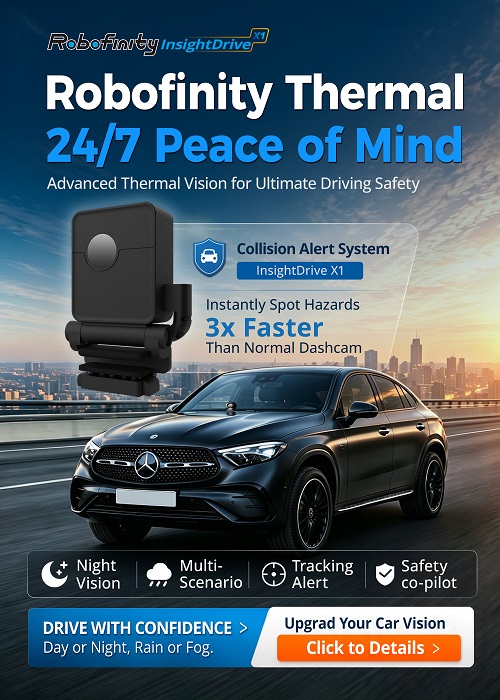
Advanced safety is not limited to factory equipment. Drivers who regularly face darkness, rural roads, or poor visibility may consider aftermarket systems such as Robofinity InsightDrive, a vehicle thermal imaging night vision solution intended to support awareness of pedestrians, animals, vehicles, and obstacles in low-light conditions.
Related upgrade guidance is covered in Aftermarket Thermal Night Vision: Best Must-Have Vehicle Upgrade.
What to Check Before Buying an Aftermarket Camera
A careful inspection of the system is more important than choosing based on appearance or a long feature list.
Camera performance
Find out whether the camera uses thermal imaging, infrared, or a conventional low-light sensor. These technologies behave differently. Thermal imaging can highlight heat-producing objects, but it may not provide the same visual detail as a normal camera. A conventional camera may show road markings and signs more naturally but lose useful detail in darkness.
Ask how the camera performs in:
- Complete darkness
- Rain and fog
- Snow or road spray
- Headlight glare
- Dirty or wet conditions
- Curved roads and elevation changes
No camera sees through every obstruction. Dense vegetation, walls, parked vehicles, and heavy precipitation can still block or reduce useful information.
Detection distance and field of view
A longer detection range is not automatically better if the display is difficult to interpret or the field of view is narrow. Buyers should consider whether the camera shows enough of the road ahead and whether detected objects can be identified with sufficient time to respond safely.
The system should complement, not replace, headlights. Drivers still need to look through the windshield and judge distance, speed, lane position, and road conditions using normal visual information.
Alert design
Alerts should be clear and proportionate. A system that warns about every warm object or roadside movement may create frequent false alerts. A system that provides too few warnings may fail to attract attention when it matters.
Check whether alerts are visual, audible, or both. Also determine whether the driver can adjust their volume, sensitivity, or display behavior without creating a distraction.
Installation quality
The camera should be mounted securely, aligned with the road, and positioned where it can be cleaned easily. Wiring should not interfere with airbags, pedals, steering components, or visibility.
Professional installation may be worthwhile if the system requires trim removal, electrical integration, calibration, or a permanent camera mount. Even a technically good camera can perform poorly when installed at the wrong angle.
Weather protection and maintenance
A forward-facing camera is exposed to water, mud, insects, dust, salt, and stones. Look for clear information about its environmental protection and cleaning requirements. The lens should be accessible without damaging the mount.
Maintenance is usually simple but important:
- Keep the lens clean
- Inspect the mount after rough-road driving
- Check wiring for damage
- Confirm that the display remains secure
- Test alerts periodically
- Review the image after seasonal weather changes
Situations Where Night Vision Can Help
Night vision is most useful when it adds information that the driver may otherwise receive too late or not at all. In a factory vs aftermarket night vision comparison, the benefit depends on whether the system matches the conditions you actually face.
Rural roads and wildlife
Unlit rural roads can contain animals near the shoulder or in fields beside the roadway. Thermal imaging may help draw attention to a warm object before it enters the headlight beam. The driver must still reduce speed appropriately and avoid sudden, unsafe maneuvers.
Pedestrians in low-light conditions
A pedestrian wearing dark clothing may blend into the background, particularly on roads without sidewalks. A night vision display or alert can provide another indication that something is ahead, but the driver must confirm the situation visually and be prepared to stop.
Fog, rain, and glare
Visible-light cameras can struggle when contrast is low or glare is strong. Thermal systems may offer useful contrast in some poor-visibility conditions, although weather can affect every sensor. The driver should treat the system as an aid, not as permission to maintain normal speed in hazardous conditions.
Long-distance driving
Drivers on long nighttime trips may benefit from an additional awareness tool, especially when fatigue, changing light levels, and unfamiliar roads make hazards harder to notice. However, no electronic system compensates for fatigue. Rest breaks and appropriate speed remain essential.
When Night Vision May Not Be Worth the Cost
A night vision camera is not equally valuable for every driver. In many factory vs aftermarket night vision scenarios, the biggest deciding factor is frequency—how often you drive where low visibility is truly a problem.
It may offer limited benefit when most journeys take place in well-lit urban areas, at low speeds, or in conditions where the driver already has excellent visibility.
The feature may also be a lower priority if the vehicle needs more fundamental safety improvements. Good tires, properly adjusted headlights, clean windshield glass, working mirrors, functioning brakes, and reliable wipers usually deserve attention first.
The technology may be less useful when:
- The driver rarely travels at night
- The display is difficult to see or interpret
- The camera is frequently covered by dirt or spray
- Alerts are confusing or excessive
- Installation would compromise the vehicle’s interior or wiring
- The total cost approaches the value of replacing the vehicle with one that includes broader safety technology
A Practical Decision Framework
Use the following questions to make the choice more objectively:
-
How often do you drive in darkness?
Occasional night driving may not justify a major upgrade, while daily low-light travel may make factory vs aftermarket night vision upgrades more practical. -
What hazards are common on your routes?
Wildlife, pedestrians, cyclists, fog, and unlit roads create different needs. -
Are you buying a car or keeping your current one?
Factory installation is easier to consider during a new-vehicle purchase. Aftermarket equipment is more relevant when keeping an existing car. -
How important is integration?
If a clean dashboard and centralized controls matter most, factory equipment has an advantage. -
Can the aftermarket system be installed correctly?
A professional assessment should cover mounting, power, display location, sensor interference, and calibration. -
What other safety features does the vehicle have?
Night vision should be evaluated as one part of the vehicle’s safety equipment, not as a substitute for headlights, mirrors, braking systems, or collision avoidance functions. -
Will you use the information responsibly?
The system is valuable only if the driver checks the road, interprets alerts correctly, and leaves enough time and distance to respond.
FAQ
Is factory-installed night vision always better than aftermarket equipment?
No. Factory systems usually offer better integration and appearance, but an aftermarket system may be more practical for an existing vehicle or a specific driving environment. Performance depends on the camera technology, display, installation, and alert design.
Can an aftermarket night vision camera replace headlights?
No. Night vision is a driver-assistance tool. It does not replace headlights, windshield visibility, mirrors, road signs, or the driver’s responsibility to follow speed and lighting laws.
Does thermal imaging work in fog and rain?
Thermal imaging can provide useful heat-based contrast in some poor-visibility conditions, but heavy rain, dense fog, snow, dirt, and physical obstructions can still reduce performance. Drivers should always adjust speed to the conditions.
Is professional installation necessary?
It depends on the system and the vehicle. Professional installation is advisable when wiring, trim removal, permanent mounting, calibration, or integration with existing displays is involved. Incorrect installation can affect reliability and driver safety.
Who benefits most from a vehicle night vision system?
Drivers who frequently travel on dark rural roads, encounter wildlife, drive long distances at night, or regularly face poor visibility may see the greatest practical benefit. Drivers who stay mainly on well-lit urban roads may place a lower priority on it.
Should night vision influence which car I buy?
It can be one consideration, but it should not outweigh basic safety, reliability, tire condition, braking performance, visibility, and the overall suitability of the vehicle. Compare the complete safety package rather than focusing on one feature.
Conclusion
In a factory vs aftermarket night vision decision, factory-installed systems typically deliver seamless integration, a cleaner appearance, and manufacturer-supported compatibility. Aftermarket equipment typically delivers more flexibility and can add useful awareness to a vehicle that is otherwise worth keeping. The better choice comes down to your driving environment, budget, vehicle plans, tolerance for installation work, and realistic expectations about what the technology can do.
Before buying, consider the hazards you actually face rather than selecting the longest feature list. Confirm the camera type, detection behavior, display location, weather resistance, installation requirements, and maintenance needs. Most importantly, remember that night vision supports observation; it does not replace cautious speed, effective headlights, safe following distance, or active driver attention.
For background on how driver-assistance technologies are evaluated and used responsibly, see the U.S. National Highway Traffic Safety Administration (NHTSA) vehicle safety technology overview.