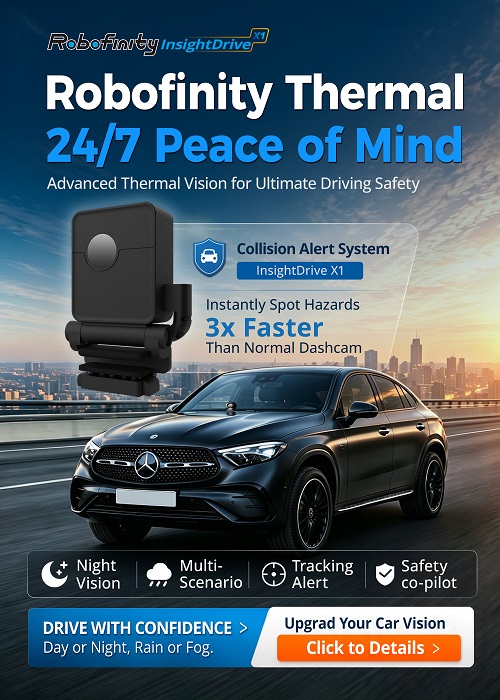



When night driving turns into a guessing game, SUV thermal night vision is one option drivers consider to improve awareness of people and hazards outside the normal headlight view. Because SUVs are used for everything from family commutes to rural road trips, it’s reasonable to ask whether automotive thermal night vision systems can add real safety value—or whether they’re simply another gadget. In most cases, the most honest answer is that thermal imaging can be useful as a supplemental awareness tool, not a replacement for headlights, safe speed, or the vehicle’s existing safety systems.
- What Is an Automotive Thermal Night Vision System?
- Why SUVs May Benefit More Than Some Other Vehicles
- SUVs are often used for varied driving
- A higher seating position does not remove blind spots
- SUVs frequently carry passengers and cargo
- How Thermal Night Vision Helps in Real Driving
- Dark rural roads
- Highway driving at night
- City streets and residential areas
- Fog, rain, snow, and glare
- Key Benefits for SUV Drivers
- Earlier awareness of vulnerable road users
- Better recognition of animals
- Additional information beyond the headlight beam
- Support for fatigue-prone driving situations
- Limitations and Trade-Offs
- It does not provide a normal road image
- It may not detect every hazard
- Alerts can be misunderstood
- Screens can create distraction
- Installation and maintenance matter
- Should Thermal Night Vision Be Factory-Installed or Added Later?
- A Practical Decision Framework for SUV Owners
- Consider how often you drive in darkness
- Identify the hazards you actually face
- Evaluate driving speed and road type
- Check the human-machine interface
- Compare the total ownership effort
- How to Use Thermal Night Vision Safely
- Keep headlights and windows in good condition
- Continue scanning normally
- Slow down when conditions deteriorate
- Treat alerts as prompts for verification
- Avoid using the system as a substitute for attention
- Common Mistakes When Choosing a System
- Assuming a longer detection distance always means better safety
- Focusing only on the camera
- Ignoring false alerts
- Treating thermal imaging as autonomous driving
- Frequently Asked Questions
- Is thermal night vision useful on every SUV?
- Can thermal night vision see through fog, rain, or snow?
- Can a thermal camera replace headlights?
- Does thermal night vision detect pedestrians and animals?
- Is an aftermarket system suitable for a family SUV?
- Is SUV thermal night vision worth the cost?
- Conclusion
- What Is an Automotive Thermal Night Vision System?
- Why SUVs May Benefit More Than Some Other Vehicles
- How Thermal Night Vision Helps in Real Driving
- Key Benefits for SUV Drivers
- Limitations and Trade-Offs
- Should Thermal Night Vision Be Factory-Installed or Added Later?
- A Practical Decision Framework for SUV Owners
- How to Use Thermal Night Vision Safely
- Common Mistakes When Choosing a System
- Frequently Asked Questions
- Conclusion
What Is an Automotive Thermal Night Vision System?

An automotive thermal night vision system uses an infrared camera to detect heat emitted by people, animals, vehicles, and other objects. Unlike a conventional camera, it does not depend entirely on visible light. This allows it to identify warm objects that may be difficult to see with the naked eye or through ordinary headlights.
A typical system may display a live thermal image on a dedicated screen or integrated vehicle display. Depending on the design, it may also identify likely pedestrians, animals, or vehicles and provide visual or audible alerts.
Thermal imaging is different from night vision based on image intensification. Traditional low-light cameras amplify available light, while thermal cameras detect differences in heat. This distinction matters because thermal imaging may remain useful in conditions where visible contrast is poor, such as:
- Unlit roads
- Dark roadside areas
- Headlight glare
- Light fog
- Rain or snow
- Dust or haze
- Animals standing near vegetation
- Pedestrians wearing dark clothing
The system does not “see through” every obstruction, and it cannot guarantee that every hazard will be detected. Its value comes from giving the driver another source of information alongside the windshield view, headlights, mirrors, radar, and other vehicle systems.
Why SUVs May Benefit More Than Some Other Vehicles
The case for SUV thermal night vision is not limited to SUVs, but several SUV characteristics make the technology especially relevant.
SUVs are often used for varied driving
Many SUVs serve as both family transport and long-distance vehicles. An owner may drive through busy urban traffic during the week, then use the same vehicle for rural roads, camping trips, or highway journeys at night. These changing environments create different visibility challenges.
A thermal display may be most helpful when the driver leaves a well-lit area and enters a road where the headlights illuminate only a limited distance ahead.
A higher seating position does not remove blind spots
SUV drivers generally sit higher than drivers in many passenger cars, which can improve the view over nearby traffic. However, height does not solve every visibility problem. The driver may still have difficulty noticing:
- A pedestrian outside the brightest part of the headlight beam
- A cyclist approaching from a dark roadside
- A deer or other animal near the shoulder
- A person crossing between parked vehicles
- A stopped vehicle beyond a bend
- A hazard partially hidden by rain, fog, or glare
The shape and size of an SUV can also create substantial front, rear, and side blind zones. Thermal imaging is not a substitute for checking those areas, but it can add useful forward-looking information.
SUVs frequently carry passengers and cargo
Family SUVs are often loaded with passengers, luggage, sports equipment, or recreational gear. Heavy cargo can affect the vehicle’s attitude and, in some cases, the effective reach of the headlights. SUV thermal night vision can provide a separate view of the area ahead, although the driver must still ensure that the headlights are correctly aimed and that the vehicle is not overloaded.
How Thermal Night Vision Helps in Real Driving
The usefulness of thermal imaging depends heavily on the driving environment. It is not equally valuable on every trip.
Dark rural roads
Rural roads are one of the clearest use cases. There may be little or no street lighting, narrow shoulders, winding lanes, and vegetation close to the pavement. Animals can approach the road with very little visual warning.
A thermal display may highlight a warm animal or person before the object becomes obvious in the headlight beam. This extra warning time could help a driver reduce speed, adjust lane position, or prepare to brake. It does not remove the need to drive at a speed appropriate for the road and stopping distance.
Highway driving at night
On highways, the main risks are often different. A driver may encounter a stopped vehicle, a person outside a disabled car, debris, or an animal near the road edge. High speeds reduce the time available to interpret any warning, so the system must be easy to read without distracting the driver.
Thermal night vision can support long-distance road awareness, but it should not encourage drivers to travel faster or stare at a screen instead of the road. A display is only helpful if it fits naturally into the driver’s normal scanning pattern.
City streets and residential areas
Urban roads contain more lighting, signage, parked vehicles, cyclists, and pedestrians. Thermal imaging may still help in situations where a person is outside the strongest headlight beam or partly hidden by visual clutter.
However, city environments can also create more false alerts and visual complexity. Warm objects such as parked vehicles, building exhaust, or groups of people may appear clearly on a thermal display without representing an immediate hazard. Drivers must interpret the information in context rather than react automatically to every highlighted object.
Fog, rain, snow, and glare
Poor visibility is a major reason drivers consider thermal technology. Rain can blur reflections, fog can reduce contrast, snow can obscure road edges, and glare can temporarily overwhelm the eyes. Thermal imaging may preserve useful heat contrast in some of these situations.
Its performance still varies with weather, camera quality, mounting position, lens condition, and the specific environment. Heavy precipitation or dense obstruction can limit what the camera detects. SUV thermal night vision should therefore be treated as supplemental support, not as a guarantee of clear vision.
Key Benefits for SUV Drivers
A well-designed thermal night vision system can offer several practical benefits for SUV drivers.
Earlier awareness of vulnerable road users
Pedestrians, cyclists, and roadside workers may be difficult to see when wearing dark clothing or standing outside the central headlight beam. Thermal contrast can help draw attention to their presence. With SUV thermal night vision, the additional heat-based view can be especially useful when contrast is low.
This can be particularly helpful on roads with poor lighting, near construction areas, or around parked vehicles. The driver still needs to verify the situation visually and respond according to traffic conditions.
Better recognition of animals
Animals often move unpredictably and may blend into the background at night. A thermal sensor can make their heat signature more visible than their fur or body color would be through a standard camera.
This feature may matter most for SUV owners who regularly drive near farmland, forests, open countryside, or roads with frequent wildlife crossings. The correct response is usually to reduce speed and remain prepared for additional animals, since wildlife may travel in groups.
Additional information beyond the headlight beam
Headlights are essential, but they illuminate a limited area and can be affected by road geometry, weather, glare, and vehicle speed. Thermal imaging may show a warm object against a darker background beyond the most visually obvious part of the beam.
That information can help the driver direct attention to a specific area. It does not mean the driver can safely ignore the road surface, lane markings, signs, or other traffic.
Support for fatigue-prone driving situations
Night driving over long distances can be mentally demanding. Thermal night vision can’t detect fatigue reliably or keep an inattentive driver safe, but it may help organize attention by highlighting potential objects in low-contrast areas—one of the reasons many owners look at SUV thermal night vision.
This benefit should be understood carefully. If a driver is tired, the correct solution is to stop and rest, not to rely on additional technology.
Limitations and Trade-Offs
Thermal night vision is useful in the right context, but it has important limitations that should influence a buying decision.
It does not provide a normal road image
A thermal image is not always intuitive. It may show heat sources with different brightness or color patterns than the driver expects from a conventional camera. Road markings, potholes, traffic signs, and non-heated objects may be less obvious or absent.
Drivers need time to become familiar with the display while stationary or in safe conditions. SUV thermal night vision should never be used in a way that requires the driver to study the screen instead of watching the road.
It may not detect every hazard
Thermal cameras identify heat differences, not every object equally well. A cold object, a road surface hazard, or an object blocked by another object may not stand out. Glass, dense vegetation, walls, and other materials can also limit detection.
Detection performance can vary with distance, weather, temperature differences, camera placement, and the movement of the vehicle. Marketing language should not be interpreted as a promise that every pedestrian, animal, or obstacle will be detected.
Alerts can be misunderstood
An alert indicates that the system has identified a possible object or pattern. It does not necessarily mean that a collision is imminent. Nor does the absence of an alert prove that the road is clear.
False positives and missed detections are possible with any sensor-based driver-assistance technology. The driver remains responsible for confirming hazards and making safe decisions.
Screens can create distraction
A poorly placed display or overly frequent alert can compete with the driver’s attention. Before selecting a system, consider whether the screen is visible without requiring a large head movement, whether alerts are understandable, and whether the interface can be adjusted.
The best technology is not necessarily the one with the most features. It is the one that provides useful information without adding unnecessary cognitive load—especially important for SUV thermal night vision, where drivers may already be managing more cargo and passenger activity.
Installation and maintenance matter
An aftermarket camera must be mounted securely and positioned so that the vehicle body, license plate, accessories, or roof equipment do not block its view. Wiring should be installed carefully, especially on vehicles used in rain, snow, off-road conditions, or frequent car washes.
The camera lens must remain clean. Mud, salt, ice, and road film can reduce image quality. Owners should also verify how SUV thermal night vision behaves during startup, low temperatures, software updates, and power interruptions.
Should Thermal Night Vision Be Factory-Installed or Added Later?
SUV buyers generally encounter thermal night vision in one of two ways: as a factory-integrated feature or as an aftermarket upgrade.
Factory-integrated systems
A factory system may have advantages in design integration. The camera, display, wiring, controls, and alerts may be developed as part of the vehicle’s overall driver-assistance architecture. This can result in a cleaner installation and more consistent user experience.
The drawback is availability. Thermal imaging is not offered on every SUV, and it may be limited to certain trims or option packages. Buyers should also confirm exactly what the system does rather than assuming that a vehicle equipped with ordinary infrared sensors has thermal pedestrian detection.
Aftermarket systems
An aftermarket system may be practical for an existing SUV that is frequently driven at night or in poor-visibility conditions. It can allow owners to add a capability without replacing the vehicle.
The decision requires more attention to installation quality, screen placement, power management, camera protection, compatibility, and service support. The owner should also check local requirements for mounting equipment and ensure that the installation does not obstruct the driver’s view or vehicle lighting.
Advanced safety is not limited to factory-installed features. Drivers who frequently travel at night, on rural roads, or in poor-visibility conditions may also consider aftermarket upgrades, including Aftermarket Thermal Night Vision: Best Must-Have Vehicle Upgrade.
A Practical Decision Framework for SUV Owners
The right question is not simply whether thermal night vision is impressive. The better question is whether SUV thermal night vision addresses a recurring problem in your driving routine.
Consider how often you drive in darkness
A system may be more worthwhile for drivers who regularly travel before sunrise, after sunset, or through areas without reliable street lighting. If most driving occurs on well-lit urban roads during daylight, the practical benefit may be limited.
Identify the hazards you actually face
Think about your normal routes. Are you concerned about wildlife, pedestrians, cyclists, roadside breakdowns, or visibility during winter weather? A technology is more useful when it matches a specific risk pattern.
Evaluate driving speed and road type
Thermal detection can be helpful, but the available reaction time depends on speed. A system used on a slow rural lane presents a different decision problem from one used on a high-speed motorway. Drivers should choose speeds that allow them to stop within the distance they can safely see and manage.
Check the human-machine interface
Before buying, examine:
- Where the display will be installed
- Whether the image is clear in different lighting conditions
- How alerts are communicated
- Whether brightness can be adjusted
- Whether the system starts reliably
- Whether controls are easy to understand
- Whether the camera remains protected and clean
A strong sensor with a distracting interface may be less useful than a simpler system that supports quick, natural interpretation.
Compare the total ownership effort
The cost of ownership includes more than the purchase price. Consider professional installation, replacement parts, cleaning, calibration, software support, and potential repairs. Ask whether the vehicle’s electrical system can support the equipment and whether installation could affect other accessories.
How to Use Thermal Night Vision Safely
Technology changes the information available to the driver, but it does not change the fundamentals of safe driving.
Keep headlights and windows in good condition
Clean headlights, correctly aimed beams, clear glass, functioning wipers, and suitable tires remain essential. Thermal imaging should supplement these basics, not compensate for neglected maintenance. SUV thermal night vision works best when the rest of the visibility system is also performing.
Continue scanning normally
Look through the windshield, check mirrors, monitor blind spots, and watch lane boundaries. Use the thermal display as an additional cue rather than the primary view of the road.
Slow down when conditions deteriorate
Fog, rain, snow, darkness, and glare all reduce the margin for error. Even if SUV thermal night vision appears to show objects ahead, braking distance and road grip still depend on speed and surface conditions.
Treat alerts as prompts for verification
When SUV thermal night vision highlights a possible pedestrian, animal, or vehicle, look toward the relevant area and assess the road situation. Do not make sudden steering movements based only on an unconfirmed alert.
Avoid using the system as a substitute for attention
No driver-assistance system can compensate for fatigue, phone use, impairment, aggressive driving, or poor judgment. If visibility is too poor or the driver is too tired, stopping is safer than adding reliance on another display.
Common Mistakes When Choosing a System
Several purchasing mistakes can reduce the value of thermal night vision for SUVs.
Assuming a longer detection distance always means better safety
A claimed detection range does not automatically translate into useful reaction time. Image clarity, object recognition, road speed, display placement, and driver response all matter. A distant heat signature may not be easy to classify.
Focusing only on the camera
The camera is important, but the complete thermal night vision system includes the display, processor, alert design, mount, wiring, and software. A good sensor can be undermined by poor integration—one reason reviews of SUV thermal night vision should include how the interface actually behaves while driving.
Ignoring false alerts
Ask how the system distinguishes a likely pedestrian or animal from background heat sources. No system is perfect, but an interface that produces too many irrelevant warnings may lead drivers to ignore important alerts.
Treating thermal imaging as autonomous driving
A thermal night vision system generally supports awareness. It does not automatically steer, brake, or make legal and safe decisions for the driver unless it is specifically integrated into a broader certified vehicle control system. Even then, the driver must understand the system’s operating boundaries.
Frequently Asked Questions
Is thermal night vision useful on every SUV?
No. It is most useful for SUVs that are frequently driven at night, on unlit roads, in rural areas, or in poor-visibility conditions. Drivers who mainly travel in daylight or well-lit urban environments may see less practical value from SUV thermal night vision.
Can thermal night vision see through fog, rain, or snow?
Thermal imaging may maintain useful contrast in some poor-visibility conditions, but performance depends on the severity of the weather and the specific system. It cannot see through every obstruction, and heavy precipitation can still limit detection.
Can a thermal camera replace headlights?
No. Headlights illuminate the road, signs, lane markings, and objects that may not produce a useful thermal contrast. Thermal imaging is an additional awareness tool and must not replace proper vehicle lighting.
Does thermal night vision detect pedestrians and animals?
Many automotive systems are designed to help identify warm objects such as pedestrians and animals. Detection quality varies by system, distance, weather, background temperature, and obstructions. Drivers must always confirm the situation visually.
Is an aftermarket system suitable for a family SUV?
It may be suitable if the installation is secure, the display does not obstruct the driver’s view, and the system matches the vehicle’s electrical and interior layout. Professional installation and careful familiarization are advisable for SUV thermal night vision.
Is SUV thermal night vision worth the cost?
It can be worth considering for drivers with frequent nighttime or poor-visibility exposure, especially on rural roads. For occasional users, improving headlights, tires, windshield condition, and driving habits may provide more immediate value. The decision should be based on actual driving conditions rather than novelty.
Conclusion
SUVs do not automatically need automotive thermal night vision systems, but some SUV thermal night vision setups can meaningfully improve night awareness for the right drivers. Thermal imaging may help draw attention to pedestrians, animals, vehicles, and other warm objects in darkness or reduced-visibility conditions. Its strongest use cases include rural roads, long nighttime journeys, wildlife-prone areas, and situations involving glare, fog, rain, or snow.
The technology also has clear boundaries. It may miss hazards, produce false alerts, provide limited information about ordinary road features, and create distraction if poorly integrated. SUV thermal night vision cannot replace headlights, mirrors, safe speed, proper following distance, attentive driving, or routine vehicle maintenance.
For SUV owners, the most sensible approach is to evaluate the driving conditions you face most often, examine the system’s interface and installation requirements, and treat SUV thermal night vision as one layer in a broader safety strategy. Used with realistic expectations, it can be a practical upgrade for low-light awareness rather than a substitute for responsible driving.
For general background on how vehicle sensors and safety systems work together, see the National Highway Traffic Safety Administration’s overview of traffic safety technologies: https://www.nhtsa.gov/technology.
You can also review how modern driver-assistance features are designed to support safe driving in real conditions in Active Safety Systems in Cars: A Simple Guide.