


SEO Title: Automotive-Grade Thermal Night Vision: How It Works and What to Look For
- What Does Automotive Grade Mean for Thermal Night Vision?
- How Thermal Night Vision Works
- What Can a Vehicle Thermal Camera Detect?
- Where Thermal Night Vision Provides the Most Value
- Unlit Rural Roads
- Highway Driving After Dark
- Urban Streets
- Family and Commuter Driving
- Fog, Rain, and Snow
- Understanding Detection Distance and Warning Time
- Real-Time Alerts and the Human-Factors Problem
- Factory Systems Versus Aftermarket Upgrades
- A Practical Buying Framework
- 1. Define the Driving Problem
- 2. Examine Detection Claims Carefully
- 3. Check Image Refresh and Latency
- 4. Review Environmental Protection
- 5. Assess Object Recognition and Alerts
- 6. Consider Display Placement
- 7. Evaluate Installation Support
- 8. Budget for Total Ownership
- Installation and Maintenance Considerations
- What Thermal Night Vision Cannot Do
- Using Thermal Night Vision Responsibly
- Frequently Asked Questions
- Does automotive thermal night vision work in complete darkness?
- Can thermal cameras see through fog or heavy rain?
- Is thermal night vision better than headlights?
- Can a thermal system detect deer and other animals?
- Is an aftermarket thermal camera difficult to install?
- Is thermal night vision worth adding to a car?
- Conclusion
Meta Description: Learn how automotive-grade thermal night vision detects pedestrians, animals, and vehicles after dark, including its benefits, limits, installation needs, and buying factors.
Automotive-grade thermal night vision is a driver-assistance technology that uses heat signatures to reveal people, animals, vehicles, and other objects that may be difficult to see with headlights alone. It is particularly relevant on dark rural roads, during nighttime highway travel, and in some poor-visibility conditions. However, “automotive grade” should mean more than attaching a thermal camera to a car. A useful system must deliver a stable image, timely alerts, durable hardware, and an interface that supports awareness without creating another distraction.
This guide explains how the technology works, where it offers practical value, what its limitations are, and how to assess factory-installed or aftermarket systems.
What Does Automotive Grade Mean for Thermal Night Vision?
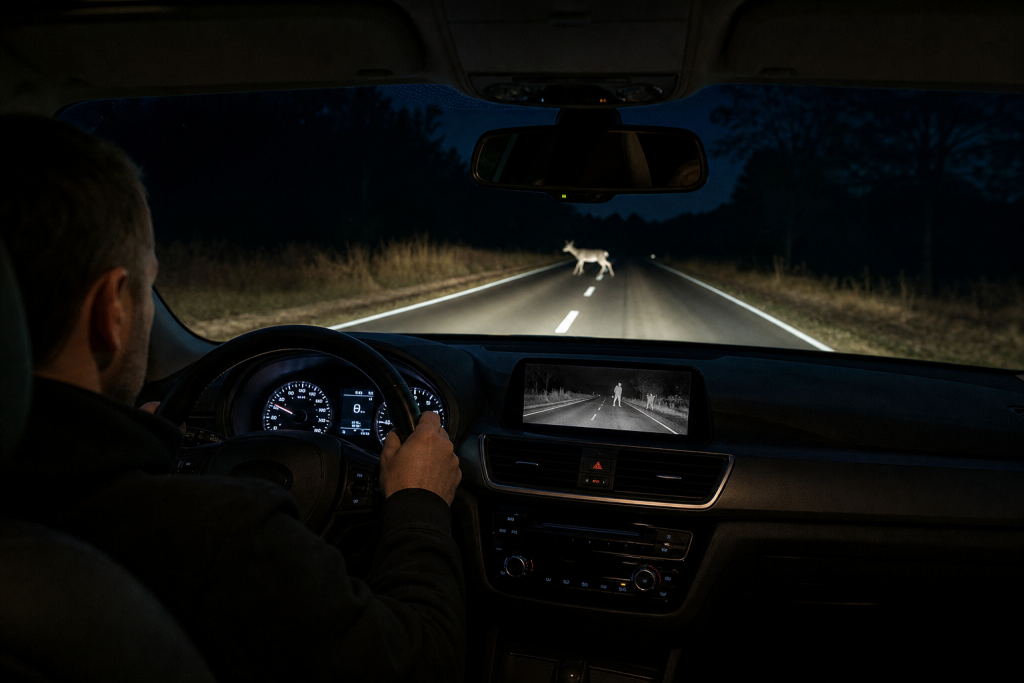
A general-purpose thermal camera can display temperature differences, but vehicle use creates additional demands. The camera must operate while exposed to vibration, changing temperatures, road spray, dust, and weather. Its image must remain useful as the vehicle moves, and its alerts must arrive early enough to support a driver’s decision-making.
In practical terms, an automotive-grade thermal imaging system should be evaluated across four areas:

- Environmental durability: The exterior camera needs protection against water, dust, temperature changes, vibration, and ordinary road contamination.
- Useful image performance: The display should update smoothly and present enough detail for drivers to interpret the road scene.
- Relevant object recognition: If the system includes automated detection, it should distinguish useful road hazards such as pedestrians, animals, and vehicles.
- Driver-centered integration: Warnings and imagery should be visible without blocking the road view, creating excessive glare, or demanding prolonged attention.
The term itself is not a complete guarantee of quality. Buyers should look beyond the label and examine documented specifications, installation requirements, warranty coverage, and the system’s intended operating conditions.
How Thermal Night Vision Works
Thermal cameras detect infrared energy emitted by objects. They convert temperature differences into an image that can be viewed on a dashboard display or another in-vehicle interface.
A person or warm animal may appear distinct from a cooler road or roadside background, even when there is little visible light. Unlike conventional cameras, thermal imagers do not rely on streetlights or reflected headlight illumination to form the basic image.
Thermal Imaging Versus Visible-Light Cameras
A visible-light night vision camera amplifies available light or uses an infrared illuminator to illuminate the road beyond what the human eye can readily see. Image quality can be familiar and detailed, but performance may be affected by darkness, glare, shadows, and precipitation.
A thermal imaging system approaches the problem differently. It displays heat contrast rather than natural colors and visible surface details. This can make warm road users easier to separate from dark surroundings. However, thermal imagery may not clearly show painted lane markings, road signs, traffic-signal colors, or the exact texture of an obstacle.
The technologies therefore serve different purposes:
- Headlights illuminate the road and make the vehicle visible to others.
- Visible-light cameras show an enhanced version of the visual scene.
- Thermal cameras emphasize heat-producing or heat-retaining objects.
- Radar can estimate the range and relative movement of certain objects.
- Driver-assistance software may analyze information and generate warnings.
No single sensor provides complete awareness in every situation.
Passive Detection Is an Important Distinction
Automotive thermal cameras are typically passive sensors. They detect infrared energy rather than projecting a beam to illuminate the scene. That makes them useful in darkness without adding visible light, but their performance still depends on heat contrast, camera condition, software interpretation, and environmental factors.
A thermal image is not an X-ray view. Solid objects, terrain, dense vegetation, walls, and other obstructions can conceal hazards. The camera can only detect thermal information reaching its sensor.
What Can a Vehicle Thermal Camera Detect?
The answer depends on the sensor, lens, processing software, mounting position, environmental conditions, and the object itself. A system may display more than it can classify reliably, so viewing range and recognition range should not automatically be treated as the same measurement.
Pedestrians
Pedestrian detection is one of the strongest use cases for thermal night vision. A person walking along an unlit shoulder may create a noticeable heat signature before clothing colors or body outlines become obvious in the headlight beam.
Even then, detection is not guaranteed. A pedestrian may be partly hidden by a parked vehicle, barrier, vegetation, or another object. Heat contrast can also vary with weather, clothing, distance, and background temperature.
Animals
Animal detection is especially relevant on rural roads and forested routes. Deer and other large animals may enter the roadway with little warning, while headlight glare and roadside shadows can make their movement difficult to interpret.
Thermal imaging may help reveal warm animals near the road, but recognition software will not identify every species, position, or partially obscured body. Drivers should continue to reduce speed in known wildlife areas and scan both road edges.
Vehicles
Cars, trucks, motorcycles, and other vehicles can present thermal contrast through engines, exhaust components, tires, brakes, occupants, or sun-warmed bodywork. Vehicle recognition can help organize the scene, but the thermal picture does not replace tail lights, mirrors, blind-spot checks, or safe following distance.
Inanimate Obstacles
Some nonliving objects may be visible because they have absorbed heat or differ in temperature from the surrounding road. Others may blend into the background. A fallen load, cold barrier, pothole, or road debris may not produce a prominent thermal signature.
That limitation matters: thermal night vision should not be interpreted as universal obstacle detection.
Where Thermal Night Vision Provides the Most Value
The technology is most useful when a driver’s normal visual range is limited and a potential hazard has meaningful thermal contrast.
Unlit Rural Roads
Rural routes combine limited lighting, higher speeds, curves, narrow shoulders, and animal activity. A thermal display may provide useful supplementary awareness of a pedestrian or animal beyond the strongest portion of the headlight beam.
The practical benefit is additional information, not permission to drive faster. Speed should always remain low enough for the driver to stop within the distance that can be managed safely.
Highway Driving After Dark
On long nighttime trips, hazards may include stopped vehicles, people near the roadway, animals, and debris from previous incidents. Thermal imaging can add another layer of road awareness, particularly on highway sections without continuous lighting.
Fatigue remains a separate and serious concern. No camera compensates for drowsiness, delayed reactions, or impaired judgment. A tired driver needs rest rather than additional dashboard technology.
Urban Streets
City lighting does not eliminate visibility problems. Pedestrians can emerge between parked cars, cyclists may cross through mixed lighting, and reflections can complicate the visual scene.
Thermal imaging may help highlight a person against the background, but dense traffic can also produce many heat sources and alerts. In urban use, clear warning prioritization and low nuisance-alert frequency are particularly important.
Family and Commuter Driving
For families regularly traveling after dark, the value may come from greater awareness on school routes, residential streets, and weekend journeys. Commuters with early starts or late finishes may also encounter pedestrians and cyclists in low-light conditions.
The decision should be based on actual driving patterns. Someone who mainly drives short daytime trips in a well-lit area may gain less practical value than a driver who routinely covers dark rural roads.
Fog, Rain, and Snow
Thermal imaging can remain useful in some poor-visibility conditions, but it does not see perfectly through weather. Water droplets, dense fog, heavy rain, falling snow, road spray, and contamination on the lens can weaken contrast or obscure the image.
Performance can vary considerably with conditions. The correct response to severely reduced visibility is still to slow down, increase following distance, use appropriate lights, and stop somewhere safe when conditions become unmanageable.
Understanding Detection Distance and Warning Time
A long advertised detection distance can sound decisive, but range alone does not establish usefulness.
Drivers should separate four concepts:
- Detection: The system indicates that an object may be present.
- Recognition: It identifies the general type of object, such as a pedestrian.
- Classification confidence: The software determines how certain it is about that identification.
- Actionable warning: The driver receives a clear alert early enough to respond appropriately.
Real warning time depends on speed. At 100 km/h, or about 62 mph, a car travels approximately 28 meters every second before accounting for braking. A hazard displayed at a long distance is only useful if the system detects it reliably, presents it clearly, and does not require the driver to study the screen.
Conditions also matter. A person standing fully exposed against a cool background is a different detection challenge from someone partly concealed on a warm evening. Buyers should treat maximum-range figures as conditional specifications rather than a promise of identical performance on every journey.
Real-Time Alerts and the Human-Factors Problem
Automated object recognition can reduce the need to interpret every detail of a thermal image. A system may mark a detected pedestrian, animal, or vehicle and issue a visual or audible warning.
This can be valuable, but alert design is central to safety. Frequent false alarms can cause drivers to ignore warnings. Alerts that are too subtle may be missed, while aggressive sounds may startle the driver or become irritating during normal traffic.
A well-designed interface should:
- Prioritize immediate hazards rather than highlighting everything.
- Make warning categories easy to understand at a glance.
- Avoid excessive screen brightness and reflections at night.
- Allow appropriate adjustment of alert volume or sensitivity.
- Keep the display close to the driver’s normal line of sight.
- Avoid covering instruments, airbag zones, or the windshield view.
Drivers also need time to learn what the imagery means. Thermal scenes look different from normal video, and apparent size or distance may be difficult to judge initially. Familiarization should occur while parked and during low-risk use, not during a demanding first nighttime journey.
Factory Systems Versus Aftermarket Upgrades
Some vehicles offer integrated night vision, while aftermarket systems can add thermal capability to vehicles that lack it. Neither route is automatically better for every owner.
Factory-Installed Systems
Factory systems may integrate with the instrument cluster, head-up display, vehicle networks, and other driver-assistance features. Their controls and warning logic are often designed alongside the vehicle.
Potential disadvantages include limited availability, higher vehicle or option-package costs, and expensive repairs if a proprietary component fails. Features may also differ substantially among manufacturers and model years.
Aftermarket Thermal Night Vision
Aftermarket equipment can make the technology available without replacing the vehicle. It may also offer a dedicated display and broader installation options.
Installation quality becomes especially important. A poorly positioned camera can produce a compromised view, while unsecured wiring, an obstructive display, or an unsuitable power connection can create reliability and safety problems.
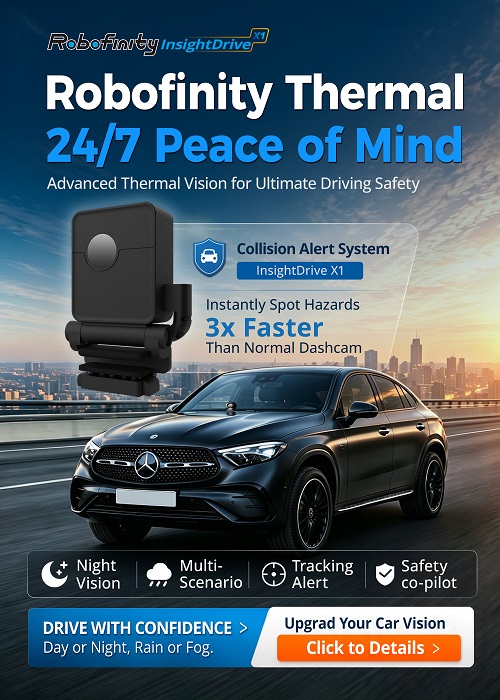
Robofinity InsightDrive is one example in this category. It uses AI-powered thermal imaging to support recognition of pedestrians, animals, and vehicles, with real-time alerts intended to improve awareness in low-light and poor-visibility conditions. As with any driver-assistance product, those functions supplement rather than replace headlights, mirrors, safe speed, braking distance, and continuous attention.
A Practical Buying Framework
Rather than choosing a system from one headline specification, evaluate how the complete product fits the vehicle and the conditions in which it will be used.
1. Define the Driving Problem
Start with your regular routes. Is the main concern deer on rural roads, pedestrians on unlit streets, nighttime highway travel, or frequent driving in mixed weather?
A clear use case helps prevent paying for features that do not address a real need.
2. Examine Detection Claims Carefully
Check what the stated distance refers to. Is it the range at which the sensor can display something, or the distance at which software can recognize a pedestrian or animal? Look for clearly documented conditions and avoid assuming that a maximum figure applies in all weather.
3. Check Image Refresh and Latency
Moving vehicles need current information. A smoother frame rate can make motion easier to interpret, but processing delay also matters. Ask whether the image and alerts remain responsive during actual driving rather than focusing only on screen resolution.
4. Review Environmental Protection
The external camera should be designed for exposure to weather, dust, road spray, and temperature changes. An ingress-protection rating can provide useful information, but it does not explain resistance to every hazard, such as stone impacts, road salt, automatic car-wash equipment, or long-term vibration.
5. Assess Object Recognition and Alerts
Determine which objects the system is designed to recognize and how it communicates risk. Useful questions include:
- Does it distinguish pedestrians, animals, and vehicles?
- Are warning zones visible without studying the display?
- Can alert settings be adjusted?
- How does it handle dense traffic?
- What happens when the camera view is obstructed?
6. Consider Display Placement
A larger screen is not necessarily safer. The display must be readable without blocking the driver’s view, creating distracting reflections, or requiring a large downward glance.
Installation should also account for local requirements concerning windshield and dashboard obstructions. Rules vary by location, so owners should verify current requirements before mounting a display.
7. Evaluate Installation Support
Some systems may suit competent do-it-yourself installation, while others are better handled by an automotive electronics professional. Installation can involve routing cables through the engine bay and cabin, selecting a power source, protecting circuits, mounting the camera securely, and aiming it correctly.
Owners should avoid interfering with airbags, steering components, braking systems, driver-assistance sensors, or weather seals.
8. Budget for Total Ownership
The purchase price is only one part of the decision. Consider installation labor, replacement mounting hardware, possible screen or camera damage, software support, and whether individual components can be replaced separately.
Do not assume that adding a driver-assistance accessory will reduce insurance costs or increase resale value. Those outcomes depend on the insurer, market, installation quality, and buyer preferences.
Installation and Maintenance Considerations
A thermal camera needs a clear, stable view of the road. Mounting too low can expose it to dirt and impact damage; mounting too high or away from the vehicle centerline may affect scene alignment. The camera should not interfere with cooling airflow, active grille shutters, parking sensors, radar units, or manufacturer-installed cameras.
After installation, confirm that:
- The camera is secure and aimed correctly.
- Wiring is protected from heat, abrasion, and moving parts.
- The display does not obstruct the road or instruments.
- Alerts can be heard without being excessively loud.
- The system starts and shuts down as intended.
- The installation does not create battery drain while parked.
Routine care is straightforward but important. Inspect the lens before long nighttime trips and clean it using methods approved for the camera surface. Mud, salt film, insects, frost, and snow can degrade the image. Check mounts and exposed wiring periodically, especially after harsh weather, a minor impact, or service work near the installation.
A persistent blurred image, intermittent power, delayed video, repeated false alerts, or a shifted camera view warrants inspection. Electrical or mounting problems should be corrected by a qualified installer when the cause is not obvious.
What Thermal Night Vision Cannot Do
Balanced expectations are essential. Thermal imaging can extend awareness, but it does not create complete visibility or autonomous hazard avoidance.
It cannot reliably:
- Reveal objects hidden behind solid obstructions.
- Show every cold or low-contrast road hazard.
- Replace lane markings, signs, signals, or normal visual observation.
- Determine safe braking distance for the driver.
- Eliminate weather-related visibility loss.
- Guarantee recognition of every person, animal, or vehicle.
- Compensate for speeding, distraction, fatigue, or impairment.
The driver remains responsible for controlling the vehicle. Headlights must still be used correctly, the windshield must remain clean, speed must suit the conditions, and following distance must allow for perception and braking.
Using Thermal Night Vision Responsibly
The safest approach is to treat the system as an additional source of information. Keep primary attention on the road and use alerts as prompts to inspect the relevant area.
Avoid trying to “drive through the screen.” Thermal imagery omits important visual information, including many road markings and surface details. It may also make a distant warm object prominent without providing intuitive depth cues.
When an alert appears:
- Keep control of the vehicle and look toward the indicated area.
- Reduce speed progressively when conditions allow.
- Increase space from nearby traffic.
- Prepare to brake without making an abrupt maneuver based solely on the display.
- Follow road signs, traffic laws, and direct visual evidence.
Technology is most effective when paired with conservative nighttime driving habits.
Frequently Asked Questions
Does automotive thermal night vision work in complete darkness?
Yes. Thermal cameras detect infrared energy emitted by objects and do not require visible light to form the basic image. Performance still depends on heat contrast, range, obstructions, weather, and camera condition.
Can thermal cameras see through fog or heavy rain?
They may provide useful information in some fog, rain, or snow, but they cannot see perfectly through severe weather. Moisture, precipitation, spray, and lens contamination can reduce image quality and detection performance.
Is thermal night vision better than headlights?
It performs a different job. Thermal imaging can reveal heat signatures outside the most useful headlight illumination, while headlights show road markings, signs, colors, and surface detail and make the vehicle visible to others. Thermal night vision does not replace legal, properly maintained headlights.
Can a thermal system detect deer and other animals?
Many systems are designed to display or recognize warm animals, making rural wildlife detection an important use case. Success varies with distance, animal size, position, concealment, background temperature, weather, and the system’s recognition software.
Is an aftermarket thermal camera difficult to install?
Difficulty varies by vehicle and product. Installation may require secure camera mounting, protected wiring, a suitable fused power connection, display placement, and correct aiming. Professional installation is sensible when airbags, existing sensors, weather seals, or complex vehicle electronics could be affected.
Is thermal night vision worth adding to a car?
It can be valuable for drivers who regularly use dark rural roads, travel at night, or face frequent pedestrian or animal exposure. Its value is lower when nighttime driving is rare. The decision should consider actual routes, system quality, installation, maintenance, and the driver’s willingness to use the display without distraction.
Conclusion
Automotive thermal night vision is most useful as a targeted awareness tool for situations where headlights and ambient lighting may not reveal a warm road user early enough. Its practical strengths include identifying thermal contrast in darkness and supporting pedestrian, animal, and vehicle detection. Its limitations include reduced detail, variable performance in weather, uncertain visibility of cold obstacles, and dependence on thoughtful alert design.
Before choosing a system, define the driving problem, distinguish detection range from reliable recognition, check durability and installation requirements, and assess whether the interface can be used without drawing attention away from the road. Combined with maintained headlights, appropriate speed, adequate following distance, and an attentive driver, thermal imaging can be a worthwhile addition to a broader nighttime road-safety strategy.