


Thermal Cameras Detect Snakes by sensing heat contrast rather than visible details. That means a snake can sometimes stand out clearly as a distinct warm or cool shape—but it can also blend into the background when the temperature difference is small. Understanding what affects contrast, distance, and camera resolution helps you set realistic expectations and improve your chances of spotting a snake safely.
- How thermal cameras detect snakes
- When snakes are most likely to be visible
- What a snake looks like on thermal imaging
- Limitations of thermal cameras for snake detection
- Small body size and limited pixels
- Equalized temperatures reduce contrast
- Obstructions and physical hiding spots
- Distance, optics, and resolution
- Best uses for thermal cameras around snakes
- Home and property inspection
- Field observation and research
- Safety and prevention (with realistic expectations)
- Tips for spotting snakes with a thermal camera
- Scan slowly and deliberately
- Prioritize edges, cover, and travel paths
- Time your scans with temperature changes
- Use a “confirm before approach” mindset
- Reduce visual clutter in your scan
- Compare multiple frames, not just one moment
- Frequently asked questions about snake detection
- Can thermal cameras detect snakes through grass?
- Will every snake appear bright on thermal imaging?
- Are thermal cameras better than regular night vision for snake spotting?
- Do all thermal cameras detect snakes equally well?
- What’s the safest way to act on what you see?
- Final thoughts
Table of Contents
- How thermal cameras detect snakes
- When snakes are most likely to be visible
- What a snake looks like on thermal imaging
- Limitations of thermal cameras for snake detection
- Best uses for thermal cameras around snakes
- Tips for spotting snakes with a thermal camera
- Frequently asked questions about snake detection
- Final thoughts
How thermal cameras detect snakes
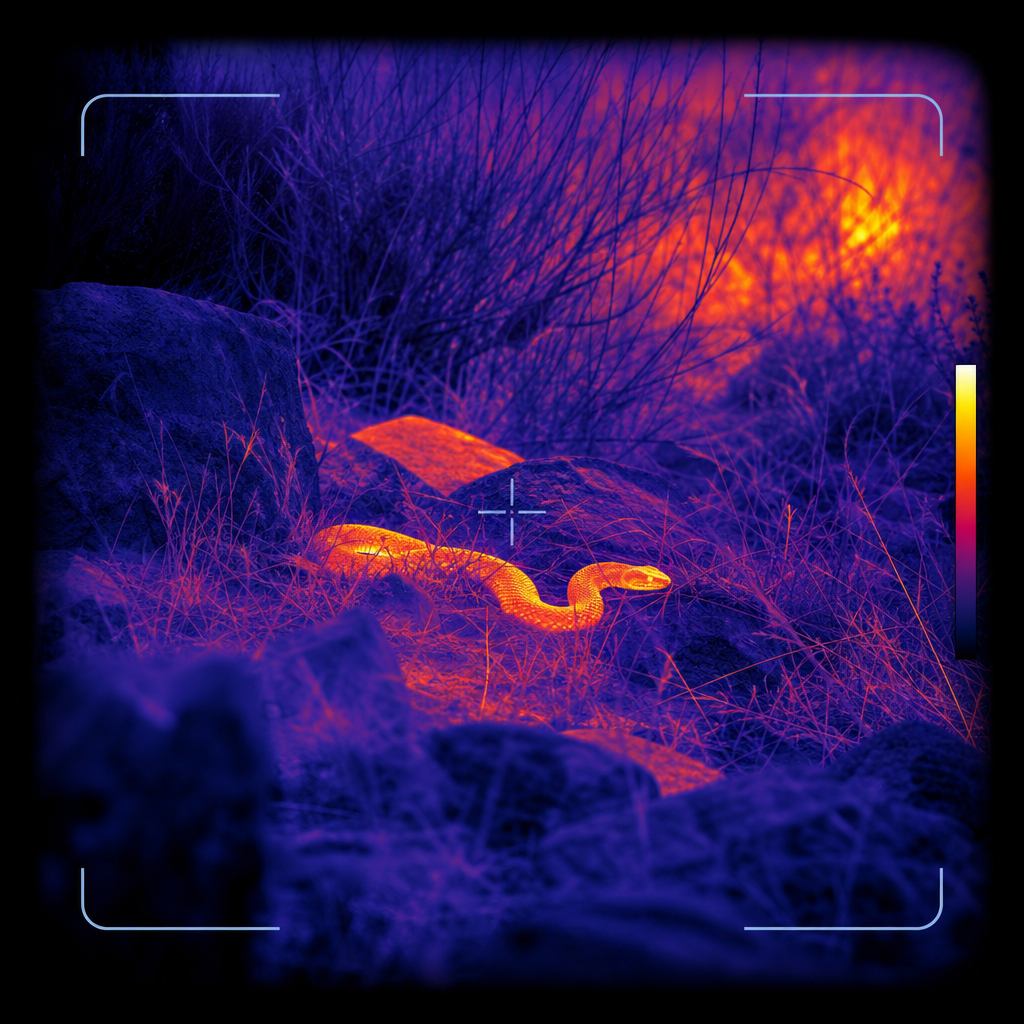
Thermal Cameras Detect Snakes by capturing infrared radiation—energy emitted by all objects with a temperature above absolute zero. In simple terms, warmer objects emit more infrared energy than cooler ones. The camera converts those temperature differences into a visual image, which is why thermal viewing is usually about contrast, not about “true color.”
For wildlife, this can make animals easier to notice. Mammals and birds often appear as clear heat sources because they are warm-blooded and maintain a more stable body temperature. Snakes are different: as ectotherms, they regulate body temperature using external heat sources like sun-warmed ground, rocks, and cool shade.
That means a snake’s thermal signature depends heavily on recent behavior. A snake that has been basking may look warmer than nearby surfaces, while a snake hidden in shade may appear closer in temperature to the surrounding plants or soil. In other words, thermal cameras detect snakes best when conditions create a meaningful separation between the snake and the background.
Why snakes are different from warm-blooded animals
Because snakes do not generate consistent internal heat the way mammals do, their appearance on thermal imaging can be less predictable. A snake that is basking on a sun-warmed rock might stand out strongly, while the same snake after moving into shade can become much harder to distinguish.
It also works the other way: sometimes the background may be the hotter element. If a snake lies on a surface that retains heat longer than the snake itself, the animal may appear cooler than the ground. The key takeaway is that thermal detection is driven by the temperature relationship between the snake and its environment.
More EV News

What the camera actually “sees”
Thermal cameras don’t “see” the snake’s body in the way your eyes see fur, scales, or patterns. Instead, they map small temperature differences across the scene. When the snake’s body temperature differs from nearby surfaces, you may see an elongated shape. When it doesn’t, the snake may blend in or only partially appear.
This is why two people can scan the same area with similar equipment and have different results. Small changes in timing, angle, weather, and how recently the snake moved can dramatically affect what the thermal image shows.
When snakes are most likely to be visible
A snake is more likely to show up clearly on a thermal camera when there is a strong temperature difference between the snake and its background. Timing, weather, and the types of surfaces nearby all matter.
Warm surfaces and cool surroundings
If a snake has been lying on a sun-warmed surface, it may retain heat for a while after moving into a cooler area. During that period, the body can appear as a distinct thermal shape.
Conversely, if the ground is hotter than the snake’s body at that moment, thermal imaging may make the snake appear darker than the background. Thermal cameras detect snakes most consistently when the snake and the surface are not at nearly the same temperature.
Nighttime conditions
Thermal cameras are often especially useful at night because visible light is low and temperature differences can become more noticeable—especially if the surrounding ground cools faster than the animal. A snake moving across a cooler path, driveway, or grassy area may stand out more readily after sunset.
That’s one reason thermal imaging is used for wildlife observation after dark: it can highlight temperature-based changes even when you can’t see much by eye.
Open terrain tends to work better
Snakes are generally easier to detect on open ground than in dense vegetation. Thick grass, leaf litter, branches, and rocks can clutter the scene or block the view. A snake stretched across a relatively flat, visible surface is usually easier to spot than one tucked under debris or positioned inside heavy cover.
When scanning outdoors for hazards or animals on larger properties, the same principles apply—contrast and context matter. If you’re also thinking about thermal detection for driving safety, Car Thermal Imaging: Boost Night Safety on Rural Roads provides helpful perspective on how environments change what you can reliably notice.
What a snake looks like on thermal imaging
On a thermal camera, a snake usually appears as a narrow, elongated shape with a temperature contrast relative to the background. However, the exact look can vary depending on the background temperature, the snake’s posture, and the camera’s resolution and sensitivity.
Common visual patterns
A snake may appear in different ways:
- Bright against a cooler background if it is warmer than the surroundings
- Dark against a warmer background if it is cooler than the surface
- Partially visible if only part of the body creates enough contrast
Because a snake is long and thin, it often forms a line-like or curved thermal “thread” rather than a solid blob. That makes identification tricky at distance, especially if the resolution is limited or if the scene includes multiple heat sources and shadows.
When thermal cameras detect snakes, the shape and continuity across frames (especially with slight movement) can be as important as the brightness level.
Movement matters more than you might think
Movement can help reveal a snake even when contrast is weak. As it slithers, the heat pattern shifts, making it easier to notice against the background. A motion cue can also reduce the chance that you mistake a stationary thermal artifact for an animal.
At the same time, a snake that is completely still and well-camouflaged in thermal terms may be difficult to confirm. For better results, it helps to look for both thermal contrast and plausible animal-like shape over time rather than relying on a single frame.
Limitations of thermal cameras for snake detection
Thermal cameras are useful, but they are not a guaranteed snake detector. There are several reasons a snake might not show up clearly, even if it’s present.
Small body size and limited pixels
Many snakes are relatively thin. If the snake occupies only a small portion of the camera’s field of view, the heat signature can be too small to distinguish from background noise or texture. Lower-resolution thermal cameras may struggle to separate a snake from soil patterns, rocks, or shadows.
Equalized temperatures reduce contrast
If the snake’s body temperature is close to the temperature of the surface it’s resting on, the camera may show very little difference. This can happen during moderate weather, after a snake spends time in a stable environment, or when surfaces have had enough time to thermally “match.”
Obstructions and physical hiding spots
Thermal imaging can be limited by anything that blocks the line of sight. Dense vegetation, logs, rocks, and loose soil can hide the snake from the camera’s view. Thermal imaging may reduce the impact of visual camouflage, but it can’t see through obstacles.
Distance, optics, and resolution
Detection becomes harder as distance increases. A thermal camera may clearly show a larger heat source at range, but a snake could become too small or too low-contrast to identify unless the device has strong sensitivity and adequate resolution for the viewing distance.
Field observation is also about matching your approach to the situation. The National Park Service wildlife science resources emphasize that observation tools work best when they are appropriate for the species, terrain, and visibility conditions.
Even with strong equipment, thermal cameras detect snakes best when the scene is not overly cluttered and the temperature contrast is favorable.
Best uses for thermal cameras around snakes
Thermal cameras can be very helpful in certain scenarios where snake awareness matters. The biggest benefit is often early warning and improved scanning efficiency.
Home and property inspection
People sometimes use thermal imaging around homes, sheds, garages, and yards to check for unusual wildlife activity at night. If a snake is positioned where it creates a strong contrast—like on a warm surface or in a relatively open area—the camera may help you locate it without standing close or using harsh lighting.
In these situations, thermal cameras detect snakes most usefully as a screening tool. You should still confirm what you’re seeing before taking action, because thermal images can be ambiguous for small, thin animals.
Field observation and research
Wildlife observers and researchers can use thermal cameras at night or in low visibility. This can support studying activity patterns, habitat use, and movement timing. Because thermal detection is based on temperature rather than visible light, it can help document wildlife presence with less disruption in sensitive habitats.
Safety and prevention (with realistic expectations)
In areas where venomous snakes are a concern, thermal scanning can add an extra layer of caution before reaching into brush, checking around wood piles, or walking through low-visibility areas.
Thermal cameras should not replace careful visual inspection and safe behavior. Instead, they can improve awareness by highlighting temperature-based anomalies you might otherwise miss. If your primary goal is night safety in general, Car Thermal Imaging Camera: Best Affordable Night Driving Upgrade can help connect the broader idea of thermal hazard detection to driving scenarios.
Tips for spotting snakes with a thermal camera
If you’re using thermal imaging to look for snakes, small technique changes often make a big difference. The goal is to maximize contrast, reduce confusion from clutter, and verify what you see.
Scan slowly and deliberately
Move the camera slowly across the area. Quick panning can blur small heat signatures and make it harder to follow a shape long enough to recognize it as an animal.
Prioritize edges, cover, and travel paths
Look near rocks, logs, fences, mulch piles, and shaded edges where snakes may rest or move between warmer and cooler spots. These transition areas often create enough thermal contrast to improve detection chances.
Time your scans with temperature changes
Warm afternoons followed by cooler evenings frequently create stronger differences between animals and background surfaces. If snakes were basking earlier, they may still retain heat as the surroundings cool.
Use a “confirm before approach” mindset
A thermal camera can help you notice something unusual, but it should not be the only basis for decisions. Confirm with visual observation when possible, and avoid approaching a snake too closely unless you’re certain it’s safe and you understand local wildlife guidance.
If you want more background on how thermal systems work and why they can be powerful yet limited, Does Automotive Thermal Imaging Really Work in 2026? offers a practical breakdown of what thermal detection can accomplish and where it may fall short.
Reduce visual clutter in your scan
Try to scan in simpler, more open sections of the environment first. Crowded scenes with many warm objects (pipes, vehicles, outdoor lights, hot stones, or multiple animals) can make thermal images harder to interpret. Once you’re confident with what “normal” looks like in that area, snake-shaped anomalies stand out more clearly.
Compare multiple frames, not just one moment
Thermal imaging is best approached as a short observation process. If you see a thin line or curved shape, pause and check whether the pattern persists and moves in a way consistent with an animal. This reduces the chance of mistaking wind-driven heat changes, reflections, or soil temperature gradients for a real snake.
Frequently asked questions about snake detection
Can thermal cameras detect snakes through grass?
Sometimes, but not reliably. Thin or sparse grass may still allow a heat signature to show through. Thick grass, dense weeds, and leaf cover can block the view or reduce contrast. Thermal cameras detect snakes through grass best when vegetation is short and the temperature difference is strong.
Will every snake appear bright on thermal imaging?
No. A snake can look bright, dark, or only partly visible depending on the background temperature and how the snake’s body temperature compares at that moment. Thermal cameras detect snakes based on contrast rather than a fixed “color” pattern.
Are thermal cameras better than regular night vision for snake spotting?
Thermal cameras are often better for noticing heat differences quickly, especially when darkness limits visible detail. Regular night vision can show shapes and texture if there is enough ambient light, but it usually won’t reveal the same temperature-based information thermal imaging provides.
Do all thermal cameras detect snakes equally well?
No. Resolution, lens quality, sensitivity, refresh rate, and viewing distance all affect performance. In general, higher-quality thermal cameras make it easier to spot small animals like snakes because they produce cleaner contrast and more detail.
What’s the safest way to act on what you see?
If thermal imaging suggests a snake, treat it as unknown until verified. Keep distance, avoid sudden movements, and use safe routes when possible. If you’re dealing with a potential venomous species, follow local wildlife and safety guidance.
Final thoughts
Thermal Cameras Detect Snakes by highlighting temperature differences, but visibility depends on contrast, background conditions, body size, distance, and whether the snake is exposed or physically obstructed. In the right setting, thermal imaging can make a snake surprisingly easy to notice. In the wrong setting—when temperatures equalize, vegetation blocks the view, or the snake occupies too few pixels—it may blend into the scene or disappear from view.
For anyone using thermal cameras for wildlife awareness, home safety, or outdoor exploration, the best results come from understanding what the device can and cannot do. Thermal cameras detect snakes effectively in many real-world situations, but they work best as part of a careful, informed approach rather than a guaranteed solution.
With realistic expectations, proper scanning technique, and safe decision-making, thermal cameras can improve awareness and help reduce surprises in the field.