

In this car reliability comparison, Toyota, Honda, and Lexus remain the brands most buyers trust when they want a vehicle that will last. In 2026, these three names still dominate long-term ownership conversations because they consistently build cars that stay on the road for years with relatively low maintenance costs. But “lasts longer” can mean different things: mechanical durability, resistance to major repairs, resale value, and how well a vehicle ages after 100,000 miles and beyond. A fair car reliability comparison needs to look at all of those factors, especially as modern vehicles become more complex with hybrid systems, advanced electronics, and more technology than ever before.
- Why Longevity Still Matters in 2026
- Toyota: The Benchmark for Long-Term Dependability
- Honda: Strong Durability with a Slightly Different Personality
- Lexus: Luxury with Toyota’s Reliability DNA
- Toyota vs. Honda vs. Lexus: Which One Lasts Longer?
- What Really Determines How Long a Car Lasts
- Best Choices by Type of Buyer
- If You Want the Safest Long-Term Bet
- If You Want a Reliable Car with More Driving Enjoyment
- If You Want Reliability and Luxury Together
- The Bottom Line
If you are also weighing broader ownership decisions, it can help to read more about car brand reliability before narrowing the field.
- Why Longevity Still Matters in 2026
- Toyota: The Benchmark for Long-Term Dependability
- Honda: Strong Durability with a Slightly Different Personality
- Lexus: Luxury with Toyota’s Reliability DNA
- Toyota vs. Honda vs. Lexus: Which One Lasts Longer?
- What Really Determines How Long a Car Lasts
- Best Choices by Type of Buyer
- The Bottom Line
Why Longevity Still Matters in 2026
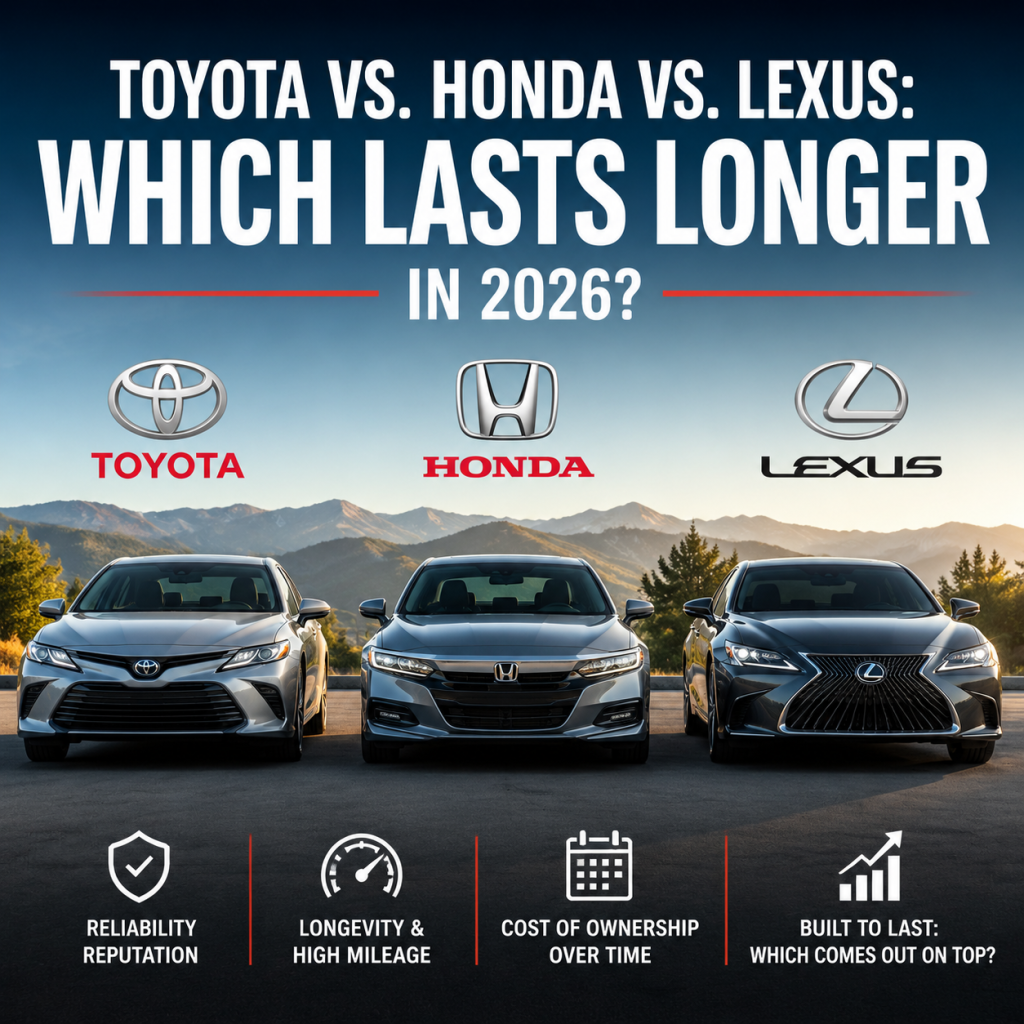
For many drivers, a car is not just transportation; it is a long-term investment. In a market where prices remain high and new cars are packed with expensive features, longevity can make a huge difference in total ownership cost. A vehicle that runs reliably for 12 to 15 years may be far more valuable than one that feels modern but becomes costly to maintain after only a few years.
Toyota, Honda, and Lexus have earned loyal followings because they tend to deliver dependable engines, solid transmissions, and predictable maintenance needs. Even as automotive technology changes, their reputation remains strong because they usually design systems with durability in mind. This car reliability comparison matters most to shoppers who plan to keep a vehicle for the long haul.
Toyota: The Benchmark for Long-Term Dependability
Toyota has long been considered the gold standard for longevity, and that reputation still holds in 2026. The brand’s strength is not just that its vehicles are reliable in the short term; it is that many Toyota models are known to reach very high mileage with routine maintenance.
What Toyota Does Well
Toyota’s engineering philosophy often prioritizes simplicity, proven components, and conservative updates. That approach helps reduce the likelihood of widespread mechanical issues. Several Toyota engines and hybrid systems have a track record of lasting well beyond 200,000 miles when cared for properly.
More EV News

The brand also benefits from a broad parts network and high production volume, which can help keep maintenance and repair costs reasonable. Models like the Corolla, Camry, RAV4, and Highlander have historically been among the most dependable in their segments. Toyota hybrids, in particular, have become a major strength, with battery and drivetrain reliability improving over time.
Toyota’s Possible Weak Points
Toyota is not perfect. Some newer models emphasize efficiency and tech features that can introduce more complexity than older generations had. Infotainment systems, driver-assist tools, and turbocharged engines in certain trims can create more potential repair points over the long haul. Still, compared with many competitors, Toyota generally remains a safe bet for long-term ownership.
Honda: Strong Durability with a Slightly Different Personality
Honda is another brand known for lasting a long time, but its reputation comes from a slightly different formula. Honda vehicles often feel more engaging to drive while still delivering impressive reliability. In 2026, Honda continues to be a serious contender for buyers who want a balance between longevity, practicality, and daily drivability.
Where Honda Excels
Honda has a long history of building efficient engines and well-designed compact and midsize vehicles. Models like the Civic, Accord, CR-V, and Pilot are often praised for lasting many years with proper care. Honda’s engines are usually efficient and durable, and the brand has made notable progress in improving its transmissions and hybrid systems.
One of Honda’s strengths is that its vehicles often age gracefully. Interiors may wear well, drivetrains tend to stay smooth, and owners often report strong satisfaction over long ownership periods. Honda also tends to design cars that are easy enough to maintain, which supports long-term reliability.
Honda’s Challenges
Honda’s recent history has included a few model-specific issues that have affected its reputation in some segments, especially compared with Toyota’s more consistent record. Some turbocharged engines and transmission setups have drawn more scrutiny than the brand’s older, simpler powertrains. While Honda is still highly reliable overall, it may not always have the same edge in ultra-long-term durability that Toyota has built over decades.
Lexus: Luxury with Toyota’s Reliability DNA
Lexus stands out because it offers premium comfort and features without abandoning the core reliability principles that made Toyota famous. Since Lexus is Toyota’s luxury division, it benefits from much of the same engineering discipline, but with added refinement and materials.
Why Lexus Can Last So Long
Lexus vehicles often rank near the top in long-term reliability surveys because they combine strong mechanical foundations with carefully controlled engineering. Many Lexus models use proven Toyota platforms and powertrains, which helps reduce risk. At the same time, Lexus typically uses higher-quality interior materials and better sound insulation, so vehicles tend to feel newer for longer.
This matters because longevity is not only about whether a car starts every morning. A Lexus may still look, feel, and function like a high-quality vehicle after years of ownership, especially when compared with mainstream brands that show more interior wear over time.
The Trade-Offs with Lexus
The main drawback is cost. Lexus vehicles generally cost more to buy, insure, and repair than comparable Toyota or Honda models. While they may last a very long time, the ownership experience can be more expensive. Luxury features also mean more systems that could eventually need service. That said, Lexus still tends to outperform many luxury competitors when it comes to long-term dependability.
Toyota vs. Honda vs. Lexus: Which One Lasts Longer?
If the question is strictly which brand is most likely to last the longest with the fewest major issues, Toyota usually takes the top spot. Lexus is extremely close and may even surpass Toyota in some cases because its vehicles are often better built and more premium from the start. However, Lexus also includes more equipment, which can increase maintenance complexity over time.
Honda comes in as an excellent long-term brand, but it tends to be slightly less consistent than Toyota and Lexus across the lineup. Honda can absolutely produce vehicles that last 200,000 miles or more, but Toyota’s long-standing record for durability and hybrid reliability gives it a narrow advantage in this car reliability comparison.
A Simple Ranking for 2026
- Toyota — Best overall balance of durability, cost of ownership, and proven reliability
- Lexus — Potentially longest-lasting in premium form, with higher ownership costs
- Honda — Very durable and often excellent, but slightly less consistent across all models
What Really Determines How Long a Car Lasts
Brand reputation matters, but individual ownership habits matter just as much. A well-maintained Honda can outlast a neglected Toyota. A Lexus driven hard with delayed service may age faster than a carefully maintained Corolla.
Key Factors That Influence Lifespan
- Regular oil changes and fluid service
- Transmission and hybrid system maintenance
- Driving style and climate
- Quality of repairs and replacement parts
- How much stop-and-go driving the vehicle sees
Even the most reliable brand cannot overcome poor maintenance habits. Longevity depends on both engineering and ownership discipline. For a broader buying plan, it can also help to review buying a car tips before choosing a model.
For more background on long-term dependability, the Consumer Reports cars resource is a useful external reference for reliability trends and owner experiences.
Best Choices by Type of Buyer
If You Want the Safest Long-Term Bet
Toyota is the most straightforward answer. It offers a wide range of dependable vehicles with strong resale value and manageable maintenance costs. In most car reliability comparison discussions, Toyota remains the default choice for buyers focused on simple ownership and long service life.
If You Want a Reliable Car with More Driving Enjoyment
Honda is a smart choice. It often blends reliability with a more engaging feel behind the wheel.
If You Want Reliability and Luxury Together
Lexus is hard to beat. It offers premium comfort with the kind of durability most luxury brands struggle to match.
The Bottom Line
In 2026, Toyota still has the strongest overall reputation for lasting longer, especially when considering cost of ownership and long-term consistency. Lexus is close behind and may deliver the best premium longevity for buyers willing to pay more upfront. Honda remains a highly dependable brand and a strong choice for drivers who want reliability with a bit more character.
If the goal is maximum lifespan with the least drama, Toyota usually wins this car reliability comparison. If comfort and refinement matter just as much as durability, Lexus becomes the standout. And if you want a reliable vehicle that feels a little more engaging without sacrificing much in the way of dependability, Honda is still one of the best options on the market.
For most shoppers, the best answer is not just choosing the longest-lasting brand, but choosing the right model, keeping up with maintenance, and buying a vehicle that fits your needs for the long haul.