



Comparing SUV vs sedan for families is less about finding one universally superior vehicle and more about matching a vehicle to your household. SUVs generally provide more cargo flexibility, easier access to child seats, and greater capability on rough or snowy roads. Sedans often cost less to buy and operate, feel easier to maneuver, and deliver a smoother, more efficient daily drive.
- SUV vs sedan for families: The Short Answer
- Passenger Space and Child-Seat Practicality
- Installing and Using Child Seats
- Rear-Seat Comfort as Children Grow
- Third Rows Require Close Inspection
- Cargo Space: Capacity Is Only Part of the Story
- Safety: Focus on the Vehicle, Not the Silhouette
- SUV Safety Advantages and Trade-Offs
- Sedan Safety Advantages and Trade-Offs
- Safety Features Worth Prioritizing
- Comfort and Ride Quality
- Fuel, Insurance, and Long-Term Ownership Costs
- City Driving and Parking
- Rural Roads, Winter Conditions, and Bad Weather
- Road Trips and Everyday Family Logistics
- A Practical Family-Car Decision Framework
- 1. Define the Normal Load
- 2. Set a Complete Budget
- 3. Identify Non-Negotiable Features
- 4. Perform a Family Test Fit
- 5. Test Drive Comparable Versions
- 6. Compare the Finalists on One Page
- Common Buying Mistakes to Avoid
- Assuming Every SUV Is Spacious
- Buying a Third Row Without Testing It
- Ignoring Tire Costs
- Confusing All-Wheel Drive With Complete Winter Safety
- Choosing for Rare Events
- Overlooking Visibility From the Driver’s Seat
- Frequently Asked Questions
- Is an SUV safer than a sedan for children?
- Is a sedan big enough for a family of four?
- Do families need all-wheel drive?
- Which is cheaper to own, an SUV or a sedan?
- Are three-row SUVs suitable for adults?
- Is a compact SUV better than a midsize sedan?
- Conclusion
The right answer to SUV vs sedan for families depends on how many people you carry, the ages of your children, what you transport, where you drive, and how much you can comfortably spend. For a broader look at these body styles, read our sedan vs SUV comparison.
- The short answer
- Passenger space and child seats
- Cargo space
- Safety
- Ownership costs
- Road trips and family logistics
- Decision framework
- Frequently asked questions
SUV vs sedan for families: The Short Answer
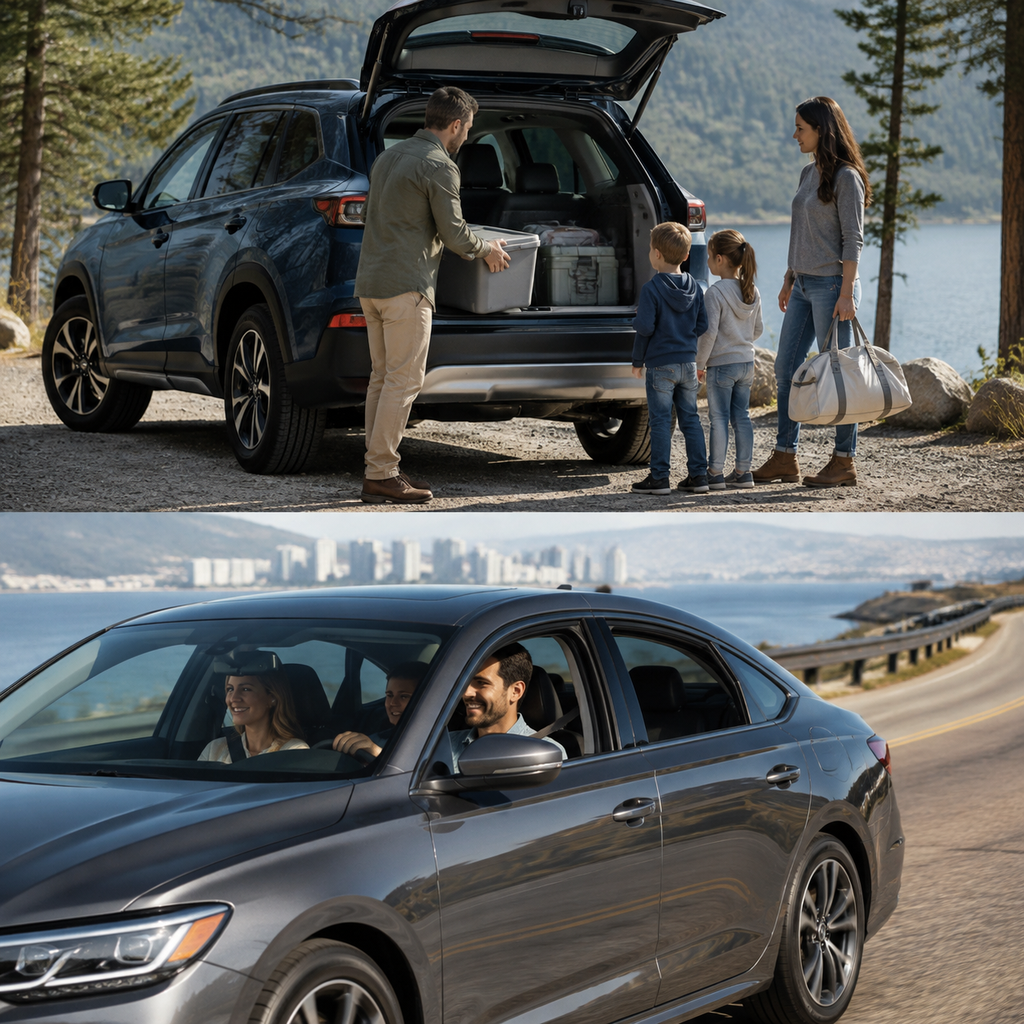
An SUV is usually the better fit when your family needs:
- Flexible cargo space for strollers, sports equipment, pets, or luggage
- A third row for more than five occupants
- A higher seating position and easier child-seat access
- Available all-wheel drive and useful ground clearance
- More towing capacity, depending on the model
A sedan is often the smarter choice when your priorities are:
- Lower purchase and running costs
- Better fuel or energy efficiency
- Easier parking and city maneuverability
- A separate, secure trunk
- Car-like handling and ride comfort
When weighing SUV vs sedan for families, a compact household with one or two children may find that a midsize sedan provides all the necessary space. A family carrying three children, a large stroller, and vacation luggage may benefit from a midsize or three-row SUV. Evaluate usable space instead of assuming every SUV is roomier than every sedan.
Passenger Space and Child-Seat Practicality
Passenger measurements help narrow the SUV vs sedan for families shortlist, but they do not tell the full story. Door openings, roof height, seat shape, floor height, and center-console width all influence how comfortable a vehicle feels in daily use.
Installing and Using Child Seats
An SUV’s higher seat base can reduce bending when lifting an infant carrier or fastening a young child into a harness. That can be a meaningful advantage for parents, grandparents, or caregivers who frequently load children.
In an SUV vs sedan for families comparison, however, a higher vehicle is not automatically easier to use. A tall SUV may require smaller children to climb, and some models have wide door sills that increase the reach to the rear seat. Running boards may help access, but they can become dirty or slippery in bad weather.
In any vehicle under consideration, check:
- Whether the rear doors open widely enough for an infant carrier
- How easy it is to reach the child-seat anchors
- Whether a rear-facing seat affects front-passenger legroom
- Whether three required seats can fit across the second row
- Whether head restraints interfere with forward-facing seats
- Whether the child-seat manufacturer allows the intended installation
Bring your actual child seats to the dealership when possible. A test installation reveals much more than a specification sheet. The National Highway Traffic Safety Administration’s child-seat guidance also explains how to select and install an appropriate restraint.
Rear-Seat Comfort as Children Grow
Rear-seat comfort can change the outcome of SUV vs sedan for families. A sedan may accommodate young children comfortably but become restrictive when teenagers need more headroom, knee room, and foot space. Some SUVs offer a sliding second row that lets families balance passenger space against cargo capacity.
Do not judge rear space only while the front seats are in a showroom position. Adjust the driver’s seat for the tallest regular driver, then sit directly behind it. Also inspect the center position, which may have a raised floor or a narrow cushion.
Third Rows Require Close Inspection
Third-row availability often favors the SUV side of SUV vs sedan for families. It can be useful for school trips, extended family, or a growing household, but third rows vary considerably. Some are best suited to occasional child use, while others can accommodate adults more comfortably.
Check access with child seats installed in the second row. In some vehicles, a second-row seat cannot tilt or slide properly when occupied by a child restraint. Also inspect cargo room with every seat raised; a three-row model may leave surprisingly little space for groceries or a stroller when fully occupied.
Cargo Space: Capacity Is Only Part of the Story
Cargo flexibility is a major factor in SUV vs sedan for families. SUVs typically have an advantage because their open cargo areas extend upward and the rear seats can usually fold. This makes it easier to carry bulky objects such as bicycles, flat-pack furniture, large pet crates, or several suitcases.
Sedans remain practical for many households. A well-shaped trunk can hold groceries, school bags, and compact strollers while keeping them concealed from view. The closed trunk also separates loose cargo from passengers, which can reduce noise and help prevent everyday items from entering the cabin.
Measure the Objects You Actually Carry
For a useful SUV vs sedan for families cargo comparison, consider shape as well as published volume. A high-volume compartment may still be awkward if it has a narrow opening, steeply sloped rear glass, protruding wheel housings, or a high load floor.
Test these everyday scenarios:
- Loading the stroller without removing its wheels
- Carrying a weekly grocery trip with the stroller still aboard
- Fitting vacation bags without blocking rearward visibility
- Loading a pet safely while retaining luggage space
- Folding seats without removing child restraints
- Storing charging cables, emergency equipment, or a spare tire
A compact SUV may have less usable luggage space than a roomy hatchback or wagon, while a large sedan may have a deeper trunk than expected. Compare specific vehicles, not just categories.
Safety: Focus on the Vehicle, Not the Silhouette
Safety should lead any SUV vs sedan for families decision. Size and mass can affect crash outcomes, but family safety also depends on structural design, restraint systems, crash-avoidance technology, tires, visibility, handling, and driver behavior.
While researching SUV vs sedan for families, review current, market-relevant crash-test results for the exact model and generation under consideration. Ratings from different organizations or test years may not be directly comparable, so examine individual categories rather than relying only on an overall badge.
SUV Safety Advantages and Trade-Offs
On the SUV side of SUV vs sedan for families, a higher seating position can improve the driver’s view over some surrounding traffic. Larger SUVs may also offer more physical space between occupants and certain impact points.
The trade-offs include a higher center of gravity and potentially larger blind areas close to the vehicle, particularly around the front corners and rear. Modern stability control has improved rollover resistance, but an SUV still responds differently from a low sedan during abrupt maneuvers. Larger dimensions can also make tight streets more demanding.
Sedan Safety Advantages and Trade-Offs
On the sedan side of SUV vs sedan for families, a lower center of gravity often contributes to stable cornering and predictable emergency handling. Lower hood lines and smaller exterior dimensions may make nearby road users or obstacles easier to see.
Disadvantages can include lower eye height in heavy traffic and less ground clearance in deep snow, standing water, or damaged road surfaces. A sedan may also be at a mass disadvantage in a collision with a substantially larger vehicle, although crash performance varies significantly by model.
Safety Features Worth Prioritizing
Regardless of which option leads your SUV vs sedan for families comparison, examine the standard and optional equipment on each trim level. Useful systems can include:
- Automatic emergency braking
- Pedestrian and cyclist detection
- Blind-spot monitoring
- Rear cross-traffic alert
- Lane-departure warning or lane-keeping assistance
- Adaptive cruise control
- Parking sensors and a clear reversing camera
- Driver-attention monitoring
- Rear-seat occupant reminders
Confirm how each system operates. Detection performance can be affected by weather, glare, dirt, road markings, speed, or sensor obstruction. Driver-assistance technology supports awareness; it does not replace attentive driving, safe following distance, appropriate speed, mirrors, headlights, or compliance with traffic laws.
Nighttime visibility can also influence SUV vs sedan for families. Families who regularly drive after dark may consider visibility upgrades such as Robofinity InsightDrive, an aftermarket thermal imaging night-vision system designed to support awareness of pedestrians, animals, vehicles, and obstacles. Such technology is an additional information source, not a substitute for headlights, braking distance, or direct observation.
Comfort and Ride Quality
Comfort can shift the balance of SUV vs sedan for families. SUVs provide a more upright seating position, which some people prefer on longer journeys. Their taller cabins can provide generous headroom, and larger models may offer wider seats and more storage.
Sedans often feel more settled because their bodies sit lower and usually move less from side to side. They may also produce less wind noise at highway speeds because of their lower profile. Wheel size and suspension tuning can matter more than body style, however. A sedan with large wheels and thin tire sidewalls may ride more harshly than an SUV fitted with smaller wheels and taller tires.
During a family test drive, use roads that reflect normal use:
- Broken urban pavement
- Speed bumps
- Curving roads
- A highway or motorway
- A tight parking area
- A steep driveway, if relevant
Listen for tire and wind noise from every seating row. Children may also be more susceptible to motion sickness in a softly sprung, high-riding vehicle, so include them in a test ride where practical.
Fuel, Insurance, and Long-Term Ownership Costs
Running costs often favor the sedan in SUV vs sedan for families. Sedans tend to be lighter, lower, and more aerodynamic. They may use smaller, less expensive tires and require less fuel for comparable trips. Where vehicle taxes or fees are linked to emissions, weight, power, or list price, these differences may also affect ownership costs.
SUV costs can be higher in several areas:
- Purchase price
- Fuel or electricity use
- Tire replacement
- Insurance
- Registration or taxation, depending on location
- Brake and suspension component costs
- Parking
These are tendencies, not fixed rules. A hybrid compact SUV could consume less fuel than a powerful gasoline sedan, while an electric model changes the running-cost calculation again.
Before deciding SUV vs sedan for families, estimate annual costs using local fuel or electricity prices, insurance quotes, scheduled servicing, taxes, and expected tire replacement. Large wheels, all-wheel drive, powerful engines, and heavier option packages can increase costs without adding much value to your routine.
City Driving and Parking
City use commonly favors the sedan in SUV vs sedan for families. Sedans are generally easier to place on narrow streets and in compact garages. Their lower weight and smaller frontal area may make stop-and-go driving more efficient.
Compact SUVs may have exterior footprints similar to sedans, but their upright bodies can make the cabin feel larger. The elevated position may improve the view through traffic, yet thick roof pillars and higher beltlines can create blind spots.
When testing parking practicality for SUV vs sedan for families, check:
- Overall length and width, including mirrors
- Turning circle
- Camera image quality in daylight and darkness
- Visibility over the hood and through the rear window
- Door clearance beside walls or adjacent vehicles
- Whether the vehicle fits your garage with the tailgate open
A powered SUV tailgate is convenient in an open parking lot but may strike a low garage ceiling unless its opening height can be limited.
Rural Roads, Winter Conditions, and Bad Weather
Rural conditions can favor the SUV in SUV vs sedan for families because it may offer more ground clearance and all-wheel drive. That combination can help on rutted tracks, unplowed roads, steep driveways, and muddy parking areas.
Still, all-wheel drive mainly helps a vehicle accelerate when traction is limited. It does not overcome the laws of physics during braking or cornering. Suitable tires, moderate speed, and additional stopping distance remain essential.
Winter testing is essential when comparing SUV vs sedan for families. A front-wheel-drive sedan with high-quality seasonal tires may perform better on snow and ice than an all-wheel-drive SUV with unsuitable tires. Ground clearance becomes decisive only when the surface is deep, uneven, or likely to contact the underside.
For frequent highway use, consider crosswind stability, wet-weather behavior, headlight performance, and lane-change visibility. Taller SUVs present more side area to wind, while low sedans may feel more planted. The individual model and tire choice still matter.
Road Trips and Everyday Family Logistics
Road-trip requirements can favor an SUV in SUV vs sedan for families. Its flexible cargo area and upright cabin may accommodate luggage, coolers, travel beds, and recreational equipment without complex packing. Three-row models also allow children to sit farther apart.
A sedan remains competitive in SUV vs sedan for families during long-distance travel. Its aerodynamic shape often supports better highway efficiency, while the lower ride height may provide a quieter, more composed experience. A separate trunk also keeps luggage out of sight and away from passengers.
Small details determine whether either vehicle works well:
- Rear air vents or multi-zone climate control
- Easy-clean upholstery and floor coverings
- Enough charging points for all seating rows
- Accessible cupholders and door pockets
- Sunshades or tinted rear glass where legally permitted
- A full-size spare, temporary spare, or repair kit
- Roof-load limits and towing limits, if needed
Avoid buying extra capacity for a trip that happens once a year if it creates higher costs and inconvenience every day. Renting a larger vehicle for an occasional vacation may be more economical than owning one year-round.
A Practical Family-Car Decision Framework
This process turns SUV vs sedan for families into a decision based on your household’s actual use.
1. Define the Normal Load
Begin the SUV vs sedan for families assessment by listing everyone who travels during a typical week. Include child seats, pets, school bags, mobility equipment, sports gear, and work items. List exceptional needs, such as an annual camping trip, separately.
Buy primarily for the routine load while leaving a sensible margin for growth.
2. Set a Complete Budget
A realistic SUV vs sedan for families budget includes insurance, energy, servicing, tires, taxes, depreciation, and financing rather than only the purchase price or monthly payment.
A vehicle that stretches the household budget can become burdensome even if it perfectly satisfies the space requirement.
3. Identify Non-Negotiable Features
Keep the list short and practical. Examples might include three usable rear seats, automatic emergency braking, a low cargo lip, all-wheel drive, or enough garage clearance.
Separate essential features from preferences such as oversized wheels, premium trim, or rarely used off-road modes.
4. Perform a Family Test Fit
The most revealing SUV vs sedan for families test uses your child seats, stroller, and representative bags. Have every regular passenger sit in the usual position, then check access, visibility, storage, and climate controls.
5. Test Drive Comparable Versions
Drive the engine, drivetrain, wheel size, and trim you intend to buy. A top-spec demonstration vehicle may ride, accelerate, and sound different from the model within your budget.
Test low-speed maneuvering, braking, merging, rough roads, and parking. Pay attention to whether safety alerts are clear and useful or distracting.
6. Compare the Finalists on One Page
Use one table to compare your SUV vs sedan for families finalists:
| Decision factor | SUV finalist | Sedan finalist |
|---|---|---|
| Child-seat access | ||
| Rear passenger space | ||
| Usable cargo area | ||
| Parking ease | ||
| Fuel or energy cost | ||
| Insurance quote | ||
| Safety equipment | ||
| Ride and noise | ||
| Winter-road suitability | ||
| Five-year practicality |
Score each category according to your household’s priorities. A family living in a dense city may assign more weight to size and parking, while a rural family may emphasize clearance and winter access.
Common Buying Mistakes to Avoid
Several assumptions can distort an SUV vs sedan for families comparison before the test drive begins.
Assuming Every SUV Is Spacious
Some small crossovers prioritize styling over rear-seat or cargo space. Compare measurements and test your equipment rather than trusting the category label.
Buying a Third Row Without Testing It
A nominal seven-seat capacity does not guarantee seven practical seats. Verify access, legroom, headroom, child-restraint compatibility, and luggage capacity with the third row in use.
Ignoring Tire Costs
Large SUV wheels can require expensive tires, and some performance-oriented sedan trims have similarly costly fitments. Price a replacement set before selecting a wheel package.
Confusing All-Wheel Drive With Complete Winter Safety
Traction during acceleration is only one part of winter performance. Tires, visibility, braking technique, speed, and road conditions remain crucial.
Choosing for Rare Events
Do not accept years of higher operating costs solely for an occasional journey that could be handled with a roof box, trailer, rental vehicle, or delivery service.
Overlooking Visibility From the Driver’s Seat
A high seating position can improve the distant view while worsening close-range visibility. Check front corners, rear pillars, mirrors, and camera coverage in real parking conditions.
Frequently Asked Questions
Is an SUV safer than a sedan for children?
Safety in SUV vs sedan for families is not determined by body style alone. Vehicle size and weight influence some crash outcomes, but structural performance, restraints, crash-avoidance systems, tires, visibility, and correct child-seat installation are also critical.
Is a sedan big enough for a family of four?
Often, yes. Many midsize sedans can comfortably carry two adults, two children, and routine luggage. Families should test rear-facing child seats and load their stroller or travel bags before deciding.
Do families need all-wheel drive?
All-wheel drive is useful for steep, snowy, muddy, or loose surfaces, but many families do not need it for paved urban driving. Appropriate tires and cautious driving remain essential regardless of drivetrain.
Which is cheaper to own, an SUV or a sedan?
A comparable sedan will often cost less to fuel, insure, and equip with replacement tires, but model-specific differences can reverse that result. Obtain real insurance quotes and estimate local energy, maintenance, and tax costs before buying.
Are three-row SUVs suitable for adults?
Some are, while others provide limited headroom, legroom, and access. Adults who will regularly use the third row should sit there during the test drive and evaluate comfort with the second row positioned normally.
Is a compact SUV better than a midsize sedan?
A compact SUV may offer easier loading and a more flexible cargo area. A midsize sedan may provide more rear legroom, better efficiency, and a quieter highway ride. The better option depends on whether your family values vertical cargo space or passenger comfort and lower running costs.
Conclusion
The best answer to SUV vs sedan for families is the vehicle that handles ordinary life comfortably, safely, and within budget. Choose an SUV when you genuinely need flexible cargo space, easier child-seat access, extra seating, ground clearance, or towing capability. Choose a sedan when efficiency, parking ease, stable road manners, and lower ownership costs matter more than maximum versatility.
Before committing, test the exact vehicle with your family, child seats, and everyday cargo. Review model-specific safety equipment, calculate realistic long-term costs, and judge rare needs separately from weekly ones. That practical exercise will produce a more reliable answer than choosing based on image, popularity, or body style alone.