

Night Driving Visibility drops fast after dark, and that’s why night driving often feels more dangerous than it really “should.” Darkness reduces your usable sight window, glare can overwhelm your eyes, and everyday hazards show up later than they should—especially during rain, fog, snow, and in wildlife-heavy areas. The good news is that drivers can improve visibility with smarter habits, better vehicle maintenance, and the right safety technology.
- Why Night Driving Visibility Feels More Difficult
- Reduced visibility limits reaction time
- Depth perception becomes less reliable
- Peripheral vision is weaker
- Fatigue is more common after dark
- Glare can be more intense
- Common Night Driving Hazards Drivers Overlook
- Pedestrians in low-light areas
- Animals on rural and suburban roads
- Unlit or poorly lit vehicles
- Road edge and lane boundary problems
- Weather-related visibility loss
- Why Night Driving Is More Dangerous on Rural Roads and Highways
- How Drivers Can Improve Visibility at Night
- Keep headlights clean and properly aimed
- Use the right beam at the right time
- Keep your windshield and mirrors clean
- Replace worn wiper blades
- Make sure tires, brakes, and suspension are in good condition
- Smart Driving Habits That Reduce Risk After Dark
- Slow down when visibility drops
- Increase following distance
- Scan farther ahead and wider
- Avoid overdriving your headlights
- Take breaks on long nighttime trips
- Limit distractions
- How Technology Can Support Nighttime Awareness
- Thermal imaging and night vision systems
- Lane departure and collision warning features
- Adaptive lighting systems
- Why technology still has limits
- Night Driving in Rain, Fog, and Snow
- What to Check Before You Drive at Night
- When Night Driving Requires Extra Caution
- FAQ
- Why is night driving more dangerous than daytime driving?
- What is the biggest risk during night driving?
- How can I improve visibility while driving at night?
- Are high beams always better at night?
- Can technology help with night driving?
- Should I rely on night vision or thermal imaging instead of headlights?
- Conclusion
- Why Night Driving Feels More Difficult
- Common Night Driving Hazards Drivers Overlook
- Why Night Driving Is More Dangerous on Rural Roads and Highways
- How Drivers Can Improve Visibility at Night
- Smart Driving Habits That Reduce Risk After Dark
- How Technology Can Support Nighttime Awareness
- Night Driving in Rain, Fog, and Snow
- What to Check Before You Drive at Night
- When Night Driving Requires Extra Caution
- FAQ
Why Night Driving Visibility Feels More Difficult
Driving in the dark is not only a matter of “less light.” Human vision works differently at night, and road conditions often become less forgiving. Several factors combine to make night travel more dangerous than daytime driving.
Reduced visibility limits reaction time
During the day, drivers can see farther ahead and identify details more easily. At night, your eyes have less ambient light to work with, so objects often appear later and less clearly. That shorter visual window gives you less time to respond to hazards such as:
- pedestrians near the road
- animals crossing unexpectedly
- stalled or slow-moving vehicles
- debris or potholes
- cyclists without strong reflectors
When hazards appear later, every second matters.
Depth perception becomes less reliable
Depth perception depends partly on light and contrast. In darkness, it can become harder to tell how far away another vehicle is or how fast it is approaching. This can lead to misjudging safe following distance, merging gaps, and overtaking opportunities.
Peripheral vision is weaker
At night, the eye relies more on direct focus and less on peripheral awareness. That means moving objects at the edges of your field of view may be easier to miss. This is especially important on roads where people or animals may approach from the shoulder, side streets, or wooded areas.
More EV News

Fatigue is more common after dark
Night driving often happens when people are already tired. Fatigue slows reaction time, reduces concentration, and makes it easier to miss subtle cues. Even if you feel only slightly drowsy, your ability to drive safely can drop significantly.
Glare can be more intense
Night roads often create harsh lighting contrasts. Oncoming headlights, wet pavement, reflective signs, and bright LED beams can all produce glare. Instead of improving visibility, bright light in the wrong place can temporarily reduce it by causing your eyes to adjust poorly.
Common Night Driving Hazards Drivers Overlook
The danger of driving at night is not only that it is dark. It is also that many hazards become harder to recognize until they are very close—often right when you need the most time to react.
Pedestrians in low-light areas
People walking near roads may wear dark clothing, move unpredictably, or cross outside marked areas. In neighborhoods, near parking lots, or around entertainment districts, pedestrians may enter the roadway in ways that are harder to anticipate after dark.
Animals on rural and suburban roads
Wildlife is one of the biggest concerns in night driving, especially on rural roads, mountain routes, and highways near wooded areas. Animals can move suddenly, and their size, speed, and direction may be difficult to judge until it is almost too late.
Unlit or poorly lit vehicles
A vehicle without working taillights, reflectors, or hazard lights can be much harder to detect at night. Farm equipment, disabled cars, trailers, and slow-moving vehicles may blend into the darkness until you are close enough to be at risk.
Road edge and lane boundary problems
Lane markings, curbs, shoulders, and road edges can be difficult to see when lighting is poor. That can make it harder to stay centered in your lane, especially on narrow roads or unfamiliar routes.
Weather-related visibility loss
Rain, fog, snow, and mist all magnify nighttime hazards. Headlights reflect off moisture in the air or on the pavement, which can scatter light and reduce contrast instead of improving it.
Why Night Driving Is More Dangerous on Rural Roads and Highways
Not all roads present the same level of risk after dark. Some environments are especially challenging, so the night driving visibility you expect from street lighting may simply not exist.
Rural roads
Rural roads are often darker, narrower, and less predictable than city streets. They may have:
- fewer streetlights
- sharper curves
- blind hills
- wildlife crossings
- limited shoulders
- uneven pavement
Because of these conditions, a hazard may appear very suddenly. A thermal imaging system can be a helpful awareness upgrade in these settings, because thermal imaging may help make certain objects easier to notice ahead in darkness or poor visibility.
When your night driving visibility is limited, being able to spot heat signatures earlier can add the extra time you need to slow down smoothly or change lanes safely when appropriate.
For related driving scenarios and equipment choices, see Car Thermal Imaging Camera: Must-Have Affordable Night Driving Safety.
Highways at night
Highways may seem easier because traffic flows more predictably, but nighttime highway driving has its own risks. Higher speeds reduce the time available to react, and glare from headlights can be tiring over long distances. Debris, disabled vehicles, and animals crossing near medians or shoulders may be difficult to see in time.
Even if road lines are visible, poor night driving visibility can still show up as glare, fatigue, and reduced contrast—so you still need to adjust speed and following distance.
Mountain and winding roads
Curves, elevation changes, and limited sightlines make night travel on mountain roads especially demanding. Oncoming headlights can create temporary blindness around bends, and road edges may be harder to judge—making visibility feel inconsistent from one segment to the next.
In these conditions, night driving visibility can shift minute by minute, so anticipating changes and scanning early becomes critical.
How Drivers Can Improve Visibility at Night
Improving visibility is partly about vehicle maintenance and partly about driving habits. The best approach combines both, because small improvements add up to better night driving visibility.
Keep headlights clean and properly aimed
Dirty, fogged, or misaligned headlights reduce how much road you can actually see. A headlight lens covered in grime or oxidation can cut light output and make the beam less effective. If headlights are aimed too low, too high, or unevenly, they may not illuminate the road correctly and can even increase glare for others.
Check them regularly and clean them as part of routine maintenance to preserve night driving visibility.
Use the right beam at the right time
High beams can improve visibility on dark roads with no oncoming traffic, but they should be used responsibly. Switch back to low beams when another vehicle approaches or when you are following closely behind someone. Misused high beams create glare and can make the road less comfortable and less safe for everyone.
Keep your windshield and mirrors clean
A dirty windshield can scatter light from headlights and streetlamps, which makes nighttime glare worse. Inside haze, fingerprints, and dust can also reduce clarity. Mirrors should be clean and properly adjusted so you can monitor surrounding traffic with less head movement and stronger night driving visibility.
Replace worn wiper blades
If it rains at night, weak wiper blades make visibility worse very quickly. Streaks and smears are especially distracting in low-light conditions because they increase glare and blur road markings. Clear glass helps protect night driving visibility when the weather turns.
Make sure tires, brakes, and suspension are in good condition
Visibility is only one part of safe night driving. If you cannot stop or steer confidently, seeing a hazard earlier may not be enough. Tires with proper tread, responsive brakes, and a stable suspension system all support safer driving in darkness and help you respond when night driving visibility is reduced.
Smart Driving Habits That Reduce Risk After Dark
Even with good equipment, driver behavior remains the most important safety factor. Great night driving visibility still won’t help if you’re driving too fast for the conditions.
Slow down when visibility drops
Night driving should often mean lower speed, especially when roads are unfamiliar or conditions are poor. Slowing down gives you more time to notice hazards and make smooth decisions. It also reduces stopping distance, which is critical when an obstacle appears suddenly.
When your night driving visibility improves only slightly, speed adjustment is often the difference between a controlled stop and a dangerous late reaction.
Increase following distance
A larger gap between vehicles helps compensate for delayed hazard detection and sudden braking. This is especially important when glare, wet pavement, or fatigue make it harder to judge what is happening ahead.
Scan farther ahead and wider
Do not focus only on the vehicle directly in front of you. Look farther down the road, check shoulders, and monitor intersections, side streets, and crosswalks. Scanning early helps you spot movement before it enters your lane.
Avoid overdriving your headlights
You should be able to stop safely within the distance illuminated by your headlights. If you are driving faster than you can see, you may not have enough time to react to an obstacle or animal in the road. Overdriving is one of the biggest reasons that even strong night driving visibility doesn’t translate into safer outcomes.
Take breaks on long nighttime trips
Fatigue often builds slowly. If you are on a long drive, take breaks before you feel exhausted. Stretch, hydrate, and rest your eyes. A short pause can help you stay alert longer and reduce mental fatigue—protecting your night driving visibility and decision-making.
Limit distractions
At night, your eyes are already working harder. That makes distractions like phone use, infotainment adjustments, and unnecessary conversations even more risky. Keep your attention on the road and reduce nonessential tasks to keep night driving visibility working for you instead of fighting you.
How Technology Can Support Nighttime Awareness
Modern safety technology can help drivers detect hazards earlier when visibility is limited. These tools are most helpful when used as support, not as a replacement for careful driving.
Thermal imaging and night vision systems
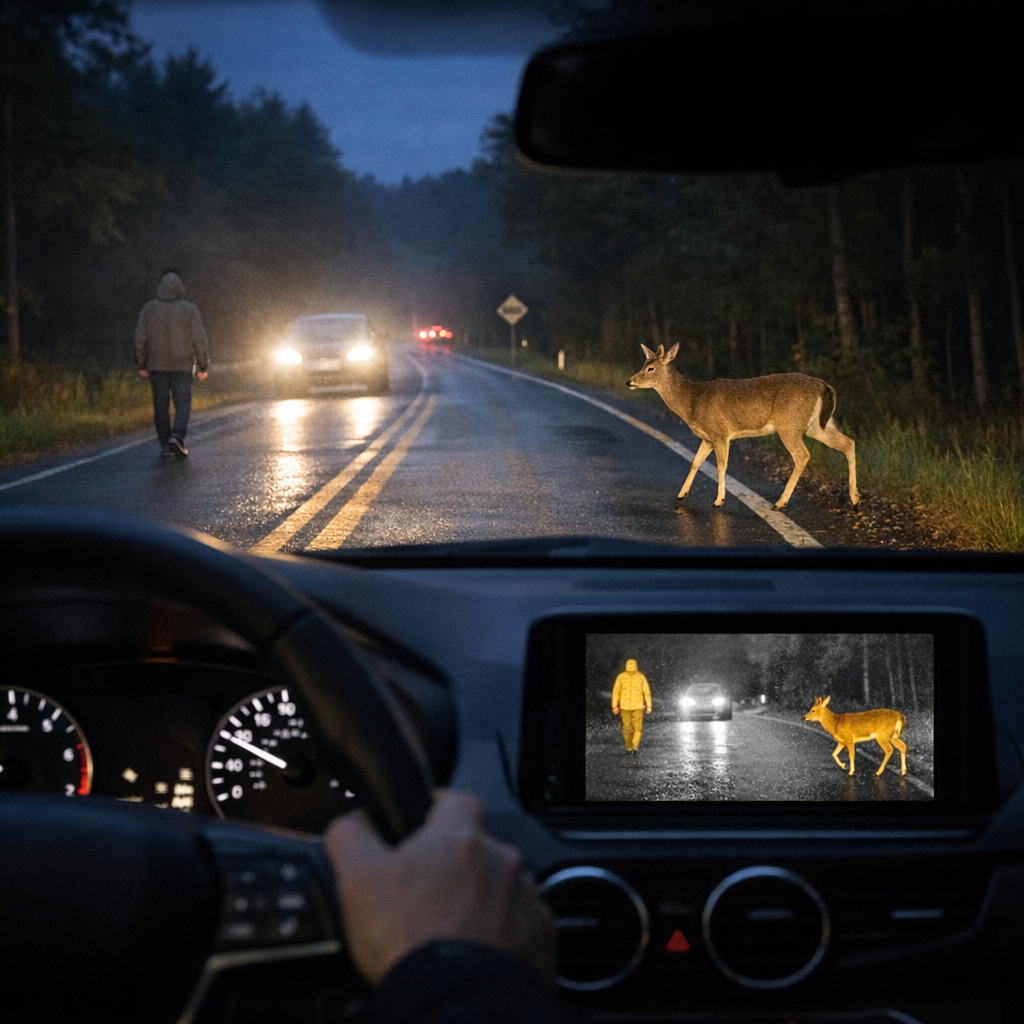
Thermal imaging can detect heat signatures from pedestrians, animals, and vehicles in darkness or poor visibility. Unlike visible-light cameras, thermal systems do not depend on ambient light in the same way. That makes them useful in situations where headlights and standard cameras struggle.
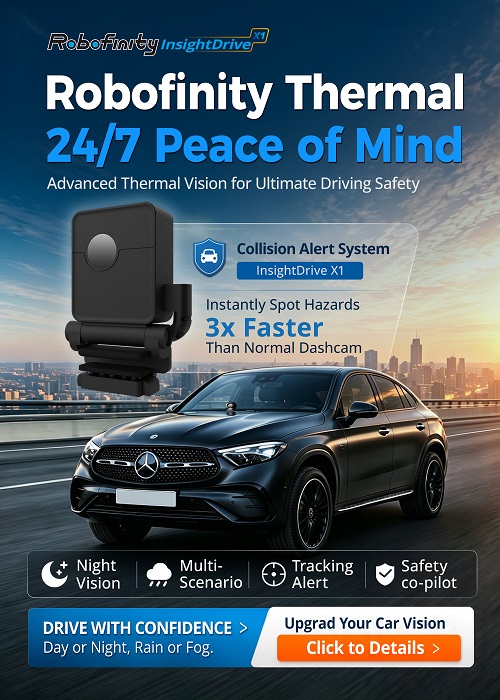
For drivers who frequently travel at night on rural roads, highways, or in poor weather, a thermal night vision system can be an extra layer for improving night driving visibility. For example, a thermal system like Robofinity InsightDrive Car Thermal Night Vision is designed to improve awareness in low-light and low-visibility environments, helping turn hard-to-see road risks into visible thermal imagery.
Lane departure and collision warning features
Many vehicles include driver-assistance systems that can alert you to lane drift, forward collision risk, or nearby obstacles. These features can be helpful on long night drives when concentration starts to fade, though they still require an attentive driver.
Adaptive lighting systems
Some vehicles adjust headlight direction and intensity based on steering angle, speed, or traffic conditions. These systems can help illuminate curves more effectively and reduce glare in certain scenarios.
Why technology still has limits
No camera, sensor, or alert system can see everything. Fog, heavy snow, dirty lenses, unusual road surfaces, and extreme weather can still interfere with performance. That is why night visibility technology should be seen as an additional layer of awareness, not a guarantee of safety.
Night Driving in Rain, Fog, and Snow
Poor weather at night creates a multiplying effect. Each condition already reduces visibility; combined with darkness, the challenge becomes even greater. That’s why night driving visibility can change dramatically after a sudden weather shift.
Rain
Wet roads reflect headlights and create glare. Heavy rain can also blur lane markings and make it harder to see brake lights at a distance. Slow down and increase following distance.
Fog
Fog scatters light and can make high beams less effective by reflecting light back into your eyes. Low beams usually perform better in fog because they aim downward and reduce reflected glare.
If fog is a frequent problem on your routes, also read Car Thermal Camera Fog: Must-Have Solution for Safer Driving.
Snow
Snow can obscure road edges, cover lane markings, and reflect light in unpredictable ways. Fresh snowfall can also hide potholes, curbs, and debris. Night snow driving requires extra caution and reduced speed.
Mist and humidity
Even mild moisture in the air can change how light behaves. If you have ever felt that headlights “disappear” into a gray wall, humidity and light scatter may be part of the reason for reduced night driving visibility.
What to Check Before You Drive at Night
A few minutes of preparation can make a meaningful difference in night driving visibility and overall safety.
Vehicle checklist
- confirm headlights and taillights work
- clean windshield, mirrors, and windows
- check tire condition and pressure
- test wipers and washer fluid
- make sure dashboard brightness is comfortable
- remove clutter that blocks your view
Driver checklist
- avoid driving when drowsy
- wear any corrective lenses you need
- reduce distractions before you start
- plan your route in advance
- allow extra travel time so you do not rush
When Night Driving Requires Extra Caution
Some situations deserve a higher level of awareness than others, because the visibility you get can change quickly—along with your night driving visibility.
Long-distance driving
Fatigue and reduced concentration become more likely over longer trips. Taking regular breaks matters just as much as maintaining the vehicle.
Driving in unfamiliar areas
You are more likely to miss signs, turns, lane changes, and hazards when you do not know the road layout. Slow down and use navigation early enough to avoid sudden maneuvers.
Driving near wildlife zones
If road signs indicate animal crossings or if the area is wooded or open farmland, treat night driving with added caution. Many collisions with animals happen when visibility is limited and speed is high—two factors that directly reduce night driving visibility and your reaction time.
Heavy traffic with glare
Bright headlights, reflective road signs, and constant lane changes can be tiring. In traffic, staying calm and keeping your lane discipline is often more important than trying to outpace other drivers. Glare can effectively shrink night driving visibility even when the road looks “bright” at first glance.
FAQ
Why is night driving more dangerous than daytime driving?
Night driving is more dangerous because night driving visibility is lower, glare is stronger, and it is harder to judge distance, lane position, and hazards ahead. Fatigue also tends to be more common at night.
What is the biggest risk during night driving?
The biggest risk is often delayed hazard detection. Pedestrians, animals, unlit vehicles, and road debris can appear too late for a quick reaction if you are driving too fast or not scanning ahead. When night driving visibility is reduced, this delayed detection becomes more likely.
How can I improve visibility while driving at night?
Keep headlights clean and properly aimed, use the correct beam, clean your windshield and mirrors, reduce speed, and increase following distance. Regular vehicle maintenance also helps make night driving visibility more predictable.
Are high beams always better at night?
No. High beams help on dark roads with no oncoming traffic, but they should be switched off when other drivers are nearby. Improper use can create dangerous glare and reduce night driving visibility.
Can technology help with night driving?
Yes, certain driver-assistance technologies can improve awareness. Thermal imaging systems, collision alerts, and adaptive lighting may help drivers notice hazards earlier and protect night driving visibility, but they do not replace attentive driving.
Should I rely on night vision or thermal imaging instead of headlights?
No. Thermal imaging can support awareness in dark or poor-visibility conditions, but headlights, mirrors, safe following distance, and careful driving are still essential. Technology should enhance night driving visibility, not replace safe driving fundamentals.
Conclusion
Night driving is more dangerous because it reduces night driving visibility, increases glare, and makes it harder to detect hazards in time. Add fatigue, weather, and unfamiliar roads, and even routine trips can become more demanding.
The safest approach is to combine smart driving habits with good vehicle maintenance and, where appropriate, helpful driver-assistance technology. When you keep headlights clean, slow down, scan farther ahead, and stay alert to pedestrians, animals, and road conditions, you protect night driving visibility and significantly lower your risk.
For deeper guidance on night safety upgrades, explore Night Vision Driving: 7 Powerful Safety Tips.
Reference: For general guidance on visibility and safe driving practices, see the U.S. National Highway Traffic Safety Administration (NHTSA) Road Safety resources.