


SEO Title: Wildlife on the Road at Night: Safe Driving Steps That Reduce Collision Risk
- What to Do Immediately When Wildlife Appears
- Why Swerving Is Often More Dangerous Than Braking
- How to Brake Without Losing Control
- Do Not Assume an Animal Will Move Predictably
- Use Headlights Strategically
- When and How to Use the Horn
- Recognizing High-Risk Locations and Conditions
- Build a Better Night-Driving Scanning Routine
- Technology Can Support Awareness, but It Has Limits
- What to Do If a Collision Is Unavoidable
- Do Not Approach an Injured Animal
- Check the Vehicle Before Driving Away
- How to Reduce Wildlife Risk Before a Night Journey
- Maintain Tires, Brakes, and Lights
- Plan for Rural and Forest Routes
- Leave More Space
- Secure Passengers and Cargo
- Practical Responses in Common Scenarios
- A Deer Stands at the Edge of a Rural Road
- An Animal Appears While Another Car Is Approaching
- Wildlife Appears on a Wet Bend
- An Animal Crosses on a Motorway
- You See Movement but Cannot Identify It
- Frequently Asked Questions
- Should I swerve to avoid hitting a deer?
- Should I use high beams when wildlife is nearby?
- What should I do after hitting an animal at night?
- Why do deer sometimes freeze in headlights?
- Are animal whistles effective on cars?
- Can thermal night vision replace normal headlights?
- Make Control Your First Priority
Meta Description: Learn how to respond safely when deer or other wildlife appear at night, including braking, steering, visibility, roadside safety, and prevention tips.
Driving after dark can become dangerous in seconds when a deer, wild boar, elk, fox, or other animal enters the road. When you encounter wildlife while driving at night, the safest response is usually to reduce speed firmly, keep the vehicle under control, and avoid a sudden swerve into another lane or roadside hazard. Knowing what to do before that moment arrives can help you make a controlled decision instead of reacting on instinct.
This guide explains how to recognize wildlife hazards, respond when an animal appears, handle a collision, and reduce risk on future nighttime journeys. It applies to rural roads, forest routes, motorways, suburban edges, and other places where animals and traffic may cross paths.
What to Do Immediately When Wildlife Appears

The correct response depends on distance, road conditions, surrounding traffic, and the animal’s movement. However, a simple sequence works in many situations:
- Take your foot off the accelerator.
- Brake firmly while keeping the vehicle stable.
- Hold the steering wheel with both hands.
- Stay in your lane unless you can clearly confirm another path is safe.
- Sound the horn if there is enough time and doing so will not distract you.
- Prepare for more animals to follow.
- If impact is unavoidable, continue braking and prioritize vehicle control.
Check your mirrors as part of your normal awareness, but do not let concern about a following vehicle prevent you from braking for an immediate obstruction. Progressive, decisive braking gives other drivers more opportunity to notice your brake lights than a last-second maneuver.
More EV News

At the same time, do not fixate on the animal. Look toward the safe path you want the vehicle to follow. Drivers tend to steer toward what they stare at, particularly during high-stress events.
Why Swerving Is Often More Dangerous Than Braking
A sudden steering input may feel like the obvious way to miss an animal. In reality, swerving can turn one hazard into several.
You may enter opposing traffic, clip another vehicle, leave the paved surface, hit a tree, roll on a soft shoulder, or lose control on wet or icy pavement. The danger is especially high in a tall vehicle, a heavily loaded car, or a vehicle towing a trailer.
Modern stability-control systems can help manage some loss of traction, but they cannot overcome physics or create space where none exists. Even with advanced vehicle safety technology, a high-speed lane change on a narrow road remains risky.
The practical rule is to brake in a straight line and maintain your lane unless you have enough time to identify a genuinely clear escape route. An empty-looking shoulder may contain a ditch, barrier, cyclist, pedestrian, parked vehicle, or uneven ground that headlights do not reveal clearly.
How to Brake Without Losing Control
If your vehicle has an anti-lock braking system, press the brake pedal firmly and maintain pressure. You may feel pulsing through the pedal as the system works. Do not pump the brakes on an ABS-equipped vehicle.
In a vehicle without ABS, wheel lock is more likely under hard braking. The driver may need to ease pressure slightly if the wheels lock and steering response disappears. Because braking behavior varies by vehicle, understanding your car’s equipment before an emergency matters.
Your available stopping distance also changes with:
- Vehicle speed
- Tire condition and pressure
- Wet, snowy, icy, or loose road surfaces
- Vehicle load
- Brake condition
- Downhill gradients
- Driver reaction time
Reducing speed before entering a wildlife-prone area is far more effective than relying on emergency braking once an animal is directly ahead. A modest speed reduction provides more time to identify movement and shortens the distance required to stop.
Do Not Assume an Animal Will Move Predictably
Wild animals do not follow road rules, and their behavior can change abruptly. One may stop in the lane, reverse direction, run alongside the vehicle, or cross and then turn back.
Some species also travel in groups. A deer crossing safely may be followed by another animal seconds later. Wild boar may move as a group, and smaller animals may be difficult to distinguish from roadside vegetation until they enter the beam of the headlights.
After one animal crosses, continue at a reduced speed and scan both sides of the road. Do not accelerate immediately because the visible animal has cleared your lane.
Large Animals Require Extra Caution
A collision involving a large deer, elk, moose, horse, cow, or similar animal can cause severe damage. The animal’s body may strike the hood, windshield, or roof area rather than remaining below the front of the vehicle.
Avoid trying to predict the exact outcome or make an extreme maneuver based solely on the animal’s size. The priority remains maximum practical speed reduction and stable vehicle control. The lower the impact speed, the more energy you remove from the collision.
Small Animals Still Create Serious Decisions
Drivers often instinctively swerve for a rabbit, fox, raccoon, or other small animal. On a busy, narrow, or high-speed road, that maneuver may expose the occupants and other road users to a much greater hazard.
Brake as conditions allow, keep the vehicle stable, and avoid crossing into an unsafe lane or leaving the roadway. This is emotionally difficult, but preserving control is generally the safest choice when no confirmed escape route exists.
Use Headlights Strategically
High beams can improve driving visibility on unlit roads, but only when they are legal and will not dazzle another road user. Dip the headlights for approaching traffic and when following another vehicle closely enough that glare could affect its driver.
Scan beyond the center of the lane. Look along the road edges, grassy verges, openings between trees, field entrances, and drainage areas. Reflected eye shine may provide an early clue, but it is not reliable for every species, angle, or condition.
If you see eyes or movement near the road:
- Reduce speed before reaching the animal.
- Cover the brake pedal.
- Move away from cruise control.
- Watch the opposite verge for additional animals.
- Be ready for an abrupt crossing.
Do not overdrive your headlights. You should be able to stop within the distance you can see to be clear. If curves, hill crests, rain, fog, glare, or dirty glass shorten that visible area, reduce speed accordingly.
When and How to Use the Horn
A brief horn signal may encourage an animal to move away, but it is not guaranteed to produce a helpful response. The animal may freeze, bolt forward, or reverse direction.
Use the horn as a secondary measure after reducing speed and establishing control. Do not substitute repeated horn use for braking. Flashing headlights is also unreliable and may leave you with poorer vision when your eyes readjust, particularly if you switch rapidly between high and low beams.
The safest assumption is that the animal may remain in your path.
Recognizing High-Risk Locations and Conditions
Wildlife can appear anywhere, but the likelihood is often greater where roads divide natural habitat or connect feeding, water, and shelter areas.
Pay closer attention around:
- Forest and woodland edges
- Agricultural fields and hedgerows
- Rivers, streams, lakes, and drainage channels
- Wildlife crossing signs
- Parks and protected areas
- Recently harvested fields
- Roads with previous animal-collision evidence
- Rural routes with limited fencing
- Suburban areas beside green corridors
Dawn and dusk commonly involve wildlife movement, but full darkness is not automatically safer. Seasonal breeding, migration, food availability, weather, and human activity can all influence when animals travel.
A warning sign does not mean an animal will appear at one exact point. Treat it as notice that the surrounding stretch of road deserves greater attention and a more conservative speed.
Build a Better Night-Driving Scanning Routine
Good observation is not a fixed stare down the center of the road. Use a repeating scan that takes in the distance ahead, lane position, road edges, mirrors, and instrument display.
Keep instrument lighting bright enough to read but not so bright that it degrades your view outside. Clean the inside and outside of the windshield because haze, fingerprints, and condensation scatter light and amplify glare. Clean headlamp lenses and check that both low and high beams work properly.
Your own condition matters just as much as the vehicle. Fatigue reduces hazard recognition and delays decisions. If your eyes feel heavy, you miss signs, or your lane position becomes inconsistent, stop in a safe place rather than attempting to push through the journey.
Nighttime road safety depends on seeing a hazard early enough to act. It is not simply a question of whether the headlights illuminate it eventually.
Technology Can Support Awareness, but It Has Limits
Some vehicles use forward cameras, radar, automatic emergency braking, or night-vision systems to support hazard detection. Capabilities vary substantially by vehicle and system, and not every feature is designed or validated to recognize every species in every condition.
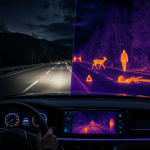
Thermal imaging can add another source of information because it identifies heat patterns rather than relying only on visible light. For example, Robofinity InsightDrive is a vehicle thermal imaging night vision system designed to support awareness of pedestrians, animals, vehicles, and obstacles in low-light or poor-visibility conditions. It remains driver-assistance technology, not a substitute for headlights, mirrors, safe speed, braking distance, traffic laws, or attention.
Any added display can also become a distraction if it draws the driver’s eyes away from the road. Alerts should be treated as prompts to evaluate the situation, not instructions to make an automatic steering maneuver. Drivers considering an aftermarket system should assess display placement, installation quality, field of view, alert behavior, and how naturally it fits their normal scanning routine.
What to Do If a Collision Is Unavoidable
Sometimes an animal enters the lane too close for the vehicle to stop. Continue braking firmly, hold the steering wheel, and maintain a stable path. Do not release the brake because impact seems inevitable; every reduction in speed may matter.
Keep your seat belt fastened and sit in a proper driving position. Avoid leaning or turning away from the road. If an impact occurs, bring the vehicle to a controlled stop as soon as it is safe.
After stopping:
- Switch on the hazard lights.
- Move out of active traffic if the vehicle can be driven safely.
- Turn off the engine if the vehicle is badly damaged or leaking fluid.
- Check yourself and passengers for injuries.
- Contact emergency services when anyone is injured or the crash creates an immediate road hazard.
- Warn other traffic only from a safe location.
- Follow local reporting requirements for wildlife collisions.
Procedures differ between countries and regions, especially for protected species, livestock, or large game. Police, road authorities, animal-control services, or wildlife agencies may handle the incident depending on location.
Do Not Approach an Injured Animal
An injured or frightened animal can behave defensively, even if it appears motionless. Hooves, antlers, horns, teeth, and sudden movement can create a serious risk.
Stay inside the vehicle if you are stopped in a dangerous location. Do not attempt to move, treat, transport, or dispatch the animal yourself. Provide responders with your location, direction of travel, animal type if known, and whether it is blocking the road.
Keep children and pets inside the car. If you must exit because of fire or another immediate danger, move well away from traffic and the animal, preferably behind a substantial roadside barrier.
Check the Vehicle Before Driving Away
A car may look drivable while having hidden damage. Before continuing, and only if you can inspect it from a safe position, look for:
- Fluid leaks
- Tire or wheel damage
- Broken lights
- A loose bumper or underbody panel
- Windshield damage
- Steam, smoke, or unusual odors
- Warning lights
- Restricted steering
- Unusual braking behavior
Do not continue if steering, braking, lighting, visibility, tire condition, or cooling appears compromised. Debris dragging under the vehicle can detach and endanger others. A damaged radiator or cooling component may also cause overheating shortly after the crash.
Photograph the scene and damage only when it is safe and lawful to do so. Record the location and time for insurance or reporting purposes, but never stand in a live lane to collect evidence.
How to Reduce Wildlife Risk Before a Night Journey
Preventive preparation will not eliminate animal encounters, but it improves the driver’s ability to respond.
Maintain Tires, Brakes, and Lights
Correct tire pressure, usable tread, functioning brakes, and properly working lights are fundamental. A sophisticated detection system cannot compensate for worn tires or poor braking performance.
Headlamps should also be correctly aimed. Lights aimed too low reduce useful viewing distance; lights aimed too high may create glare for other drivers without improving road coverage where it is needed.
Plan for Rural and Forest Routes
Before a long trip, review the route for unlit roads, mountain passes, forest sections, or long distances between safe stopping points. Build additional travel time into the plan so maintaining a lower speed does not feel like an unexpected delay.
On unfamiliar roads, assume that a dark bend may conceal an animal, stopped vehicle, cyclist, fallen branch, or other obstruction.
Leave More Space
Following another vehicle too closely reduces your view and your response time. Increase the gap so you can see farther ahead and brake without depending entirely on the lead driver’s reaction.
If a vehicle follows too closely, avoid speeding up beyond what visibility allows. Maintain a controlled pace and allow it to pass at a safe, legal opportunity.
Secure Passengers and Cargo
Every occupant should wear a seat belt, including on short rural journeys. Pets should be properly restrained, and loose cargo should be secured. Emergency braking can turn unrestrained items into hazards inside the cabin.
Practical Responses in Common Scenarios
A Deer Stands at the Edge of a Rural Road
Ease off the accelerator immediately and cover the brake. Do not assume the deer will remain still. Scan the opposite side for more animals, lower your speed significantly, and pass only when you have enough space to respond to a sudden crossing.
An Animal Appears While Another Car Is Approaching
Dip high beams as required, brake firmly, and remain in your lane. Swerving toward opposing traffic is likely to create a more severe conflict. Keep your eyes on the safe path while monitoring the animal’s position.
Wildlife Appears on a Wet Bend
Do as much speed reduction as possible with the vehicle settled and the steering smooth. Abrupt steering and braking together can overwhelm available grip. Avoid making multiple sharp corrections if the animal changes direction.
An Animal Crosses on a Motorway
Brake progressively but firmly and keep the car stable. Use hazard lights if traffic behind needs warning of rapidly slowing or stopped vehicles. Be prepared for secondary risks, including other animals, debris, and drivers making unpredictable maneuvers.
You See Movement but Cannot Identify It
Treat uncertain movement as a potential hazard. Reduce speed until you can determine whether it is an animal, pedestrian, roadside object, or visual effect. It is safer to lose a few seconds than to maintain speed based on an optimistic guess.
Frequently Asked Questions
Should I swerve to avoid hitting a deer?
Usually, braking firmly while maintaining control is safer than a sudden swerve. Swerving can lead to opposing traffic, a roadside object, a rollover, or loss of control. Steer away only when you have enough time to confirm that the alternative path is clear and stable.
Should I use high beams when wildlife is nearby?
High beams can help you see farther on an empty, unlit road, but they must be dipped when they could dazzle another road user. When an animal is already visible, reduce speed and prepare to stop rather than relying on brighter lights to make it move.
What should I do after hitting an animal at night?
Stop safely, activate hazard lights, check for injuries, and contact the appropriate emergency or local authority when required. Do not approach the animal. Inspect the vehicle only from a safe location, and do not drive away if safety-critical components may be damaged.
Why do deer sometimes freeze in headlights?
A sudden, intense light source can leave an animal disoriented or uncertain about where to move. Drivers should never assume the animal will continue crossing. Slow down, maintain control, and expect an unpredictable change of direction.
Are animal whistles effective on cars?
Their real-world effectiveness can be uncertain and may depend on speed, placement, environmental conditions, and animal behavior. They should never be treated as a replacement for reduced speed, attentive scanning, proper headlights, or controlled braking.
Can thermal night vision replace normal headlights?
No. A thermal imaging system may support road awareness by showing heat signatures, but it does not replace legal vehicle lighting, direct observation, mirrors, safe following distance, or driver judgment. The road scene and system display must always be interpreted in context.
Make Control Your First Priority
A wildlife encounter at night demands a fast response, but not a panicked one. Reduce speed, brake firmly, keep the vehicle stable, and avoid swerving into a hazard you cannot fully assess. Continue watching for additional animals even after the first one clears the road.
The best protection begins before an animal appears: maintain the vehicle, use lights correctly, leave sufficient following distance, manage fatigue, and adjust speed to the distance you can actually see. On the next nighttime journey, make a deliberate habit of scanning road edges and treating unexplained movement as a reason to slow down.