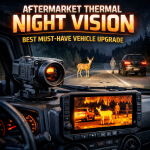



Thermal night vision is becoming a practical fleet-safety upgrade because it helps drivers spot heat-based hazards earlier when visibility breaks down at night. Logistics fleets spend much of their operation on tight schedules, long routes, and unpredictable lighting conditions—so the ability to detect heat signatures can support better timing, safety, and consistent vehicle uptime.
- What Thermal Night Vision Does for Fleet Operations
- Why Fleets Face a Different Risk Profile at Night
- The Most Relevant Fleet Benefits
- Earlier warning in low-light conditions
- Better support on rural and suburban routes
- More confidence in poor weather and glare
- Improved situational awareness for multi-stop work
- Where Thermal Night Vision Fits in the Safety Stack
- Practical Fleet Scenarios Where It Helps Most
- Long-haul and overnight freight
- Regional delivery on mixed roads
- Depot, yard, and industrial site movement
- Seasonal operations in wildlife-heavy regions
- What It Can Recognize, and What It Cannot
- Buying and Deployment Considerations for Fleet Managers
- Route profile
- Driver workload
- Installation and vehicle compatibility
- Training and policy
- Lifecycle and maintenance
- Why Thermal Night Vision Can Make Financial Sense
- Limitations Fleet Decision-Makers Should Not Ignore
- A Simple Evaluation Framework for Fleets
- FAQ
- Is thermal night vision useful for all logistics fleets?
- Does thermal night vision replace headlights?
- Can thermal imaging driver assistance help with pedestrian and animal detection?
- Is it only useful on highways?
- Does thermal night vision work in bad weather?
- Should fleet managers train drivers on it?
- Conclusion
What Thermal Night Vision Does for Fleet Operations

Thermal night vision works differently from standard headlights or visible-light camera systems. Instead of relying on visible light, it detects heat signatures and presents them in a way that helps drivers notice living beings and other heat-emitting objects earlier in low-light conditions. In fleet use, that matters because many serious risks do not appear in a perfect line of sight. A pedestrian near a service road, a cyclist near a warehouse entrance, or an animal on an unlit rural route can be hard to spot until the situation becomes urgent.
The goal is not to replace the driver’s eyes or judgment. Thermal imaging driver assistance extends awareness so the driver can react sooner when the road is dim, the weather is poor, or glare from opposing traffic reduces the value of conventional lighting. In practical terms, this additional margin can help reduce the chance of a close call.
Why Fleets Face a Different Risk Profile at Night
Fleet vehicles are not driven like private cars. They operate on schedules, on repeat routes, and often under pressure to keep deliveries moving. That combination creates distinct nighttime challenges.
First, commercial vehicles often run when traffic is lighter, so a driver may be moving faster relative to how much information is available ahead. A road can look empty until it isn’t. Second, logistics routes commonly include industrial areas, loading zones, and rural connectors where lighting is inconsistent. Third, drivers may encounter fatigue over long shifts, which can slow the time it takes to notice a hazard.
Night driving safety in fleet work is also shaped by the vehicle itself. Larger trucks and vans sit higher, have wider blind zones, and often carry cargo that limits rearward visibility. Mirrors and standard cameras help, but they cannot always reveal a person in dark clothing standing near a loading bay or an animal stepping into a roadside shoulder. Thermal night vision adds a different layer of detection that can be useful precisely where ordinary visibility breaks down.

The Most Relevant Fleet Benefits
Earlier warning in low-light conditions
The biggest reason fleets look at thermal night vision is earlier hazard recognition. A driver does not need to wait for a headlight beam to fully reveal a person, animal, or stopped vehicle. That extra detection margin can matter most when braking distance is already stretched by speed, weather, or load weight.
Better support on rural and suburban routes
Many logistics operators run routes that are part highway, part industrial park, and part rural access road. These environments are where thermal imaging driver assistance often delivers the greatest value. Street lighting can disappear quickly outside city centers, and wildlife encounters are more common on the edges of towns and near open land. For fleets that regularly cross these zones, night vision support can be a sensible risk-management layer.
More confidence in poor weather and glare
Rain, mist, snow, and headlight glare all complicate night driving. Thermal night vision systems are not immune to weather, but they can still provide useful contrast when visible-light viewing is compromised. This does not mean drivers can treat the technology as a shield. It does mean thermal imaging can help highlight a heat source that would otherwise blend into a dark background.
Improved situational awareness for multi-stop work
Fleet drivers making repeated stops often spend time entering and exiting yards, depots, and customer sites. These are environments where people may be walking unexpectedly near moving vehicles. Thermal imaging driver assistance can add awareness during slow-speed maneuvering, especially before full headlight illumination reaches the path ahead.
Where Thermal Night Vision Fits in the Safety Stack
A common mistake is to treat any advanced driving aid as a standalone answer. Thermal night vision works best as part of a broader safety stack that includes good fleet policies, properly aimed headlights, mirrors, cameras, driver training, and sensible scheduling.
For example, a driver-assistance technology system can support road awareness, but it does not replace safe following distance, speed discipline, or an alert driver. It also does not remove the need to scan for pedestrians, cyclists, debris, and lane changes. The right use case is support, not substitution.
This is why thermal imaging driver assistance is often easiest to justify in fleets that already invest in layered safety measures. If a company is serious about reducing nighttime risk, it should view thermal night vision as one more tool in a broader operating system, not as a single fix. For additional context, you can also review Thermal Imaging Safety: How It Improves Driver Assistance for Safer Night Driving.
Practical Fleet Scenarios Where It Helps Most
Long-haul and overnight freight
Long-haul drivers often operate when fatigue risk is highest and visual cues are weakest. On dark interstates, thermal imaging driver assistance can help with earlier awareness of people or animals near the roadway, especially around construction zones, breakdown shoulders, and exit ramps.
Regional delivery on mixed roads
Regional fleets often transition from highways to local streets and then to unlit access roads. That is a tough environment for any driver because speed, lighting, and road design change quickly. Thermal night vision can support those transitions by providing additional information before the vehicle enters a darker area.
Depot, yard, and industrial site movement
Accidents do not only happen at speed. Low-speed collisions in yards and loading areas are a real issue for fleets. Thermal imaging driver assistance can help drivers notice workers, forklift paths, and other moving objects when the area is poorly lit or cluttered.
Seasonal operations in wildlife-heavy regions
Some fleets operate through regions where animals on the road are an ordinary hazard. This is especially relevant for early morning and late-night travel. Thermal night vision is useful because animal detection is exactly the sort of situation where heat-based awareness can be more meaningful than visible-light contrast alone.
What It Can Recognize, and What It Cannot
The most useful systems do more than provide a heat map. In practice, fleets care about whether thermal imaging driver assistance helps drivers interpret what they are seeing quickly enough to act. Depending on the platform, thermal night vision may support recognition of pedestrians, animals, vehicles, or other obstacles ahead.
That said, limitations matter. Thermal night vision can struggle with fine visual detail. It may show that something is present without explaining everything about it. It is also not a substitute for lane discipline, road signs, reflective markings, or clean windshields. Visibility can still be affected by heavy fog, severe weather, dirty lenses, or obstructed mounting positions. A fleet that installs thermal imaging still needs maintenance routines and driver instruction to keep it effective.
In other words, thermal imaging is strongest when the question is “Is something there?” It is less complete when the question is “What exactly is it?” That distinction affects driver behavior and the expectations that fleet leadership sets internally.
Buying and Deployment Considerations for Fleet Managers
Fleet managers evaluating thermal night vision should focus on operational fit, not just the technology headline.
Route profile
Start with route patterns. Fleets that spend most of their time in well-lit urban centers may see less value than fleets that operate at night on highways, rural connectors, industrial estates, or mixed-access roads. The more variable and poorly lit the route, the stronger the case tends to be.
Driver workload
Systems that are too distracting can create more problems than they solve. A thermal display should support quick interpretation at a glance. Drivers should not need to spend extra time decoding the screen during normal operation. When thermal imaging driver assistance alerts are designed well, drivers can use them as an additional signal rather than a second job.
Installation and vehicle compatibility
Fleet vehicles vary in cabin layout, electrical setup, and mounting options. Some solutions are easier to integrate than others. Before deployment, managers should consider whether the thermal night vision system fits the vehicle class, whether it can be installed without interfering with existing equipment, and how it will be maintained across a mixed fleet.
Training and policy
Technology only helps if drivers know how to use it responsibly. Fleet policy should define when thermal imaging driver assistance is most useful, what it does not replace, and how alerts should be handled. Clear guidance reduces overreliance and encourages consistent behavior.
Lifecycle and maintenance
Any camera or sensor mounted on a working vehicle is exposed to vibration, dirt, weather, and road grime. Fleets should plan for cleaning, inspection, and periodic checks. A thermal night vision system that is not maintained can silently lose value over time.
Why Thermal Night Vision Can Make Financial Sense
Logistics fleets usually justify technology through operational impact. The right question is not whether thermal night vision sounds advanced. The question is whether thermal imaging driver assistance can reduce exposure to avoidable nighttime risk in a way that supports the business.
A minor collision, an animal strike, or a low-speed yard incident can create costs that extend beyond repair bills. There can be vehicle downtime, route disruption, claims handling, and driver inconvenience. If thermal night vision helps prevent even a small number of avoidable events, it may be worth serious consideration for fleets that run high-risk routes.
That does not mean every fleet needs it. A well-lit urban delivery operation may get more value from other safety upgrades. But for fleets that regularly drive in darkness or poor visibility, thermal night vision can fill a real operational gap. If you are still comparing options, the broader overview in Car Thermal Night Vision System: Is It Really Useful? (2026 Guide) can help you think through real-world expectations.
Limitations Fleet Decision-Makers Should Not Ignore
A realistic buying decision starts with boundaries.
Thermal night vision does not eliminate risk. It does not guarantee that a driver will react in time, and it does not make unsafe habits safer. Speed still matters. Following distance still matters. Fatigue still matters. So do weather conditions, road design, and vehicle condition.
It is also important not to overstate thermal imaging driver assistance in all conditions. Visibility problems caused by rain, fog, or snow can still challenge any driver-assistance technology. A fleet manager should be skeptical of any solution described as a complete answer. The right framing is improved awareness, not total protection.
A Simple Evaluation Framework for Fleets
If you are assessing whether thermal night vision belongs in your fleet, use a straightforward framework:
- Identify the routes with the highest nighttime exposure.
- Review the types of hazards most often encountered on those routes.
- Decide whether the current safety setup gives drivers enough awareness in low light.
- Estimate the operational value of reducing night-related incidents.
- Check whether thermal imaging driver assistance can be installed, maintained, and used consistently across the fleet.
This keeps the decision grounded in actual use cases instead of marketing language. For additional safety context and human-factors guidance, see NHTSA road safety resources.
FAQ
Is thermal night vision useful for all logistics fleets?
No. It is most useful for fleets that regularly drive at night, on rural roads, in poor weather, or in environments with limited lighting. Urban fleets with short daytime routes may find less value.
Does thermal night vision replace headlights?
No. Headlights, mirrors, and driver attention are still essential. Thermal imaging is an additional awareness tool, not a replacement.
Can thermal imaging driver assistance help with pedestrian and animal detection?
Yes. Heat-based imaging can make pedestrians and animals easier to notice in dark or low-contrast conditions.
Is it only useful on highways?
No. It can also help in depots, yards, industrial sites, and mixed-route driving where lighting changes quickly.
Does thermal night vision work in bad weather?
It can still be useful in some poor-visibility situations, but it is not immune to weather limitations. Heavy fog, snow, dirt, and other conditions can still affect performance.
Should fleet managers train drivers on it?
Yes. Any driver-assistance technology works better when drivers understand what it can and cannot do, and when they know how to use it without overreliance.
Conclusion
For logistics fleets, thermal night vision is worth considering because it addresses a real operational problem: the difficulty of seeing hazards clearly when the road is dark, the weather is poor, or the route is unfamiliar. It is especially relevant for fleets that run overnight, travel rural corridors, or move through mixed industrial and suburban areas where pedestrians, animals, and vehicles may appear late.
The strongest case for thermal imaging driver assistance is not that it makes driving easy. It is that it can improve awareness in conditions where ordinary visibility falls short—so drivers can make safer decisions sooner. For fleet managers, that makes thermal imaging driver assistance a practical safety discussion rather than a novelty feature.