


Choosing between a hybrid and a gasoline-powered vehicle in 2026 comes down to more than sticker price or brand preference. For many buyers, the real question is how much they’ll spend at the pump over the life of the car. With fuel economy standards tightening, hybrid technology improving, and gasoline engines becoming more efficient, the gap is not always as obvious as it once was. Still, when you compare a 2026 hybrid vs gasoline model side by side, the hybrid usually has the edge in fuel savings—especially for drivers who spend a lot of time in city traffic or rack up high annual mileage.
- How Hybrids and Gasoline Cars Use Fuel Differently
- What Makes a Hybrid More Efficient
- How Gasoline Cars Have Improved
- Why the Gap Is Smaller Than It Used to Be
- The Fuel Savings Difference in Real-World Driving
- City Driving Favors Hybrids
- Highway Driving Narrows the Gap
- Mixed Driving Makes Comparison More Complicated
- Which 2026 Model Saves the Most on Fuel?
- Hybrids Usually Win on Total Fuel Costs
- Gasoline Cars Can Still Be the Better Value for Some Drivers
- How Break-Even Math Helps
- Factors That Affect Fuel Savings Beyond the Powertrain
- Vehicle Size and Weight
- Drivetrain and Trim Level
- Driving Habits
- Climate and Terrain
- Traffic Patterns and Idle Time
- Cost of Ownership: Fuel Isn’t the Only Expense
- How to Decide Which One Makes Sense for You
- Hybrid vs Gasoline fuel savings: the practical takeaway
That said, the most fuel-efficient choice depends on how you drive, where you drive, and how long you plan to keep the vehicle. A hybrid may save you more on fuel overall, but a gasoline model can sometimes make more sense if your driving habits don’t match the conditions where hybrids shine. Understanding the differences can help you make a smarter, more cost-effective decision.
- How Hybrids and Gasoline Cars Use Fuel Differently
- The Fuel Savings Difference in Real-World Driving
- Which 2026 Model Saves the Most on Fuel?
- Factors That Affect Fuel Savings Beyond the Powertrain
- Cost of Ownership: Fuel Isn’t the Only Expense
- How to Decide Which One Makes Sense for You
- The Bottom Line
How Hybrids and Gasoline Cars Use Fuel Differently
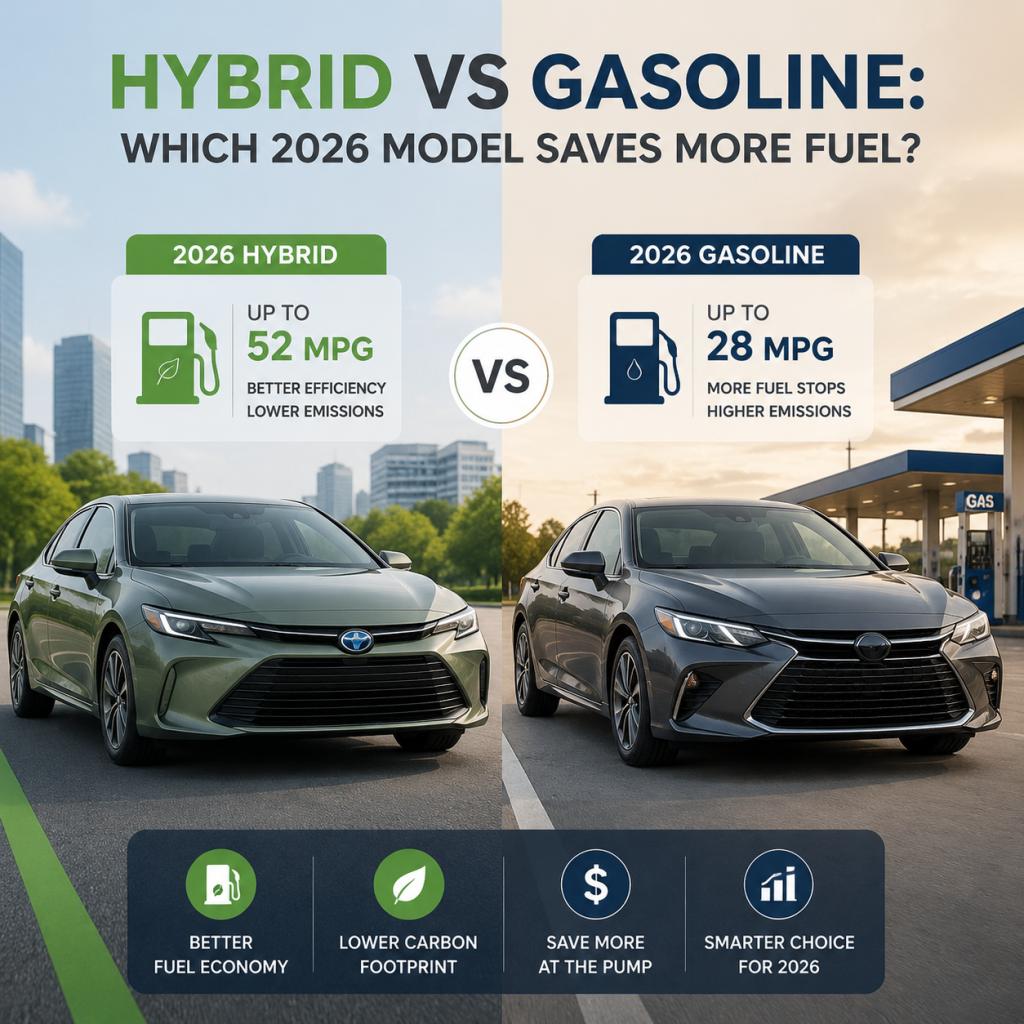
The biggest distinction between hybrid and gasoline vehicles is how they generate power. In a hybrid vs gasoline comparison, that difference shapes both fuel use and everyday driving behavior. It also affects how the car feels in traffic, on the highway, and during short trips around town.
What Makes a Hybrid More Efficient
A hybrid combines a gasoline engine with an electric motor and battery pack. The system can switch between the two power sources or use them together depending on driving conditions. In stop-and-go traffic, the electric motor can do much of the work, reducing fuel use. Regenerative braking also helps by capturing energy that would otherwise be lost and storing it in the battery.
This setup makes hybrids especially efficient in urban driving, where frequent braking and acceleration would normally hurt fuel economy in a traditional car. That is one reason the hybrid vs gasoline debate often favors the hybrid for commuters. It is also why many shoppers notice the biggest savings after a few months of real-world driving rather than in a brochure comparison alone.
How Gasoline Cars Have Improved
Gasoline engines have also become more efficient in recent years. Features like turbocharging, direct injection, cylinder deactivation, and smarter transmissions help reduce fuel consumption. Some 2026 gasoline models now post impressive highway mpg ratings, and for drivers who spend most of their time cruising at steady speeds, the difference from a hybrid may be smaller than expected.

Still, a gasoline-only car has one major limitation: it cannot recover energy during braking or rely on electric assistance to reduce engine load. That usually gives hybrids the advantage in overall efficiency. Even when the numbers look close on paper, the day-to-day hybrid vs gasoline result often depends on how much time the engine spends idling or accelerating from a stop.
Why the Gap Is Smaller Than It Used to Be
Ten years ago, the fuel-economy gap between these powertrains was often dramatic. Today, the gap is more nuanced. A well-designed gasoline sedan can be surprisingly frugal, and a modern hybrid may not always deliver huge highway gains if the trip is long and steady. That is why it is wise to compare specific trim levels instead of assuming every hybrid will outperform every gasoline model.
When buyers ask whether a hybrid vs gasoline car saves more fuel, the honest answer is that the best option depends on the exact vehicle, the engine size, and the route you drive most often. A small efficient sedan will naturally compete better than a larger crossover or truck-based model.
The Fuel Savings Difference in Real-World Driving
On paper, manufacturer mpg ratings tell an important part of the story. In real-world use, however, the savings depend heavily on driving style and environment. That is why the hybrid vs gasoline question has no one-size-fits-all answer. Two drivers in the same model can also see different results if one drives in dense traffic and the other mostly uses open highways.
City Driving Favors Hybrids
If your commute includes traffic lights, congestion, short trips, and low-speed driving, a hybrid can save a meaningful amount of fuel. Traditional gasoline engines are least efficient in these conditions because they burn fuel even when the car isn’t moving much. Hybrids, by contrast, can shut off the engine at idle and use electric power at lower speeds.
For drivers in dense urban areas, the fuel savings can be substantial over a year. In some cases, a hybrid may use 30% to 50% less fuel than a comparable gasoline model. For shoppers comparing a hybrid vs gasoline option, city use is often the deciding factor. If your daily routine includes school drop-offs, errands, and rush-hour traffic, the hybrid advantage can be especially noticeable.
Highway Driving Narrows the Gap
At highway speeds, the efficiency advantage of a hybrid often shrinks. Once a vehicle is maintaining a steady pace, the electric motor contributes less, and the gasoline engine does most of the work. Some hybrids still perform well on the highway, but a well-engineered gasoline model can come close in fuel economy.
That means if you drive long distances mostly on open roads, the extra cost of a hybrid may take longer to pay off. In that case, hybrid vs gasoline savings can be closer than many buyers expect. Drivers who log frequent interstate miles should compare annual fuel cost estimates carefully rather than relying on the mpg label alone.
Mixed Driving Makes Comparison More Complicated
Many people do not drive purely in the city or purely on the highway. Mixed driving is common, and that is where the answer can vary by commute. A hybrid can still perform well in these situations because even a short amount of stop-and-go driving helps it recover energy and reduce engine use. However, the savings are usually less dramatic than in a city-only commute.
If your schedule changes often, it helps to estimate your own average route. A hybrid vs gasoline comparison based on your actual mileage mix will be more accurate than a generic brochure estimate. That simple step can prevent disappointment and make the financial math easier to trust.
Which 2026 Model Saves the Most on Fuel?
There is no single answer for every driver, but the general pattern is clear. The hybrid vs gasoline matchup usually favors the hybrid when annual mileage is moderate to high. For buyers who drive a lot, those extra mpg points can translate into real money over the life of the vehicle.
Hybrids Usually Win on Total Fuel Costs
For most people, especially those with mixed driving or city-heavy routines, a 2026 hybrid will likely save more on fuel than a gasoline counterpart. The better mileage, lower idle consumption, and regenerative braking all add up over time.
If two similar vehicles are priced differently, the hybrid’s added cost may be offset by fuel savings after several years. This break-even point depends on the price gap between models and how many miles you drive annually. In other words, the hybrid vs gasoline decision is not only about mpg; it is also about how long you plan to own the car and how many tanks of fuel you expect to buy.
To estimate the difference more accurately, the U.S. Department of Energy’s FuelEconomy.gov is a useful reference for mpg comparisons and annual fuel cost estimates: FuelEconomy.gov mpg and fuel cost tools.
Gasoline Cars Can Still Be the Better Value for Some Drivers
A gasoline model may be the better buy if you drive relatively few miles each year, keep the car for a short time, or mostly travel on highways. In those cases, the fuel savings from a hybrid may not be large enough to justify the higher purchase price.
Gasoline vehicles also tend to have simpler drivetrains, which can mean lower repair complexity in the long run. While modern hybrids are very reliable, some buyers still prefer the familiarity and lower upfront cost of a conventional engine in a hybrid vs gasoline decision. If budget is tight, the less expensive option may deliver the best overall value even if it uses a bit more fuel.
How Break-Even Math Helps
A practical way to decide is to compare the added purchase price of the hybrid with the estimated yearly fuel savings. If the hybrid costs more upfront but saves a noticeable amount each year, you can estimate how many years it will take to recover the premium. That break-even period is often the deciding factor for shoppers who plan to keep their vehicle for a long time.
For example, a driver who keeps a car for eight to ten years may find a hybrid much easier to justify than someone who trades in every three or four years. In a hybrid vs gasoline comparison, ownership length can matter almost as much as fuel economy itself.
Factors That Affect Fuel Savings Beyond the Powertrain
Fuel economy is not determined by hybrid or gasoline status alone. Several other factors matter in any hybrid vs gasoline comparison. Looking at these details can help explain why two vehicles with similar powertrains may deliver different results.
Vehicle Size and Weight
A compact hybrid will usually outperform a larger gasoline SUV, but a compact gasoline sedan may still beat a heavy hybrid crossover. Size, aerodynamics, and curb weight all play a major role in fuel consumption. Bigger vehicles require more energy to move, especially in city traffic where acceleration happens constantly.
That means the body style matters almost as much as the engine type. If you are comparing a sedan to an SUV, the sedan may save more fuel regardless of whether it is a hybrid or gasoline model. This is another reason the hybrid vs gasoline question should be judged on specific vehicles rather than general categories.
Drivetrain and Trim Level
All-wheel drive, larger wheels, performance tires, and sport-tuned suspensions can reduce mpg ratings. A higher trim version of the same vehicle may use more fuel than the base model, even if both are available in hybrid and gasoline forms.
Some buyers focus on premium features and forget that wheel size alone can make a noticeable difference in efficiency. If fuel savings are the top priority, it is worth comparing trim-by-trim specifications before deciding which hybrid vs gasoline version fits your needs.
Driving Habits
Aggressive acceleration, hard braking, and high-speed driving reduce efficiency in both types of vehicles. Hybrids are more forgiving in traffic, but gentle driving still helps maximize savings. Smooth inputs and steady speeds can make a measurable difference over the course of a year.
Even the most efficient car cannot fully overcome poor driving habits. A calm driver in a gasoline car may get better results than an aggressive driver in a hybrid. That is why the hybrid vs gasoline outcome always includes a human factor.
Climate and Terrain
Cold weather can reduce battery efficiency in hybrids and increase fuel use in gasoline vehicles. Hilly terrain also demands more energy from both systems, though hybrids may recover some energy on the way down.
In colder climates, short winter trips can reduce hybrid benefits because the engine may run more often to warm up. On steep routes, however, the ability to recover braking energy can help the hybrid vs gasoline comparison tilt back toward the hybrid. Local weather and road conditions are often overlooked in fuel-saving calculations, but they can have a real effect.
Traffic Patterns and Idle Time
If your daily commute includes frequent idling, long lights, or heavy congestion, a hybrid usually gains even more ground. Gasoline engines waste fuel while waiting, while hybrids can often shut down the engine when the car is stopped. The more time you spend in traffic, the more likely the hybrid vs gasoline difference will show up in your fuel bill.
Cost of Ownership: Fuel Isn’t the Only Expense
While fuel savings are important, they are only part of the ownership picture. In a hybrid vs gasoline decision, ownership costs can change the final answer. A car that uses less fuel but costs significantly more to buy may not be the best deal for every household.
Upfront Price
Hybrids often cost more at purchase than comparable gasoline models. If the price difference is significant, it can take time to recover that extra cost through lower fuel bills.
For buyers who focus on monthly budgeting, that difference matters. A lower purchase price can free up cash for insurance, taxes, or maintenance, even if it means slightly higher fuel costs later. In a hybrid vs gasoline decision, the cheaper upfront option can still be the smarter short-term move.
Maintenance and Repairs
Gasoline cars usually have fewer complex components than hybrids, which can make maintenance simpler. However, hybrids do not automatically cost more to maintain. In many cases, their brakes wear more slowly because regenerative braking reduces friction brake use. For shoppers comparing options, this is one area where hybrid vs gasoline ownership costs can be closer than expected.
Routine service schedules are also changing across the industry. Some modern hybrids are engineered for long service intervals and strong reliability, so it is wise to compare warranty coverage, battery protection, and recommended maintenance before assuming one option is much cheaper to own.
Resale Value
Many hybrids hold their value well because buyers appreciate fuel efficiency. That can improve the total cost equation when it comes time to sell or trade in the vehicle.
Resale values can shift based on fuel prices, vehicle popularity, and market demand. If gas prices rise, demand for efficient cars often grows, which can support hybrid resale values. That makes the hybrid vs gasoline decision more attractive for some long-term owners.
Insurance and Tires
Insurance costs vary by model, trim, and repair complexity, so there is no universal rule that hybrids are always cheaper or more expensive to insure. Tire wear can also vary based on vehicle weight and wheel size. Some hybrids use low-resistance tires that help efficiency, but those tires may affect ride feel or replacement pricing.
When you add insurance, tires, fuel, and depreciation together, the overall picture becomes clearer. A hybrid vs gasoline comparison should always include more than the gas station savings alone.
How to Decide Which One Makes Sense for You
The best choice depends on your driving profile. The hybrid vs gasoline choice becomes easier once you match the car to your habits. A practical comparison starts with your commute, your annual mileage, and how long you intend to keep the vehicle.
Choose a Hybrid If:
- You drive a lot in the city or in traffic
- You put high mileage on your vehicle each year
- You want to minimize fuel stops
- You plan to keep the car for several years
- You want the best chance of long-term fuel savings
Choose a Gasoline Model If:
- You drive fewer miles annually
- Most of your driving is highway-based
- You want the lowest purchase price
- You prefer a simpler powertrain
- Fuel savings are less important than upfront cost
If you are still comparing budgets, a broader car-shopping guide can help you weigh purchase price against long-term value: Buying a Car: Smart Tips for the Best Deal.
It can also help to compare your fuel budget against similar ownership goals. If saving money matters more than getting the newest powertrain technology, some shoppers begin with a lower-cost vehicle and work outward from there. In that case, resources like Cheap cars: Which Car Is the Cheapest to Buy? can be useful before narrowing down a final choice.
A Simple Decision Checklist
- Estimate your yearly mileage.
- Decide whether most trips are city, highway, or mixed.
- Compare the exact mpg ratings of the vehicles you are considering.
- Calculate the price difference between the hybrid and gasoline versions.
- Estimate how long you will keep the vehicle.
- Include maintenance, insurance, and resale value in the final decision.
When those numbers are clear, the hybrid vs gasoline choice usually becomes much easier. The better fuel saver is not always the car with the best brochure mpg; it is the one that fits your daily routine and long-term budget.
Hybrid vs Gasoline fuel savings: the practical takeaway
When comparing a 2026 hybrid vs gasoline vehicle, the hybrid is usually the stronger choice for fuel savings. Its advantage is most noticeable in city driving, stop-and-go traffic, and high-mileage ownership. A gasoline model can still be a smart pick for low-mileage drivers or those who spend most of their time on the highway, especially if the upfront price difference is large.
In other words, the vehicle that saves you the most on fuel is the one that fits your real-world driving habits. For many buyers, that will be a hybrid. For others, a modern gasoline car may be the more practical and financially balanced option. The smartest move is to compare mpg ratings, estimate annual fuel costs, and think honestly about how you use your vehicle every day. If you are comparing hybrid vs gasoline models, use both your commute and your budget to decide.
For shoppers who want the broadest possible savings, the best approach is to look beyond the powertrain and consider the full ownership picture. When you combine fuel economy, purchase price, and how long you plan to keep the car, the right choice becomes much clearer.