


SEO Title: Are Night Vision Systems Useful for Pickup Trucks?
- What Night Vision Systems Actually Do
- Why Pickup Trucks Can Benefit More Than Some Other Vehicles
- Where Night Vision Helps Most
- Rural and Dark Roads
- Work Trucks and Job Sites
- Highway Driving After Dark
- Bad Weather and Low Visibility
- Where Night Vision Falls Short
- It Does Not Replace Headlights
- It Does Not Eliminate Driver Attention
- It Can Be Less Helpful in Certain Environments
- It Can Add Information Without Reducing Risk Automatically
- Practical Scenarios Where Pickup Owners Notice the Difference
- What Pickup Buyers Should Consider Before Paying for Night Vision
- 1. Where You Actually Drive
- 2. How Often You Drive After Dark
- 3. Whether You Need Awareness or Convenience
- 4. How the System Is Displayed
- 5. How It Fits With Other Safety Tech
- Robofinity as a Practical Example
- Night Vision vs. Standard Driver-Assist Features
- Thermal Imaging Systems and Pickup Truck Use
- Limitations That Matter in Real Driving
- How to Decide If It Is Worth It for Your Truck
- Ownership Advice for Drivers Who Want Better Night Safety
- FAQ
- Are night vision systems useful on pickup trucks?
- Do night vision systems work in fog or rain?
- Can a night vision system spot animals better than headlights?
- Is night vision the same as a dash camera or backup camera?
- Do pickup trucks need night vision more than cars?
- Should I buy night vision instead of better headlights?
- Conclusion
Meta Description: Night vision systems can improve pickup truck awareness in low-light and poor-visibility conditions, but they are not a replacement for headlights, mirrors, or attentive driving. Learn where they help, where they fall short, and how to decide if they fit your truck.
Are Night Vision Systems Useful for Pickup Trucks?
Night vision systems can be genuinely useful for pickup trucks, but only if you understand what they do well and what they do not do. In the right conditions, a pickup truck night vision system can improve road awareness after dark by helping drivers spot pedestrians, animals, vehicles, and obstacles sooner than headlights alone might allow. That can matter on rural roads, dark job sites, long highway drives, and in poor-visibility weather.
The short answer is yes, they can help. The more useful answer is that they are a support tool, not a replacement for safe driving habits, proper lighting, or alertness. For pickup truck owners, the value depends on how and where the truck is used.
What Night Vision Systems Actually Do

Night vision systems in vehicles are not all the same. Some use infrared light and image enhancement. Others, especially thermal imaging systems, detect heat signatures rather than simply brightening the camera feed. That difference matters because thermal imaging can sometimes reveal people or animals that are hard to see with headlights alone.
In practical terms, these systems are designed to extend the driver’s ability to notice hazards in low-light driving. They are not meant to let you drive faster at night. They are meant to give you more information earlier.

For pickup trucks, that extra awareness can be especially helpful because trucks are often used in environments where lighting is inconsistent:
- Rural roads with wildlife crossings
- Construction or work sites with minimal lighting
- Long stretches of highway at night
- Neighborhood streets with poor lighting
- Stormy or foggy conditions where contrast drops
Why Pickup Trucks Can Benefit More Than Some Other Vehicles
Pickup trucks are frequently driven in scenarios where visibility is not ideal. A family SUV may spend much of its life in suburban traffic and well-lit roads, while a truck may be used on darker routes, towing at night, or moving between job sites before sunrise.
A pickup’s higher ride height gives the driver a broader view, but it does not solve everything. Headlights still have limitations, especially when:
- A pedestrian is dressed in dark clothing
- An animal stands near the edge of the road
- A curve hides an obstacle until the last second
- Headlight glare from oncoming traffic reduces contrast
- Rain, fog, or snow blurs the scene ahead
That is where a night vision system can add value. It can support road awareness by making hazards easier to notice before they enter the beam pattern of the headlights.
Where Night Vision Helps Most
Rural and Dark Roads
This is the most obvious use case. On unlit roads, headlights only reveal what is directly in front of the truck. A thermal imaging system can help draw attention to heat sources farther ahead, which can be useful for spotting deer, livestock, cyclists, or pedestrians near the roadway.
For pickup drivers in rural areas, that early warning can be meaningful because large vehicles need more distance to brake and maneuver.
Work Trucks and Job Sites
Pickup trucks used for work often move through uneven or poorly lit areas. Crew members, tools, barriers, and equipment can all create hazards. A night vision system may help the driver notice people or objects sooner, especially in busy environments where attention is split between parking, backing, and maneuvering.
Highway Driving After Dark
Night highway driving has its own risks. Traffic can move quickly, and sudden lane changes, stopped vehicles, or debris can appear with little warning. A driver-assistance technology that improves forward awareness can be helpful here, especially on long drives where fatigue begins to affect reaction time.
Bad Weather and Low Visibility
Rain, fog, mist, and snow all reduce the effectiveness of human vision and headlights. Thermal imaging does not magically restore visibility, but it may help retain some contrast where ordinary camera systems struggle. It is especially useful when the eye has difficulty separating a hazard from a dark background.
Where Night Vision Falls Short
A useful night vision system is still limited. That is important, because some drivers assume it is a kind of advanced replacement for headlights. It is not.
It Does Not Replace Headlights
Headlights still matter for everything from lane positioning to signaling your presence to other road users. Night vision can assist with detection, but it does not illuminate the road the way proper lighting does.
It Does Not Eliminate Driver Attention
You still need to scan mirrors, check blind spots, read the road, and respond to changing conditions. A thermal imaging feed can help, but it should be treated like an extra layer of awareness, not the primary source of truth.
It Can Be Less Helpful in Certain Environments
Some hazards do not stand out well in thermal imagery. Road debris, lane markings, wet pavement, and some low-heat objects may remain difficult to interpret. In other words, the system may help you notice a warm body near the road more easily than a piece of tire debris sitting in the lane.
It Can Add Information Without Reducing Risk Automatically
More information is useful only if the driver processes it correctly. A system that adds alerts can still overload a distracted driver. Good night driving habits still matter: controlled speed, longer following distance, clean glass, and properly aimed headlights.
Practical Scenarios Where Pickup Owners Notice the Difference
A pickup night vision system is most useful when the driver regularly faces situations like these:
- Commuting before dawn on unlit roads
- Driving home late on rural routes
- Pulling a trailer at night
- Inspecting a job site after sunset
- Transporting family members in regions with frequent deer crossings
- Driving through heavy rain, fog, or snow where visibility is inconsistent
In these cases, the value is not that the system does the driving for you. The value is that it may help you identify a hazard earlier, giving you more time to slow down or adjust position.
What Pickup Buyers Should Consider Before Paying for Night Vision
If you are deciding whether this technology is worthwhile, focus on your real driving pattern rather than the feature list.
1. Where You Actually Drive
If your truck spends most of its time in bright urban traffic, the benefit may be modest. If you regularly drive on dark roads, the value rises.
2. How Often You Drive After Dark
A feature can be impressive and still be unnecessary if you rarely drive at night. Night vision systems make more sense for frequent night commuters, shift workers, rural drivers, and people who take long trips after sunset.
3. Whether You Need Awareness or Convenience
Some technology makes driving easier. Some makes it safer. Night vision is mainly about awareness. That distinction matters because it helps you judge the feature against your real needs.
4. How the System Is Displayed
A clear display, sensible alerts, and simple integration matter more than flashy presentation. If the driver has to look away too long to interpret the feed, the benefit drops quickly. Good design should support quick recognition, not create another distraction.
5. How It Fits With Other Safety Tech
Night vision is most effective when it complements other systems such as forward collision warning, automatic emergency braking, lane departure alerts, and strong standard lighting. It should be part of a broader safety setup, not a standalone answer.
Robofinity as a Practical Example
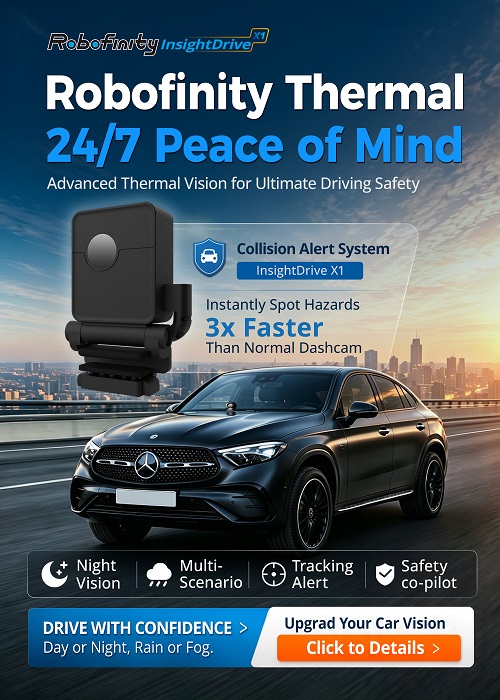
Advanced safety is not limited to factory-installed features. Drivers who often travel at night, on rural roads, or in poor-visibility conditions may also consider aftermarket driver-assistance upgrades such as Robofinity InsightDrive, a vehicle thermal imaging night vision system designed to support awareness of pedestrians, animals, vehicles, and obstacles ahead.
Night Vision vs. Standard Driver-Assist Features
It helps to separate night vision from other driver-assistance technology. A forward collision warning system uses sensors and software to detect risk and alert the driver. A night vision system focuses on helping the driver see hazards in darkness or low visibility.
That means they solve different problems.
- Collision alerts help when a vehicle is closing in too quickly.
- Night vision helps when something is difficult to see in the first place.
- Blind-spot monitoring helps with lane changes.
- Lane keeping helps maintain position.
- Night vision helps with early hazard awareness at the front of the vehicle.
For many pickup owners, the best setup is not choosing one feature over another. It is understanding how they work together.
Thermal Imaging Systems and Pickup Truck Use
Thermal imaging has a specific advantage: it reacts to heat, which can make people and animals stand out against a dark background. That is one reason it is often discussed in relation to nighttime road safety and pedestrian detection.
In pickup truck use, that can be especially relevant because:
- Trucks are often driven on long, open roads where wildlife is common
- Their mass means extra stopping distance
- Higher ride height can make the driver feel more confident than the actual conditions justify
- Towing can reduce acceleration and extend braking distance
A thermal imaging system does not change the truck’s physics, but it may help the driver respond sooner when something enters the truck’s path.
Limitations That Matter in Real Driving
The biggest mistake is assuming any night vision system makes nighttime driving easy. It does not. It only improves certain kinds of visibility.
Here are the practical limits to keep in mind:
- It does not identify every obstacle equally well
- It does not replace a clean windshield and properly aimed headlights
- It does not shorten braking distance
- It does not remove fatigue
- It does not help if the driver ignores the alerts
- It may be less useful if the display is hard to read quickly
That is why the best attitude is cautious optimism. Night vision can be useful, but it should fit into a disciplined driving routine.
How to Decide If It Is Worth It for Your Truck
A simple decision framework works better than a feature checklist.
Ask these questions:
- Do I often drive after dark?
- Do I regularly use rural roads, dark highways, or poorly lit work areas?
- Do I frequently encounter wildlife, pedestrians, or cross-traffic in low light?
- Would earlier hazard awareness make a meaningful difference for my driving?
- Am I prepared to treat the system as a supplement, not a substitute?
If you answer yes to most of those questions, night vision may be worth serious consideration. If not, you may be better served by improving your lighting, maintaining your windshield and mirrors, and choosing a trim with stronger standard safety equipment.
Ownership Advice for Drivers Who Want Better Night Safety
If you are focused on nighttime road safety, start with the basics before adding advanced equipment.
- Keep headlights clean and properly aimed
- Replace weak bulbs with correct-specification bulbs
- Keep the windshield free of streaks and chips
- Use mirrors and lane positioning correctly
- Reduce speed in unfamiliar or unlit areas
- Take fatigue seriously on long night drives
- Use driver-assistance features as support, not autopilot
For many truck owners, those habits produce more consistent safety gains than any single accessory.
FAQ
Are night vision systems useful on pickup trucks?
Yes, especially for drivers who regularly travel on dark roads, rural highways, or poor-visibility routes. They are most useful as a support tool for earlier hazard awareness.
Do night vision systems work in fog or rain?
They may help in some poor-visibility conditions, but they are not a cure for severe weather. Visibility can still be limited, and the driver still needs to slow down and drive cautiously.
Can a night vision system spot animals better than headlights?
Often, yes, because thermal imaging can make animals stand out more clearly against a dark background. But it is not perfect and should not replace careful scanning.
Is night vision the same as a dash camera or backup camera?
No. A dash camera records video, and a backup camera helps with reversing. A night vision system is designed to improve forward awareness in low light or poor visibility.
Do pickup trucks need night vision more than cars?
Not necessarily, but many pickup trucks are used in situations where it can be especially valuable, such as rural roads, towing, job sites, and long night drives.
Should I buy night vision instead of better headlights?
No. Better lighting, proper maintenance, and safe driving habits come first. Night vision is an additional awareness tool, not a replacement for good headlights.
Conclusion
Night vision systems can be useful for pickup trucks when the truck is regularly driven after dark, on rural roads, or in low-visibility conditions. Their main value is earlier hazard awareness, especially for pedestrians, animals, and obstacles that are hard to catch with headlights alone. But the limits are just as important: they do not replace driver attention, safe speed, braking distance, or proper lighting.
For pickup owners, the right decision comes down to real use. If your driving often takes you into dark, unpredictable, or poorly lit environments, night vision may be a practical safety upgrade. If most of your miles are in well-lit areas, it may be less important than core lighting and standard driver-assistance features.