

Night Driving Safety in fog is one of the most stressful situations a motorist can face. Visibility drops quickly, depth perception becomes unreliable, and familiar road markings can disappear into a gray wall. If you are looking for effective guidance for foggy roads, the answer is not a single trick but a combination of careful speed control, proper lighting, increased attention, and the right mindset. The goal is to stay calm, preserve your field of view, and give yourself more time to react when hazards appear unexpectedly.
- Why Night Fog Is So Dangerous
- How to Prepare Before You Start Driving
- Proper Lighting: Use the Right Lights, Not All the Lights
- Reduce Speed and Increase Following Distance
- Focus on Lane Position and Road Markings
- Watch for Hidden Hazards
- Use Defogging Techniques Correctly
- Handle Glare from Headlights and Streetlights
- Know When to Pull Over
- Driving on Different Road Types in Fog
- Technology That Can Help in Low-Visibility Driving
- Common Mistakes to Avoid
- Practical Night Fog Driving Checklist
- Frequently Asked Questions
- What is the best light setting for driving in fog at night?
- Should I drive slower in fog even on roads I know well?
- Is it safer to use fog lights or regular headlights?
- How can I keep my windshield from fogging up inside the car?
- What should I do if fog becomes too thick to continue?
- Can thermal imaging help in foggy night driving?
- Conclusion
Fog affects drivers differently depending on its thickness, the road type, and the surrounding light. On rural roads, you may encounter hidden curves, animals, or pedestrians with little warning. On highways, fog can make lane changes and braking distances more dangerous. In cities, reflections from streetlights and oncoming headlights can create glare that makes the road even harder to read. Understanding how to respond in these conditions can make a major difference in night driving safety.
Table of Contents
- Why Night Fog Is So Dangerous
- How to Prepare Before You Start Driving
- Proper Lighting: Use the Right Lights, Not All the Lights
- Reduce Speed and Increase Following Distance
- Focus on Lane Position and Road Markings
- Watch for Hidden Hazards
- Use Defogging Techniques Correctly
- Handle Glare from Headlights and Streetlights
- Know When to Pull Over
- Technology That Can Help in Low-Visibility Driving
- Common Mistakes to Avoid
- Practical Night Fog Driving Checklist
- Frequently Asked Questions
- Conclusion
Why Night Fog Is So Dangerous
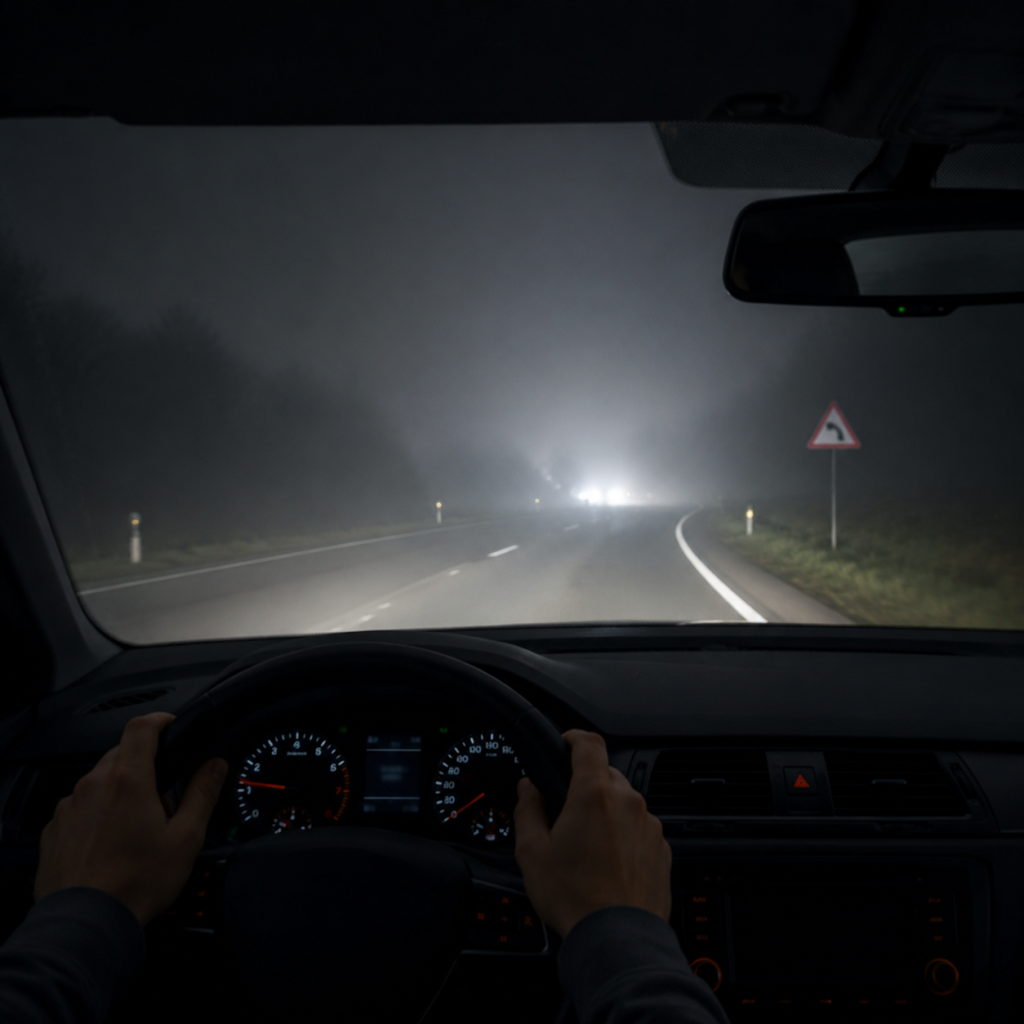
Fog is made of tiny water droplets suspended in the air. At night, these droplets scatter light from headlights, streetlights, and other vehicles, making it harder to see far ahead. That reduced visibility affects more than just what you can see directly in front of the car. It also affects how quickly you judge distance, speed, and the position of lane markings, guardrails, and obstacles.
At night, the brain already relies more heavily on headlights and contrast. When fog reduces contrast, your visual system has less information to work with. That means a stopped vehicle, a cyclist, or an animal may appear much later than expected. Even if you are a cautious driver, poor-visibility conditions demand a different driving strategy for stronger night driving safety.
How to Prepare Before You Start Driving
The safest decision is always to avoid unnecessary travel in heavy fog at night. If the trip is not essential, delaying it is often the best option. But if you must drive, preparation matters.
Check the forecast and local conditions before leaving. Fog can be patchy, and one area of your route may be clear while another becomes extremely low visibility. Let someone know where you are going and when you expect to arrive, especially if you are driving through rural areas or long stretches of highway.
More EV News

Make sure your vehicle is ready as well. Clean windows, mirrors, and headlights before you leave. Dirt and moisture can worsen glare and reduce clarity. Confirm that your windshield wipers, defroster, and climate control are working properly, because fog inside the vehicle can be just as limiting as fog outside. If your windows fog up during the trip, reduce interior humidity and direct airflow toward the windshield.
Before a long route, it also helps to review What Are the Best Practices for Night Driving Safety? so you can reinforce the basics before conditions worsen.
Proper Lighting: Use the Right Lights, Not All the Lights
Many drivers think turning on every available light improves visibility, but that is not always true. In fog, high beams usually make things worse because the light reflects off the water droplets and bounces back into your eyes. That reflection can create a bright white wall and reduce your ability to see the road.
Use low beams instead. They are angled downward and are generally more effective in fog. If your vehicle has factory fog lights, use them according to the owner’s manual. Fog lights are designed to help illuminate the road closer to the vehicle with less glare. However, they are not a substitute for careful driving or for understanding local traffic laws.
If other drivers have their high beams on, do not stare into them. Look slightly toward the right edge of your lane, where you may still catch lane markers or road edges without being blinded by incoming light.
Reduce Speed and Increase Following Distance
Speed is one of the biggest risk factors in night fog. If you cannot clearly see what is ahead, traveling at normal highway speed leaves very little time to respond. A lower speed gives you more reaction time and reduces the chance that you will be unable to stop in time for a hazard—core night driving safety.
There is no universal speed that works in all fog conditions. The right speed is the one that allows you to stop safely within the distance you can see. That principle is especially important at night, when your effective visual range is already reduced. If the fog is thick enough that you can only see a short distance ahead, your speed should drop accordingly.
A larger following distance is equally important. Tailgating in fog is especially dangerous because the car ahead can disappear and reappear in moments, and brake lights may be your only warning. Leave more space than you would in clear weather, and avoid sudden lane changes or aggressive maneuvers for stronger night driving safety.
Focus on Lane Position and Road Markings
In fog, lane markers become one of your most reliable guides. Keep your eyes centered on the lane and use the painted lines to maintain a steady position. On roads with reflective lane markings, you may be able to follow the right edge of your lane more comfortably by using the white line as a reference.
Do not overcorrect if you lose sight of the lane momentarily. Small steering inputs are safer than abrupt movements. Fog can make the road appear narrower or shift visually, which can tempt drivers to steer too much. Stay smooth and deliberate—this is a key part of night driving safety.
If lane markings are faded or missing, slow down further. Road edges, curbs, guardrails, and reflectors may become your best reference points. In rural areas, watch for narrow shoulders, ditches, and unlit intersections where the road can change suddenly.
Watch for Hidden Hazards
Fog at night can hide more than just the road. It can conceal pedestrians, cyclists, stalled vehicles, debris, or animals crossing unexpectedly. This is especially important on rural highways and mountain roads, where wildlife movement is more common and street lighting is limited.
Scan far ahead, but also watch the near field in front of your vehicle. The area just beyond the headlights often becomes a critical zone in fog. If you are driving through an area known for deer, livestock, or other wildlife, slow down before entering the zone rather than after you see movement.
For drivers focused on night driving safety, adding awareness tools can help, especially when visible-light cameras struggle. A vehicle thermal imaging system can make heat signatures easier to notice than visible-light cameras alone. For drivers who frequently travel at night in fog or on rural roads, this type of driver-assistance support can help detect pedestrians, animals, vehicles, and obstacles more clearly in darkness and poor visibility. It should be viewed as an aid, not a replacement for attentive driving.
If you want to understand the broader category of safety technology, see the National Highway Traffic Safety Administration’s overview of advanced driver-assistance systems.
Use Defogging Techniques Correctly
Fog outside the car is only part of the challenge. Moisture inside the cabin can create a film on the windshield that makes night driving even more difficult. If that happens, use the defroster and air conditioning if needed to clear the glass. Cool, dry air often helps remove moisture faster than warm air alone.
Keep the windshield clean on both sides. The inside of the glass can build up a thin layer of residue from dashboard materials, smoke, or dust, and that residue often becomes very noticeable at night when lights are scattered across it.
If side windows or mirrors fog up, clear them before continuing. Good visibility requires more than a clear windshield. You need a full view of traffic around you, especially when merging or changing lanes—another practical part of night driving safety.
Handle Glare from Headlights and Streetlights
Fog can turn oncoming headlights into bright halos, making it difficult to see what lies beyond the glare. Streetlights can also reflect off the fog and create a washed-out effect that reduces contrast. The best response is to keep your gaze steady and avoid looking directly at bright light sources longer than necessary.
If traffic is heavy, allow your eyes to adjust and do not rely on peripheral flashes to judge distance. A vehicle approaching through fog may seem farther away or closer than it really is because the light does not behave normally in low-visibility air.
When glare is extreme, it helps to slow down further and avoid abrupt lane changes until your visibility improves. The fewer unpredictable moves you make, the safer you remain.
Know When to Pull Over
Sometimes the safest choice is to stop driving. If the fog becomes so dense that you can no longer see lane markings, roadside features, or enough distance to brake safely, pulling over may be the smartest decision for night driving safety.
If you must stop, do so in a safe location away from the travel lane. Turn on your hazard lights if appropriate and follow local rules. Avoid stopping in a live lane or on a blind curve. Parking lots, rest areas, and designated pull-offs are much safer than the shoulder of a fast-moving road.
Many drivers feel pressure to continue because they are close to their destination. But in heavy fog, arriving a little later is far better than taking unnecessary risks.
Driving on Different Road Types in Fog
City Streets
Urban driving in fog can be deceptive. Lower speeds may make the situation feel manageable, but fog can also make pedestrians and cyclists harder to spot at crosswalks, intersections, and bus stops. Watch for people stepping off curbs unexpectedly and for delivery vehicles stopped along the road.
Highways
Highway driving in fog is especially dangerous because speed differentials can be severe. Reduce speed early, avoid sudden lane changes, and use lane markers as your guide. Be prepared for traffic to bunch up quickly if visibility drops suddenly. Keeping night driving safety in mind means matching your speed to the distance you can actually see.
Rural Roads
Rural roads demand the most caution. Fog can hide animals, sharp curves, narrow shoulders, and unlit intersections. Road signs may appear late, and the surrounding landscape can make depth perception even more confusing. Drive slower than you think you need for reliable night driving safety.
Mountain Roads
On mountain roads, fog often combines with curves, elevation changes, and limited guardrails. Stay focused on the road edge and avoid relying on distant visibility. Control your speed before entering a bend, not during it.
Technology That Can Help in Low-Visibility Driving
Modern vehicles increasingly offer driver-assistance technology that can support nighttime road safety. Features such as forward collision warnings, lane departure alerts, and parking sensors may help in certain conditions, but none of them eliminate the need for careful driving. They can support night driving safety, but your responsibility remains the same.
Thermal imaging systems are especially relevant in fog because they can detect heat signatures that may remain harder to see with ordinary cameras. Unlike visible-light systems, a thermal imaging system can support hazard detection in darkness, rain, and fog by highlighting pedestrians, animals, and vehicles that might otherwise blend into the background. That is one reason some drivers exploring advanced safety upgrades consider products in this category when they spend a lot of time on rural roads or highway routes at night.
If you are comparing upgrade options, Vehicle Mounted Thermal Camera for Night Vision can help you understand where thermal imaging fits into a broader driving strategy. Still, any technology should be treated as an additional layer of awareness, not a reason to relax your attention. Safe driving habits remain essential, especially when your goal is dependable night driving safety.
Common Mistakes to Avoid
One of the most common mistakes is using high beams in fog. Another is driving too fast because the road feels familiar. Familiar roads can become dangerous in poor visibility conditions because your usual visual cues disappear.
Avoid over-relying on the taillights of the car ahead. If that driver slows unexpectedly or exits your lane, you may have been using them as an informal guide rather than paying full attention to the road.
Do not assume that fog will remain constant. It can thicken or thin rapidly over short distances. A clear stretch can tempt you to speed up, only for a denser patch to appear moments later. Keep your speed conservative until visibility is consistently good.
If stress builds while you drive, it can interfere with your judgment. Learning strategies for calm focus can also improve night driving safety—see How to Overcome Highway Anxiety While Driving.
Practical Night Fog Driving Checklist
Before entering fog at night, it helps to review a simple checklist:
- Clean windshield, mirrors, and headlights
- Use low beams, not high beams
- Slow down to match visibility
- Increase following distance
- Stay centered in your lane
- Watch for pedestrians, animals, and stalled vehicles
- Use defogging systems to keep glass clear
- Pull over if visibility becomes unsafe
This kind of routine creates consistency. When conditions are stressful, having a simple process can reduce mistakes and improve night driving safety.
Frequently Asked Questions
What is the best light setting for driving in fog at night?
Low beams are usually the best choice because they reduce glare and help light the road closer to the vehicle. High beams often reflect back into your eyes and make visibility worse. For night driving safety, prioritize clarity over brightness.
Should I drive slower in fog even on roads I know well?
Yes. Familiarity can create false confidence. Fog changes the road environment quickly, and you may need more distance to react than you do in clear weather. That’s why night driving safety depends on adapting to current visibility.
Is it safer to use fog lights or regular headlights?
Fog lights can help in some vehicles, but they work best as a supplement to low beams, not a replacement. Check your owner’s manual and local regulations for proper use.
How can I keep my windshield from fogging up inside the car?
Use the defroster, adjust airflow to the windshield, and reduce cabin humidity. If needed, use air conditioning to dry the air and clear condensation faster.
What should I do if fog becomes too thick to continue?
Pull over in a safe, legal location away from traffic and wait until visibility improves. Do not stop in a live lane or on a blind curve.
Can thermal imaging help in foggy night driving?
Yes, thermal imaging can improve awareness by highlighting heat signatures from pedestrians, animals, vehicles, and other obstacles in poor visibility. It is a driver-assistance tool, not a replacement for careful driving. Used responsibly, it can support night driving safety.
Conclusion
Driving safely at night in fog requires patience, discipline, and the willingness to slow down when conditions demand it. The most important habits are simple: use the right lights, reduce speed, increase following distance, keep your windows clear, and stay alert for hazards that may be hidden until the last moment—these are the foundation of night driving safety.
Fog can make even routine trips feel uncertain, but a calm, methodical approach goes a long way toward reducing risk. If you regularly travel after dark in poor visibility conditions, it may also be worth learning more about advanced driver-assistance tools that can improve road awareness. For some drivers, thermal imaging technology such as Robofinity InsightDrive may be a useful addition to safer night driving, especially on rural roads, highways, and other low-light routes where pedestrians, animals, and vehicles can be hard to spot in time.
For more practical guidance, read Night Vision Driving: 7 Powerful Safety Tips and explore What Is Thermal Night Vision for Driving?.