

Crash Test Results should matter when buying a car, but they should not be the only factor behind your decision. A strong rating can indicate how well a vehicle protects occupants in specific controlled collisions, while a weaker result may reveal meaningful concerns about structural integrity, airbag performance, or injury risk. However, ratings from different organizations are not always directly comparable, and even a top-rated vehicle cannot protect against every real-world crash. The most useful approach is to treat crash testing as one part of a broader safety assessment that also considers collision-avoidance technology, visibility, vehicle size, maintenance, and how you actually drive.
- Table of Contents
- What Crash Tests Can Tell You
- Why Safety Ratings Deserve a Place in Your Buying Decision
- How to Read Crash Test Results Correctly
- Crashworthiness and Crash Avoidance Are Different
- Consider the Type of Driving You Actually Do
- Family and Rear-Seat Use
- Highway Commuting
- City Traffic
- Rural Roads and Night Driving
- Winter and Poor-Weather Driving
- Vehicle Size and Weight Complicate Comparisons
- What Crash Ratings Do Not Reveal
- Safety Equipment May Vary by Trim
- A Practical Safety Decision Framework
- 1. Define Your Non-Negotiable Needs
- 2. Eliminate Clearly Weak Performers
- 3. Compare Similar Vehicles Under the Same Protocol
- 4. Verify the Specific Car’s Equipment
- 5. Evaluate Real-World Usability
- 6. Inspect Condition and Plan for Ownership
- When Should a Poor Result Be a Deal-Breaker?
- Common Mistakes Buyers Make
- Frequently Asked Questions
- Are five-star crash ratings always comparable?
- Is a top safety rating enough to identify the safest car?
- Do larger vehicles always protect occupants better?
- Should I avoid every used car with an older crash rating?
- Are automatic emergency braking and lane assistance included in crash ratings?
- Can safety technology compensate for a weak crash test result?
- Conclusion
Table of Contents
What Crash Tests Can Tell You
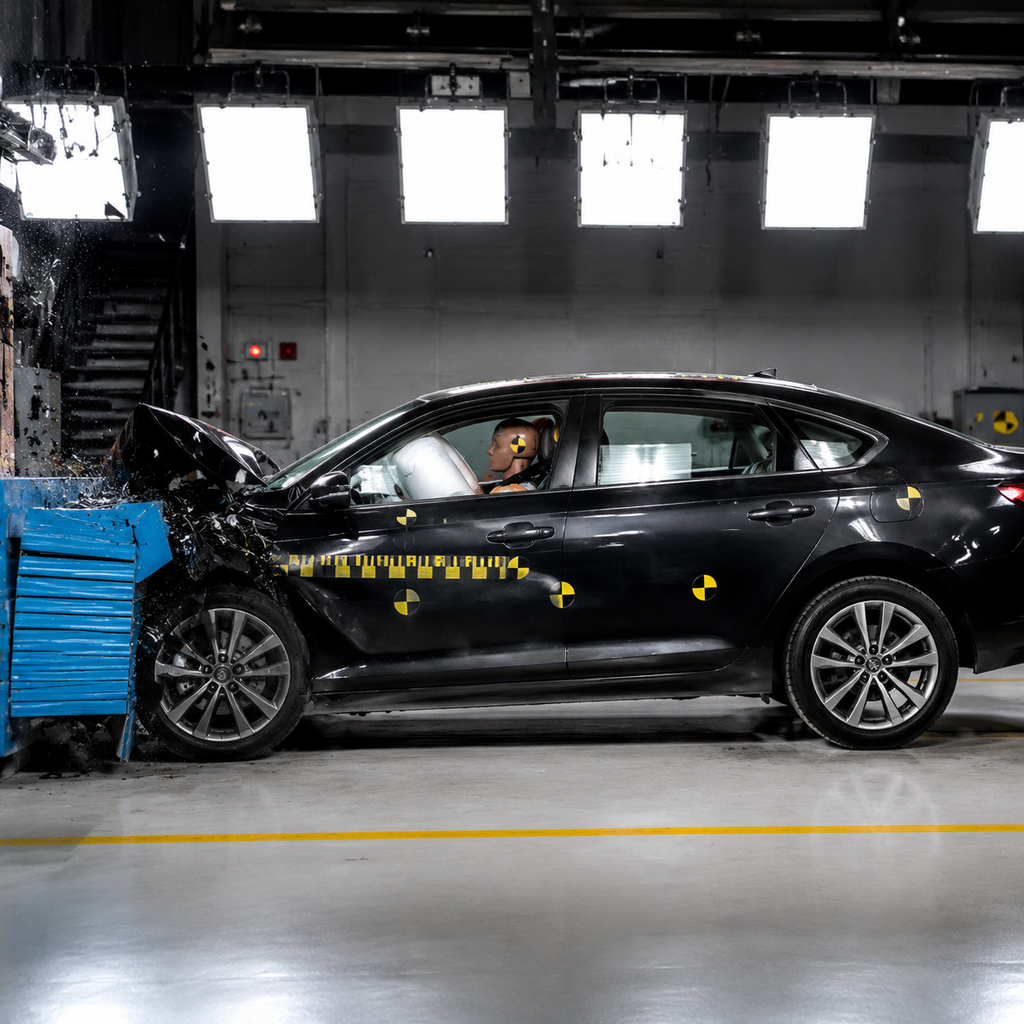
Crash tests are designed to evaluate how a vehicle and its restraint systems respond to defined impact conditions. Depending on the testing organization, assessments may include frontal impacts, side impacts, rollover resistance, pedestrian protection, roof strength, head restraint performance, and evaluations of automatic emergency braking. Reading crash test results helps buyers understand how the tested systems performed in each scenario.
These tests can help answer several important questions:
- Does the passenger compartment remain reasonably intact?
- How effectively do the seat belts and airbags manage occupant movement?
- Which body regions face the greatest injury risk?
- How well are children protected when appropriate restraints are used?
- Can the vehicle detect or avoid certain collisions?
- How does the vehicle perform in a side impact or rollover-related assessment?
The results are useful because shoppers cannot determine crashworthiness from a showroom visit. A solid-feeling door, large exterior dimensions, or a long list of airbags does not independently prove that a car will perform well in a collision. Controlled testing provides evidence that cannot be gained through a test drive.
At the same time, these crash test results apply to particular test procedures. They do not reproduce every possible speed, angle, object, occupant position, weather condition, or sequence of impacts found on public roads.
Why Safety Ratings Deserve a Place in Your Buying Decision
For most buyers, crash protection is a low-frequency but high-consequence consideration. You may never experience a serious collision, but if one occurs, the vehicle’s structure and restraint systems can become critically important. That is why crash test results deserve meaningful weight in a buying decision.
A poor result should therefore receive more attention than a minor difference in fuel economy, screen size, cargo capacity, or convenience equipment. This is especially true for families, drivers who spend significant time on highways, and anyone regularly carrying children or older passengers.

Crash Test Results are particularly valuable when comparing vehicles of a similar class, age, and price. If two compact SUVs meet your practical needs but one performs consistently better in current testing, that difference may reasonably influence the decision. Buyers comparing body styles can also review this guide to choosing a sedan or SUV in 2026.
The key word is consistently. One overall star rating or award does not always tell the entire story. To understand crash test results properly, look at individual test categories and read the detailed findings where available.
How to Read Crash Test Results Correctly
Several organizations publish vehicle safety information, including the National Highway Traffic Safety Administration and the Insurance Institute for Highway Safety in the United States, as well as Euro NCAP in Europe. Other markets operate their own new car assessment programs. Buyers in the United States can review official NHTSA vehicle safety ratings by model and model year. Official crash test results from these programs provide more detail than advertising claims alone.
Each organization uses its own procedures, rating scales, thresholds, and update schedules. A five-star result from one program is not necessarily equivalent to the highest rating from another. Because crash test results depend on the underlying protocol, compare scores within the same testing program whenever possible.
Compare Like With Like
The most meaningful comparison is usually between vehicles tested:
- By the same organization
- Under the same or similar testing protocol
- In the same model year or generation
- In a comparable size and weight class
- With the relevant safety equipment installed
A rating earned many years ago may have been excellent under the standards of that period, but testing methods evolve. New assessments may place greater emphasis on small-overlap crashes, rear-seat protection, pedestrian detection, nighttime automatic braking, or other scenarios that were previously absent or less demanding. When reviewing crash test results, always check when the applicable protocol was introduced.
This means an older car’s top rating should not automatically be interpreted as equivalent to a current top rating. Historical crash test results remain useful, but they need to be understood within the standards of their time.
Check the Exact Model Year and Body Style
Vehicle names can remain unchanged while the underlying structure, airbags, sensors, or safety software changes. A redesign may substantially improve crash protection, while a mid-cycle update may alter certain systems without changing the vehicle’s appearance very much. Verify that the crash test results apply to the exact version under consideration.
Confirm that the result applies to:
- The model year you are considering
- The correct body style
- The relevant powertrain or vehicle variant
- The correct seating configuration
- The market where the car was sold
A sedan’s result may not apply to a hatchback or SUV carrying a similar name. Likewise, a rating for a vehicle sold in Europe may not transfer perfectly to the North American version if equipment or structural details differ.
Read Beyond the Overall Score
An overall rating makes comparison easier, but it can conceal uneven performance. A vehicle might do well in a moderate frontal impact yet show weaknesses in a side test or in protection for rear-seat passengers. Detailed crash test results make those differences easier to identify.
Review the category-level results and note whether the testing organization identified:
- Excessive intrusion into the occupant compartment
- Elevated injury measurements for particular body areas
- Weak head or chest protection
- Poor control of occupant movement
- Airbag deployment concerns
- Limited protection for rear passengers
- Reduced performance in pedestrian or cyclist detection
- Headlight shortcomings
The importance of each result depends partly on your circumstances. Parents may focus closely on rear-seat and child-occupant protection. A driver with a long nighttime commute may give extra weight to headlight evaluations and nighttime collision-avoidance performance. Interpreting crash test results through the lens of your actual use makes the data more relevant.
Crashworthiness and Crash Avoidance Are Different
Vehicle safety is often divided into two broad areas: crashworthiness and crash avoidance. Crash test results generally emphasize one or both of these areas, depending on the testing program.
Crashworthiness concerns what happens when a collision occurs. It includes the vehicle’s structure, crumple zones, seat belts, airbags, seats, head restraints, and occupant compartment.
Crash avoidance concerns the vehicle’s ability to help the driver avoid or reduce the severity of a collision. Relevant systems may include:
- Forward collision warning
- Automatic emergency braking
- Blind-spot monitoring
- Lane departure warning
- Lane-keeping assistance
- Rear cross-traffic alert
- Pedestrian or cyclist detection
- Electronic stability control
- Driver monitoring
- Effective headlights
A vehicle may perform strongly in physical testing but offer limited active safety equipment. Another may have extensive driver-assistance technology but only average occupant protection in a particular impact. This is why crash test results should be reviewed alongside the vehicle’s complete safety specification.
Ideally, a car should perform well in both areas. Avoidance technology can reduce risk before an impact, while crashworthy construction provides a defensive layer when avoidance is not possible. The best reading of crash test results accounts for this complementary relationship.
Driver-assistance technology still has boundaries. Sensors may perform differently in darkness, glare, heavy rain, snow, fog, road spray, sharp curves, or when lane markings are unclear. These systems support the driver; they do not replace attentive driving, proper headlights, mirrors, safe speed, adequate following distance, or timely braking.
Consider the Type of Driving You Actually Do
A useful car buying guide should connect crash test results to real use rather than treating safety as an abstract score. Start by identifying where your exposure is greatest.
Family and Rear-Seat Use
If children or adults regularly sit in the rear, investigate rear-seat protection rather than relying exclusively on front-occupant results. For families, crash test results should be checked for rear-seat and child-occupant findings. Also check the accessibility of child-seat anchors, the compatibility of your child restraint, and the ease of achieving a secure installation.
Take the child seat to the dealership if possible. A vehicle can earn favorable safety ratings while still being inconvenient for your particular seat, especially when rear-facing restraints affect front-seat space.
Highway Commuting
Highway drivers face sustained speeds, merging traffic, sudden congestion, and a greater possibility of severe impacts. Highway-focused buyers should weigh crash test results together with structural performance, effective seat belts, stable emergency handling, and well-calibrated forward collision systems.
Adaptive cruise control may reduce workload, but it should not be confused with autonomous driving. The driver remains responsible for monitoring traffic and responding when the system reaches its limits.
City Traffic
Urban driving increases exposure to pedestrians, cyclists, intersections, parked-car doors, and low-speed conflicts. In city use, crash test results are most informative when combined with pedestrian-detection performance, outward visibility, manageable vehicle dimensions, and predictable braking.
A large vehicle can offer a size advantage in some vehicle-to-vehicle crashes, but its weight and dimensions may make it more difficult to see vulnerable road users nearby. Safety should be considered from the perspective of both occupants and other road users.
Rural Roads and Night Driving
Rural travel can involve unlit roads, higher speeds, animals, narrow shoulders, and longer emergency response times. Conventional crash test results do not fully describe headlight performance or forward visibility, so both deserve separate attention.
Drivers who frequently use dark rural roads may also examine aftermarket road-awareness technology. One example is Robofinity InsightDrive, a vehicle thermal imaging night vision system designed to support awareness of pedestrians, animals, vehicles, and obstacles in low-light conditions. Such a system remains an aid rather than a substitute for headlights, appropriate speed, braking distance, or driver attention.
Winter and Poor-Weather Driving
Crash results do not tell you how a particular set of tires will perform on snow, ice, or wet pavement. Likewise, crash test results do not fully describe the driver’s ability to maintain control before a collision.
For difficult weather, tire condition and suitability can be more immediately relevant than a small difference between two favorable crash ratings. Electronic stability control and all-wheel drive may assist in certain circumstances, but neither can create traction when the tires cannot grip the road.
Vehicle Size and Weight Complicate Comparisons
Crash ratings are often most useful within the same vehicle category. A small car and a large SUV can both earn excellent ratings, but equal scores do not necessarily mean equal outcomes when those vehicles collide with each other. For that reason, crash test results should first be compared among vehicles of similar size and weight.
In general, size and weight influence the forces experienced in a crash. A heavier vehicle may offer an advantage to its occupants in a collision with a lighter one. However, even excellent crash test results do not mean that buying the largest vehicle possible is a complete safety strategy.
Larger vehicles can bring trade-offs:
- Longer braking distances in some conditions
- Wider blind areas
- Greater rollover considerations for taller vehicles
- More difficult parking and urban maneuvering
- Greater risk posed to pedestrians and occupants of smaller vehicles
- Higher tire, fuel, and ownership costs
A smaller vehicle with excellent structure, modern restraints, strong active safety systems, and good visibility may be a more suitable choice than a much larger vehicle that is difficult for its owner to control or maintain.
Use crash test results to compare performance within the class first, then consider whether that class fits your passenger, cargo, road, and visibility needs.
What Crash Ratings Do Not Reveal
Crash Test Results also leave gaps. Even detailed testing does not provide a complete picture of:
- Driver visibility in every direction
- Braking feel and emergency controllability
- Tire quality on the specific vehicle for sale
- Driver-assistance behavior in every road condition
- Reliability of safety-related components over many years
- Quality of previous collision repairs
- Corrosion or hidden structural damage
- Whether occupants use seat belts correctly
- Whether cargo is properly secured
- Compatibility with every child restraint
This is particularly important when buying a used car. For used cars, crash test results describe the tested design rather than the present condition of an individual vehicle. A highly rated model may no longer provide its original level of protection if it has unrepaired crash damage, missing airbags, warning lights, heavily worn tires, modified suspension, or poorly executed structural repairs.
A pre-purchase inspection should therefore complement the rating research. Treat crash test results as one source of evidence, while the inspection checks the vehicle’s physical condition. A vehicle history report and service records may provide additional context. No single source can confirm the entire history, so inconsistencies deserve further investigation.
Safety Equipment May Vary by Trim
Do not assume every trim level includes the technology evaluated in a published test. The crash test results for a model may reflect equipment that was optional or unavailable on another trim. Some driver-assistance features may be standard on later model years but optional on earlier ones.
Before purchasing, verify the actual vehicle rather than relying on a model brochure or listing headline. Check the window sticker, equipment record, owner’s manual, dashboard controls, and vehicle settings. During the test drive, confirm that no airbag, braking, stability-control, or sensor warning lights remain illuminated.
Also consider repair costs. A bumper containing cameras, radar units, or parking sensors may require calibration after repairs. Windshield replacement can also affect camera-based systems. Ask how the manufacturer handles calibration and whether qualified service is readily available in your area.
A Practical Safety Decision Framework
Rather than searching for a single “safest car,” use a sequence that reflects your real priorities.
1. Define Your Non-Negotiable Needs
Establish the vehicle class, seating capacity, child-seat needs, cargo requirements, budget, and typical routes. A car that does not fit your household or driving environment is unlikely to be a successful long-term purchase, regardless of its score.
2. Eliminate Clearly Weak Performers
Use current crash test results to identify serious weaknesses. Pay attention to poor structural performance, concerning injury measures, or significant omissions in collision-avoidance equipment.
One weak subcategory does not automatically make a vehicle unsuitable, but it should prompt closer review rather than being dismissed because the overall score appears acceptable.
3. Compare Similar Vehicles Under the Same Protocol
Create a shortlist of vehicles tested by the same organization and under comparable standards. Look for balanced results across frontal, side, rear-seat, rollover, and active safety categories where those assessments are available.
4. Verify the Specific Car’s Equipment
Confirm that the trim and model year contain the safety features you expect. For used vehicles, make sure the systems are operational and that required cameras or radar sensors have not been disabled, obstructed, or poorly repaired.
5. Evaluate Real-World Usability
During the test drive, examine sightlines, mirror coverage, control layout, headlight performance where practical, braking response, and the behavior of driver-assistance alerts. A warning system that is confusing or frequently switched off provides less practical benefit.
6. Inspect Condition and Plan for Ownership
Review tires, brakes, warning lights, maintenance records, recalls, and evidence of previous damage. Budget for proper tires, scheduled maintenance, sensor calibration, and repairs. Safety performance depends partly on keeping the vehicle in its intended operating condition.
When Should a Poor Result Be a Deal-Breaker?
There is no universal threshold because buyers face different budgets, vehicle markets, and transportation needs. Still, a poor result deserves serious concern when it involves major occupant-compartment collapse, high injury measurements, ineffective restraint performance, or a safety weakness directly related to how you will use the vehicle.
The concern becomes stronger when several comparable alternatives perform better without creating unacceptable trade-offs in price, reliability, accessibility, or ownership costs.
For an older used car, the decision may be more complicated. Newer designs often benefit from updated structures and safety systems, but condition and affordability still matter. A well-maintained older vehicle with sound tires and functioning restraints may be a more responsible purchase than a newer, highly rated vehicle with hidden damage or unaffordable maintenance needs.
The goal is not to chase a perfect score at any cost. It is to avoid taking on an unnecessary, poorly understood risk when a reasonable alternative exists.
Common Mistakes Buyers Make
One mistake is relying on an overall score without checking what it includes. Another is comparing ratings from different programs as though they use the same test.
Buyers also commonly overlook these issues:
- Assuming all model years share one rating
- Treating driver assistance as self-driving capability
- Ignoring rear-seat performance
- Failing to confirm trim-specific equipment
- Believing more airbags automatically means better protection
- Overlooking tires, brakes, and prior damage
- Assuming all top-rated vehicles provide equal protection regardless of size
- Choosing a car with poor visibility because it has extensive electronic aids
A balanced assessment combines test evidence with a careful inspection and a realistic understanding of the vehicle’s use.
Frequently Asked Questions
Are five-star crash ratings always comparable?
No. Rating systems use different procedures and scoring methods, and standards change over time. Compare vehicles tested by the same organization under the same protocol whenever possible.
Is a top safety rating enough to identify the safest car?
No. It is strong evidence for performance in the tested scenarios, but it does not cover every collision, road condition, equipment variation, or ownership issue. Visibility, tires, active safety features, vehicle size, condition, and driver behavior also matter.
Do larger vehicles always protect occupants better?
Larger and heavier vehicles can have an advantage in some collisions with smaller vehicles, but size introduces other considerations, including blind areas, maneuverability, rollover characteristics, and risk to other road users. Compare vehicles within a class and choose a size you can operate confidently.
Should I avoid every used car with an older crash rating?
Not automatically. Consider how old the test is, whether the vehicle’s structure and equipment changed, and how it compares with alternatives in your budget. The specific car’s maintenance history, tires, airbag status, and repair quality are also essential.
Are automatic emergency braking and lane assistance included in crash ratings?
Some safety programs evaluate collision-avoidance systems, but the scope varies by organization and test year. Read the category details to learn which technologies were assessed and whether they were standard or optional on the tested vehicle.
Can safety technology compensate for a weak crash test result?
It should not be treated as a complete substitute. Collision-avoidance systems may help prevent or reduce certain impacts, but they can have operational limits. Strong crash protection remains important when a collision cannot be avoided.
Conclusion
Used carefully, crash test results provide one of the few objective ways to examine how a vehicle may protect occupants, so they deserve meaningful weight in a purchase decision. Their value is highest when you compare similar vehicles tested under the same standards, review individual categories, and confirm that the rating applies to the exact model year and configuration under consideration.
The right way to use crash test results is to combine them with a wider assessment. Consider active safety technology, rear-seat needs, nighttime visibility, tire condition, prior repairs, vehicle size, and the roads you travel most often. A strong purchase is not simply the car with the most impressive badge or overall score. It is a vehicle with credible crash protection, useful avoidance systems, suitable dimensions, and a condition you can responsibly maintain.