


SEO Title: How to Choose Real-Time Warning Features in a Car Night Vision System
- Why Real-Time Warnings Matter in Night Vision Systems
- Start With the Type of Hazard the System Detects
- Look at How the Warning Is Delivered
- On-screen visual alerts
- Audible alerts
- Directional or priority-based alerts
- Haptic or seat-based alerts
- Choose a Detection Range That Matches Real Driving, Not Marketing
- False Alarms Are a Major Buying Decision
- Display Quality Affects Warning Quality
- Prioritize Systems That Explain Why They Are Warning You
- Consider the Conditions You Actually Drive In
- Understand the Limits of Thermal Imaging
- Where Robofinity Fits as an Example
- Match the Warning Style to the Driver
- What to Ask Before You Buy
- Installation and Ownership Considerations
- FAQ
- What makes a real-time warning feature useful in a car night vision system?
- Is a longer detection range always better?
- Should I choose visual alerts or audible alerts?
- Do thermal night vision systems replace headlights?
- Are these systems useful in bad weather?
- What should I prioritize if I drive mostly on rural roads?
- Conclusion
Meta Description: Learn how to choose real-time warning features in a car night vision system, including alert types, detection range, display clarity, false alarms, and practical safety limits.
Choosing real-time warning features in a car night vision system is less about chasing the longest feature list and more about finding alerts that actually help you drive more safely at night. A good system should improve road awareness in low-light driving, not distract you with constant noise or vague warnings. If you are comparing vehicle thermal imaging options, the key question is simple: which real-time alerts will help you notice pedestrians, animals, vehicles, and obstacles early enough to respond calmly and correctly?
Why Real-Time Warnings Matter in Night Vision Systems
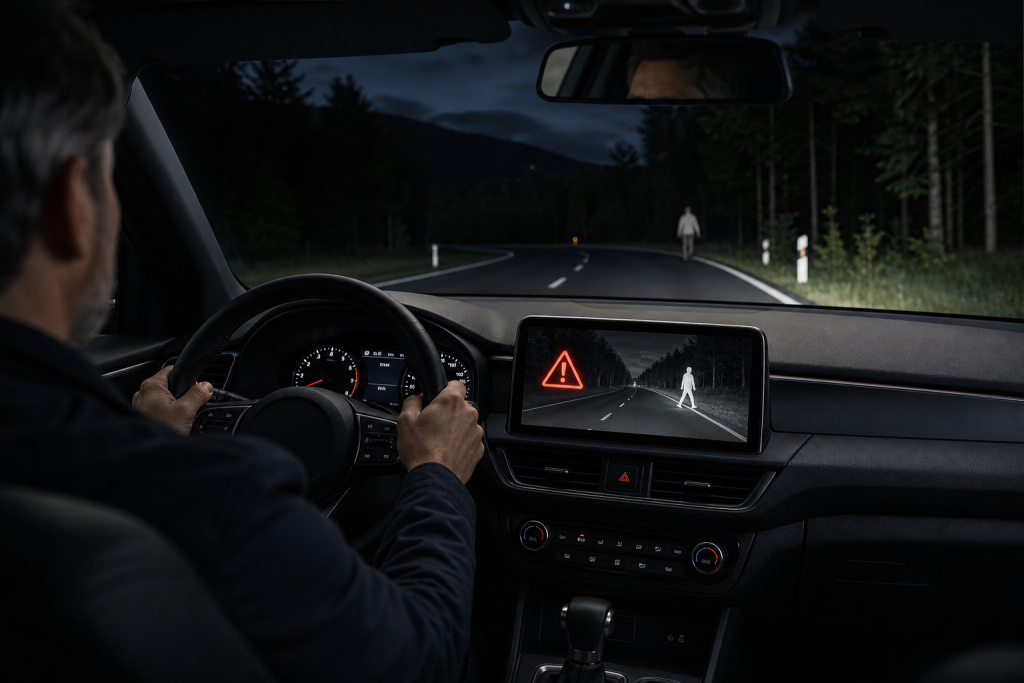
Night vision technology is useful because the human eye loses detail in darkness, glare, rain, fog, and other poor-visibility conditions. Headlights only reveal so much, and they can leave hazards outside the strongest part of the beam until the last moment. Real-time warnings are the part of the system that turns detection into action.
A thermal imaging system may show a person, animal, or vehicle on screen, but the warning feature is what tells you that something matters right now. That matters for several common driving situations:
- Rural roads where wildlife can appear suddenly
- Unlit streets where pedestrians are hard to see
- Highway driving with reduced contrast at the edge of the lane
- Fog, rain, or snow that weakens visual clarity
- Long-distance driving when fatigue reduces reaction speed
The best warning feature is not the loudest one. It is the one that gives you enough time to adjust your speed, scan the road, and avoid a surprise without creating alert fatigue.
More EV News
Start With the Type of Hazard the System Detects
Before comparing alert styles, confirm what the system is actually designed to recognize. Real-time warnings are only useful if the detection logic matches the risks you face most often.
Pedestrians
Pedestrian detection is one of the most important functions for city edges, crosswalks, roadside shoulders, and poorly lit suburban streets. A strong system should recognize a walking person clearly enough to warn early, not just once they are already in the headlight beam.
Animals
Animal detection matters most on rural roads, wooded routes, and areas where deer or larger animals are common. Animal-related warnings should be stable enough to avoid constant chatter from harmless background shapes while still alerting you when a real crossing risk appears.
Vehicles
Vehicle recognition can help in situations where a car, motorcycle, or stopped vehicle is hard to see in the dark or in weather that reduces contrast. This is especially relevant when a vehicle has no rear lighting visible from your angle or is partially obscured.
Obstacles and road hazards
Some systems also warn about stationary obstacles. This category is useful, but it should be treated carefully. Night vision can support awareness, but it is not a substitute for attentive driving, lane discipline, or proper following distance.
If a system only detects one category well, that may still be useful. The right choice depends on your routes and risks, not on whether the box lists every possible hazard.
Look at How the Warning Is Delivered
Real-time warnings can reach the driver in several ways, and the method matters as much as the detection itself. A good system makes the alert easy to understand immediately, without forcing you to interpret complicated graphics while driving.
On-screen visual alerts
These are usually symbols, highlighted objects, outlines, or color changes on the display. They are helpful because you can confirm what the system sees. The drawback is that they still require your eyes to move to the screen, so they work best when the display is positioned and sized sensibly.
Audible alerts
Sound-based warnings are useful because they do not require constant screen checking. They can be especially helpful when your attention is split between mirrors, traffic, and road edges. The downside is that audible warnings can become irritating if they trigger too often or at the wrong times.
Directional or priority-based alerts
Some systems try to indicate whether a hazard is in your lane, roadside, or approaching from the side. That can improve judgment, because not every detected object deserves the same response. If a system can prioritize threats clearly, it is easier to trust.
Haptic or seat-based alerts
These are less common in night vision systems, but when available they can reduce visual overload. The issue is that they may be better suited to broader driver-assistance setups than to thermal night vision specifically.
In practice, the best warning design often combines visual confirmation with a clear audible cue. That gives you both precision and speed.
Choose a Detection Range That Matches Real Driving, Not Marketing
Detection range is important, but it should be interpreted carefully. A long claimed range is not automatically better if the warning is unreliable, delayed, or overly sensitive.
For real-time warnings, the practical questions are:
- How early does the system detect a hazard in normal driving conditions?
- Does it still work in fog, rain, or snow?
- Can it distinguish a real person or animal from a reflective sign, curb, or roadside clutter?
- Does the alert arrive early enough to be useful at your actual driving speed?
A long range is most useful when the system can still recognize what it sees at that distance. If recognition drops off early, the extra range may not improve your ability to respond.
For highway use, a driver needs warnings that arrive with enough lead time at higher speeds. For city driving, shorter range can still be effective if the alert is accurate and not too busy. The right balance depends on where you drive most often.
False Alarms Are a Major Buying Decision
A warning system is only useful if you trust it. If it triggers too often, drivers start ignoring it. That is one of the biggest practical problems with poorly tuned driver-assistance technology.
When comparing systems, pay attention to how they handle:
- Roadside reflections
- Signposts and guardrails
- Heat sources that are not hazards
- Pedestrians standing still on the edge of the scene
- Animals partially hidden by brush or darkness
- Traffic in adjacent lanes
False alarms are not just annoying. They can make you hesitate when you should act, or make you stop paying attention to alerts altogether.
Good real-time warnings should feel selective. They should reserve stronger alerts for objects that are likely to affect your path, not every warm object in the frame.
Display Quality Affects Warning Quality
Even the smartest alert logic is less useful if the display is hard to read quickly. A driver should be able to understand the warning at a glance.
Screen size and layout
The display should be large enough to show hazards clearly without crowding other driving information. If the warning icon, object highlight, and road scene are too small, you lose the benefit of the system.
Contrast and clarity
Low-light driving already reduces visual confidence. A screen with poor contrast or confusing colors can make warnings harder to process. The important point is not visual drama. It is fast comprehension.
Placement in the cabin
A well-placed display reduces eye movement. If you have to look too far away from the road, the warning becomes less effective. This is especially relevant in dense traffic or bad weather.
Response speed
Warnings need to appear promptly when the system identifies a hazard. If there is noticeable lag, the driver loses the time advantage that night vision is supposed to provide.
When evaluating a system, think about the complete chain: detection, interpretation, display, and response. Weakness in any one part reduces the value of the real-time warning.
Prioritize Systems That Explain Why They Are Warning You
A useful warning is not just a beep. It should help you understand the reason for the alert. That does not mean the system must be overly complex. It means the information should be specific enough to support action.
For example, a strong setup may indicate whether the hazard is:
- A pedestrian in or near the roadway
- An animal near the shoulder
- A vehicle ahead or partially in view
- An object obstructing the lane
This matters because the right response changes with the hazard. A pedestrian near a crossing needs different attention than a parked vehicle on the shoulder. If the alert is too generic, you still have to spend time figuring out what the system means.
Consider the Conditions You Actually Drive In
A night vision system should be chosen for your routine, not for the rare extreme case.
City and suburban driving
If you mostly drive in illuminated areas, your priority may be early pedestrian detection, crosswalk awareness, and alerts that do not overreact to traffic clutter. You may not need the longest possible range, but you do need a system that stays calm in busy scenes.
Rural roads
If you spend time on dark rural roads, animal detection and earlier warnings matter more. Here, a system that is quiet most of the time but decisive when a hazard appears is valuable.
Highway driving
For highway use, vehicle recognition and long-range awareness can matter more than close-range object tracking. The warning should help with fast-moving situations and lane-edge hazards without overloading you with constant alerts.
Bad weather
In fog, rain, and snow, the system’s ability to support visibility becomes more important than its polished interface. But no night vision feature removes the need to slow down and drive conservatively in poor conditions.
Understand the Limits of Thermal Imaging
Thermal imaging helps highlight heat differences, but it is not magic. It is a support tool, not a replacement for the driver.
A thermal night vision system may struggle with:
- Very distant objects with limited thermal contrast
- Warm backgrounds that reduce separation
- Non-human hazards that do not stand out thermally
- Heavy environmental interference depending on conditions
- Situations where the driver is not scanning the road actively
This is why real-time warnings should be judged as part of a broader safety setup. Headlights, mirrors, lane discipline, speed control, and alert driving still matter. The best systems improve awareness; they do not eliminate risk.
Where Robofinity Fits as an Example
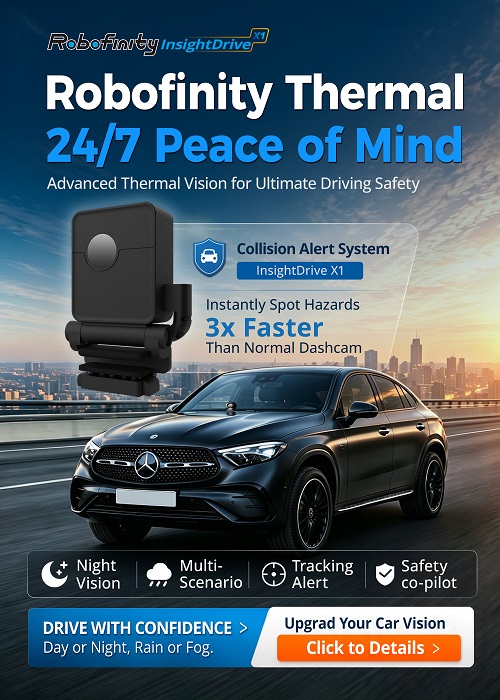
For drivers looking at aftermarket awareness upgrades, Robofinity InsightDrive is an example of a vehicle thermal imaging night vision system positioned around low-light road awareness. Its concept is relevant here because it combines thermal detection with real-time alerts for pedestrians, animals, vehicles, and obstacles, which is the kind of warning logic that matters most on dark roads and in poor visibility.
Match the Warning Style to the Driver
Not every driver needs the same alert behavior. The best system for one person may be frustrating for another.
For cautious drivers
A more informative display with moderate alerting may be best. These drivers often want clear confirmation before reacting.
For busy commuters
Simplicity matters more. The system should give straightforward, fast alerts that do not compete with traffic decisions.
For long-distance drivers
Consistency is critical. Warnings should remain dependable over long stretches of road, especially when fatigue sets in and reaction time worsens.
For family vehicles
A family driver may value early pedestrian and animal awareness above advanced customization. The system should reduce stress, not add another layer of controls to manage.
The right choice is the one that supports the way you actually drive.
What to Ask Before You Buy
When comparing car night vision systems, use practical questions instead of marketing language.
- What hazards does the system detect in real time?
- How does it warn the driver: screen, sound, both, or another method?
- Can the alerts be adjusted for sensitivity or volume?
- Does it stay useful in fog, rain, or glare?
- How easy is the display to read at night?
- Is the system meant for occasional support or frequent night driving?
- Does it complement the vehicle’s existing safety equipment without creating confusion?
These questions help you separate genuinely useful driver-assistance technology from features that look impressive but do little in real traffic.
Installation and Ownership Considerations
If you are evaluating an aftermarket thermal night vision system, think beyond the feature list. Ownership quality matters.
Power and integration
A system should be installed cleanly and operate reliably without creating distraction. Poor integration can make even good warnings annoying to use.
Maintenance
Camera lenses, display brightness, and cable integrity matter over time. Like any automotive safety technology, a night vision system works best when it is kept clean and checked regularly.
Ease of use
If settings are too complicated, drivers may leave the system on the wrong mode or stop using it entirely. The best warning features are the ones you can understand quickly, without digging through menus while parked in a driveway.
FAQ
What makes a real-time warning feature useful in a car night vision system?
It should alert you early enough to respond, identify hazards clearly, and avoid constant false alarms. The best warnings are easy to understand at a glance.
Is a longer detection range always better?
No. Range only matters if the system can accurately recognize hazards at that distance and warn you in time for your speed and road conditions.
Should I choose visual alerts or audible alerts?
The strongest systems often use both. Visual alerts help confirm what the system sees, while audible alerts can get your attention without requiring you to look away for long.
Do thermal night vision systems replace headlights?
No. They support visibility, but they do not replace headlights, mirrors, safe speed, or driver attention.
Are these systems useful in bad weather?
They can help in some poor-visibility conditions, but they are not a substitute for slower, more cautious driving in fog, rain, or snow.
What should I prioritize if I drive mostly on rural roads?
Animal detection, clear real-time warnings, and low false alarm rates are usually the most important factors for rural driving.
Conclusion
The best real-time warning feature in a car night vision system is the one that improves decision-making without adding confusion. Focus on what the system detects, how clearly it warns you, how often it false-alarms, and whether the display is easy to use in real driving conditions. For most buyers, the right answer is not the system with the most dramatic claims, but the one that fits the roads they actually drive, whether that is city traffic, rural highways, or poor-visibility commuting.
A careful comparison of alert quality, detection logic, and usability will tell you more than a spec sheet alone. That is the practical way to choose a system that supports safer night driving without pretending to do the driver’s job for them.