



Car Reliability can be a strong clue that a vehicle will stay on the road for many years, but it is not the only factor. When shoppers ask whether car reliability means a longer lifespan, they are usually thinking about repairs, breakdowns, and how long the vehicle will remain practical to own. The short answer is yes: strong car reliability often supports longer life, but maintenance, driving habits, and design still matter a great deal.
- Reliability vs. Longevity: What’s the Difference?
- Why Reliable Cars Often Last Longer
- 1. Fewer Weak Points
- 2. Conservative Engineering
- 3. Better Parts Availability and Known Repair Paths
- 4. Lower Ownership Friction
- Car Reliability and Long-Term Ownership
- Rank Math Readability Checklist for Long-Term Ownership
- The Real Reason Some Cars Last 200,000 Miles or More
- Maintenance Matters More Than Most People Think
- Example: Oil Changes
- Example: Transmission Service
- Example: Cooling System Care
- Example: Rust Prevention
- What Makes a Car Unreliable But Still Long-Lasting?
- Does Brand Reputation Predict Longevity?
- Driving Habits Can Make or Break Longevity
- The Car Type Matters Too
- High Mileage Isn’t the Same as “Lasts Longer”
- How to Tell If a Reliable Car Is Likely to Last
- Are Reliable Cars Always Better Investments?
- So, Do Reliable Cars Last Longer?
- Conclusion
For readers comparing long-term ownership options, this topic connects closely with buying decisions and budget planning. If you want a broader look at choosing wisely, see our guide to buying a car.
Table of Contents
Reliability vs. Longevity: What’s the Difference?
Car Reliability is about how often a vehicle fails or needs unplanned repairs. Longevity is about how long it remains usable, safe, and economical to keep driving.
A reliable car:
- Starts consistently
- Has fewer breakdowns
- Needs fewer unscheduled repairs
- Tends to give owners fewer surprises
A long-lasting car:
- Can reach high mileage or many years of service
- Maintains structural and mechanical integrity
- Remains economical enough to repair and keep
- Stays safe and functional over time
These two qualities overlap, but they are not the same. A vehicle with strong car reliability is often a good candidate for a long service life because it usually has durable systems and fewer recurring weaknesses. But longevity also depends on design, usage, climate, maintenance, and how expensive it is to keep the car running once age and mileage start adding up.
Why Reliable Cars Often Last Longer
Reliable cars tend to last longer because durability is usually built into their engineering philosophy. Manufacturers that emphasize car reliability often focus on proven components, conservative tuning, and simpler mechanical layouts. Those choices reduce the chances of failure and can extend service life.
1. Fewer Weak Points
Every vehicle contains dozens of subsystems: engine, transmission, cooling, electronics, suspension, braking, steering, and more. A car with fewer chronic weak points has less to fix and less to wear out prematurely.
For example, a simple naturally aspirated engine with a traditional automatic transmission often has fewer long-term complications than a highly stressed turbocharged engine paired with a complex dual-clutch system. That does not automatically make the latter bad, but it does mean there are more parts that can age poorly or require expensive intervention.
2. Conservative Engineering
Reliable vehicles are often not the most exciting on paper. They may have modest horsepower, less aggressive tuning, and less advanced technology. But conservatism can be a strength.
An engine operating below its mechanical limits typically experiences less heat, stress, and wear. Components such as pistons, turbochargers, transmissions, and cooling systems are less likely to be pushed hard on a daily basis. Over time, that can add up to a longer service life.
3. Better Parts Availability and Known Repair Paths
Popular cars with strong car reliability often benefit from widespread parts availability and familiar repair procedures. That matters for longevity because a car is only as long-lasting as the owner’s ability to keep it repaired reasonably.
When parts are easy to find and mechanics know the vehicle well, owners are more likely to fix issues early instead of abandoning the car. In that sense, reliability supports longevity not just mechanically but economically.
4. Lower Ownership Friction
Cars that are constantly going into the shop are more likely to be sold, neglected, or scrapped early. A reliable car encourages continued ownership because it does not create as many frustrating interruptions. Owners tend to keep cars longer when the vehicle does not feel like a burden.
Car Reliability and Long-Term Ownership
Car Reliability matters most when you plan to keep a vehicle beyond the first few years of ownership. A dependable model does not just save time at the repair shop; it also helps preserve resale value and reduces the chance that the car becomes a financial burden before its useful life is over.
Long-term ownership works best when the car is easy to service, parts are widely available, and the most common repairs are straightforward. That is why many buyers compare car reliability ratings alongside maintenance costs, expected mileage, and known problem areas before they commit.
In real-world use, a car with strong car reliability often gives owners more confidence to keep driving it after the loan is paid off. That confidence matters, because the cheapest car to own is often the one you can keep running for years without major disruption.
Rank Math Readability Checklist for Long-Term Ownership
When you are evaluating a vehicle for long service life, use a simple checklist. This keeps the focus on practical factors rather than marketing language.
- Check the maintenance history.
- Review known problem areas for the exact model.
- Look for signs of rust, leaks, and overheating.
- Compare repair costs against the car’s market value.
- Study owner reports at 100,000 miles and beyond.
For independent reliability data, it helps to review sources such as Consumer Reports’ car reliability and ownership resources.
The Real Reason Some Cars Last 200,000 Miles or More
When people talk about cars that last forever, they usually mean vehicles that combine robust design with disciplined maintenance. Car reliability makes that journey easier, but maintenance often decides the outcome.
A durable car usually has:
- A well-designed engine and transmission
- A cooling system that avoids chronic overheating
- Rust resistance or good corrosion protection
- Suspension and steering components that wear predictably
- An owner who follows maintenance schedules
- Reasonable driving habits and operating conditions
In other words, reliability gets the car to the high-mileage club, but upkeep keeps it there. A vehicle with strong car reliability can still fall apart early if fluids are ignored, warning lights are dismissed, or repairs are delayed until multiple systems are damaged.
Maintenance Matters More Than Most People Think
A reliable car does not last long just because it is reliable. It still needs oil changes, fluid services, brakes, tires, filters, belts, batteries, and attention to early warning signs. Neglect can ruin even the best-designed car.
In practice, car reliability and maintenance work together. Reliability lowers the odds of random failure, while maintenance protects the parts that naturally wear out. If one of those two pieces is missing, the car’s lifespan usually drops.
Example: Oil Changes
Regular oil changes are one of the simplest ways to extend engine life. Clean oil reduces friction, removes heat, and helps prevent sludge buildup. A well-built engine can still fail early if oil changes are skipped or delayed for years.
Example: Transmission Service
Some drivers assume a “lifetime fluid” transmission needs no service. In practice, many transmissions last longer when fluid is changed at appropriate intervals. Heat and contamination degrade the fluid over time, and transmission wear can accelerate if service is ignored.
Example: Cooling System Care
Overheating is one of the fastest ways to shorten the lifespan of an engine. A reliable car may handle daily use very well, but a failing radiator, water pump, thermostat, or coolant hose can still cause major damage if not addressed quickly.
Example: Rust Prevention
In colder climates, road salt can destroy a car long before its engine wears out. Rust can attack brake lines, suspension mounts, floors, rocker panels, and subframes. A mechanically reliable car can still become unsafe or uneconomical if corrosion is left unchecked.
That is why car reliability should always be judged alongside the vehicle’s body condition and service history. A spotless maintenance record on a rusted-out car is still a bad sign if the structure is compromised.
What Makes a Car Unreliable But Still Long-Lasting?
It may sound contradictory, but some cars are known for being unreliable in the short term while still lasting a long time. The difference is often between annoying problems and catastrophic ones.
A car may have:
- Frequent sensor failures
- Electrical glitches
- Stubborn infotainment problems
- Small leaks or trim issues
- Recurring but manageable suspension wear
If these problems are minor and the engine, transmission, and chassis are fundamentally strong, the car may still reach very high mileage. Owners may just have to spend more time and money keeping it happy.
This is why reliability ratings and longevity do not always match perfectly. A vehicle can rank poorly in dependability studies but still prove durable if its core mechanical systems are stout and repairs remain affordable.
Does Brand Reputation Predict Longevity?
Sometimes, but not perfectly. Brand reputation is a useful shortcut, not a guarantee.
Certain manufacturers have built a track record for reliable, long-lasting vehicles because they tend to engineer conservative powertrains, use durable materials, and refine components over multiple generations. Buyers often trust those brands because the odds of long service life are better.
Still, reputation can hide important details:
- A reliable brand may have one model that ages poorly
- A less reliable brand may produce a standout long-life model
- Newer models may use different engines or transmissions than older ones
- Individual care can outweigh brand averages
The best approach is to evaluate the specific vehicle, not just the badge on the hood. A single well-maintained car often tells you more than a general reputation, especially when car reliability varies from one trim or engine to another.
Driving Habits Can Make or Break Longevity
Even a reliable car will age faster if it is driven harshly. Driving style has a real effect on wear, and strong car reliability does not eliminate that reality.
Hard Use Shortens Life
Frequent aggressive acceleration, heavy towing, repeated short trips, and high-speed driving all increase stress on mechanical systems. Short trips are especially hard on engines because they may not reach full operating temperature, which can promote moisture buildup and sludge formation.
Smooth Use Helps Preserve Components
Gentle acceleration, regular highway drives, proper warm-up, and avoiding overload all contribute to long life. A car that spends much of its time on steady highway routes often lasts longer than a similar car used mainly for stop-and-go urban driving.
The Role of Storage and Environment
Cars parked outdoors in harsh weather may age faster than cars kept in garages. Sun damage can fade interiors and crack plastics, while cold and moisture can accelerate corrosion. Even the most reliable car will struggle if it lives in an environment that constantly attacks its materials.
If you want car reliability to translate into longevity, the goal is to reduce repeated stress wherever possible. That means avoiding unnecessary load, fixing problems early, and keeping the vehicle clean enough to prevent long-term damage.
The Car Type Matters Too
Not all vehicle categories age the same way. Longevity depends partly on what the car is designed to do.
Sedans and Compact Cars
These often last well because they are lighter, simpler, and usually less expensive to maintain. Many of the longest-lasting vehicles on the road fall into this category.
Trucks and SUVs
These can last a very long time too, especially when built on robust frames or with durable drivetrains. However, heavier weight and more complex systems can increase wear and repair costs.
Luxury Cars
Luxury vehicles may be engineered beautifully, but their long-term ownership costs can be high. When advanced electronics, air suspension, performance engines, and premium features age, repairs can become expensive enough to discourage long-term ownership.
Hybrid Vehicles
Hybrids often last a long time because electric assistance reduces stress on the engine and braking system. But battery condition, inverter health, and specialized repairs matter. A hybrid can be extremely durable, but only if its high-voltage systems age well.
Electric Vehicles
EVs have fewer moving parts than gasoline vehicles, which can help with reliability and longevity. However, battery degradation, charging habits, climate, and software support influence how long the car remains practical.
In every category, car reliability helps, but the way the vehicle is used matters just as much. The right car for a commuter may not be the best car for towing, and the most reliable model on paper may still be a poor fit for a specific owner’s routine.
High Mileage Isn’t the Same as “Lasts Longer”
A car reaching 200,000 miles sounds impressive, but mileage alone does not tell the full story. A vehicle that accumulates highway miles gently may be in better shape than one with lower mileage but severe city use and neglected service.
Longevity should be judged by:
- Mechanical condition
- Safety
- Repair cost relative to value
- Parts availability
- Structural integrity
- Owner satisfaction
A high-mileage car that still runs well, passes inspections, and remains affordable to repair is a successful long-lasting car. A lower-mileage car with chronic issues may be far less durable in practical terms.
This is another reason car reliability is only one piece of the puzzle. Mileage, maintenance, climate exposure, and repair economics all shape the real lifespan of a vehicle.
How to Tell If a Reliable Car Is Likely to Last
If you are shopping for a car and want long life, look for more than a good reliability score. Focus on design and ownership patterns.
Signs of Good Longevity Potential
- Proven engine and transmission combination
- Long production run with few major redesign problems
- Good maintenance history
- No signs of overheating or neglected fluid service
- Clean underbody with limited rust
- Simple, well-documented repairs
- Strong owner reports at high mileage
Red Flags
- Evidence of skipped maintenance
- Unresolved coolant leaks
- Transmission hesitation or slipping
- Severe rust in structural areas
- Electrical issues that keep returning
- Poor parts support or unusually expensive repairs
Buying a car with strong car reliability but a bad maintenance history can still lead to trouble. Conversely, buying a less glamorous vehicle with excellent service records can be a smart path to long-term ownership.
That balance is why car reliability should be treated as a guide, not a promise. The best used cars are usually the ones with both a strong track record and a visible history of care.
Are Reliable Cars Always Better Investments?
Not necessarily, but they often are. A car that stays on the road longer can reduce the cost per year of ownership. Fewer breakdowns, slower depreciation, and lower repair risk all help.
But the best long-term investment is not always the most reliable car on paper. It is the one that fits the buyer’s needs and budget while remaining economical to keep over time.
Sometimes that means:
- Choosing a reliable used sedan instead of a flashy new crossover
- Buying a simpler trim with fewer expensive features
- Prioritizing maintenance history over model-year hype
- Avoiding vehicles with known expensive failure points
A dependable car that is cheap to buy, cheap to repair, and easy to live with often becomes the best long-term value.
If you are weighing long-term costs, car reliability should be part of a bigger ownership plan that also includes insurance, fuel, depreciation, and expected maintenance. A vehicle that looks expensive at first may still save money over time if it proves durable and predictable.
So, Do Reliable Cars Last Longer?
Yes, reliable cars usually do last longer, because reliability reduces the chances of early failure, lowers repair stress, and encourages owners to keep maintaining the vehicle. But reliability alone does not guarantee a long life.
A car lasts longest when reliability is paired with:
- Solid engineering
- Regular maintenance
- Rust control
- Good driving habits
- Reasonable repair costs
- A supportive parts and service network
That is why some cars become legends at high mileage while others disappear early. Car reliability gives a car a strong foundation, but longevity is built over years of proper care.
Conclusion
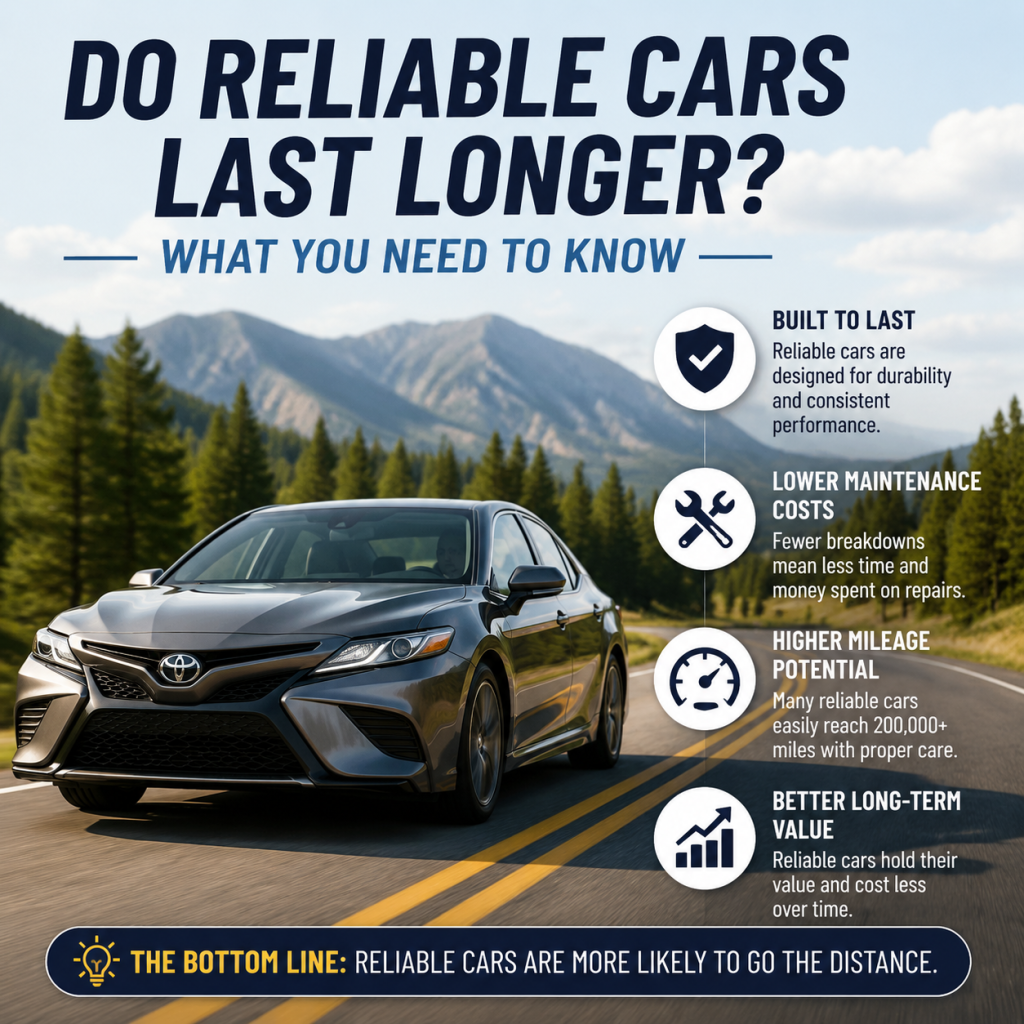
Reliable cars tend to last longer because they are designed to fail less often, cost less to maintain, and remain easier to keep on the road. Still, the real secret to long vehicle life is the combination of reliable engineering and consistent care. A dependable car with poor maintenance may die young, while a less perfect car with good upkeep may surprise everyone with its endurance.
If long life is the goal, the smartest strategy is to choose a proven vehicle, maintain it carefully, and avoid habits that accelerate wear. Reliability is the starting point, not the finish line. With strong car reliability, sensible ownership, and timely repairs, a good car can deliver many years of dependable service.