

When the road is truly pitch black, it’s natural to wonder whether a vehicle thermal imaging system can still “see” clearly enough to keep you safer. Thermal cameras don’t rely on visible light the way regular headlights and night cameras do. Instead, they visualize temperature differences—so targets can appear even when there’s almost no illumination. In this guide, you’ll learn what thermal imaging can realistically show in complete darkness, what it can and can’t detect, and how to get the most reliable results for night driving and low-visibility conditions.
- How a Vehicle Thermal Imaging System Works
- Can a Vehicle Thermal Imaging System See in Complete Darkness?
- Where Thermal Imaging Helps Most
- What It Can and Cannot Detect
- Does More Resolution Mean Better Night Vision?
- How Real-Time Alerts Improve Awareness
- How Thermal Imaging Compares With Other Night Driving Tools
- Real-World Driving Scenarios Where It Can Help
- What Drivers Should Keep in Mind
- It does not replace safe driving habits
- It isn’t equally effective everywhere
- It works best as part of a broader safety approach
- How to Get the Most From a Thermal Imaging System
- FAQ
- Can automotive thermal imaging work without headlights?
- Can thermal imaging see through fog or rain?
- Can thermal imaging detect pedestrians and animals?
- Does thermal imaging show lane markings and road signs clearly?
- Is thermal imaging a replacement for safe driving?
- What about real brands and options for thermal night vision?
- Conclusion
- How a Vehicle Thermal Imaging System Works
- Can a Vehicle Thermal Imaging System See in Complete Darkness?
- Where Thermal Imaging Helps Most
- What It Can and Cannot Detect
- Does More Resolution Mean Better Night Vision?
- How Real-Time Alerts Improve Awareness
- How Thermal Imaging Compares With Other Night Driving Tools
- Real-World Driving Scenarios Where It Can Help
- What Drivers Should Keep in Mind
- FAQ
- Conclusion
We’ll also cover the practical limits that affect clarity, including distance, temperature contrast, weather, lens design, and processing speed. By the end, you’ll have a realistic idea of what to expect and how to use thermal imaging as a driver-assistance layer rather than a replacement for fundamentals like headlights, speed control, and attention.
How a Vehicle Thermal Imaging System Works
Thermal imaging systems detect infrared radiation emitted by objects as heat. Every warm object releases some infrared energy, and a thermal camera converts differences in that energy into a visual image. Warmer areas typically appear brighter or more defined than cooler areas, allowing the system to build a scene even when the road is completely dark.
Unlike a regular camera that depends on reflected visible light, a thermal imaging system can operate in darkness because it is not “looking” for illumination. That’s why thermal technology is often discussed for rural routes, low-light driving, and situations where visible-light cameras may struggle due to limited ambient light.
In most automotive setups, the thermal sensor captures heat signatures and the vehicle’s computer processing translates them into alerts or recognizable shapes. Some systems also integrate additional features such as detection logic for pedestrians, animals, vehicles, and obstacles—helping drivers focus on likely hazards rather than interpreting every part of the thermal picture.
Can a Vehicle Thermal Imaging System See in Complete Darkness?
In many cases, a vehicle thermal imaging system performs well in complete darkness because the technology doesn’t require streetlights, moonlight, or clear headlight reflections. Instead, it responds to temperature contrast. If a person, animal, or vehicle has heat that differs from the surrounding environment, thermal imaging can often make that target stand out.
However, “see clearly” depends on your definition of clarity. Thermal imaging typically improves hazard recognition earlier than many visible-light systems in near-black conditions, but it doesn’t behave like a high-resolution daytime camera. Clarity depends on several practical factors:
- Distance to the object (far targets occupy fewer pixels)
- Temperature contrast between the target and the background
- Weather and atmospheric conditions that affect infrared propagation
- Camera resolution and thermal sensitivity
- Frame rate and processing quality (important for moving targets)
- Target size and shape (smaller targets can be harder to distinguish)
- How the system chooses to display the scene (contrast enhancement, palettes, and overlays)
In real driving, a thermal image may help you spot a person, animal, or vehicle sooner, even when you can’t see them with your eyes. But it often won’t show fine clothing details, facial features, or crisp texture the way daylight does. A vehicle thermal imaging system is best thought of as road-awareness support that helps you detect and react faster—especially at the edge of normal headlight effectiveness.
Where Thermal Imaging Helps Most
Thermal imaging shines most when visibility is limited and reaction time matters. The best scenarios are usually those where hazards have enough heat contrast to appear distinct from the surrounding background.
Rural roads and wildlife zones
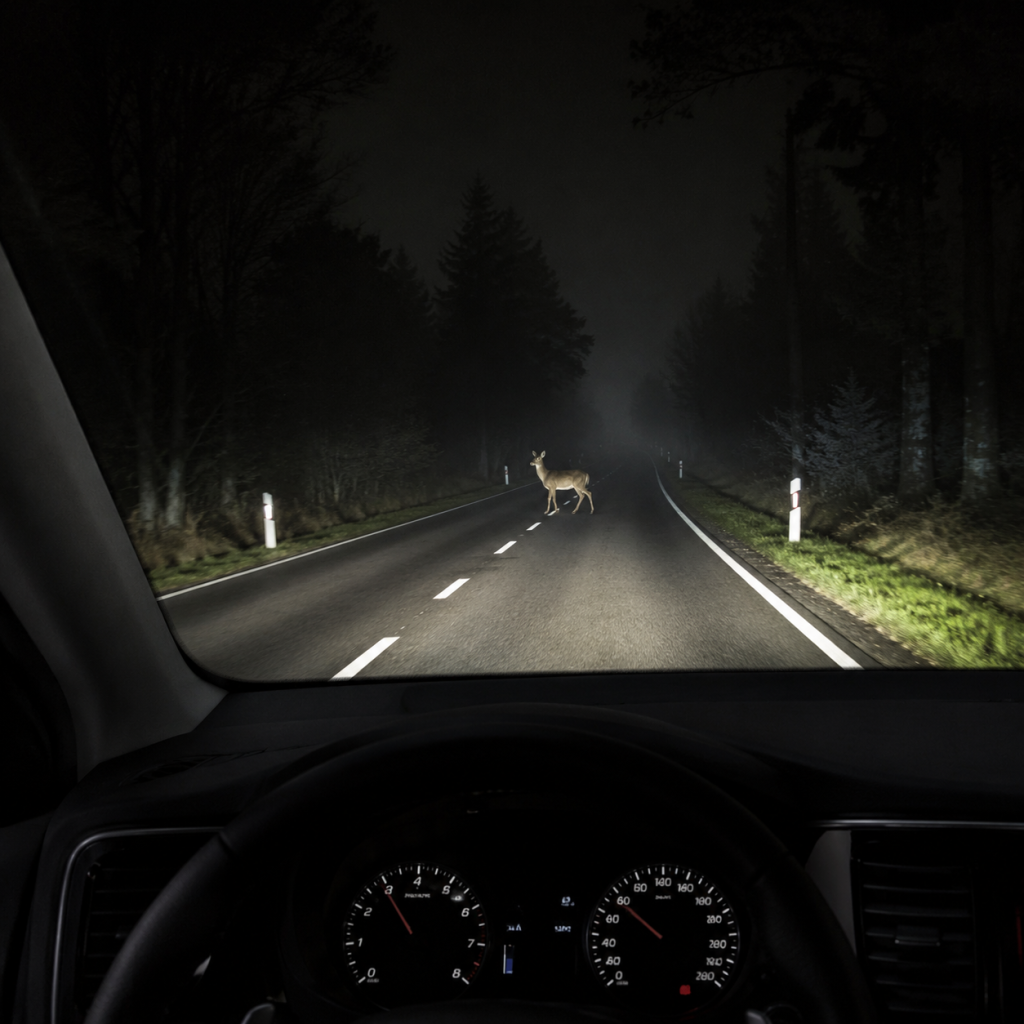
One of the most common uses for car thermal night vision is on rural routes where animals may enter the roadway unexpectedly. Deer, elk, dogs, and other wildlife can be difficult to detect before they’re dangerously close. Because animals emit heat, thermal imaging often makes them stand out against cooler backgrounds such as asphalt, grass, and trees.
If you drive through areas known for wildlife, a vehicle thermal imaging system can be valuable for earlier recognition—especially during late night hours when ambient light is minimal and your headlight pattern may not be enough to reveal small, low-contrast movement.
Highway driving at night
At highway speeds, seeing farther ahead matters. A vehicle thermal imaging system may help identify pedestrians, stalled vehicles, or large animals beyond the range where headlights create meaningful visible contrast. That earlier detection can provide more time to slow down, adjust spacing, or prepare for lane changes when conditions require.
It’s also useful for recognizing changes in the environment—like a new thermal “hot spot” that wasn’t present earlier—so you can react before a hazard fully enters your headlight beam.
Fog, rain, snow, and glare
Thermal imaging is frequently discussed for poor-visibility conditions because it doesn’t depend on visible light the way standard cameras do. In fog, rain, snow, and glare-heavy scenarios, thermal displays may still reveal useful heat signatures even when the road appears washed out or dim to the human eye.
Keep expectations realistic, though. Dense fog, wet glass, and a dirty lens can still affect how clearly the vehicle thermal imaging system presents the scene. Additionally, even when thermal imaging works, you may still need to reduce speed because overall hazard detection—whether by eyes or sensors—can be less reliable at longer distances.
What It Can and Cannot Detect
A vehicle thermal imaging system is useful, but it is not equally effective for every situation. Understanding the strengths and limits helps you set expectations that match how thermal cameras actually behave.
What it can often detect
- Pedestrians (human body heat often stands out)
- Animals (fur and size can create visible thermal contrast)
- Vehicles with warm engines or recently driven components
- Large roadside objects with strong thermal contrast
- Some obstacles on or near the roadway
When the target has enough heat and enough size relative to the camera’s field of view, a vehicle thermal imaging system can often make the hazard easier to recognize than a purely visible-light approach in darkness.
What it may struggle with
- Very small objects with limited heat difference
- Cold objects that blend into the background
- Thin debris lying flat on the road
- Targets blocked by other vehicles, barriers, or terrain
- Fine visual details such as sign text, lane markings, and labels
This is why thermal imaging works best as a driver-assistance technology rather than a full replacement for headlights, mirrors, or lane awareness. A vehicle thermal imaging system can improve situational awareness, but safe driving still relies on your vision, your understanding of the road, and proper speed and spacing.
Does More Resolution Mean Better Night Vision?
Resolution matters, but it’s only one part of the picture. A thermal camera with higher resolution can show a more detailed image, which may help interpretation and make targets easier to distinguish. Still, resolution alone doesn’t determine usefulness for a vehicle thermal imaging system.
Other factors include lens design, thermal sensitivity, frame rate, and how the system processes the image in real time. For instance, a system with slightly lower resolution may still perform better if its processing is fast and its contrast enhancement highlights relevant targets effectively.
Some automotive systems combine thermal imaging with AI-based detection to identify pedestrians, animals, vehicles, and obstacles. In real driving, that kind of processing can reduce confusion by narrowing attention to likely hazards. Instead of scanning every thermal detail, drivers can focus on prioritized alerts and guidance.
If you’re comparing options, also consider the practical measurement that matters to daily use: how far the camera can detect and recognize targets. For range details, you can review Thermal Camera Range: How Far Can a Thermal Camera Pick Up?.
How Real-Time Alerts Improve Awareness
A thermal image can help, but the real value often comes from real-time alerts. When a vehicle thermal imaging system detects a likely hazard, it can help you notice threats sooner than vision alone—particularly at the edge of visibility where subtle motion or low-contrast shapes are easy to miss.
Instead of asking the driver to constantly inspect the screen, modern driver-assistance features highlight relevant risks and support faster decision-making. This can be especially helpful in dark environments where human sight is limited by lighting conditions and the limits of headlight beam patterns.
In practice, the alert strategy matters as much as the sensor. Strong systems reduce false positives, track targets reliably as they move, and present warnings in a way that’s understandable while you’re driving. Weak implementations may clutter the display or fail to react quickly enough for fast-moving hazards.
For example, STG Thermal Night Vision for Vehicle setups (where available) are designed to emphasize night awareness and assist with hazard detection for drivers who face wildlife, dim roads, or frequent low-visibility driving. To see why that matters in a safety context, you may find STG Thermal Night Vision for Vehicle: 7 Smart Benefits useful.
How Thermal Imaging Compares With Other Night Driving Tools
Drivers often compare thermal imaging with LED headlights, dash cams, and visible-light night vision systems. Each tool serves a different role, and the most helpful approach is usually combining them appropriately.
Headlights
Headlights illuminate the road ahead, but they only light a limited area and are dependent on reflective surfaces. They help you see lane markings and the immediate road environment, yet they may not reveal a dark animal on the shoulder until it’s closer than you’d like.
Dash cams
Dash cams are built primarily for recording, not for continuous hazard detection and early warnings. They can capture events after they happen, but they typically don’t provide the heat-based contrast and immediate alerting that a vehicle thermal imaging system is designed to deliver.
Visible-light night vision
Some night-driving camera systems improve low-light visibility using image enhancement or infrared illumination. These can be useful, but they still depend more on available or generated illumination than thermal imaging does for darkness performance.
Thermal imaging
Thermal imaging often performs best when the road is nearly black and the hazard has clear temperature contrast. That makes a vehicle thermal imaging system a strong option for night driving safety and animal detection on long, dark routes—especially when headlights alone don’t give you enough early warning.
Real-World Driving Scenarios Where It Can Help
A vehicle thermal imaging system can be especially helpful in situations like these:
- A driver on a mountain road spots a pedestrian near the edge of the lane before reaching a turn
- A pickup traveling through rural areas notices a deer standing by the road shoulder
- A family driving on a highway sees a stopped vehicle farther ahead in the dark
- A commuter encounters fog and gains an extra layer of road awareness when visibility drops
- A long-distance truck driver uses the system as an added safety aid during overnight routes
In practice, the benefit may not look dramatic at first glance. With a vehicle thermal imaging system, the improvement often comes from earlier recognition of potential danger and more time to react—particularly when a hazard appears unexpectedly in conditions where your eyes would normally rely heavily on ambient light.
If you’re curious about what features matter most, a practical comparison can also help you decide what level of thermal awareness you need. You can explore Car Thermal Imager: 7 Best Features and Uses for a feature-focused breakdown.
What Drivers Should Keep in Mind
A vehicle thermal imaging system can be a strong addition to vehicle safety, but it should be used with realistic expectations.
It does not replace safe driving habits
Drivers should keep scanning the road, slow down as conditions change, and maintain a safe following distance. Thermal imaging is support, not a substitute for attention. Even with advanced detection, your vehicle speed and braking response time remain critical.
It isn’t equally effective everywhere
Very hot pavement (like just after sunset in summer), wet lenses, heavy clutter, or low thermal contrast can reduce the clarity of what’s displayed on your thermal screen. The vehicle thermal imaging system may still work, but the view may be less useful than expected.
Similarly, a hazard with minimal temperature difference—such as a cooled object—may be harder to distinguish from the environment, especially at longer ranges.
It works best as part of a broader safety approach
Thermal imaging adds value when paired with responsible driving behavior and existing vehicle safety features. It’s one more layer of awareness, especially at night and in poor-visibility conditions. The strongest results usually come from using the vehicle thermal imaging system to inform your decisions earlier, not from relying on it to solve every visibility challenge.
How to Get the Most From a Thermal Imaging System
If you’re considering vehicle thermal imaging, a few practical steps can help you get more consistent results from the system:
- Keep the camera lens clean and unobstructed
- Confirm proper mounting so the field of view matches what you expect
- Learn the alert behavior before you need it (how warnings appear and how targets are highlighted)
- Treat thermal highlights as warnings, not guarantees of exact distance or identity
- Continue using headlights, mirrors, and safe speed control
- Slow down in unfamiliar areas or wildlife-prone zones
The best results usually come when you understand what a vehicle thermal imaging system can reveal and what it can’t. When you know how to interpret the thermal view and prioritize alerts, the technology becomes a practical safety tool rather than a confusing distraction.
FAQ
Can automotive thermal imaging work without headlights?
Yes. A vehicle thermal imaging system does not depend on visible light the way normal cameras do, so it can function in complete darkness. Headlights are still important for standard driving and should remain in use.
Can thermal imaging see through fog or rain?
It can sometimes perform better than visible-light cameras in fog, rain, or snow because it detects heat rather than light. However, heavy weather can still reduce clarity and overall performance, especially at longer distances.
Can thermal imaging detect pedestrians and animals?
Yes. People and animals usually stand out well because body heat creates contrast against cooler surroundings. The exact level of detail depends on distance, target size, and thermal contrast.
Does thermal imaging show lane markings and road signs clearly?
Not as well as visible-light systems. Thermal imaging is better for highlighting heat-based hazards than for reading signs or showing fine road details.
Is thermal imaging a replacement for safe driving?
No. It’s a driver-assistance technology that can improve awareness, but it does not replace careful driving, safe speed, traffic laws, or full attention.
What about real brands and options for thermal night vision?
If you want to compare common options, including different approaches to thermal awareness, it can help to review curated comparisons such as Car Thermal Night Vision Brands: 7 Great Top Picks.
Conclusion
So, can a vehicle thermal imaging system see clearly in complete darkness? In many cases, it can detect heat signatures in total darkness and provide earlier hazard recognition—making it valuable for night driving safety and poor-visibility conditions. Still, how clearly you can identify a target depends on system quality, target size, temperature contrast, resolution, and the environment.
A vehicle thermal imaging system works best as an extra layer of road awareness—not a replacement for headlights, mirrors, safe driving habits, or driver attention. If you frequently drive at night on rural roads, highways, or wildlife-prone routes, thermal imaging may help you recognize hazards earlier and react with more time.
For background that supports decision-making, you can also explore What Are the Best Automotive Thermal Night Vision Systems in 2026?.
For general scientific and measurement context around infrared imaging concepts, see the U.S. National Institute of Standards and Technology (NIST).