

Thermal Camera Range depends on the sensor, lens, target size, and weather conditions. In other words, the answer to thermal camera range is not a single number. A thermal camera may detect heat from only a few feet away in close inspections, or it may pick up a warm person, vehicle, or animal from hundreds of feet away in the right conditions. If you are comparing options for long-distance viewing, this guide will help you set realistic expectations and choose the right system.
- What Thermal Cameras Actually Detect
- Average Detection Range by Use Case
- Factors That Affect Thermal Camera Range
- Resolution
- Lens and Field of View
- Temperature Contrast
- Weather and Environment
- Object Size and Heat Signature
- Camera Sensitivity
- Detection, Recognition, and Identification
- How Thermal Cameras Compare to Night Vision
- Choosing the Right Camera for Your Range Needs
- Practical Expectations
- Real-World Examples of Thermal Camera Range
- Example 1: A Person in Open Ground
- Example 2: A Vehicle on a Highway
- Example 3: Wildlife in Brush
- Example 4: Building Inspection Indoors
- Choosing Between Portable and Fixed Systems
- Thermal Camera Range for Vehicle Safety
- Common Mistakes When Judging Thermal Camera Range
- How to Get the Most from Thermal Camera Range
- Final Thoughts
Table of Contents
- What Thermal Cameras Actually Detect
- Average Detection Range by Use Case
- Factors That Affect Thermal Camera Range
- Detection, Recognition, and Identification
- How Thermal Cameras Compare to Night Vision
- Choosing the Right Camera for Your Range Needs
- Practical Expectations
- Real-World Examples of Thermal Camera Range
- Choosing Between Portable and Fixed Systems
- Thermal Camera Range for Vehicle Safety
- Final Thoughts
What Thermal Cameras Actually Detect
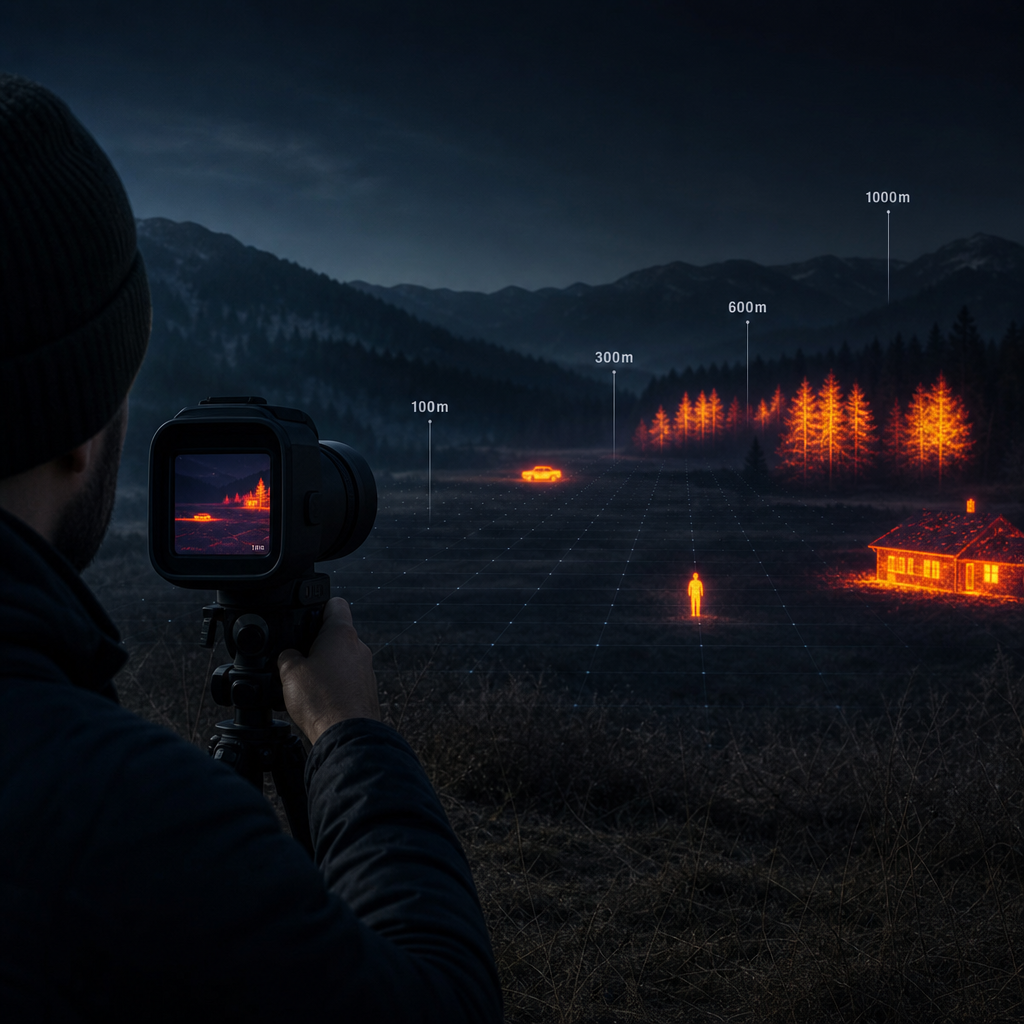
Thermal cameras do not “see” objects in the same way regular cameras do. Instead, they detect infrared radiation, which is emitted by all objects based on their temperature. The camera converts that invisible energy into a visible image, often shown in shades of black, white, and color gradients.
Because thermal imaging is based on heat contrast, thermal camera range is not just about distance. A hot engine, a person walking in cool surroundings, or a warm animal in a cold field will stand out much more clearly than an object that is close to the same temperature as its background. That means a thermal camera’s practical detection range can vary dramatically depending on what it is trying to spot.
It also helps to remember that thermal imaging is about contrast, not detail alone. Two cameras with similar specs can behave very differently if one is paired with a better lens or used in a scene with stronger temperature separation. That is why buyers often find that thermal camera range in the real world is better or worse than the marketing copy suggests.
Average Detection Range by Use Case
There is no single universal answer to how far a thermal camera can pick up, but typical ranges can be grouped by application.
Security and Surveillance
In security use, many thermal cameras can detect a human-sized target from about 100 to 300 feet, depending on the model. Higher-end surveillance systems with long-range lenses can detect people or vehicles from much farther away, sometimes several hundred yards or more.

For example:
- Entry-level thermal security cameras may detect a person at 50 to 150 feet
- Mid-range systems may detect a human target at 200 to 500 feet
- Long-range professional systems may detect vehicles or large heat sources from 1,000 feet or beyond
It is important to note that detection does not mean identification. A camera may detect that something warm is present at a long range, but it may not be able to tell exactly what it is until the target is much closer. That is why thermal camera range must always be judged alongside image detail and lens choice.
If you want to compare how thermal systems are used in vehicle safety, see Vehicle Thermal Camera: 7 Powerful Safety Benefits.
Wildlife Observation
Thermal cameras are often used to spot animals in the dark or in dense vegetation. In this case, the range depends on the size of the animal and the terrain. A deer, coyote, or hog may be visible at a greater distance than a small bird or rodent.
Large animals can often be detected from several hundred feet away, especially in open areas. However, trees, brush, humidity, and uneven ground can reduce clarity very quickly. In field conditions, the real-world thermal camera range may be much shorter than the headline range listed by the manufacturer.
For hunters, landowners, and wildlife observers, the main goal is often awareness rather than detail. A thermal image can reveal movement through brush or show a heat signature at the edge of a field, which gives you time to react. In those settings, thermal camera range is valuable even when the subject is too far away for exact identification.
Building and Industrial Inspections
For inspections, the camera is usually used at close to moderate range. A thermal camera used to check electrical panels, HVAC systems, or insulation problems typically operates from a few inches to several dozen feet away. In these scenarios, the goal is not long-distance detection, but precise measurement of surface temperatures and hot spots.
For a deeper look at performance expectations, you can also read Does Automotive Thermal Imaging Really Work in 2026?
When used for diagnostics, the right viewing distance often matters more than maximum range. If the camera is too far away, the thermal signature may spread across too few pixels to reveal a problem accurately. In that sense, the best thermal camera range for inspections is often a shorter, more controlled distance.
Factors That Affect Thermal Camera Range
Several variables determine how far a thermal camera can realistically pick up a target. When people talk about thermal camera range, they are usually talking about the combined effect of these factors rather than the camera alone.
Resolution
Higher resolution cameras produce more detail and can detect smaller objects at longer distances. A low-resolution camera may show a blur or vague heat blob at a distance, while a higher-resolution model can reveal more shape and contrast.
Common thermal sensor resolutions include:
- 160 x 120
- 320 x 240
- 640 x 480
- Higher-end specialty systems beyond that
The higher the resolution, the more pixels are available to represent the target at a distance, which improves both detection and recognition. That said, resolution alone does not determine thermal camera range, because lens quality and environmental conditions still have a major impact.
Lens and Field of View
The lens strongly affects range. A wide-angle lens captures a larger area but reduces the size of distant objects on the sensor. A narrower lens, on the other hand, zooms in on distant heat signatures and makes them easier to detect.
This is why some thermal cameras are designed for short-range inspections, while others are built with telephoto lenses for long-distance surveillance.
If your target is far away, a narrow field of view usually helps the camera concentrate its pixels on that subject. If your target is nearby, a wider view may be better because it gives you more situational awareness. Matching the lens to the task is one of the simplest ways to improve thermal camera range in practice.
Temperature Contrast
The greater the difference between the object and its background, the easier it is to detect. A person in winter at night stands out much more than a person on a hot summer day with sun-heated surroundings.
In general:
- High contrast improves detection range
- Low contrast reduces the effective range
- Similar temperatures between object and background make detection harder
This is one reason thermal camera range can feel inconsistent from one day to the next. A camera used before sunrise may perform better than the same camera used after a road has been heated by direct sunlight. The sensor is the same, but the scene is not.
Weather and Environment
Environmental conditions can have a major impact on thermal performance. Fog, heavy rain, snow, smoke, dust, and high humidity can all reduce the distance a thermal camera can see clearly. While thermal cameras can often still function in poor visibility better than visible-light cameras, they are not immune to atmospheric interference.
Outdoor factors that influence range include:
- Humidity
- Rain or snowfall
- Fog
- Air pollution
- Heat shimmer
- Obstacles such as walls, trees, or glass
For a practical example of fog and visibility issues, see Car Thermal Camera Fog: Must-Have Solution for Safer Driving.
In especially humid or smoky conditions, thermal camera range can shorten noticeably. Heat signatures may still appear, but the image can lose crisp edges and usable definition. That is why a camera that looks excellent on a clean indoor test may perform differently outdoors on a damp night.
Object Size and Heat Signature
Larger objects are easier to detect than smaller ones. A truck, building, or large animal will show up at greater distances than a hand tool or small animal. Also, objects with active heat sources, such as a running engine or a person’s body, are easier to detect than passive objects that only retain a little residual warmth.
For example, a parked vehicle that has just been driven may remain visible for a while after the engine is off, but the signal weakens as it cools. Likewise, a warm animal is easier to spot than a rock that merely absorbed heat earlier in the day. These differences directly affect thermal camera range in real scenes.
Camera Sensitivity
Another important factor is the camera’s thermal sensitivity, often described by NETD or similar specifications. A more sensitive sensor can detect finer temperature differences, which can help reveal a target that would otherwise blend into the background. This is especially useful when contrast is low.
Even when two cameras have the same resolution, the more sensitive model may show a clearer target at the same distance. That means thermal camera range is not only about how many pixels the camera has, but also about how well it can notice subtle heat differences.
Detection, Recognition, and Identification
When discussing thermal camera range, it helps to separate three levels of visibility:
Detection
This means noticing that something is present. A thermal camera may detect a warm body or vehicle at a long distance even if details are unclear.
Recognition
At this stage, the camera can suggest what the object is. For example, you may be able to tell it is a person, a vehicle, or an animal.
Identification
This is the most detailed level, where you can determine specific features or confirm exactly what the object is.
A thermal camera may detect a person at a very long distance, recognize them as a human at a moderate distance, and identify details only when much closer. That is why a strong thermal camera range does not always mean useful detail at the same distance.
A simple way to think about it is this: detection answers “Is something there?”, recognition answers “What kind of thing is it?”, and identification answers “Exactly what is it?” Once you understand that difference, it becomes easier to evaluate thermal camera range without overestimating what the image can actually deliver.
How Thermal Cameras Compare to Night Vision
People sometimes confuse thermal cameras with night vision. The two technologies are different. Night vision amplifies available light, while thermal cameras detect heat. As a result, thermal cameras often perform better in complete darkness and through certain visual obstructions like light smoke or light fog.
However, thermal imaging usually shows less fine detail than standard optical cameras. A thermal camera may be excellent at spotting a person far away, but a visible-light camera may do a better job of identifying facial features or reading a license plate.
This is why many users combine both technologies instead of choosing one or the other. If the priority is finding a heat source at distance, thermal imaging is often the better option. If the priority is fine detail, night vision or regular optics may be more helpful. In both cases, thermal camera range should be judged by the job it needs to do.
Choosing the Right Camera for Your Range Needs
If you need a thermal camera for long-distance detection, consider the following before buying:
- Sensor resolution
- Lens focal length
- Intended use
- Target size
- Environmental conditions
- Whether you need detection, recognition, or identification
For surveillance, choose a model built for distance and with a narrow lens if the target is far away. For inspections, a close-range handheld camera may be more practical. For wildlife or search operations, a balanced system with good sensitivity and a suitable lens can make a major difference.
For a broader buyer’s guide, this post can help: What Are the Best Automotive Thermal Night Vision Systems in 2026?
If you are comparing products, do not rely only on the advertised maximum distance. Look for real use-case examples, lens details, and sample images. The best thermal camera range for you is the one that matches your actual distance, not the largest number on the spec sheet.
Practical Expectations
A thermal camera can pick up heat at impressive distances, but the realistic range depends on what you expect it to do. In ideal conditions, large warm objects may be visible from hundreds or even thousands of feet away. But for clear recognition and detailed identification, the usable range is often much shorter.
The best way to think about thermal camera range is this: the camera does not have one fixed limit. Instead, its effective distance changes based on the scene, the target, and the quality of the system.
When the scene is high contrast and the lens matches the task, thermal camera range can be excellent. When the target blends into the background or the weather turns poor, the same camera may seem far less capable. That is normal and expected.
According to the U.S. Department of Energy’s Energy Saver guidance on infrared and home performance tools, infrared imaging is most useful when conditions and setup support a clear temperature difference, which reinforces the importance of contrast in real-world thermal work: https://www.energy.gov/energysaver/infrared-pictures-your-home.
In practical terms, the right expectation is often more important than the maximum distance claim. A camera that reliably detects a person at a consistent working distance may be far more useful than a model with a bigger advertised number that loses clarity in the conditions you actually face. That is one of the most important lessons when evaluating thermal camera range.
Real-World Examples of Thermal Camera Range
To make the idea more concrete, here are a few simple examples of how thermal camera range changes by situation.
Example 1: A Person in Open Ground
On a cool evening, a person standing in an open field may be easy to detect at a long distance because the human body is warmer than the surrounding air and ground. If the same person moves near a hot wall or sun-warmed pavement, the contrast may drop and the effective range may shrink.
Example 2: A Vehicle on a Highway
A moving car or truck usually gives off a strong heat signature from the engine and tires. That can make it easier to detect than a person in some conditions. However, if the engine has been off for a while, the signature weakens and thermal camera range becomes less impressive.
Example 3: Wildlife in Brush
A large animal may still be visible in sparse brush, but dense vegetation can block or confuse the image. In that case, the camera may detect movement or a partial heat shape without giving a clear outline. This is where the difference between detection and identification becomes especially important.
Example 4: Building Inspection Indoors
When checking electrical components indoors, a thermal camera might only need a few feet of working distance to be effective. The target is smaller, the environment is controlled, and the purpose is precision rather than reach. So even though thermal camera range matters, the real goal is accurate measurement at a practical viewing distance.
Choosing Between Portable and Fixed Systems
Different thermal camera types are built for different distance needs. Handheld devices are often more flexible for close-range work and spot checks, while fixed security systems are often optimized for continuous monitoring and longer range.
Portable cameras are useful when you need to move around a property, inspect different surfaces, or scan vehicles and equipment on demand. Fixed cameras are better when you want to watch one area continuously. In both cases, thermal camera range should be matched to the viewing task, the camera mounting height, and the field of view you need.
If you are comparing systems for automotive use, the best choice often depends on whether you want obstacle detection, night driving awareness, or general safety support. Each of those use cases places slightly different demands on thermal camera range.
Thermal Camera Range for Vehicle Safety
Vehicle applications are one of the most practical examples of why thermal camera range matters. On the road, the goal is usually early awareness rather than detailed identification. Spotting a pedestrian, animal, or vehicle ahead of time can provide valuable reaction time, especially in darkness or poor visibility.
For drivers, the useful range may depend on speed, road conditions, and how quickly the camera highlights obstacles. A system that detects a warm object far enough in front of the vehicle can make driving feel safer and more confident. That is one reason thermal imaging is often considered a strong upgrade for night driving.
For readers comparing upgrades, this article may also be useful: Car Thermal Imaging Camera: Best Affordable Night Driving Upgrade.
In vehicle settings, it is not always necessary to identify exactly what the object is at a very long distance. The main benefit is alerting the driver to something on the road sooner than the naked eye might. That makes thermal camera range especially valuable when paired with real-world driving needs rather than abstract performance claims.
If your main concern is safer driving after dark, another helpful resource is Car Thermal Imaging Camera: Must-Have Affordable Night Driving Safety. It expands on why thermal systems can be useful where visible-light viewing falls short.
Common Mistakes When Judging Thermal Camera Range
One of the most common mistakes is assuming that a maximum distance claim means clear detail at that distance. In reality, a camera may only detect a heat source at the far end of its range while recognition happens much closer.
Another mistake is ignoring the scene. A thermal camera used on a cool dry night will often look much stronger than the same model used in rain, haze, or high humidity. A third mistake is choosing the wrong lens. Even a good sensor can underperform if the optics do not match the distance you need.
To avoid disappointment, compare range claims with actual use cases. Ask yourself whether you need simple detection, confident recognition, or detailed identification. Once you answer that question, it becomes much easier to judge whether the claimed thermal camera range is truly enough.
How to Get the Most from Thermal Camera Range
If you want better results, there are a few practical ways to improve what you see without changing the camera entirely:
- Use the correct lens for the distance
- Reduce atmospheric interference when possible
- Choose scenes with stronger temperature contrast
- Keep the camera clean and properly focused
- Mount or hold the camera steadily to reduce motion blur
- Match expectations to the output level you need
These steps will not turn a short-range device into a long-range system, but they can make a noticeable difference. In many cases, the most effective way to improve thermal camera range is simply to use the camera in a way that fits its design.
For a broader overview of thermal imaging performance in cars, the following guide may also help: Car Thermal Imaging Camera: Must-Have Affordable 4K Night Vision.
Final Thoughts
How far a thermal camera can pick up depends on more than just the camera itself. Sensor quality, lens choice, temperature contrast, weather, object size, and the level of detail you need all play a role. Some cameras are designed to detect heat at long range, while others are better suited to close-up inspections.
If you understand the difference between detection and identification, you can choose the right thermal camera for your specific task and get much better results. Thermal imaging is a powerful tool, but its true range is always shaped by real-world conditions.
In short, thermal camera range is best measured in context. Use the right lens, expect the right level of detail, and choose the camera that fits the scene you actually need to see. When you do that, thermal camera range becomes a useful planning tool rather than a vague marketing claim.