

If you’ve ever wondered whether automotive thermal imaging is actually useful in the real world, the short answer is yes — but only when it’s used for the right problems. In 2026, thermal imaging for cars has become more accessible, more compact, and more integrated with modern diagnostic workflows. That has made it a practical tool for both professionals and serious DIY owners. It is not magic, and it will not replace traditional diagnostics, but it can reveal heat patterns, hidden faults, and system behavior that are difficult to spot any other way.
- What Automotive Thermal Imaging Actually Does
- Real-World Use: Where It Helps Most
- Brake Problems and Wheel-End Issues
- Cooling System Troubleshooting
- Electrical Fault Detection
- HVAC and Cabin Comfort Issues
- What the 2026 Tools Are Like
- Where It Falls Short
- Is It Worth It for Owners?
- Best Practices for Getting Useful Results
- Compare Similar Components
- Test Under Similar Conditions
- Use It With Other Diagnostics
- Learn Normal Patterns
- Final Verdict
This owner-focused review looks at how automotive thermal imaging performs in everyday use, where it shines, where it falls short, and whether it’s worth the investment for drivers, technicians, and fleet owners.
What Automotive Thermal Imaging Actually Does
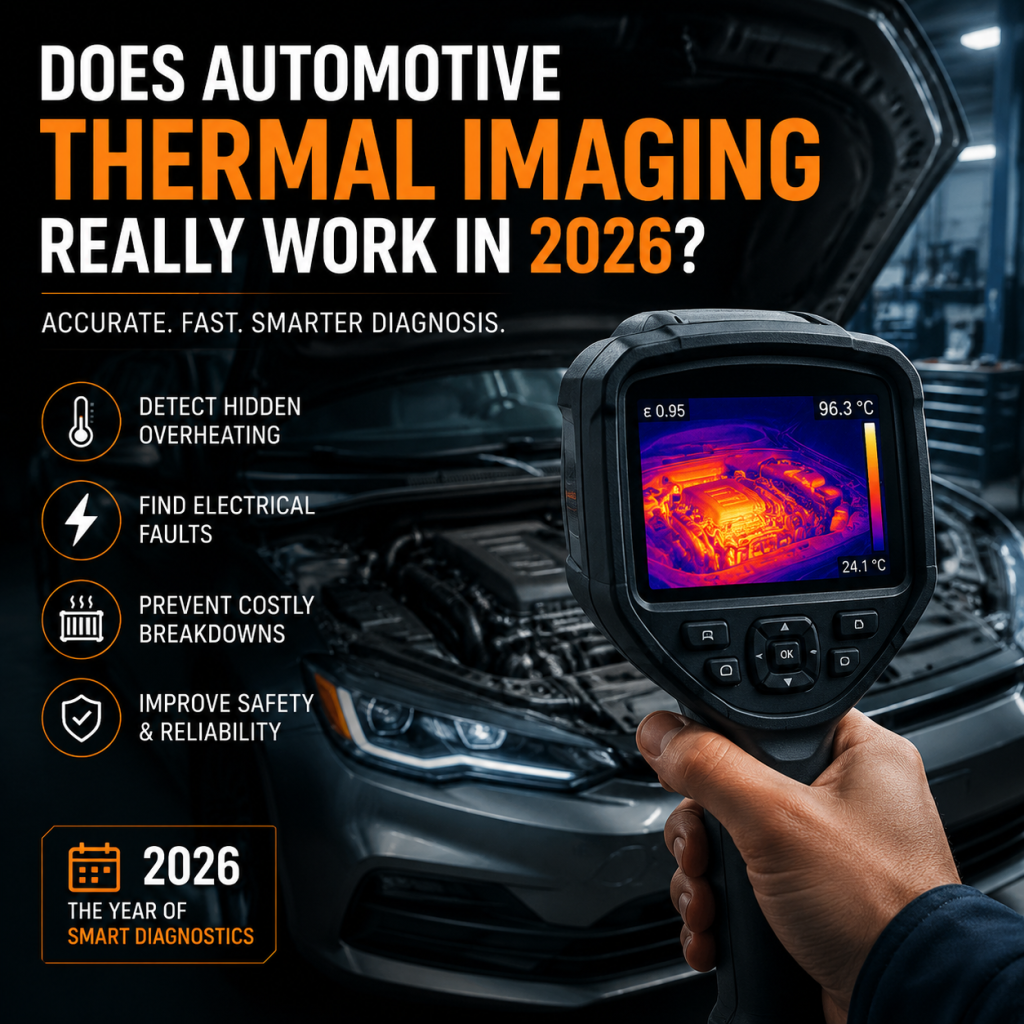
Thermal imaging detects infrared radiation and converts it into a visual heat map. In automotive use, that means you can see temperature differences across parts, components, and systems without touching them. Instead of guessing which area is overheating or underperforming, you get a visual snapshot of heat distribution.
This is especially useful for identifying issues such as:
- Brake drag and uneven brake temperatures
- Cooling system restrictions
- Exhaust leaks or hot spots
- Electrical resistance in connectors and wiring
- Misfiring cylinders
- Bearing or hub overheating
- HVAC airflow imbalances
The value lies in comparison. A single hot part may not mean much on its own, but temperature differences between similar components often point directly to a fault.
Real-World Use: Where It Helps Most
Brake Problems and Wheel-End Issues
One of the most convincing use cases is brake diagnosis. After a short drive, a thermal camera can quickly show whether one brake rotor is significantly hotter than the others. That often indicates a sticking caliper, seized slide pin, collapsed brake hose, or parking brake issue.
In owner testing, this is one of the fastest ways to spot a problem before it becomes obvious through smoke, vibration, or premature pad wear. It is especially helpful for fleet vehicles and daily drivers where small brake issues can go unnoticed for weeks.
Cooling System Troubleshooting
Thermal imaging can also help track coolant flow and detect restricted passages. A radiator with cold spots may suggest blockage. A thermostat that opens late or unevenly can sometimes be identified by watching how heat moves through the engine bay after startup.
That said, it is best used as a supporting tool. You still need proper pressure testing, scan data, and physical inspection. Thermal imaging can point you in the right direction, but it is not a complete cooling-system diagnosis on its own.
Electrical Fault Detection
Electrical problems are another strong use case. Loose connections, corroded terminals, overloaded circuits, and failing relays often create heat long before they fail completely. A thermal camera can reveal a hot fuse, a warm connector, or a wiring issue that looks normal from the outside.
This is where thermal imaging feels especially valuable in 2026. Modern vehicles have so many sensors, modules, and power loads that heat anomalies can save a lot of troubleshooting time.
HVAC and Cabin Comfort Issues
Thermal imaging is also useful for identifying poor airflow, blend door problems, and refrigerant-related temperature differences in the HVAC system. If one vent is significantly cooler than another or one side of the cabin is uneven, a thermal camera can help locate the source.
For owners who deal with intermittent climate-control complaints, this can be a major time saver.
What the 2026 Tools Are Like
Thermal cameras for automotive use have improved a lot. Entry-level models are more affordable than they used to be, and midrange units now offer better resolution, faster refresh rates, and improved temperature accuracy. Some clip directly to a smartphone, while others are standalone handheld devices.
Smart Features Matter More Now
In 2026, the best tools are not just about image quality. Software features matter too. Common improvements include:
- Color palette controls
- Spot temperature readings
- Temperature alarms
- Image capture and comparison
- App-based reporting
- Faster startup and smoother live view
These features make it easier to document findings, compare side-to-side components, and share results with customers or other technicians.
Resolution Still Makes a Difference
Lower-resolution cameras can still be useful for finding obvious hot spots, but finer diagnostics benefit from better image detail. If you plan to inspect wiring, connectors, or small components, higher resolution is worth paying for.
That said, even a modest thermal camera can be effective if you understand what you’re looking at and use it in the right context.
Where It Falls Short
Thermal imaging is useful, but it has limitations that owners should understand before buying one.
It Cannot See Everything
A thermal camera only shows surface temperature. It cannot detect internal wear, fluid contamination, compression loss, or exact sensor values. A part may look normal thermally while still being mechanically damaged.
Reflections and Environment Can Mislead
Hot exhaust nearby, sunlight, wind, and reflective surfaces can distort readings. Brake testing in direct sun, for example, may create less reliable comparisons than testing in a shaded area or after a controlled drive.
It Requires Interpretation
A thermal image is only as useful as the person reading it. A hot component is not always a failed component. Some parts are supposed to run warm or hot. You need vehicle knowledge, experience, or at least a diagnostic plan to interpret the data correctly.
Is It Worth It for Owners?
For casual drivers, thermal imaging may be more of a specialty tool than a daily necessity. But for enthusiasts, DIY mechanics, and owners who maintain older vehicles, it can absolutely be worth the money.
It makes sense if you:
- Work on your own vehicles
- Want faster troubleshooting
- Manage a fleet
- Deal with recurring brake, cooling, or electrical issues
- Like documenting repairs with visual evidence
It may not be worth it if you only want a once-a-year inspection tool and rarely diagnose problems yourself. In that case, borrowing or renting one might be a better option.
Best Practices for Getting Useful Results
Compare Similar Components
Always compare left to right, front to rear, or bank to bank. Temperature differences are more meaningful than single readings.
Test Under Similar Conditions
Try to inspect components after the same driving conditions or operating time. Random temperature comparisons can be misleading.
Use It With Other Diagnostics
Pair thermal imaging with scan tool data, visual inspection, and mechanical checks. The best results come from using it as part of a larger diagnostic process.
Learn Normal Patterns
The more you use a thermal camera, the easier it becomes to recognize what normal heat behavior looks like on your vehicle. That learning curve is one of the biggest reasons owners find it valuable over time.
Final Verdict
So, does automotive thermal imaging really work? Yes — when used correctly and for the right kinds of problems. In 2026, it has matured into a practical diagnostic aid that can save time, reveal hidden issues, and improve repair accuracy. It is especially strong for brake problems, electrical faults, cooling system concerns, and HVAC troubleshooting.
It is not a replacement for traditional diagnostics, and it will not solve every problem. But as a visual detection tool, it genuinely earns its place in the garage. For owners who value faster troubleshooting and clearer evidence, thermal imaging is more than a novelty — it is a useful and often impressive part of modern vehicle maintenance.