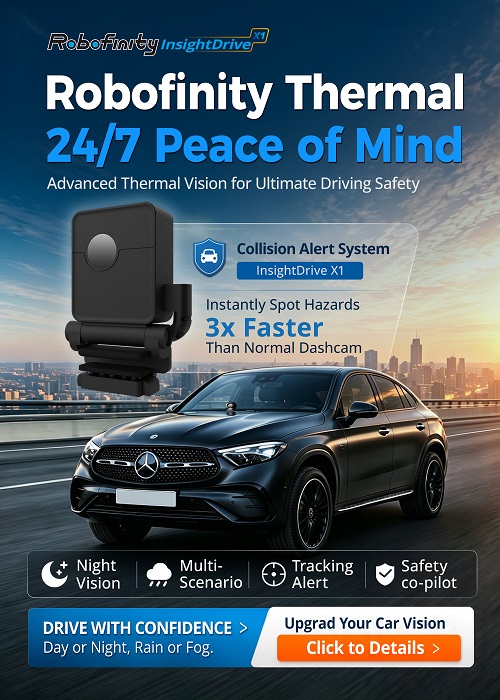


A vehicle thermal camera is one of the most practical safety technologies available for modern driving, especially in situations where visibility is limited. Unlike a standard dashboard camera or a regular night-vision system, a thermal camera does not depend on visible light. Instead, it detects heat signatures from people, animals, vehicles, and other objects, making it especially useful at night, in fog, in rain, and on dark rural roads.
- What Is a Vehicle Thermal Camera?
- How a Vehicle Thermal Camera Works
- Why Thermal Cameras Are Useful in Vehicles
- Common Applications of Vehicle Thermal Cameras
- 1. Passenger vehicles
- 2. Commercial fleets
- 3. Emergency vehicles
- 4. Off-road and adventure vehicles
- 5. Heavy equipment and industrial vehicles
- Thermal Camera vs. Standard Dash Cam vs. Night Vision
- What a Vehicle Thermal Camera Can and Cannot See
- Key Features to Look for in a Vehicle Thermal Camera
- 1. Resolution
- 2. Detection range
- 3. Field of view
- 4. Frame rate
- 5. Display type
- 6. Mounting style
- 7. Durability and weather resistance
- 8. Integration with other systems
- Installation Considerations
- Best Use Cases for Safety
- Night driving on rural roads
- Driving in fog, smoke, or haze
- Long-haul trucking
- Emergency response
- Construction and industrial sites
- Maintenance and Care
- Cost Factors and Value
- Practical Examples
- Example 1: A rural commute at night
- Example 2: A delivery truck in heavy fog
- Example 3: Emergency response in smoke
- Example 4: Off-road travel
- Limitations to Keep in Mind
- The Future of Vehicle Thermal Imaging
- Conclusion
As roads become busier and driving conditions more unpredictable, more vehicle owners, fleet operators, and safety-focused drivers are turning to vehicle thermal camera systems as an added layer of protection. Whether mounted on a personal car, commercial truck, emergency vehicle, bus, or off-road vehicle, a thermal camera can help drivers spot hazards sooner and respond more confidently.
This guide explains what a vehicle thermal camera is, how it works, where it is most useful, what to look for when buying one, and why it is becoming a valuable tool for safer driving.
Table of Contents
- What Is a Vehicle Thermal Camera?
- How a Vehicle Thermal Camera Works
- Why Thermal Cameras Are Useful in Vehicles
- Common Applications of Vehicle Thermal Cameras
- Thermal Camera vs. Standard Dash Cam vs. Night Vision
- What a Vehicle Thermal Camera Can and Cannot See
- Key Features to Look for in a Vehicle Thermal Camera
- Installation Considerations
- Best Use Cases for Safety
- Maintenance and Care
- Cost Factors and Value
- Practical Examples
- Limitations to Keep in Mind
- The Future of Vehicle Thermal Imaging
- Conclusion
What Is a Vehicle Thermal Camera?
A vehicle thermal camera is an imaging device installed on a vehicle to detect heat rather than visible light. It creates a visual representation of temperature differences in the environment. Warmer objects appear brighter or differently colored than cooler objects, depending on the display style.
These cameras are commonly used to identify:
- Pedestrians walking on dark roads
- Animals crossing at night
- Stalled vehicles or obstacles ahead
- Road hazards hidden by fog, smoke, or rain
- Weak points in vehicle systems during inspection and maintenance
Thermal cameras are often used in combination with other driving aids such as headlights, dash cams, rearview cameras, lane assist systems, and radar-based collision warning systems. Their main strength is their ability to reveal things the human eye may not notice until it is too late.
How a Vehicle Thermal Camera Works
Thermal cameras work by sensing infrared radiation, which is naturally emitted by all objects with a temperature above absolute zero. The warmer the object, the more infrared energy it gives off.

Basic process
-
The camera detects heat signatures
- It reads temperature differences in the scene instead of relying on visible light.
-
The sensor converts heat into an image
- These signals are processed into a thermal map or grayscale image.
-
The system displays the image to the driver
- Some systems show a black-and-white thermal view.
- Others use color palettes, such as white-hot, black-hot, or pseudo-color modes.
-
The driver identifies hazards
- People, animals, engine components, or road objects may stand out clearly against the background.
Unlike conventional cameras, thermal imaging does not need headlight beams, sunlight, or even clear visual conditions. That makes it effective in many environments where standard cameras struggle.
Why Thermal Cameras Are Useful in Vehicles
The most important advantage of a vehicle thermal camera is earlier hazard detection. Drivers often see obstacles only when they are close enough for headlights to illuminate them. Thermal cameras can extend that awareness farther ahead by identifying warm objects before they become obvious to the eye.
In practice, a vehicle thermal camera gives the driver a better chance to respond calmly and safely. It can be especially helpful when a road bends, the weather changes quickly, or a hazard appears suddenly in a dark area.
Key benefits
- Improved nighttime visibility
- Better detection in fog, smoke, or rain
- Early warning for pedestrians and animals
- Reduced risk of collisions on unlit roads
- Increased awareness for commercial and industrial fleets
- Additional support for low-speed maneuvering and parking
For drivers who regularly travel outside well-lit urban areas, a thermal camera can be especially valuable. Rural roads often have wildlife, uneven shoulders, and limited lighting. In those conditions, a vehicle thermal camera may help prevent an accident by giving the driver more time to react.
For more context on related safety upgrades, see Automotive Thermal Night Vision: Must-Have Guide to Effortless Driving.
Common Applications of Vehicle Thermal Cameras
Vehicle thermal cameras are used in many different settings. While they are especially popular for safety and nighttime driving, their usefulness extends far beyond that.
1. Passenger vehicles
For everyday drivers, a vehicle thermal camera can improve confidence during night travel. It can help detect:
- Deer or other animals near the roadside
- Pedestrians crossing in dark areas
- Broken-down cars without reflective warnings
- Objects hidden by darkness or weather
2. Commercial fleets
Fleet operators use thermal cameras to improve driver safety and reduce liability. Trucks, delivery vans, utility vehicles, and buses often travel long distances in varied conditions. A thermal camera may help drivers avoid costly accidents and downtime.
3. Emergency vehicles
Ambulances, fire trucks, and police vehicles frequently operate in low-visibility and high-stress environments. Thermal cameras can support rapid response by helping crews navigate through smoke, night conditions, or debris.
4. Off-road and adventure vehicles
Drivers who use vehicles for off-roading, overlanding, or remote travel often benefit from thermal imaging. It can help identify wildlife, obstacles, and terrain changes in areas with limited ambient light.
5. Heavy equipment and industrial vehicles
Construction vehicles, agricultural equipment, and industrial trucks may use thermal cameras for safety and monitoring. They can help operators see people or objects in blind spots or dangerous work zones.
Thermal Camera vs. Standard Dash Cam vs. Night Vision
It is easy to confuse thermal cameras with dash cams or night-vision systems, but they work differently and serve different purposes.
Standard dash cam
A dash cam records video using visible light, just like a regular camera. It is useful for documenting accidents, road incidents, and driving behavior. However, it depends on light and may have limited performance in darkness or bad weather.
Night vision camera
Night-vision systems usually amplify available light or use infrared illumination. They improve visibility in low light, but they still rely on some level of light or reflected infrared energy.
Thermal camera
A thermal camera does not need ambient light. It detects heat signatures, which allows it to show people, animals, and some obstacles even when the scene is very dark.
Summary of differences
- Dash cam: records events for evidence
- Night vision: improves low-light image brightness
- Thermal camera: detects heat and highlights warm objects
Many premium vehicle safety systems combine these technologies for the most complete view of the road.
What a Vehicle Thermal Camera Can and Cannot See
Thermal cameras are powerful, but they are not magic. Understanding their strengths and limitations is essential for using them effectively.
What they are good at seeing
- Humans
- Animals
- Engine heat
- Warm vehicles
- Recently used mechanical parts
- Some road objects that retain heat
What they may struggle with
- Objects with little temperature difference from the background
- Glass reflections in some situations
- Small metallic objects that do not emit much heat
- Scenes with heavy heat sources in the background
- Fine visual detail such as license plates or road signs
For example, a vehicle thermal camera may clearly show a pedestrian crossing a dark road, but it may not show the person’s clothing color, facial details, or text on a sign. For that reason, thermal cameras are best used as a situational awareness tool, not as the only source of visual information.
When visibility drops, the vehicle thermal camera can still reveal movement and body heat, which makes it easier to notice a risk early.
Key Features to Look for in a Vehicle Thermal Camera
Not all thermal cameras are built the same. If you are shopping for one, several technical and practical features should guide your decision.
1. Resolution
Resolution affects how detailed the thermal image appears. Higher resolution generally means better object recognition and more usable detail.
- Lower resolution may be enough for basic detection
- Higher resolution improves clarity and range
- Better resolution can be especially useful at highway speeds
2. Detection range
The camera should detect hazards far enough ahead to give the driver reaction time. A wider detection range is useful for fast-moving vehicles, while shorter-range systems may be fine for parking or slow driving.
3. Field of view
A broader field of view allows the camera to cover more of the road and surrounding area. A narrower view may provide more detail but less coverage.
4. Frame rate
A smoother frame rate helps display moving objects more clearly. This matters when driving at higher speeds or when hazards move quickly across the road.
5. Display type
Some systems have a built-in monitor, while others integrate with the vehicle’s infotainment screen or a dedicated dash-mounted display. Choose a display that is easy to read and does not distract the driver.
6. Mounting style
Thermal cameras may be mounted:
- On the front grille
- On the bumper
- Behind the windshield, if designed for that purpose
- On roof or auxiliary mounts for specialized vehicles
The best placement depends on the vehicle type and the intended use.
7. Durability and weather resistance
Since the camera is mounted outside the vehicle or near exposed areas, it should be able to withstand:
- Rain
- Dust
- Mud
- Vibration
- Temperature extremes
8. Integration with other systems
Some cameras can connect with:
- Collision warnings
- Lane assist systems
- Parking assist
- GPS tracking
- Fleet management platforms
Integration can make the system more useful and easier to monitor.
Installation Considerations
A vehicle thermal camera should be installed thoughtfully to maximize visibility and reliability.
Important placement factors
- Avoid obstructing the driver’s normal line of sight
- Ensure the camera has an unobstructed forward view
- Mount it low enough to detect road hazards, but high enough to avoid splash and damage
- Consider calibration and alignment during installation
Professional vs. DIY installation
Some thermal camera systems are simple enough for experienced vehicle owners to install, especially if they are designed as aftermarket accessories. However, more advanced systems may require professional installation for:
- Wiring
- Display integration
- Sensor calibration
- Software setup
- Fleet system connectivity
If the camera is meant for safety-critical use, professional installation is often the better choice.
Best Use Cases for Safety
A vehicle thermal camera is most effective when used in environments where standard vision is challenged.
Night driving on rural roads
This is one of the most common and valuable use cases. Thermal cameras can help identify deer, cattle, pedestrians, or other objects far earlier than headlights alone.
Driving in fog, smoke, or haze
Because thermal imaging does not depend on visible light, it can still reveal heat sources even when the road is partially obscured.
Long-haul trucking
Truck drivers covering large distances at night can benefit from thermal awareness, especially when fatigue, weather, and road conditions become factors.
Emergency response
In critical situations, seconds matter. Thermal imaging can help first responders see through darkness or smoke and better assess danger zones.
Construction and industrial sites
Thermal cameras can help detect workers and equipment in low-light work areas where standard visibility is limited.
If your vehicle spends time in severe weather, consider reading Car Thermal Camera Fog: Must-Have Solution for Safer Driving for more practical context.
Maintenance and Care
Like any automotive technology, a thermal camera works best when it is properly maintained.
Cleaning the lens
Dirt, road salt, mud, and water spots can reduce image quality. Clean the lens carefully using appropriate materials recommended by the manufacturer.
Checking alignment
If the camera shifts after rough driving or impacts, it may need recalibration. Even a slight misalignment can reduce its effectiveness.
Inspecting wiring and connections
Loose wiring, corrosion, or damaged connectors can cause signal loss or poor performance. Regular inspection helps prevent failures.
Software updates
Some thermal camera systems include firmware or software updates. These updates may improve image processing, detection logic, or compatibility with other vehicle systems.
Cost Factors and Value
Vehicle thermal cameras vary widely in price. Entry-level systems are more affordable, while advanced automotive-grade systems can be significantly more expensive.
What affects price?
- Image resolution
- Range and sensitivity
- Display quality
- Automotive-grade durability
- Software features
- Integration with driver-assistance systems
- Brand reputation and support
When evaluating cost, it helps to think beyond the purchase price. A vehicle thermal camera may reduce the likelihood of collisions, lower repair costs, and improve driver confidence. For commercial fleets, those benefits may translate into real operational savings.
For a broader overview of purchase decisions, you may also find the Car Thermal Imaging Camera: Must-Have Affordable 4K Night Vision guide useful.
Practical Examples
To understand the real value of a vehicle thermal camera, it helps to imagine a few common situations.
Example 1: A rural commute at night
A driver is traveling home on an unlit country road. Headlights reveal only a limited area ahead. A thermal camera detects a deer standing near the roadside before it steps into the lane, giving the driver more time to slow down.
Example 2: A delivery truck in heavy fog
A delivery driver is operating early in the morning during foggy conditions. Standard visibility is poor, but the vehicle thermal camera helps detect a person walking near the edge of the road, reducing the risk of a close call.
Example 3: Emergency response in smoke
A rescue vehicle arrives near a fire scene. Smoke reduces clear visibility, but the thermal camera helps identify warm objects and moving people in the vicinity, supporting safer navigation.
Example 4: Off-road travel
An overlanding vehicle moves through a dark trail at night. The thermal camera helps the driver notice an animal crossing ahead and a rough patch of terrain that might otherwise be missed.
For rough terrain and remote routes, Off-Road Thermal Night Vision: Best Must-Have System for Driving explores a similar use case in more detail.
Limitations to Keep in Mind
Although a thermal camera is a powerful safety tool, it is not a replacement for attentive driving.
Main limitations
- It does not show color or fine visual detail
- It may not clearly distinguish all objects
- It can be affected by hot backgrounds or environmental heat
- It does not replace mirrors, headlights, or standard cameras
- It should not encourage overly aggressive driving at night
Drivers should still use caution, reduce speed when needed, and rely on multiple sources of information. Thermal imaging is best viewed as an enhancement to good driving habits, not a substitute for them.
The Future of Vehicle Thermal Imaging
Thermal imaging technology continues to improve. As sensors become smaller, more affordable, and more efficient, vehicle thermal cameras are likely to become even more common in consumer and commercial vehicles.
Emerging trends include:
- Better integration with advanced driver-assistance systems
- Smarter object recognition powered by AI
- Improved image clarity at greater distances
- More compact, factory-installed systems in mainstream vehicles
- Enhanced fleet monitoring and predictive safety analytics
In the future, thermal imaging may become a standard component of vehicle safety packages, much like backup cameras and parking sensors have become today. For technical background on infrared sensing, see the National Institute of Standards and Technology.
Conclusion
A vehicle thermal camera offers a unique and valuable way to improve road awareness, especially in low-light and low-visibility conditions. By detecting heat signatures instead of relying on visible light, it can help drivers spot pedestrians, animals, vehicles, and hazards sooner than standard cameras often can.
For everyday drivers, it can increase confidence on dark roads. For fleets, emergency responders, and industrial vehicles, it can improve safety, reduce risk, and support better decision-making. While it is not a replacement for careful driving or other vehicle safety systems, it is a powerful tool that can make a meaningful difference.
If you drive in challenging conditions or want a stronger layer of protection on the road, a vehicle thermal camera is worth serious consideration.