


SEO Title: Car Thermal Night Vision System Price: A Practical Cost Guide
- What Does a Car Thermal Night Vision System Usually Cost?
- Thermal Night Vision Is Not the Same as Every Infrared Camera
- The Main Factors Affecting Price
- 1. Thermal sensor resolution
- 2. Lens and field of view
- 3. Image refresh rate and latency
- 4. Detection and recognition software
- 5. Display type and placement
- 6. Camera housing and weather protection
- 7. Vehicle integration
- 8. Brand support, documentation, and warranty
- Installation Costs and Hidden Expenses
- Factory Night Vision Versus an Aftermarket System
- A Relevant Aftermarket Example
- Is a More Expensive System Necessarily Better?
- Which Drivers Are Most Likely to Benefit?
- Rural-road drivers
- Frequent nighttime commuters
- Long-distance and commercial drivers
- Families and drivers in pedestrian-heavy areas
- Drivers in fog, rain, or snow
- Safety Limitations Every Buyer Should Understand
- How to Compare Quotes Without Overpaying
- Budgeting by Real-World Use Case
- FAQ
- Can thermal night vision see through fog?
- Does a thermal camera work in complete darkness?
- Can I install a car thermal camera myself?
- Is thermal night vision worth the money?
- Do all thermal systems detect pedestrians and animals?
- Will adding an aftermarket system affect my vehicle warranty?
- Making a Sound Purchase Decision
Meta Description: Learn what a car thermal night vision system costs, what affects the price, and how to compare sensors, displays, detection features, installation, and ownership expenses.
Drivers researching the car thermal night vision system price will encounter everything from inexpensive infrared-style cameras to sophisticated factory-integrated driver-assistance systems. Although basic products may cost a few hundred dollars, a capable aftermarket thermal system can move into the low thousands once installation is included. Factory equipment may add several thousand dollars to a new vehicle or require a costly option package.
The reason for this wide range is simple: products marketed as “night vision” do not all use the same technology. Sensor quality, detection software, display hardware, vehicle integration, installation complexity, environmental protection, and support can substantially change the final cost. This guide explains those factors so you can compare systems on practical value rather than price alone.
What Does a Car Thermal Night Vision System Usually Cost?
As a general budgeting framework, vehicle night vision products fall into three broad levels:
| System category | Typical price range | What it generally includes |
|---|---|---|
| Entry-level infrared or basic imaging camera | About $200-$700 | Camera, small display, limited processing, basic mounting hardware |
| Purpose-built aftermarket thermal system | About $700-$2,500 or more | Thermal sensor, dedicated display, stronger housing, detection or alert features on some models |
| Factory-installed or deeply integrated system | Roughly $2,000-$5,000 or more | Vehicle-integrated display, software, controls, and possible connection to other assistance features |
These figures are planning ranges, not quotes. Prices vary by market, tax treatment, vehicle, seller, currency, installation method, and included equipment. In Europe, displayed consumer pricing may include value-added tax, while US prices may exclude sales tax. Installation could also be bundled into one quote or charged separately.
The most useful question is therefore not simply, “How much does night vision cost?” It is, “What technology and ownership costs are included at that price?”
Thermal Night Vision Is Not the Same as Every Infrared Camera
A low-cost “night vision” listing is not automatically comparable with a true thermal imaging system.
Thermal imaging
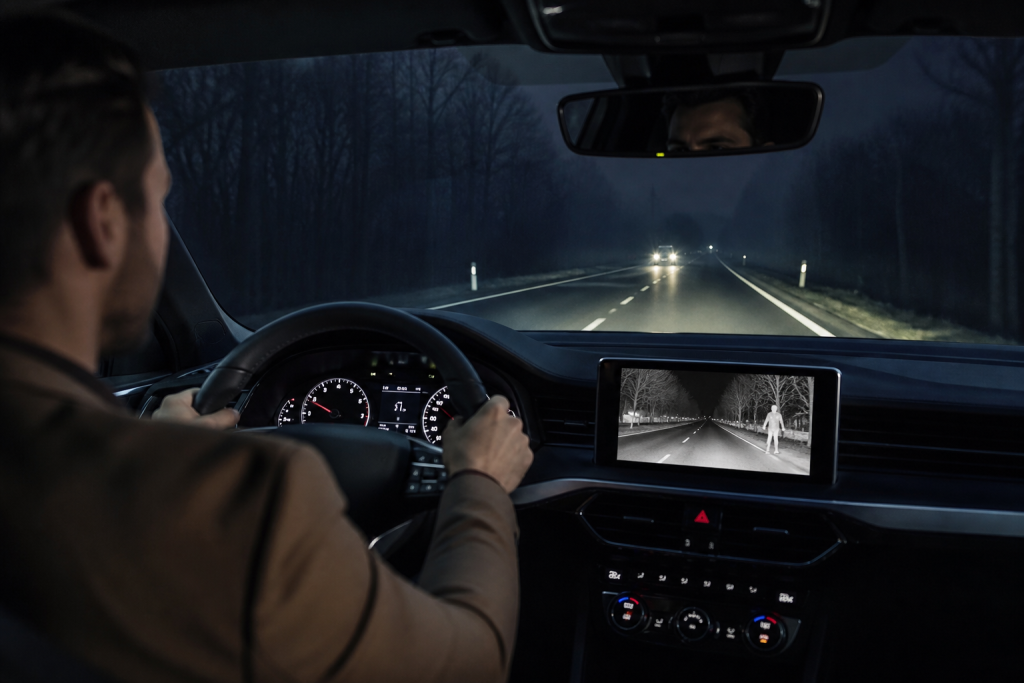
A thermal camera senses differences in emitted infrared energy and translates those differences into a visible image. Warm road users, including people and many animals, can stand out from cooler surroundings even when ordinary visible light is limited.
Because thermal imaging does not depend on illuminating the scene like a conventional camera, it can support road awareness beyond what headlights visibly reveal in some low-light situations. Its usefulness still depends on sensor performance, lens choice, calibration, display quality, software, weather, and the nature of the object ahead.
Near-infrared and illuminated cameras
Some lower-priced products use a conventional or near-infrared-sensitive camera with infrared illuminators. These devices can improve visibility compared with an ordinary camera in certain conditions, but they do not form an image from heat differences in the same way as a thermal sensor.
That distinction matters when comparing prices. Two listings may both say “infrared night vision,” yet one may contain a thermal detector while the other relies on reflected infrared light. Buyers should look for a clear explanation of the underlying sensor rather than relying on the product name.
Low-light visible cameras
A third category uses a highly light-sensitive visible camera. It can provide a familiar, detailed road image when some ambient light is available, but performance may decline in near-total darkness or severe glare. Again, it serves a different purpose from thermal imaging.
Before comparing products, confirm whether each one uses:
- A genuine thermal detector
- Near-infrared illumination
- A low-light visible camera
- A combination of technologies
This single check can explain much of the apparent price difference.
The Main Factors Affecting Price
1. Thermal sensor resolution
The thermal detector is one of the most expensive parts of the system. Higher sensor resolution can provide more image information, making it easier to distinguish the shape and position of a distant object.
Do not confuse display resolution with thermal sensor resolution. A high-definition screen cannot create detail that the sensor never captured. Product specifications should identify both values separately.
Resolution is also not the only measure of image quality. A lower-resolution detector paired with suitable optics and effective processing may perform better for a particular driving task than a higher-resolution unit with an inappropriate field of view.
2. Lens and field of view
The lens determines how much of the road appears in the image and how large distant hazards look.
A wide field of view covers more of the roadside, which may be useful in city traffic or where pedestrians and animals can enter from the shoulder. A narrower field of view makes distant objects appear larger but shows less of the surrounding area. Rural and highway users may value longer-range detail, while urban users may prioritize wider coverage.
Higher-quality thermal optics and specialized lenses increase manufacturing costs. Lens choice should match the driving environment rather than being treated as a prestige specification.
3. Image refresh rate and latency
A driving display needs to update smoothly enough for motion to be understandable. A low refresh rate may make moving vehicles, pedestrians, or animals appear less fluid. Processing delays can also reduce the practical value of the information because the display no longer represents the scene as it exists at that moment.
Higher frame rates and low-latency processing usually require better sensors and electronics, which affect cost. Ask whether the stated frame rate applies to the thermal feed itself and whether processing features add noticeable delay.
4. Detection and recognition software
Some systems only display a thermal image. The driver must notice and interpret everything manually. More advanced products may analyze the scene to identify categories such as pedestrians, animals, or vehicles and provide visual or audible alerts.
Recognition software can improve usability because drivers should not continuously stare at a secondary display. It also adds hardware and development costs. Its presence alone does not guarantee reliable performance, however. Detection can be affected by object size, distance, partial obstruction, road geometry, weather, contrast, and installation alignment.
Useful questions include:
- Which types of road users can the system identify?
- Does it distinguish between detection and classification?
- How are alerts presented?
- Can alert sensitivity or volume be adjusted?
- Are software updates available?
- Does recognition work locally, or does it depend on connectivity?
5. Display type and placement
The display may be a small standalone monitor, an instrument-cluster view, a head-up display, or an image integrated into the vehicle’s infotainment system. A simple screen is usually cheaper to install. Factory integration costs more because it may require vehicle-specific electronics, controls, software, and testing.
Screen size is not automatically a measure of usefulness. Placement, contrast, glare resistance, readability, and the amount of time required to interpret the image matter more. A display that blocks the windshield or encourages prolonged downward glances can create a new distraction.
A practical installation keeps the information visible without obstructing the road, mirrors, airbags, or controls.
6. Camera housing and weather protection
An exterior camera must tolerate rain, road spray, dust, vibration, temperature changes, and repeated exposure to road debris. Better sealing, connectors, mounting hardware, and thermal management raise the price but are important for long-term reliability.
A protection rating can provide useful context, but it does not answer every ownership question. Check whether the rating applies to the camera, connectors, control module, and display or only one component. The position of the camera also affects how often the lens needs cleaning and how vulnerable it is to stone damage.
7. Vehicle integration
A universal aftermarket system can often operate independently using its own camera and monitor. An integrated system may communicate with the vehicle’s electronics, use an existing display, or coordinate with other driver-assistance features.
Integration increases complexity. Modern vehicles can have sensitive data networks, multiple camera systems, active grille shutters, tightly packaged bumpers, and carefully managed electrical loads. Connecting equipment incorrectly may cause faults or interfere with other systems.
Vehicle-specific brackets, wiring interfaces, software configuration, and calibration can therefore add materially to the invoice.
8. Brand support, documentation, and warranty
Price can reflect more than physical components. Clear installation instructions, compatible replacement parts, technical support, software maintenance, and a meaningful warranty all have value.
Before purchase, verify who handles support, where repairs are performed, whether the camera or display can be replaced separately, and what happens if the product is discontinued. A cheaper unit may become expensive if a damaged cable or proprietary mount cannot be sourced.
Installation Costs and Hidden Expenses
The advertised product price is only one part of the budget. A more realistic calculation is:
Total ownership cost = equipment + installation + vehicle-specific parts + tax + maintenance + possible repairs
Professional aftermarket installation may add roughly $200 to $1,000 or more, depending on the vehicle and system. A straightforward installation with an independent display will generally cost less than concealed wiring, custom fabrication, bumper removal, infotainment integration, or calibration.
Potential extra costs include:
- Vehicle-specific brackets or wiring adapters
- Fuse taps, relays, connectors, and protective conduit
- Custom camera mounting or trim work
- Display mounting hardware
- Software configuration
- Calibration or realignment
- Lens covers or protective hardware
- Removal and reinstallation after collision repair
- Shipping, import duties, VAT, or sales tax
- Future replacement of cables, displays, or cameras
Obtain an itemized quote before approving the work. It should identify the equipment, labor, mounting location, wiring route, calibration requirements, warranty responsibilities, and whether installation is reversible.
Factory Night Vision Versus an Aftermarket System
Neither route is universally better. The right choice depends on whether you are purchasing a new vehicle, upgrading one you already own, or comparing long-term ownership costs.
Factory-installed systems
Factory night vision typically offers the cleanest visual and electronic integration. Controls may appear in the instrument panel, and alerts may work with other vehicle functions. The equipment is also designed around that specific model’s packaging.
The trade-off is cost and availability. Night vision may only be offered on certain trim levels or inside a larger technology package. That can make its real incremental cost much higher than the value of the camera alone. Repairs may also require specialized diagnostic equipment and model-specific components.
Factory equipment is worth considering when:
- You are already ordering a compatible new vehicle.
- Integration and a factory appearance are high priorities.
- The package contains other features you genuinely want.
- Dealer or specialist service access is acceptable.
Aftermarket systems
Aftermarket equipment offers more choice and can add thermal imaging to a vehicle that was not available with it from the manufacturer. It may also be transferred to another compatible vehicle, although labor and new mounting hardware could be required.
Quality and compatibility vary more widely. A careful installation is essential, and buyers must evaluate the camera, display, alerts, documentation, and support themselves.
An aftermarket system often makes sense when:
- You plan to keep your current vehicle.
- Night driving is a frequent part of your routine.
- You want a dedicated thermal image rather than a broad factory package.
- The installation can be completed without compromising existing safety systems.
A Relevant Aftermarket Example
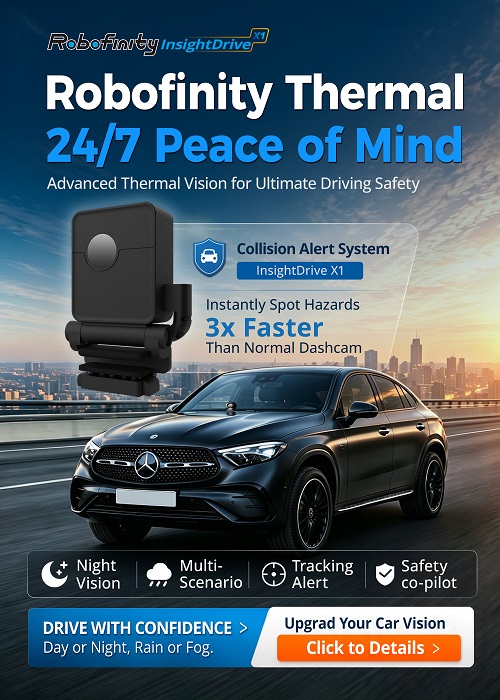
Robofinity InsightDrive is one example of a purpose-built vehicle thermal imaging night vision system. Its documented features include AI-supported recognition of pedestrians, animals, and vehicles with real-time alerts. Those capabilities illustrate why an awareness-oriented product generally costs more than a basic camera-and-screen kit: part of the price reflects scene analysis and warning functions, not merely the display of a thermal image.
As with any such product, compare the exact configuration, current seller quote, installation requirements, and vehicle compatibility. Detection support does not guarantee that every hazard will be recognized.
Is a More Expensive System Necessarily Better?
Higher cost may buy stronger hardware, better processing, deeper integration, or more dependable support. It does not automatically make a product better suited to your driving.
A premium long-range system might be valuable on dark rural roads where deer or pedestrians can be difficult to see early. A city driver may gain more from wide coverage and restrained alerts that remain useful in dense traffic. A delivery driver operating at night may prioritize durability and a clear display, while an occasional suburban driver may not use the equipment enough to justify a complex installation.
Evaluate systems using a practical scorecard:
- Technology: Is it true thermal imaging or another kind of camera?
- Driving fit: Does the field of view suit rural, highway, or urban use?
- Usability: Can information be understood quickly without sustained glances?
- Alert quality: Are warnings relevant, adjustable, and clearly presented?
- Installation: Can it be mounted without obstructing safety equipment?
- Durability: Is exterior equipment protected against normal road exposure?
- Support: Are warranty service and replacement parts realistically available?
- Total cost: Does the quote include hardware, labor, tax, and calibration?
- Limitations: Does the seller explain where performance can decline?
- Compatibility: Is the system approved by the supplier or installer for your vehicle?
Which Drivers Are Most Likely to Benefit?
Thermal night vision is most relevant when poor driving visibility is routine rather than occasional.
Rural-road drivers
Unlit roads, wooded shoulders, bends, and animal activity create a strong use case. Thermal contrast may help reveal warm road users before they become obvious in the headlight beam. The driver still needs a speed that allows stopping within the visible and usable roadway.
Frequent nighttime commuters
Drivers who regularly travel before dawn or after dark can gain more value over time than someone who rarely drives at night. Consider how many hours the system will actually be used, not just whether its demonstration image looks impressive.
Long-distance and commercial drivers
Repeated low-light driving increases exposure to fatigue, glare, and changing weather. Thermal imaging may provide an additional information source, but it is not a fatigue-management tool. Rest breaks, legal driving-hour limits, clean glass, effective lighting, and attentive driving remain fundamental.
Families and drivers in pedestrian-heavy areas
A recognition feature may be useful where people cross near dimly lit streets, parking entrances, or residential roads. In busy environments, however, excessive alerts could become distracting. Alert behavior and field of view deserve close scrutiny.
Drivers in fog, rain, or snow
Thermal imaging may retain useful contrast in some poor-visibility conditions, but performance is not unlimited. Moisture, dense precipitation, dirty lenses, spray, and the thermal characteristics of the scene can reduce image quality. No camera turns severe weather into normal driving conditions.
Safety Limitations Every Buyer Should Understand
Thermal imaging is an awareness aid, not a substitute for seeing and controlling the road through normal driving practices.
A thermal image may not clearly show lane markings, traffic-light colors, road signs, potholes, cold debris, or every vehicle boundary. Warm surfaces can produce complex scenes, and an object can be partially hidden behind vegetation, parked vehicles, or roadside structures. Detection software can miss hazards or generate an alert that does not correspond to an immediate threat.
Drivers should continue to rely on:
- Properly functioning and correctly aimed headlights
- A clean windshield, mirrors, lights, and camera lens
- Safe speed for the available visibility
- Adequate following and braking distance
- Direct observation of traffic and road conditions
- Compliance with traffic laws
- Appropriate tires and vehicle maintenance
- Regular rest during long or overnight journeys
The display should be treated like other driver information: check it briefly when appropriate, but keep primary attention on the road. An installer should also confirm that the screen and wiring do not interfere with airbags, forward cameras, radar sensors, or the driver’s field of view.
How to Compare Quotes Without Overpaying
Ask each seller or installer to quote the same scope. Otherwise, a low equipment-only price may appear cheaper than a complete installed package.
Request written answers to the following:
- What exact imaging technology does the product use?
- What are the thermal sensor and display resolutions?
- What is the frame rate?
- What is included in the box?
- Which recognition and alert functions are included?
- Is any subscription or paid software required?
- Is the stated detection distance based on detecting an object or identifying its category?
- Does the price include vehicle-specific installation?
- Will body panels or the bumper need to be removed?
- Is calibration included?
- Who covers damage or faults related to installation?
- Which parts are covered by warranty, and for how long?
- Are replacement cameras, cables, brackets, and displays available?
- Can the system be removed without permanent dashboard or body damage?
Be cautious when a listing emphasizes extreme range without explaining target size, weather, lens choice, or whether “range” means merely detecting heat rather than recognizing a pedestrian or animal. Detection, recognition, and identification are different performance thresholds.
Budgeting by Real-World Use Case
For an older commuter car, spending several thousand dollars on a deeply integrated system may not be economically sensible. A well-supported standalone thermal unit with a clean, professional installation could offer the desired function at lower cost.
For a new premium vehicle, factory integration may be worth the extra expense because it preserves the cabin design and consolidates controls. The calculation changes if night vision requires an option package full of unrelated features.
For a rural family vehicle used every evening, sensor quality, reliable alerts, environmental protection, and installer competence may justify paying above the entry level. The key value is repeated use under the conditions for which the system was purchased.
For an occasional night driver, first address lower-cost fundamentals: headlight condition and aim, windshield clarity, vision correction, wiper performance, and driving speed. A thermal system should complement those basics, not compensate for neglected maintenance.
FAQ
Can thermal night vision see through fog?
It may provide useful contrast in some foggy or hazy conditions, but it cannot see through all fog. Water droplets, rain, snow, spray, and atmospheric conditions can reduce thermal range and image quality. Drivers must slow down and use appropriate lighting whenever visibility deteriorates.
Does a thermal camera work in complete darkness?
A genuine thermal camera does not need visible light to form an image from temperature differences. However, road interpretation still has limits, and objects with little thermal contrast may be harder to distinguish. Headlights remain legally and practically necessary.
Can I install a car thermal camera myself?
Some standalone kits may be suitable for an experienced vehicle-electronics installer or skilled owner. Modern cars have airbags, data networks, active safety sensors, and complex electrical systems, so professional installation is often the safer choice. Poor placement or wiring can reduce performance or create faults.
Is thermal night vision worth the money?
It can be worthwhile for drivers who frequently use dark rural roads, travel at night, or encounter pedestrians and animals in low-light environments. It may offer less value to someone who rarely drives after dark. Frequency of use, system quality, installation cost, and realistic expectations should guide the decision.
Do all thermal systems detect pedestrians and animals?
No. Some systems only provide an image. Recognition and real-time alerts require additional processing and software, and supported object categories vary. Even systems with recognition cannot be expected to detect every hazard in every condition.
Will adding an aftermarket system affect my vehicle warranty?
Warranty treatment varies by jurisdiction, manufacturer, vehicle, and the cause of a fault. Before installation, ask the vehicle manufacturer or an authorized service provider about potential implications, and obtain written warranty terms from the equipment supplier and installer.
Making a Sound Purchase Decision
The final cost of automotive thermal night vision reflects much more than a camera. Sensor resolution, optics, frame rate, recognition software, display design, weather protection, integration, professional labor, and long-term support all contribute to the price.
Begin by identifying the conditions you actually face: dark rural roads, nighttime highway travel, city pedestrians, bad weather, or occasional low-light driving. Then compare complete installed prices and verify that each quote covers the same equipment and labor. Prioritize useful image quality, suitable coverage, manageable alerts, reliable installation, and available support over headline specifications.
Most importantly, treat thermal night vision as one additional source of information. Combined with maintained headlights, clean glass, appropriate speed, sufficient braking distance, and full driver attention, it can support better road awareness without creating a false sense of security.