


Commercial night driving safety starts with what drivers can actually see and how quickly they can recognize hazards. With commercial truck night visibility, fleets can reduce risk by improving forward sight, side awareness, hazard detection timing, and overall driver workload—especially during long overnight routes.
- Why Night Driving Is Harder for Commercial Trucks
- The Main Ways Trucks Can Improve Night Safety
- Better forward visibility
- Better side and rear awareness
- Earlier hazard recognition
- Lower driver workload
- Lighting Is the First Line of Safety
- Headlights and alignment matter
- Clean lenses and glass improve real-world performance
- Marking and outline visibility help others judge truck position
- Visibility Technology That Supports the Driver
- Camera systems and mirrors are complementary
- Thermal imaging can add another layer
- Real-time alerts can reduce delay
- Driver Habits Still Matter More Than Hardware
- Reduce speed where visibility is limited
- Increase following distance
- Scan farther ahead, not just near the hood
- Avoid overconfidence in good lighting
- Use high beams responsibly
- Fatigue Is a Safety Issue, Not Just an Efficiency Problem
- Route Selection Makes a Difference
- Rural roads demand extra caution
- Industrial and delivery zones have their own risks
- Highway driving still needs attention
- Maintenance Has a Direct Effect on Night Safety
- Tires and brakes matter more when visibility is limited
- Wipers and glass should not be treated as minor items
- Lighting faults should be fixed quickly
- Keep sensors clean and calibrated where applicable
- A Practical Checklist for Fleets and Owner-Operators
- Where Advanced Safety Tools Fit In
- FAQ
- Can commercial trucks really be safer at night than passenger cars?
- What is the biggest night driving risk for commercial trucks?
- Do driver-assistance systems replace good night driving habits?
- Are thermal imaging systems useful for truck drivers?
- What should fleets prioritize first for night safety?
- Why are rural routes more challenging for trucks at night?
- Conclusion
Night driving changes the job for every road user, but commercial trucks face a sharper version of the challenge. Their size, stopping distance, blind spots, route demands, and long operating hours make low-light conditions more complex than daytime driving. At the same time, commercial trucks can improve night driving safety in meaningful ways when fleets use the right equipment, train drivers properly, and manage fatigue, lighting, and visibility with discipline.
Table of Contents
- Why Night Driving Is Harder for Commercial Trucks
- The Main Ways Trucks Can Improve Night Safety
- Lighting Is the First Line of Safety
- Visibility Technology That Supports the Driver
- Driver Habits Still Matter More Than Hardware
- Fatigue Is a Safety Issue, Not Just an Efficiency Problem
- Route Selection Makes a Difference
- Maintenance Has a Direct Effect on Night Safety
- A Practical Checklist for Fleets and Owner-Operators
- Where Advanced Safety Tools Fit In
- FAQ
- Conclusion
Why Night Driving Is Harder for Commercial Trucks

Night driving is more demanding for any vehicle, but trucks amplify the consequences of small mistakes. Reduced ambient light makes it harder to judge distance, identify pedestrians, read road edges, and spot stalled vehicles or debris early. Headlight glare from oncoming traffic can also create momentary blind spots, especially on two-lane roads and in wet weather.
For commercial drivers, the margin for error is narrower because:
- Trucks need more space to stop.
- Mirrors and blind spots already require constant attention.
- Long shifts increase fatigue risk.
- Cargo weight can change handling and braking behavior.
- Many trucks operate on routes with rural roads, industrial zones, or warehouse areas that are poorly lit.
The practical result is that night safety depends less on one feature and more on the whole system: visibility, training, maintenance, and driver judgment working together.
The Main Ways Trucks Can Improve Night Safety
Commercial trucks improve night driving safety when they are treated as managed safety systems rather than just vehicles. Four areas matter most: seeing farther, being seen earlier, detecting hazards sooner, and reducing driver workload. With commercial truck night visibility, these improvements work best when they reinforce each other.
Better forward visibility
A truck driver who can see farther ahead has more time to react. That matters when a hazard appears suddenly, such as a stopped car, a person crossing outside a lit area, or an animal entering the road. Improved forward vision comes from properly aimed headlights, clean lenses, windshield maintenance, and tools that support detection in low light. Strong commercial truck night visibility is especially important when there is limited street lighting and the driver cannot rely on illuminated lane markings.
Better side and rear awareness
Night driving is not only about the road ahead. Trucks change lanes, turn wide, and move through loading yards where lighting can be uneven. Good mirrors, camera systems, and disciplined checks reduce the chance of clipping a vehicle, striking a barrier, or missing a cyclist or worker nearby. This is a core part of commercial truck night visibility because many incidents happen at the edges of the driving path, not in the exact center of it.
Earlier hazard recognition
Commercial trucks can be fitted with driver-assistance technology that helps spot hazards earlier than human eyes alone may manage in low light. This is especially useful for animal detection, pedestrian detection, and vehicle recognition in poor-visibility driving scenarios. When fleets plan for earlier recognition as part of commercial truck night visibility, drivers get more time to slow smoothly and choose safer positioning.
Lower driver workload
When a driver is less busy compensating for poor visibility, attention can be spent on judgment and timing rather than on simply trying to see. That matters on long-haul routes, overnight deliveries, and repeated city stops. Better commercial truck night visibility reduces the mental “cost” of seeing in darkness, which helps drivers keep scan patterns consistent.
Lighting Is the First Line of Safety
Lighting is the simplest and often the most overlooked part of night safety. A commercial truck night visibility plan with poor lighting setup or neglected bulbs can become harder to control for the driver and harder for others to see. Since lighting affects both range and contrast, small defects can create outsized risk at speed.
Headlights and alignment matter
Headlights should be bright enough for the road but also aimed correctly. If they are too high, they create glare for oncoming traffic. If they are too low, the driver loses valuable forward reach. Proper alignment is especially important after suspension work, load changes, or body repairs. Correct aim supports commercial truck night visibility by keeping the useful light where hazards are likely to appear.
Clean lenses and glass improve real-world performance
Even good lighting loses effectiveness when lenses are dirty, hazed, or damaged. That is common on commercial vehicles that work in rain, slush, dust, and industrial environments. Routine cleaning of headlight covers, marker lights, mirrors, and the windshield pays off more than many drivers expect. Clear glass and lenses improve commercial truck night visibility because they preserve contrast and reduce scatter from grime and moisture.
Marking and outline visibility help others judge truck position
Reflective markings, functioning side markers, and clear rear lights help other road users understand where a truck is and how it is moving. That becomes more important at night because drivers in passenger cars often have less time to judge a truck’s width, speed, and lane position. Strong commercial truck night visibility includes not just “what the driver sees,” but also whether others can correctly identify the truck’s location and movement.
If you want a vehicle-specific angle on night driving visibility, you may also find this helpful: Truck Night Vision Systems: Why Trucks Are Ideal for Night Vision Systems.
Visibility Technology That Supports the Driver
Modern commercial trucks can do more than rely on glass and bulbs. Driver-assistance technology can help fill in the gaps that appear in darkness, rain, fog, or glare. The best deployments improve commercial truck night visibility without distracting the driver or replacing core skills like scanning and speed control.
Camera systems and mirrors are complementary
Cameras can help with blind zones, docking, and lane changes, but they should not replace mirrors. In real night driving, the strongest setup is usually a combination of both. Mirrors provide immediate context, while cameras can make hard-to-see zones more manageable. When used together, they strengthen commercial truck night visibility where a driver cannot rely on ambient light.
Thermal imaging can add another layer
Thermal imaging systems detect heat patterns rather than visible light, which can help reveal people, animals, or vehicles that are hard to spot in darkness. For drivers who spend time on rural roads or in poor-visibility conditions, this can be a meaningful awareness aid rather than a full replacement for normal driving habits. In many cases, adding thermal capability can improve commercial truck night visibility in situations where glare, rain, and limited street lighting reduce contrast.
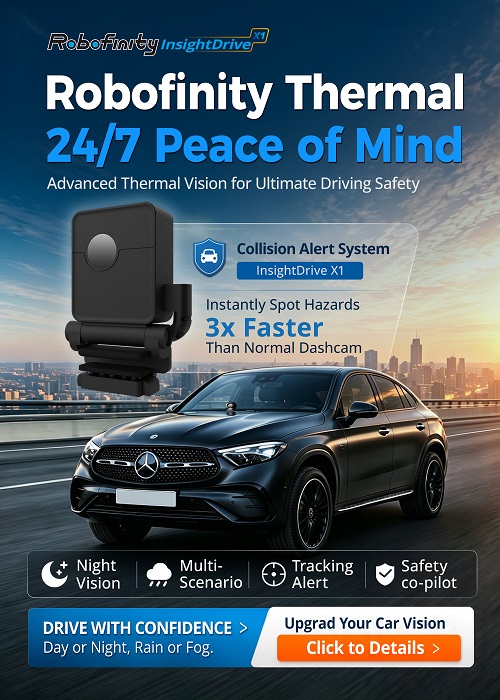
Robofinity InsightDrive is one example of an aftermarket vehicle thermal imaging system that is designed to support night driving awareness by helping identify pedestrians, animals, vehicles, and obstacles in low-light environments. Used properly, that kind of tool can support the driver’s line of sight without suggesting that headlights, mirrors, and attention are less important.
For more background on thermal-based safety features in vehicles, see Far Infrared Automotive Night Vision: 7 Powerful Safety Benefits.
Real-time alerts can reduce delay
In night driving, the value of technology often comes down to timing. If a system alerts a driver to a hazard early enough, it may create more time to slow down, adjust lane position, or prepare for braking. That is most useful when the road ahead is dark, the shoulder is narrow, or the environment includes pedestrians and wildlife movement. Well-tuned alerts help commercial truck night visibility by closing the gap between “hazard exists” and “driver notices.”
Driver Habits Still Matter More Than Hardware
A truck can have excellent equipment and still be unsafe if the driver is fatigued, distracted, or rushing. Night safety depends on behavior—and strong behavior starts with managing speed and scan patterns. Even with the best commercial truck night visibility setup, habits determine whether the driver gets usable information quickly enough.
Reduce speed where visibility is limited
Speed should match not just the posted limit but the actual sight distance. On dark roads, a safe speed may be lower than daytime travel even when the road appears empty. The reason is simple: if you cannot stop within the space you can see, you are already at a disadvantage. Commercial truck night visibility helps drivers see farther, but it cannot change physics—drivers still must set speed based on stopping distance and sight distance.
Increase following distance
Commercial trucks need more stopping room, and that gap becomes more important at night. Traffic may brake sharply for animals, unlit obstacles, or disabled vehicles. Extra distance gives the driver more time to interpret what is happening. Better commercial truck night visibility improves earlier recognition, but following distance is what creates a margin when recognition happens at the edge of light.
Scan farther ahead, not just near the hood
A common error in night driving is focusing only on the area directly in front of the truck. Safe drivers look farther down the road, check shoulders, and keep an eye on brake lights, lane reflectors, and roadside movement. That helps them detect trouble before it becomes immediate. A consistent scan pattern is a practical way to maximize commercial truck night visibility throughout the route, not just at the next curve.
Avoid overconfidence in good lighting
A brightly lit road can create a false sense of security. Even on a well-lit highway, pedestrians, debris, and stalled vehicles may not stand out immediately. Good lighting helps, but it does not make night driving low-risk. Fleets should treat commercial truck night visibility as support—not permission—to drive aggressively.
Use high beams responsibly
High beams can improve range and reaction time, but misuse can reduce visibility for everyone due to glare. Fleet training should emphasize when to switch between high beams and low beams based on traffic and road conditions. Proper high-beam habits directly influence commercial truck night visibility by balancing range with glare control.
Fatigue Is a Safety Issue, Not Just an Efficiency Problem
Commercial trucking often happens at night because of scheduling, delivery windows, and highway congestion. That makes fatigue one of the biggest safety variables. Fatigue can also degrade effective commercial truck night visibility because drivers process visual cues more slowly.
Why fatigue is worse after dark
The human body is naturally less alert overnight. Add long shifts, irregular sleep, and monotony, and the risk rises. A tired driver may not notice a change in traffic flow, may look but not truly process a hazard, or may react too slowly to avoid a collision. Even when commercial truck night visibility is strong, fatigue can reduce the driver’s ability to use that information.
Fleet habits can reduce fatigue risk
A practical night safety program should include:
- Realistic dispatch schedules
- Adequate rest breaks
- Route planning that avoids unnecessary pressure
- Clear rules about when a driver should stop driving
- Training that treats fatigue as a safety issue, not a personal weakness
A tired driver cannot be “fixed” by better headlights alone. Hardware can help visibility, but it cannot restore alertness. Commercial truck night visibility performs best when drivers are rested enough to interpret it.
For a reputable overview of how fatigue affects driving performance, consult the Federal Motor Carrier Safety Administration (FMCSA): FMCSA guidance on driver fatigue.
Route Selection Makes a Difference
The same truck can be much safer on one route than another at night. Route choice affects lighting, traffic density, road surface quality, and the number of unpredictable hazards. Route selection is one of the fastest ways to improve commercial truck night visibility because it determines the baseline level of contrast, lighting, and hazard density.
Rural roads demand extra caution
Rural routes often have less lighting, more wildlife movement, fewer shoulders, and longer emergency response times. For trucks, that means a hazard may appear with little warning and limited room to maneuver. These roads reward slower speeds, stronger forward scanning, and tools that improve awareness beyond normal headlights. Where rural lighting is limited, commercial truck night visibility upgrades can reduce risk, but disciplined speed and scan habits remain essential.
Industrial and delivery zones have their own risks
Night deliveries often happen in yards, loading docks, service roads, and warehouse districts. These areas can contain pedestrians, forklifts, tight turns, low barriers, and poor overhead lighting. Drivers should treat them as work sites, not just roads. Good commercial truck night visibility includes the ability to see people and equipment near turns and stops, not just what is visible down the roadway.
Highway driving still needs attention
Highway travel may feel easier at night because traffic is lighter, but speeds are higher and hazard detection windows are short. A tire fragment, stalled car, or lane obstruction can become dangerous quickly. Commercial trucks benefit from especially disciplined spacing and early lane planning. Strong commercial truck night visibility helps drivers react earlier, but it does not eliminate the need for spacing and speed management.
Maintenance Has a Direct Effect on Night Safety
Maintenance problems become more serious at night because the driver has fewer visual clues and less room for error. If a truck’s lights, tires, brakes, or glass are compromised, the result is lower effective commercial truck night visibility. Fleets that treat night equipment care as a scheduled safety task often prevent preventable incidents.
Tires and brakes matter more when visibility is limited
If a truck needs to brake suddenly in the dark, worn brakes or underinflated tires make the situation worse. Night driving increases the importance of basic mechanical readiness because the driver may have less time to interpret and respond. Reliable tires and braking performance support the real-world effectiveness of commercial truck night visibility by ensuring the truck can stop safely when hazards are detected late or at the edge of light.
Wipers and glass should not be treated as minor items
Road spray, fog, and mist can turn a manageable situation into a visibility problem fast. Windshield condition, washer fluid, wiper performance, and defogging systems all contribute to how well the driver can see under lights and in weather. Keeping these systems in top shape improves commercial truck night visibility by preserving contrast and reducing glare scatter.
Lighting faults should be fixed quickly
A failed marker light or weak headlight may seem small during a daytime inspection, but it can affect both visibility and how other road users judge the truck’s position. Commercial operations should treat lighting defects as safety issues, not cosmetic ones. When commercial truck night visibility is inconsistent across the fleet, risk increases—so fleets should standardize repair timelines for lighting components.
Keep sensors clean and calibrated where applicable
If a fleet uses cameras, radar, or other sensing equipment, routine cleaning and correct calibration are critical. Dirty lenses or misaligned mounts can reduce the value of driver-assistance alerts during low-light driving. This keeps commercial truck night visibility tools accurate and reduces nuisance warnings that can divert attention.
A Practical Checklist for Fleets and Owner-Operators
A simple night safety routine can prevent a lot of trouble. Before a night run, check the items that actually affect visibility and control, and repeat the most important checks at intervals. This checklist is designed to protect commercial truck night visibility from “small” issues that create big night-time gaps.
Before departure
- Test headlights, brake lights, turn signals, and marker lights
- Clean windshield, mirrors, and camera lenses
- Confirm mirror and seat position
- Check tire condition and pressure
- Verify wipers and washer fluid
- Review route risks such as rural segments, construction, or loading yards
During the trip
- Keep speed conservative in low-visibility areas
- Use high beams only when appropriate and legal
- Scan shoulders and medians for movement
- Leave extra space behind vehicles ahead
- Treat glare and reflections as warning signs, not as proof the road is clear
- Re-check mirror positioning after long stops or major adjustments
At stops and delivery points
- Slow down before entering dark yards
- Look for pedestrians, dock workers, forklifts, and parked equipment
- Use spotter guidance where available
- Avoid assuming a quiet lot is an empty lot
Where Advanced Safety Tools Fit In
Commercial trucks can improve night driving safety by combining good driving habits with well-chosen technology. That does not mean every fleet needs the same setup, and it does not mean advanced tools are a replacement for training.
A useful way to think about visibility upgrades is this: headlights and mirrors handle the basics, cameras and sensors extend awareness, and thermal imaging can help in the specific cases where darkness, fog, rain, snow, or glare make ordinary vision less reliable. The strongest value tends to appear on routes where hazards are hard to see early, such as unlit roads, rural crossings, and mixed-use areas. In those situations, commercial truck night visibility improves when systems are selected to match the real risk profile of the route.
When fleets select upgrades, it also helps to consider the vehicle type and operating context. If you want to explore how trucks and drivers can approach these systems from a real-world perspective, start with Why Long-Haul Truck Drivers Need Thermal Cameras.
For standardized guidance on safe operating practices and risk management concepts used in commercial driving, see the U.S. Department of Transportation Federal Motor Carrier Safety Administration’s FMCSA home page.
FAQ
Can commercial trucks really be safer at night than passenger cars?
In some situations, yes, because trucks sit higher and can be equipped with stronger visibility tools. But trucks also bring more mass, longer stopping distances, and larger blind spots, so safety depends on how well the truck is maintained and driven—especially how well commercial truck night visibility is supported.
What is the biggest night driving risk for commercial trucks?
Fatigue, limited visibility, and delayed hazard detection are usually the biggest combined risks. Any one of those can become serious, and they are especially dangerous when they happen together. Good commercial truck night visibility can reduce limited visibility and improve hazard timing, but fatigue still needs fleet management.
Do driver-assistance systems replace good night driving habits?
No. They can support awareness, but they do not replace safe speed, proper following distance, mirror use, braking judgment, or driver attention. Commercial truck night visibility works best when habits stay consistent even when alerts appear.
Are thermal imaging systems useful for truck drivers?
They can be, especially in poor-visibility conditions. Thermal imaging may help reveal pedestrians, animals, vehicles, and obstacles that are hard to see with headlights alone, but it should be treated as an awareness aid, not a complete safety solution. Fleets should treat thermal capability as part of a broader commercial truck night visibility plan.
What should fleets prioritize first for night safety?
Start with maintenance, lighting, fatigue management, and driver training. Those basics usually have the biggest impact before any advanced technology is added. Improving commercial truck night visibility often starts with the fundamentals: clean lenses, correct aim, and rested drivers.
Why are rural routes more challenging for trucks at night?
Rural roads often have less lighting, more wildlife, and fewer visual cues for judging distance and road edges. That makes early hazard detection more difficult. Strong commercial truck night visibility helps, but it cannot eliminate the need for lower speed and longer scan horizons.
Conclusion
Commercial trucks can improve night driving safety when fleets treat visibility, maintenance, route planning, and driver alertness as connected parts of the same problem. With stronger commercial truck night visibility—clear lights, clean glass, disciplined speed, adequate rest, and well-chosen driver-assistance technology—drivers gain more time, more information, and more control when darkness reduces what can be seen.
For operators evaluating upgrades, the most practical approach is to start with the basics, then add technologies that fit the routes and conditions the truck actually faces. Night driving rewards preparation, and in commercial transport, preparation is often what separates a manageable run from a dangerous one.