

Driving at night has always carried extra risk. Headlights help, but they only illuminate so much of the road ahead. Glare from oncoming traffic, poor weather, dark clothing, wildlife, and low-contrast obstacles can make hazards difficult to spot in time. That is where far infrared automotive night vision comes in.
- What Is Far Infrared Automotive Night Vision?
- Why Far Infrared Is Different from Other Night Vision Technologies
- How Far Infrared Automotive Night Vision Works
- What Far Infrared Night Vision Can Detect
- Benefits of Far Infrared Automotive Night Vision
- 1. Earlier detection of people and animals
- 2. Better visibility in darkness
- 3. Assistance in low-glare conditions
- 4. Useful in difficult lighting conditions
- 5. Driver confidence
- Limitations of Far Infrared Automotive Night Vision
- It does not create a full visible image
- Performance can vary with weather
- It may not detect all hazards equally well
- It is a driver-assist tool, not autonomous safety
- Cost and complexity
- Where Far Infrared Systems Are Most Useful
- Examples of How Far Infrared Night Vision Helps in Real Driving
- Example 1: A pedestrian near an unlit street
- Example 2: Deer on a rural highway
- Example 3: A stalled vehicle without lights
- Example 4: A cyclist on a poorly lit road
- What Makes a Good Far Infrared Automotive Night Vision System?
- Safety and Human Factors: How Drivers Should Use It
- Keep your eyes on the road
- Treat it as an early-warning system
- Combine it with proper headlights
- Maintain realistic expectations
- Learn the display
- The Role of Far Infrared in Advanced Driver Assistance Systems
- Current and Future Uses in the Automotive Industry
- Common Misconceptions About Far Infrared Automotive Night Vision
- Misconception 1: It works like headlights
- Misconception 2: It sees through everything
- Misconception 3: It makes night driving safe enough to ignore caution
- Misconception 4: It only helps in complete darkness
- Who Should Consider Far Infrared Automotive Night Vision?
- The Bottom Line on Value
- Conclusion
Using thermal sensing rather than visible light, far infrared automotive night vision systems can detect heat signatures from people, animals, vehicles, and objects long before a driver could see them with headlights alone. Once limited to military and premium luxury vehicles, these systems are becoming increasingly relevant in modern automotive safety conversations.
This article explains what far infrared automotive night vision is, how it works, where it performs best, and what drivers should consider before relying on it. For a broader overview, see what thermal night vision for driving means.
Table of Contents
- What Is Far Infrared Automotive Night Vision?
- Why Far Infrared Is Different from Other Night Vision Technologies
- How Far Infrared Automotive Night Vision Works
- What It Can Detect
- Benefits of Far Infrared Automotive Night Vision
- Limitations of Far Infrared Automotive Night Vision
- Where Far Infrared Systems Are Most Useful
- Safety and Human Factors
- The Bottom Line
What Is Far Infrared Automotive Night Vision?
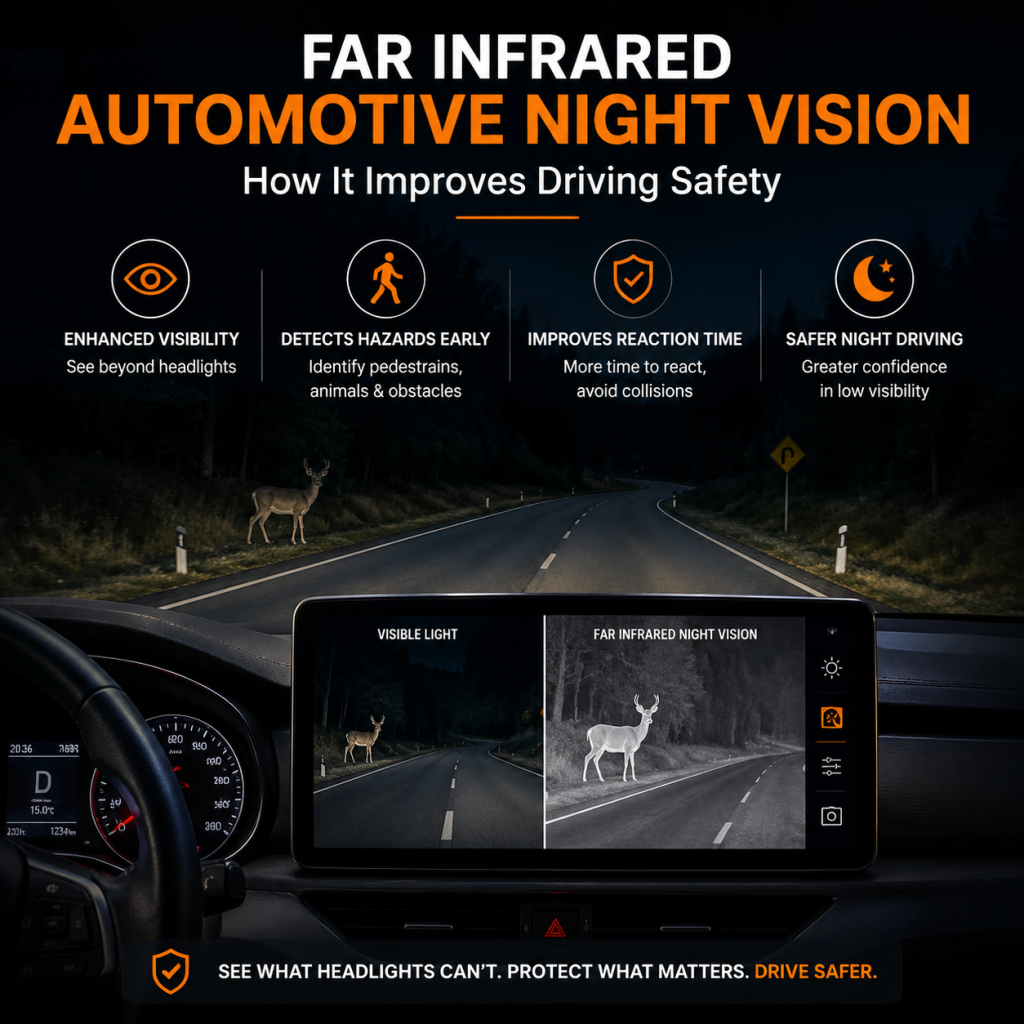
Far Infrared Automotive Night Vision is a vehicle-based imaging technology that detects heat emitted by objects and living beings. Unlike standard headlights or visible-light cameras, it does not depend on illumination. Instead, it senses temperature differences in the environment and converts them into a visual image displayed on a dashboard screen or head-up display.
In simple terms:
- Visible-light systems need light to “see.”
- Near-infrared systems use reflected infrared light, often with active illumination.
- Far infrared systems detect natural thermal radiation.
This makes far infrared automotive night vision especially useful at night or in low-visibility conditions. A pedestrian in dark clothing, a deer crossing the road, or a stalled vehicle on an unlit highway may stand out clearly in a thermal image even when they are difficult to spot with headlights.
Why Far Infrared Is Different from Other Night Vision Technologies
Not all night vision systems are the same. Automotive systems generally fall into a few categories, and far infrared is one of the most important.
Near Infrared vs. Far Infrared
Near infrared (NIR) systems use infrared light that is reflected off objects, similar to how a flashlight illuminates a scene, except the light is invisible to the human eye. These systems often rely on infrared LEDs or projectors.
Far infrared (FIR) systems, on the other hand, detect heat directly. This is why they are often called thermal imaging systems.
Key differences
-
Near infrared
- Requires some form of infrared illumination
- Works more like enhanced black-and-white video
- Can be limited by fog or environmental reflections
-
Far infrared
- Detects emitted heat, not reflected light
- Highlights warm objects regardless of lighting
- Can identify living beings and running vehicles especially well
For automotive safety, far infrared automotive night vision is often preferred when the goal is to detect real-world hazards in darkness rather than simply improve image brightness.
How Far Infrared Automotive Night Vision Works
Far Infrared Automotive Night Vision uses a thermal camera mounted at the front of the vehicle, usually behind the grille or near the windshield. This camera senses infrared radiation, which is naturally emitted by all objects above absolute zero.
The system then processes that data into a thermal image. Areas that are warmer appear brighter, while cooler areas appear darker. Depending on the system, the display may use grayscale or false-color palettes to make heat patterns easier to interpret.
The process in simple steps
-
Thermal energy is emitted by objects
- Humans, animals, engines, tires, and recently used road surfaces all give off heat.
-
The infrared sensor captures the heat map
- The sensor measures temperature differences across the field of view.
-
Software converts thermal data into an image
- Image processing boosts contrast, smooths noise, and enhances object recognition.
-
The result appears on a display
- Drivers may see a dashboard screen, center display, or head-up projection.
-
Advanced systems identify hazards
- Some systems use algorithms to highlight pedestrians, cyclists, or animals.
This makes the technology especially valuable where the naked eye struggles: darkness, long-distance detection, low-contrast environments, and complex roadsides.
What Far Infrared Night Vision Can Detect
A well-designed far infrared automotive night vision system can detect many of the hazards that are hardest to see at night.
Commonly detected objects
- Pedestrians
- Cyclists
- Large animals such as deer, elk, or livestock
- Vehicles with weak lighting or no lighting
- Road obstructions with significant heat contrast
- Vehicles or machinery that have recently been used
- Humans standing near the roadway
Why heat contrast matters
Thermal imaging performs best when there is a temperature difference between the object and its surroundings. A person walking on a cool night may stand out clearly against a cold background. A running engine or warm tire can also be visible even in total darkness.
However, not every hazard will be equally visible. A cold object, such as a broken-down metal barrier or a fallen branch, may not stand out well unless it retains heat from the day or is shaped by the system’s object-recognition software.
Benefits of Far Infrared Automotive Night Vision
The main appeal of far infrared automotive night vision is simple: it can help drivers see hazards earlier. But the real-world benefits go deeper than that.
1. Earlier detection of people and animals
Pedestrians at the side of the road can be hard to notice at night, especially when wearing dark clothing. Thermal imaging can highlight a person’s body heat before headlights would reveal enough detail.
The same is true for wildlife. Deer are a major nighttime hazard in many regions, and thermal systems can make them easier to spot near the roadside or moving into the lane.
2. Better visibility in darkness
At night, the human visual system loses color perception and fine detail. Thermal imaging can provide a clear contrast-based view that cuts through darkness.
3. Assistance in low-glare conditions
Bright headlights from oncoming traffic can cause momentary blindness or distraction. A thermal display inside the vehicle can give drivers another source of awareness without relying on direct illumination.
4. Useful in difficult lighting conditions
Far Infrared Automotive Night Vision may help in:
- unlit rural roads
- poorly lit neighborhoods
- tunnels
- areas with mixed shadow and darkness
- roads with frequent animal crossings
5. Driver confidence
Some drivers feel more relaxed on night trips when they know the vehicle has an extra layer of hazard detection. While not a substitute for safe driving, the added awareness can reduce stress and improve reaction time.
Limitations of Far Infrared Automotive Night Vision
Despite its advantages, far infrared automotive night vision is not perfect. Understanding its limits is essential so drivers do not overtrust the system.
It does not create a full visible image
Thermal cameras show heat patterns, not detailed color images. That means they may not reveal:
- road signs
- lane markings
- potholes
- small debris
- cold objects with little thermal contrast
Performance can vary with weather
Thermal imaging may be affected by heavy rain, dense fog, snow, or humidity. While it can sometimes perform better than headlights in certain low-visibility conditions, it is not immune to atmospheric interference.
It may not detect all hazards equally well
A person or animal emits enough heat to stand out, but a cold object may not. A non-warm roadside barrier, a tire fragment, or a piece of metal may blend into the background.
It is a driver-assist tool, not autonomous safety
Drivers must still watch the road, use headlights properly, and follow safe driving practices. Night vision systems can support awareness, but they do not replace judgment.
Cost and complexity
Thermal cameras, processing hardware, and display integration add cost. For that reason, far infrared automotive night vision systems are more commonly found in higher-end vehicles or specialized aftermarket solutions.
Where Far Infrared Systems Are Most Useful
Far Infrared Automotive Night Vision is especially valuable in situations where conventional lighting is least effective.
Rural and suburban roads
These roads often have limited street lighting, more wildlife, and fewer visual cues. A thermal system can help drivers detect animals crossing from wooded areas or pedestrians walking along shoulders.
Highway driving
At higher speeds, reaction time matters more. Seeing a person, stopped vehicle, or animal farther ahead can make a major difference.
Commercial and fleet vehicles
Trucks, emergency vehicles, and delivery fleets often travel at night. Thermal imaging can reduce risk during long overnight routes and in industrial areas with poor lighting.
Luxury and performance vehicles
Some automakers use night vision as a premium convenience and safety feature, especially in models designed for advanced driver assistance.
Examples of How Far Infrared Night Vision Helps in Real Driving
To understand the value of the technology, it helps to imagine a few common scenarios.
Example 1: A pedestrian near an unlit street
A driver is approaching a crosswalk in a dimly lit area. The pedestrian is wearing dark clothing and has stepped off the curb but is still partially hidden in shadow. The thermal camera highlights the person’s body heat, alerting the driver before the pedestrian becomes visible in the headlights.
Example 2: Deer on a rural highway
On a country road at night, a deer stands near the shoulder. Traditional headlights illuminate the road ahead, but the animal remains difficult to distinguish from the dark background. A far infrared automotive night vision system shows the deer as a bright shape near the roadside, giving the driver time to slow down.
Example 3: A stalled vehicle without lights
A vehicle with broken taillights is stopped ahead on a dark road. Though its exterior may blend into the night, the still-warm engine and recently driven tires may appear more clearly on a thermal display, helping the driver recognize the hazard sooner.
Example 4: A cyclist on a poorly lit road
A cyclist riding without strong reflectors can be nearly invisible at night. A thermal system may identify the warm figure moving along the edge of the road, improving awareness before the cyclist is directly in front of the car.
What Makes a Good Far Infrared Automotive Night Vision System?
Not every thermal camera setup is equally effective. If a vehicle includes this feature, several technical factors affect performance.
Resolution
Higher-resolution thermal sensors provide more detail and better object definition. Low-resolution systems can still detect heat, but they may be less precise at identifying shapes or distance.
Field of view
A wider field of view helps capture more of the roadside environment, while a narrower field can focus on longer-distance detection. The ideal balance depends on the vehicle and use case.
Range
Longer-range systems can detect hazards farther ahead, which is especially useful at highway speeds. The practical range depends on sensor quality, environmental conditions, and processing software.
Image processing
Software matters just as much as hardware. Good processing can improve contrast, reduce noise, and highlight relevant hazards.
Driver interface
If the thermal image is difficult to interpret or poorly placed on the dashboard, it becomes less useful. Clear display integration is crucial so drivers can glance at it without distraction.
Safety and Human Factors: How Drivers Should Use It
Far Infrared Automotive Night Vision can improve awareness, but it works best when used correctly.
Keep your eyes on the road
The thermal display is an additional reference, not a replacement for looking ahead. Drivers should avoid becoming fixated on the screen.
Treat it as an early-warning system
Use the system to help spot hazards earlier, then confirm with normal vision and safe driving judgment.
Combine it with proper headlights
Night vision does not replace legal and effective lighting. Headlights still matter for lane visibility, road signs, and overall scene awareness.
Maintain realistic expectations
The technology is excellent for heat-based detection, but it will not identify every hazard. Drivers should stay alert for non-warm obstacles and changing road conditions.
Learn the display
Some systems use grayscale images, while others use false-color schemes or highlight pedestrians and animals differently. Understanding how your vehicle displays thermal information makes it more useful and less distracting.
The Role of Far Infrared in Advanced Driver Assistance Systems
Far Infrared Automotive Night Vision is increasingly relevant as cars add more sensors and automation features. Thermal imaging can complement:
- forward cameras
- radar
- ultrasonic sensors
- lidar in some systems
- pedestrian detection software
Together, these technologies create a more robust safety picture.
For example, a camera may see lane markings and road signs in visible light, radar may measure distance to a vehicle ahead, and far infrared automotive night vision may detect a person crossing in darkness. Each sensor covers a different weakness of the others.
This sensor fusion is one reason thermal imaging continues to attract interest in modern vehicle design. It is not about replacing other systems; it is about filling important gaps.
For a deeper look at camera-based upgrades, see FLIR thermal camera automotive ADAS systems.
Current and Future Uses in the Automotive Industry
Far Infrared Automotive Night Vision has already found a place in some premium vehicles, but its future may expand as costs fall and safety expectations rise.
Present-day applications
- high-end luxury sedans and SUVs
- premium electric vehicles
- police and emergency vehicles
- commercial fleets
- specialty off-road or utility vehicles
Future possibilities
As sensors become smaller, cheaper, and more efficient, thermal imaging could appear in more mainstream models. Future systems may offer:
- improved automatic pedestrian alerts
- better object classification
- integration with augmented reality displays
- enhanced night driving assistance for semi-autonomous vehicles
- smarter hazard tracking in bad weather
As software improves, a thermal system may also become better at predicting movement, not just detecting heat. For instance, it could track a person stepping toward the road and provide a more immediate alert.
Common Misconceptions About Far Infrared Automotive Night Vision
Because the technology sounds advanced, it is often misunderstood.
Misconception 1: It works like headlights
Not exactly. Headlights illuminate; thermal systems detect heat. They solve different problems.
Misconception 2: It sees through everything
Far Infrared Automotive Night Vision cannot magically see through solid barriers. It also struggles with certain weather conditions and cold, low-contrast objects.
Misconception 3: It makes night driving safe enough to ignore caution
No technology can eliminate night driving risks entirely. Speed, fatigue, weather, and road design still matter.
Misconception 4: It only helps in complete darkness
It is most famous for nighttime use, but it can also help in poor visibility conditions when heat contrast is beneficial.
Who Should Consider Far Infrared Automotive Night Vision?
This technology may be especially useful for drivers who frequently face nighttime or low-visibility conditions.
Good candidates include:
- rural drivers
- long-distance highway commuters
- fleet operators
- drivers in wildlife-heavy regions
- emergency responders
- buyers of premium vehicles with advanced safety packages
For urban drivers who mostly travel on well-lit roads, the benefit may be more limited, though still useful in certain situations.
The Bottom Line on Value
Far Infrared Automotive Night Vision is one of the most practical uses of thermal imaging in consumer vehicles. Its biggest strength is early hazard detection in darkness, especially for pedestrians and animals. It adds a valuable layer of awareness when conventional headlights are not enough.
That said, it is not a perfect replacement for safe driving habits, and it should be viewed as an assistive technology rather than a stand-alone solution. Drivers who understand both its advantages and its limitations are best positioned to use it effectively.
For a related overview of nighttime road risk, read car thermal imaging on rural roads. You can also review the National Highway Traffic Safety Administration for general vehicle safety guidance.
Conclusion
Far Infrared Automotive Night Vision brings thermal sensing into the driver’s seat, helping vehicles detect heat-based hazards in conditions where the human eye struggles. It can improve awareness of pedestrians, animals, and other vehicles at night, especially on rural roads and in low-light environments. At the same time, it has clear limits: weather can affect performance, not every object emits enough heat to stand out, and the system does not replace attentive driving.
As automotive safety technology continues to evolve, far infrared automotive night vision is likely to remain an important part of the conversation. For drivers who spend time on dark roads, it can be a meaningful advantage—one that may offer precious extra seconds to react when seconds matter most.