


What Is the Best Car Camera That Works When the Car Is Off?
- What Is the Best Car Camera That Works When the Car Is Off?
- Why You Need a Camera That Works When the Car Is Off
- How Car Cameras Keep Recording After Shutdown
- The Best Type of Car Camera for Use When Parked
- Best Car Camera Types for Parked Recording
- The Most Important Features to Look For
- Parking Mode Options
- Low-Voltage Protection
- Night Performance
- Heat Resistance
- Wide Dynamic Range and Resolution
- Best Overall Choice: A Dual-Channel Dash Cam with Buffered Parking Mode
- Example 1: A Daily Driver Who Parks on the Street
- Example 2: A Driver Who Parks in a Garage or Driveway
- Example 3: A Rideshare or Commercial Vehicle
- Best Power Options for Off-Car Recording
- Hardwire Kit: Best for Most People
- Battery Pack: Best for Long Parking Times
- OBD-II Power: Best for Simplicity
- What Makes a Dash Cam “Best” for Parking Mode?
- Common Mistakes People Make
- Buying a Camera Without Parking Mode
- Ignoring Low-Voltage Protection
- Choosing a Lithium Battery Model for Hot Climates
- Assuming Motion Detection Is Enough
- Overlooking Rear Coverage
- Recommended Feature Set by Budget
- So, What Is the Best Car Camera That Works When the Car Is Off?
- Conclusion
A car camera that keeps working after the ignition is off is one of the most useful upgrades you can make to a vehicle. It can capture hit-and-runs in parking lots, monitor theft attempts, record vandalism, and provide evidence while your car sits unattended. But with so many models and features on the market, the real question is not just which dash cam is best overall—it is which one is best for recording when the car is parked and turned off.
The short answer is that the best car camera for this job is usually a parking-mode dash cam with reliable hardwire support, low-power protection, and strong front-and-rear video quality. In practice, the ideal choice depends on how long you want it to record, how much power you are willing to supply, and whether you want single-channel, dual-channel, or even a 360-degree setup.
This guide explains how off-car recording works, what features matter most, and which types of cameras are best for different use cases.
Why You Need a Camera That Works When the Car Is Off
Most drivers assume a dash cam only matters while driving. In reality, many incidents happen while the car is parked.
Common situations include:
- A vehicle backing into your bumper in a parking lot
- Someone scratching or keying your car
- Theft attempts from the cabin or trunk
- A runaway car door impact from a neighboring vehicle
- Towing, vandalism, or suspicious activity around your parked car
A camera that only records while driving will miss all of this. That is why parking surveillance has become one of the most important features in modern dash cams.
How Car Cameras Keep Recording After Shutdown
A dash cam cannot magically run forever once the engine is off. It needs power from one of several sources:
1. Hardwiring to the Fuse Box
This is the most common and reliable method. A hardwire kit connects the dash cam directly to your car’s electrical system and usually includes:
- A constant 12V source
- An ignition-switched source
- A ground connection
- Low-voltage cutoff protection
When done correctly, the camera can enter parking mode after the car is off and continue recording based on motion, impact, or time-lapse settings.
2. Battery Pack
A dedicated dash cam battery pack stores energy while you drive and powers the camera after shutdown. This is useful if you want to avoid draining the car battery or if you park for long periods.
Battery packs are especially helpful for:
- Electric vehicles
- Cars parked for many hours or overnight
- Users who want maximum protection without stressing the vehicle battery
3. OBD-II Power
Some cameras can use an OBD-II adapter for power. This is simpler to install than a hardwire kit in many cars, but it may not be as customizable or universally dependable.
4. Internal Battery or Supercapacitor
Most quality dash cams use supercapacitors, not lithium internal batteries. Supercapacitors are better for heat resistance and durability, but they do not power long parking recordings by themselves. They mainly help the camera save files safely when power is interrupted.
The Best Type of Car Camera for Use When Parked
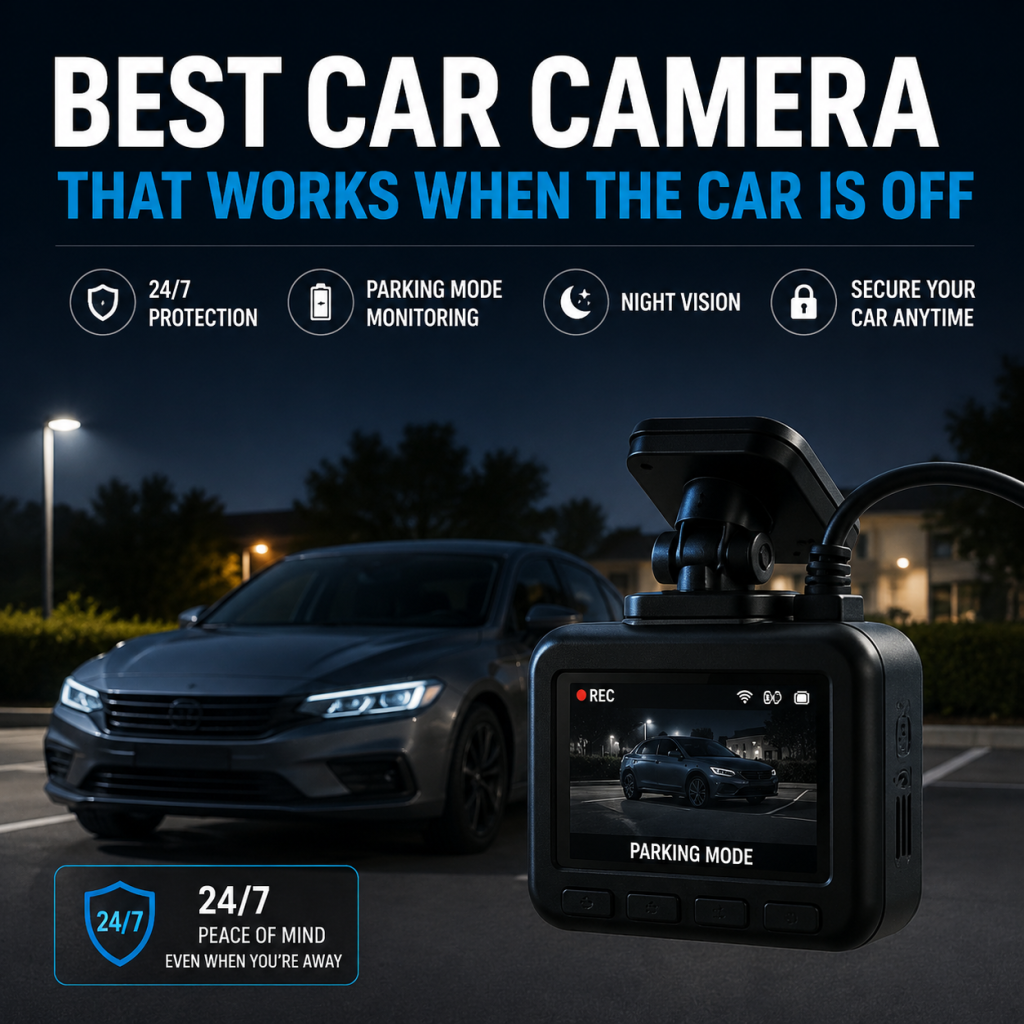
If your goal is to monitor your vehicle while it is off, the best choice is usually a dash cam with parking mode, not a basic windshield camera.
Look for these features:
- Hardwire kit compatibility
- Motion detection parking mode
- Impact detection or G-sensor parking events
- Low-voltage battery protection
- Good image quality in low light
- Wide field of view
- Reliable heat resistance
- App access or easy file review
A camera can be excellent on paper but still fail in parking mode if it is unreliable in real-world conditions. The best models balance image quality, power efficiency, and dependable recording.
Best Car Camera Types for Parked Recording
Single-Channel Dash Cam
A single-channel camera records the front of the car only. It is often the most affordable option and can still be very effective if you mainly want to capture what happens in front of the vehicle.
Best for:
- Budget buyers
- Drivers who park in low-risk areas
- Users who want simple installation
Dual-Channel Dash Cam
A dual-channel system records both the front and rear of the car. This is usually the better choice for parked protection because many incidents happen behind the vehicle, especially in parking lots.
Best for:
- Family cars
- Street parkers
- Drivers who want more complete evidence
360-Degree or Multi-Channel System
Some premium systems record front, rear, and interior or side views. These provide the most coverage but cost more and require more installation effort.
Best for:
- Rideshare drivers
- Commercial vehicles
- High-value cars
- Users who want maximum surveillance
The Most Important Features to Look For
Not all parking-mode dash cams are equal. Here is what matters most.
Parking Mode Options
A good camera should offer at least one of the following:
- Motion detection: starts recording when movement is detected
- Impact detection: records when the car is bumped or hit
- Time-lapse recording: captures continuously at a reduced frame rate
- Buffered parking mode: records a few seconds before and after an event
Buffered parking mode is especially valuable because it shows what happened just before the trigger, not only the impact itself.
Low-Voltage Protection
If the camera draws from your car battery, it must shut off before the voltage drops too low. Otherwise, you may end up with a dead battery the next time you try to start the car.
Look for:
- Adjustable voltage cutoff
- Automatic shutdown timer
- Battery pack support
Night Performance
Most parking incidents happen at night or in low light. A camera with strong low-light sensors, wide dynamic range, and good noise handling will capture more usable detail.
Heat Resistance
Cars can become extremely hot when parked in the sun. A good camera for this use should be built with heat tolerance in mind, usually via a supercapacitor instead of a lithium-ion battery.
Wide Dynamic Range and Resolution
Parking areas often have harsh lighting: headlights, streetlamps, shadows, and reflections. A camera with a good sensor and at least 1440p front resolution gives you a better chance of capturing license plates and faces.
Best Overall Choice: A Dual-Channel Dash Cam with Buffered Parking Mode
If the question is which type of car camera is best when the car is off, the strongest all-around answer is:
A dual-channel hardwired dash cam with buffered parking mode, low-voltage cutoff, and a supercapacitor.
This combination is ideal because it provides:
- Front and rear coverage
- Event recording without draining your battery too much
- Better evidence around the entire vehicle
- Reliable performance in heat
It is the best balance of protection, practicality, and value for most drivers.
Example 1: A Daily Driver Who Parks on the Street
Imagine you live in a city and park your car on the street every night. You want a camera that can catch a hit-and-run, capture someone scraping your bumper, and keep running while the car is off.
For this scenario, the best setup is:
- Dual-channel dash cam
- Hardwire kit
- Buffered parking mode
- Low-voltage cutoff
- High-quality night vision
Why this works:
You get coverage on both ends of the vehicle, and the camera can wake up instantly when something happens. Because street parking often involves people walking past the car, motion and impact detection are both useful.
Example 2: A Driver Who Parks in a Garage or Driveway
If you park in a private garage or driveway, the risk may be lower, but you still may want protection from vandalism or delivery-related damage.
A good setup here might be:
- Single-channel or dual-channel dash cam
- Motion-activated parking mode
- Moderate resolution
- Hardwire kit or battery pack
Since the environment is more controlled, you may not need the most advanced system. A simpler camera may be enough, especially if your main goal is to record unexpected contact.
Example 3: A Rideshare or Commercial Vehicle
If your car is used for rideshare work, deliveries, or business transport, you may need more than just parking surveillance. You may want cabin recording, cloud access, or multi-channel video.
Recommended setup:
- Front, rear, and cabin camera
- Hardwired connection or dash cam battery
- Continuous parking mode support
- Strong app integration
- Large storage capacity
In this case, a premium system makes more sense because the car is part of your work environment and the risk exposure is higher.
Best Power Options for Off-Car Recording
Hardwire Kit: Best for Most People
For most drivers, a hardwire kit is the best solution. It provides stable power and supports parking mode directly. It is also more discreet than a battery pack.
Pros:
- Reliable
- Clean installation
- Continuous parking support
- Usually the best value
Cons:
- Requires installation
- Risk of battery drain if configured badly
Battery Pack: Best for Long Parking Times
A dash cam battery pack is ideal if you want to avoid using the car battery or need longer parked recording sessions.
Pros:
- Protects vehicle battery
- Works well for extended parking
- Good for frequent long stops
Cons:
- More expensive
- Adds complexity
- Needs charging while driving
OBD-II Power: Best for Simplicity
OBD-II power is easy to install and may suit drivers who do not want to tap fuse boxes. But it is not always the most robust option for long-term parking surveillance.
What Makes a Dash Cam “Best” for Parking Mode?
The best parking camera is not necessarily the one with the highest resolution or the flashiest display. It is the one that performs well in the conditions that matter most.
Here is the real-world checklist:
- Can it record automatically after the car is off?
- Does it handle heat well?
- Will it protect your car battery?
- Does it record clear footage at night?
- Can it capture both front and rear activity?
- Is installation practical?
- Will the files be easy to review later?
If the answer to most of those is yes, the camera is a strong candidate.
Common Mistakes People Make
Many buyers choose the wrong camera because they focus only on resolution or price. Here are the most common mistakes.
Buying a Camera Without Parking Mode
This is the biggest mistake. A high-resolution camera that shuts off with the ignition is not enough if you want off-car surveillance.
Ignoring Low-Voltage Protection
Without battery protection, you risk a dead vehicle battery. This is especially important for older cars and vehicles that sit unused for days.
Choosing a Lithium Battery Model for Hot Climates
Lithium batteries do not handle extreme cabin heat as well as supercapacitors. If you live in a hot region, this matters a lot.
Assuming Motion Detection Is Enough
Motion-only recording can miss subtle events or trigger too often. Buffered parking mode is usually better because it captures the lead-up to the event.
Overlooking Rear Coverage
Many parked-car incidents happen from behind. A front-only setup may miss the most important footage.
Recommended Feature Set by Budget
Budget Setup
If you are cost-conscious, look for:
- Single-channel dash cam
- Basic parking mode
- Hardwire kit
- 1080p or 1440p resolution
- Supercapacitor
This setup can still protect you well if installed correctly.
Mid-Range Setup
For most drivers, this is the sweet spot:
- Dual-channel dash cam
- Buffered parking mode
- Hardwire support
- Low-voltage cutoff
- Good night performance
This offers a strong balance of price and protection.
Premium Setup
For maximum peace of mind:
- Dual or triple-channel system
- Battery pack or advanced hardwire setup
- Buffered parking mode
- Cloud or app alerts
- High-end sensors and wide dynamic range
This is best for people who park in high-risk areas or need detailed evidence.
So, What Is the Best Car Camera That Works When the Car Is Off?
If you want the most practical answer, the best car camera for off-car use is a dual-channel dash cam with buffered parking mode, hardwire support, low-voltage protection, and strong low-light performance.
That combination gives you the best overall mix of:
- Coverage
- Reliability
- Battery safety
- Video quality
- Ease of use
If you need even more runtime and battery safety, add a dedicated dash cam battery pack. If your main concern is cost, a solid single-channel parking-mode camera can still do a good job.
Conclusion
The best car camera that works when the car is off is not just a camera—it is a complete parking surveillance system. For most drivers, the ideal choice is a hardwired dual-channel dash cam with buffered parking mode and low-voltage protection. It gives you front and rear coverage, records important events while parked, and avoids draining your vehicle battery when configured properly.
The right model depends on where you park, how long you need it to run, and how much coverage you want. But if your goal is dependable protection after the engine is off, focus on parking mode first, then compare video quality, power options, and heat resistance. That is the combination that delivers real-world peace of mind.