


Buying a pre-owned vehicle can save money, reduce depreciation, and give you access to a better-equipped model than the same budget might buy new. It can also expose you to hidden damage, overdue maintenance, or costly mechanical problems. Knowing what to check when buying a used car helps you evaluate the vehicle, verify the seller’s claims, and understand the real cost of ownership before committing.
- Table of Contents
- What to check when buying a used car before a viewing
- Verify the Vehicle’s Identity and Documents
- Inspect the Exterior in Daylight
- Examine the Tires, Wheels, Brakes, and Suspension
- Check Under the Hood Before the Engine Starts
- Inspect the Cabin for Wear, Water, and Faults
- Pay Attention to Warning Lights and Safety Systems
- Take a Proper Test Drive
- Review Mileage and Maintenance as a Complete Story
- Calculate the Real Ownership Cost
- Arrange an Independent Pre-Purchase Inspection
- Recognize Reasons to Walk Away
- Use a Final Decision Framework
- Frequently Asked Questions
- What is the most important thing to inspect on a used car?
- Should I buy a used car with high mileage?
- How long should a used-car test drive take?
- Is a vehicle-history report enough?
- Should I pay for a mechanic’s inspection when buying from a dealer?
- What should I bring when viewing a used car?
- Final checks when buying a used car
The most reliable approach to buying a used car is methodical: research the model, inspect the car in daylight, review its records, take a meaningful test drive, and arrange an independent inspection. No single check proves that a vehicle is a good purchase. The goal is to combine evidence and identify inconsistencies before money changes hands.
Table of Contents
- What to check when buying a used car before a viewing
- Verify the vehicle’s identity and documents
- Inspect the exterior in daylight
- Examine the tires, wheels, brakes, and suspension
- Check under the hood before the engine starts
- Inspect the cabin for wear, water, and faults
- Pay attention to warning lights and safety systems
- Take a proper test drive
- Review mileage and maintenance
- Calculate the real ownership cost
- Arrange an independent inspection
- Recognize reasons to walk away
- Use a final decision framework
- Frequently asked questions
- Final checks when buying a used car
What to check when buying a used car before a viewing
A good inspection begins before you reach the vehicle. Researching the exact model, engine, transmission, trim level, and approximate model year is an essential part of buying a used car. Different versions of the same car can have substantially different maintenance needs, reliability concerns, fuel consumption, and equipment.
Look into:
- Common faults associated with that generation and powertrain
- Timing belt or timing chain requirements
- Transmission service intervals
- Typical tire and brake replacement costs
- Fuel economy or energy consumption
- Insurance costs
- Parts and repair availability
- Whether specialist servicing is commonly required
- Open safety recalls or service campaigns, using an official resource such as the NHTSA vehicle recall lookup where applicable
This research creates a model-specific checklist for buying a used car. For example, a diesel vehicle may deserve extra scrutiny if it has spent most of its life making short urban trips. A plug-in hybrid requires checks that would not apply to a conventional gasoline car. An older luxury model may have an attractive purchase price but expensive suspension, lighting, or electronic components.
Compare the asking price with similar vehicles, but do not focus on price alone. When buying a used car, consider mileage, condition, ownership history, specification, maintenance records, tires, and upcoming repairs. A slightly more expensive car with complete records and recent major maintenance may cost less overall than the cheapest listing.
Verify the Vehicle’s Identity and Documents
Verifying identity is a fundamental step when buying a used car. Check the vehicle identification number, commonly called the VIN, against the registration documents and any available history report. VIN locations vary, but it may appear at the base of the windshield, on a door pillar, in the engine compartment, or stamped into the body.
More EV News

The identifiers should be consistent, legible, and free from obvious signs of alteration. Differences between the VIN, license plate records, registration documents, and seller’s description require an explanation before proceeding with buying a used car.
Review the available paperwork carefully:
- Registration or title documents
- Seller identification and proof of ownership
- Service book and itemized repair invoices
- Inspection or roadworthiness certificates where applicable
- Finance or lien information
- Accident and insurance history when legitimately available
- Recall completion records
- Emissions documentation where required
- Receipts for replacement parts or major repairs
A vehicle-history report can reveal useful information such as recorded mileage, title problems, theft records, or reported damage. However, it is not a complete mechanical inspection. Repairs paid for privately, unreported collisions, and neglected maintenance may never appear in a database.
Service records should form a logical timeline. Check dates, mileage entries, workshop details, and the work performed. A stamped service book without supporting invoices provides less information than detailed receipts showing the parts and fluids used.
Inspect the Exterior in Daylight
Seeing the exterior clearly is important when buying a used car. View the vehicle when it is dry and in natural daylight if possible. Rain, darkness, and freshly applied polish can conceal scratches, dents, overspray, and inconsistent paintwork.
Walk around the vehicle slowly rather than looking at it from one position. View each panel from different angles. Watch for:
- Uneven paint color or texture
- Overspray on rubber seals, trim, or wheel-arch liners
- Large differences between panel gaps
- Doors, hood, or trunk lid that sit unevenly
- Ripples or distortion in body panels
- Cracks, deep scratches, corrosion, or bubbling paint
- Damaged lights, mirrors, windows, or trim
- Signs of water inside the headlamps
- Mismatched glass date codes, where visible
Repainted panels are not automatically a reason to reject a car when buying a used car. Cosmetic repairs are common. What matters is the quality of the work and whether the seller’s explanation matches the evidence. Structural damage, poor alignment, or concealed corrosion deserves professional assessment.
Inspect lower areas, including the rocker panels, wheel arches, lower door edges, and visible sections underneath. Surface discoloration on some exposed metal parts can be normal, especially in wet climates. Flaking metal, perforation, damaged mounting points, or corrosion near structural areas is more serious.
Check the windshield for chips, cracks, scratches, and distortion. Damage in the driver’s field of view may affect visibility or roadworthiness, depending on local rules. Heated windshields, embedded antennas, cameras, and driver-assistance sensors can also make replacement more expensive than expected.
Examine the Tires, Wheels, Brakes, and Suspension
Tire condition can reveal valuable information when buying a used car because it provides clues about maintenance, alignment, and suspension condition. Check all four road tires and the spare, if fitted. Confirm that their sizes and load specifications are appropriate for the vehicle.
Look for:
- Tread approaching the legal or practical replacement limit
- Uneven wear across the inner and outer edges
- Cracks, bulges, cuts, or exposed cords
- Very old date codes
- Different tire types or quality levels across an axle
- Missing valve caps or evidence of slow leaks
- Bent, cracked, or heavily damaged wheels
Uneven wear can indicate incorrect pressure, poor wheel alignment, worn suspension parts, or previous impact damage. It should not be dismissed as just needing tires until the underlying cause is understood.
Look through the wheels at the brake discs and pads where possible. Deep scoring, heavy lips at the disc edges, uneven surfaces, or very thin pads may indicate upcoming expense. After the test drive, check for pulling, vibration, noise, or a soft brake pedal.
Stand back and see whether the car sits level. Push down gently at each corner if appropriate; repeated bouncing may suggest weak dampers, although this simple test is not conclusive. During the drive, listen for knocks over rough surfaces and pay attention to wandering, excessive body movement, or steering that does not return naturally toward center.
Check Under the Hood Before the Engine Starts
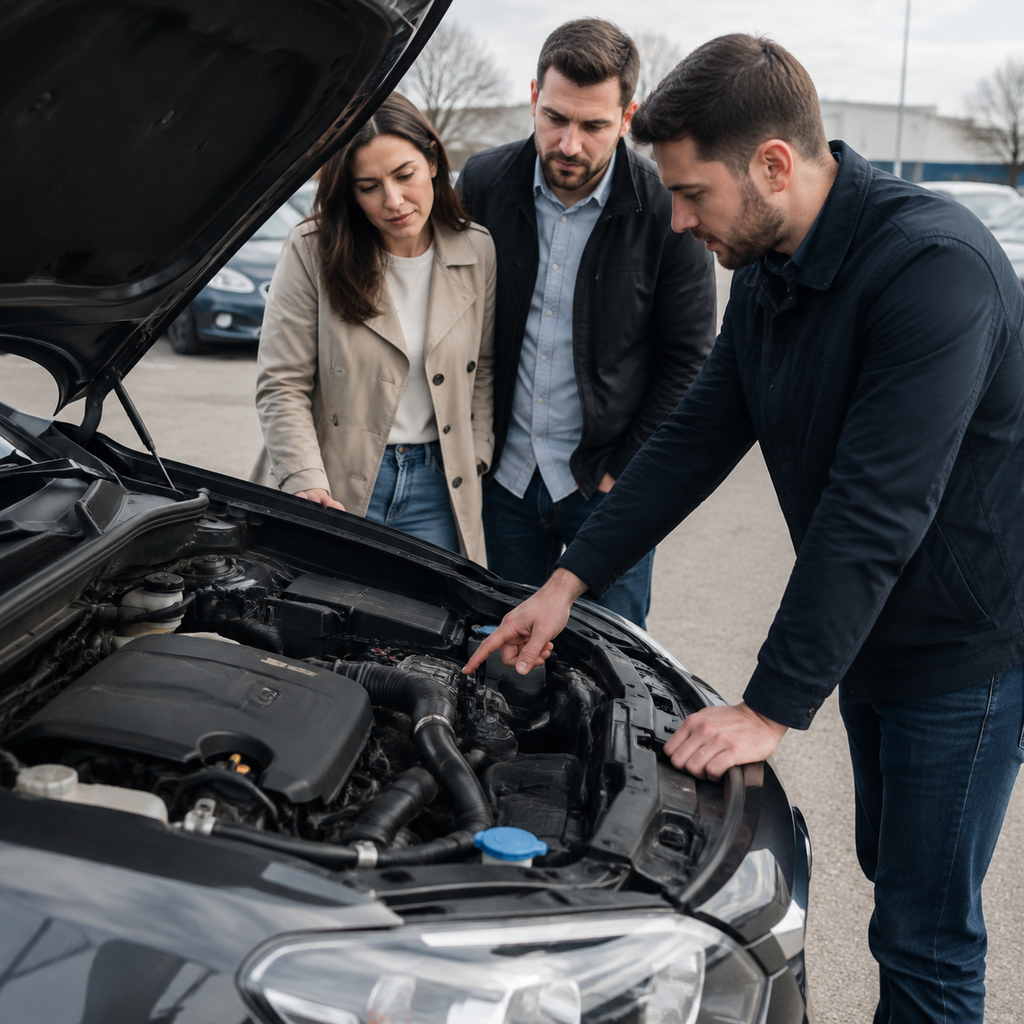
A cold engine inspection is particularly useful when buying a used car. Ask the seller not to warm the engine before your visit. A cold start can reveal slow cranking, smoke, rattles, and rough running that may be less obvious once the engine reaches operating temperature. Carefully confirm that the engine is cold before touching components.
Before starting it, inspect the engine bay for:
- Oil or coolant leaks
- Damp areas around hoses and seals
- Damaged wiring or improvised repairs
- Loose battery terminals or heavy corrosion
- Cracked hoses and worn belts
- Missing caps or fasteners
- Strong fuel or coolant odors
- Unusual cleanliness in one isolated area
A recently cleaned engine bay is not necessarily suspicious, but it can make leaks harder to detect. Examine the area again after the test drive.
Check the oil level according to the manufacturer’s procedure. Oil should be within the acceptable range. Very low oil, sludge, metallic particles, or contamination deserves investigation. The exact appearance of healthy oil varies with engine type, oil formulation, and time since the last service, so color alone is not a reliable diagnosis.
Inspect the coolant reservoir only when the engine is cold. Low coolant, oily contamination, sediment, or signs of repeated topping up can indicate a problem. Never open a pressurized cooling system when hot.
For electric and hybrid vehicles, do not touch high-voltage components or orange cabling. Battery health, charging performance, isolation faults, and cooling-system condition require model-appropriate diagnostics and, ideally, a technician familiar with high-voltage vehicles.
Inspect the Cabin for Wear, Water, and Faults
When buying a used car, the interior condition should broadly match the stated mileage and use. A high-mileage car can have a clean, well-maintained cabin, while a low-mileage one may show wear. The concern is not ordinary aging but an unexplained mismatch.
Examine the steering wheel, pedals, driver’s seat bolster, switches, door handles, and gear selector. Excessive wear does not prove mileage manipulation, but it provides a reason to compare the odometer with service records and inspection history.
Use your senses. A musty odor may indicate water intrusion. Heavy fragrances can temporarily mask smoke, dampness, or pet odors. Lift accessible floor mats and check the carpet, spare-wheel well, and trunk corners for moisture, staining, corrosion, or water lines.
Test every practical control:
- Air conditioning and heating
- Power windows, locks, mirrors, and seats
- Exterior and interior lights
- Infotainment, speakers, USB ports, and navigation
- Parking sensors and reversing camera
- Heated seats and steering wheel, if equipped
- Wipers and washers
- Sunroof and roof blind
- Remote keys and central locking
- Seat adjustments and seat belts
Electronic faults can be expensive and time-consuming to diagnose when buying a used car. Confirm that both keys are included because replacement and programming may be costly.
Pay Attention to Warning Lights and Safety Systems
Dashboard checks are easy to overlook when buying a used car. When the ignition is switched on, key warning lights should illuminate briefly and then turn off after the engine starts, according to the vehicle’s design. A light that never appears could indicate a failed bulb, coding change, or deliberate concealment. A light that remains on signals a fault requiring diagnosis.
Do not accept a claim that the car only needs a sensor without evidence. Airbag, anti-lock braking, stability control, emissions, battery, engine, and tire-pressure warnings can have multiple causes.
Verify that advertised safety equipment is present and functioning. Depending on the car, this may include:
- Automatic emergency braking
- Blind-spot monitoring
- Lane-departure warning or lane assistance
- Adaptive cruise control
- Rear cross-traffic alert
- Parking cameras and sensors
- Automatic high beams
- Driver-monitoring features
Some systems need camera or radar calibration after windshield replacement, body repair, suspension work, or wheel-alignment changes. A warning-free dashboard is encouraging but does not confirm correct calibration. Service records and a professional diagnostic scan can provide additional context.
Buyers should also consider whether the vehicle’s safety equipment suits their normal driving. Someone regularly using dark rural roads has different visibility needs from a driver who mainly travels in illuminated city traffic. An aftermarket option such as Robofinity InsightDrive uses AI-powered thermal imaging to support awareness of pedestrians, animals, vehicles, and obstacles in low-light environments. Such driver-assistance technology may complement a suitable vehicle, but it does not replace effective headlights, mirrors, safe speed, braking distance, or attentive driving.
Take a Proper Test Drive
A proper test drive is indispensable when buying a used car. A short loop around a parking lot is not enough. With the seller’s permission and appropriate insurance, drive on roads that reflect your normal use. Include low-speed turns, rough pavement, moderate acceleration, braking, and a higher-speed section where legal and safe.
Starting and Idling
Cold-start behavior can expose problems that matter when buying a used car. The engine should start promptly and settle into a stable idle. Listen for persistent knocking, tapping, squealing, or rattling. Brief noises may have model-specific explanations, but they still deserve investigation.
Watch the exhaust during startup and acceleration if this can be done safely. Some vapor in cold weather can be normal. Persistent blue, dense white, or heavy black smoke may indicate engine, fuel, or emissions-system problems.
Engine and Transmission
Engine and transmission behavior should receive close attention when buying a used car. Acceleration should be smooth and reasonably consistent with the vehicle’s design. Hesitation, loss of power, warning lights, unusual vibration, or rising temperature can indicate faults.
A manual clutch should engage predictably without slipping, juddering, or an unusually high bite point. Gear changes should not grind or resist.
An automatic transmission should select drive and reverse without excessive delay or a severe jolt. During the drive, look for slipping, flaring engine speed, harsh shifts, or hesitation. Transmission behavior differs between conventional automatics, continuously variable transmissions, dual-clutch units, and automated manuals, so model-specific knowledge matters.
Steering, Brakes, and Ride
When buying a used car, assess the steering on a level road where the vehicle should track consistently without requiring constant correction. The steering should not shake or feel abnormally loose. A pull to one side can result from tire pressure or road camber, but it may also indicate alignment, brake, suspension, or damage-related problems.
Brake progressively in a safe location. The vehicle should stop in a controlled line without steering-wheel vibration, grinding, or major pedal pulsation. Test the parking brake as appropriate.
Drive over ordinary road imperfections and listen for knocks, rattles, and squeaks. Some cabin noise is normal in an older vehicle; repeated mechanical clunks are more concerning.
After the drive, let the vehicle idle briefly and inspect underneath for fresh fluid. Recheck the engine bay without touching hot or moving parts. Completing these checks after the test drive makes buying a used car less dependent on the seller’s description. Note any new warning lights, overheating, cooling-fan issues, or strong odors.
Review Mileage and Maintenance as a Complete Story
Mileage matters when buying a used car, but condition and maintenance often matter more. Low annual mileage can sound appealing, yet prolonged storage and repeated short trips may contribute to battery problems, brake corrosion, tire aging, moisture accumulation, or emissions-system issues. Highway mileage may produce less wear on brakes and clutches than frequent stop-and-go driving, although the odometer will be higher.
Focus on whether the records show timely maintenance. Important items may include:
- Engine oil and filter changes
- Timing belt replacement where applicable
- Transmission fluid service
- Brake fluid and coolant changes
- Spark plugs, filters, and accessory belts
- Hybrid or electric cooling-system maintenance
- Air-conditioning servicing
- Differential or transfer-case fluids on applicable vehicles
- Brake, tire, battery, and suspension replacement
A seller’s claim that a component is good for life should be checked against the manufacturer’s guidance for that market and powertrain. If a major service is due soon, include it in the purchase budget.
Calculate the Real Ownership Cost
The asking price is only the entry cost when buying a used car. Before negotiating, estimate what the vehicle will require immediately and over the next year.
Potential expenses include:
- Taxes, registration, and inspection fees
- Insurance
- Routine service
- Tires and brakes
- Timing-belt or major scheduled maintenance
- Battery replacement
- Fuel or charging
- Parking or emissions-zone charges
- Repairs identified during inspection
- Accessories required for your use
- Depreciation and eventual resale value
This calculation helps compare two vehicles fairly. A less expensive car needing four tires, brakes, a major service, and an additional key may be worse value than a more expensive example with those items already addressed. Use the same evidence to determine whether the car is worth buying before you commit.
Leave a repair reserve rather than spending the entire budget on the purchase itself. Even a carefully inspected used car can need an unexpected part after purchase.
Arrange an Independent Pre-Purchase Inspection
A professional inspection is one of the strongest protections available when buying a used car. Choose a qualified mechanic or inspection service independent of the seller. A model specialist can be especially valuable for complex, performance, luxury, hybrid, or electric vehicles.
Depending on the service, an inspection may include:
- A lift inspection of the underbody
- Leak and corrosion checks
- Brake and suspension assessment
- Diagnostic scanning
- Battery and charging-system testing
- Paint-depth measurements
- Cooling-system checks
- Road testing
- High-voltage battery assessment where applicable
- Evaluation of previously repaired damage
An inspection cannot guarantee trouble-free ownership when buying a used car, but it can identify defects that are difficult to detect during a driveway viewing. It also provides a factual basis for negotiation.
Treat resistance to an independent inspection as a serious warning. There may be practical scheduling constraints, but a legitimate seller should be able to discuss a reasonable arrangement.
Recognize Reasons to Walk Away
Good judgment when buying a used car includes knowing when to leave. Not every issue requires rejecting a vehicle. Worn tires or a minor cosmetic repair may simply affect price. The larger concern is a pattern of inconsistency, concealment, or pressure.
Consider walking away when:
- The VIN or documents do not match
- Ownership cannot be established clearly
- The seller discourages basic checks
- The vehicle is already warm without a credible reason
- Warning lights have been disabled or explanations keep changing
- Mileage records conflict
- Structural repairs appear poorly completed
- Serious corrosion is visible
- Fluid contamination or overheating is present
- The seller refuses an independent inspection
- Outstanding finance or title problems remain unresolved
- You are pressured to pay immediately
- Payment instructions or seller identity appear suspicious
Do not let travel time, emotional attachment, or a rare opportunity override unresolved evidence. The cost of leaving without a car is usually far lower than the cost of buying the wrong one.
Use a Final Decision Framework
Before buying a used car, assess the candidate in five categories:
- Identity: Do the VIN, registration, seller details, and history align?
- Condition: Do the body, cabin, engine, drivetrain, brakes, tires, and electronics meet expectations?
- Evidence: Are service claims supported by dates, mileage records, and invoices?
- Suitability: Does the vehicle fit your family, commute, climate, parking, cargo, and nighttime driving needs?
- Cost: Is the price still reasonable after immediate repairs, maintenance, insurance, and fees?
A strong candidate does not need to be perfect. It needs to be honestly represented, mechanically acceptable for its age and price, suitable for your use, and affordable after known work is included.
Frequently Asked Questions
What is the most important thing to inspect on a used car?
There is no single decisive item when buying a used car. Verify the car’s identity and legal status, review its maintenance history, inspect its structural and mechanical condition, and arrange an independent pre-purchase inspection. Problems in any one of these areas can outweigh an attractive price.
Should I buy a used car with high mileage?
High mileage is not automatically bad when buying a used car. A well-maintained vehicle with complete records may be a better purchase than a lower-mileage car with neglected servicing or unexplained history. Evaluate the specific engine, transmission, previous use, maintenance evidence, and upcoming repair needs.
How long should a used-car test drive take?
When buying a used car, the test drive should be long enough to assess cold starting, urban behavior, braking, steering, ride quality, transmission operation, and higher-speed performance where lawful. The route matters more than an exact duration. Avoid making a decision based on a very short drive.
Is a vehicle-history report enough?
No. When buying a used car, remember that a history report may reveal recorded damage, title issues, mileage entries, or theft information, but it cannot show every repair or current mechanical problem. Use it alongside original documents, a physical inspection, a test drive, and professional diagnostics.
Should I pay for a mechanic’s inspection when buying from a dealer?
Yes. Paying for an independent inspection remains worthwhile when buying a used car from a dealer, particularly when the vehicle is outside a comprehensive warranty or is mechanically complex. A dealer’s preparation process and statutory obligations vary by location, but an independent inspection gives you a separate assessment of the car’s condition.
What should I bring when viewing a used car?
Useful items when buying a used car include a flashlight, paper towels, a tire-pressure gauge if you know how to use it, a phone for photographing documents with permission, and a model-specific checklist. Arrange insurance for the test drive and bring someone whose judgment you trust when practical.
Final checks when buying a used car
A dependable result from buying a used car rarely depends on finding a flawless vehicle. It comes from understanding the model, checking the paperwork, inspecting the condition, testing every important function, and pricing the repairs that lie ahead.
Take notes, photograph relevant details with the seller’s permission, and avoid negotiating until you understand the vehicle’s complete condition. When buying a used car, a coherent history, proper performance, affordable ownership costs, and an independent professional inspection provide a sound basis for making the final decision.