

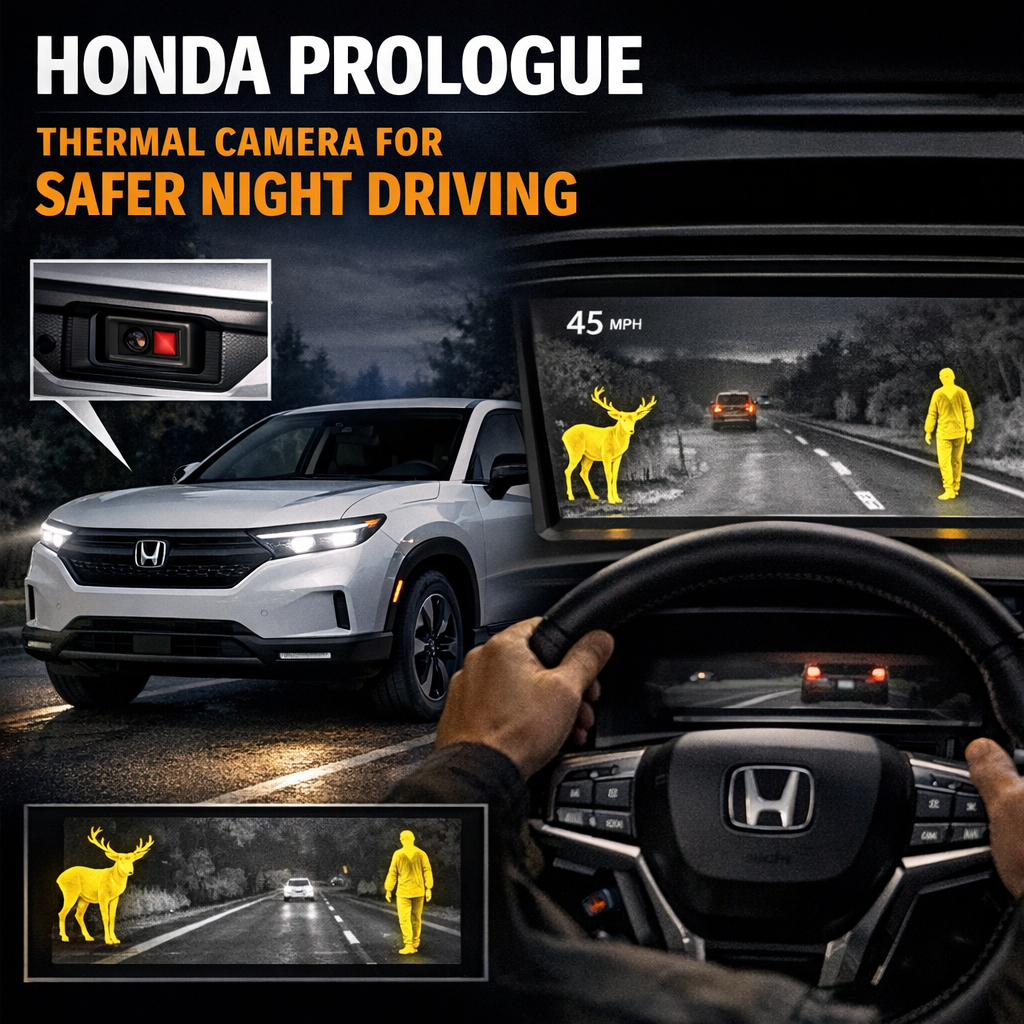
Honda Prologue Thermal Camera upgrades are becoming a popular way to improve night awareness, especially for drivers who regularly travel after dark. When visibility drops—whether from unlit roads, rain, fog, or glare—finding hazards early is what helps you slow down in time and make safer decisions. A thermal imaging car camera can complement your headlights and the Prologue’s existing driver-assistance features by detecting heat signatures that may be difficult to see with standard cameras alone.
- Why Night Vision Matters in the Honda Prologue
- How headlights and regular cameras can fall short
- Why electric SUVs benefit from extra safety awareness
- What to expect from thermal night view
- How Thermal Imaging Differs from Standard Cameras
- Thermal contrast: heat vs. background
- Why weather changes visible images but not heat detection
- What thermal cameras typically do best
- Benefits of a Honda Prologue Thermal Camera
- Better detection of pedestrians and animals
- More confidence in poor weather and glare
- Improved parking, reversing, and low-speed maneuvering
- Earlier hazard recognition can reduce reaction time pressure
- What to Look for in a Car Thermal Camera
- Sensor quality and detection range
- Display integration and how quickly you can interpret it
- Mounting stability and weather resistance
- Installation compatibility with the Prologue’s electronics
- Operational settings that matter for night use
- Where Thermal Cameras Fit Into Driver Assistance
- A support tool, not a substitute for awareness
- Useful for long-distance travel and everyday routes
- How it can change your driving decisions
- Is a Thermal Camera Worth It for Honda Prologue Owners?
- Setup and Smart Usage Tips for Real-World Safety
- Test your system in multiple lighting scenarios
- Keep your expectations realistic
- Use the thermal view as an early-warning cue
- Maintain and protect the camera installation
- Common Questions About Thermal Camera Night View
- Will a Honda Prologue thermal camera work in total darkness?
- Does thermal imaging replace headlights?
- Is a thermal camera better than standard night vision?
- How should I interpret what I see on the screen?
- Is the upgrade practical for everyday Honda Prologue driving?
- Final Thoughts
- Why Night Vision Matters in the Honda Prologue
- How Thermal Imaging Differs from Standard Cameras
- Benefits of a Honda Prologue Thermal Camera
- What to Look for in a Car Thermal Camera
- Where Thermal Cameras Fit Into Driver Assistance
- Is a Thermal Camera Worth It for Honda Prologue Owners?
- Setup and Smart Usage Tips for Real-World Safety
- Common Questions About Thermal Camera Night View
Why Night Vision Matters in the Honda Prologue
The Honda Prologue is a modern electric SUV built for comfort, quiet performance, and everyday practicality. At night, that smooth ride and low cabin noise can make driving feel more relaxed—but it can also reduce the “feel” that something is changing in the environment. When you can’t see details clearly, your reaction depends more heavily on what you notice first: movement, outlines, and distance cues.
That is where a thermal camera can be valuable. Unlike a traditional camera that relies on visible light, a Honda Prologue thermal camera setup can help reveal people, animals, and objects that are difficult to detect until they’re close. For readers who want broader context on improving nighttime safety overall, you can also explore Car Thermal Imaging Camera: Must-Have Affordable Night Driving Safety.
Night hazards are often “low-signal” hazards—things that appear small at first, blend into dark pavement, or show only subtle motion at the roadside. Thermal sensing can make those details easier to spot because warm subjects stand out against cooler surroundings.
How headlights and regular cameras can fall short
Headlights are essential, but they don’t solve every visibility problem. Glare from wet pavement, reflections from mist, and limited range on dark roads can all reduce how early you can recognize danger. Standard cameras can also struggle when the scene contains very little contrast or when weather makes the lens and image processing less reliable.
In practice, that means the earlier you can confirm a moving person or animal is near your path, the more time you have to adjust speed and steering. Early awareness is often the difference between an avoided incident and an emergency braking moment.
More EV News

Why electric SUVs benefit from extra safety awareness
With an electric drivetrain, the Prologue often provides a quieter driving experience. That quietness is a comfort benefit, but it can also change how you perceive traffic and distance cues at night. A Honda Prologue thermal camera adds a visual heat-based layer so you’re not relying only on sound and visible light.
What to expect from thermal night view
A thermal imaging car camera does not “see” like your eyes. It highlights temperature differences, which can produce a different look than typical night footage. That difference is the advantage: it can expose warmth even when the background is hard to interpret.
To get the most out of it, treat the thermal view as an early-warning assistant rather than a replacement for driving attention.
How Thermal Imaging Differs from Standard Cameras
A typical rearview or surround camera depends on available light. Even with strong image processing, glare, fog, rain, and complete darkness can limit what the camera shows. Thermal imaging works differently. Because it senses heat signatures, it can reveal living beings and warm mechanical objects even when visible detail is low.
This means a car thermal camera can be particularly helpful when headlights are not enough. For example:
- Unlit roads with no streetlights
- Heavy rain or fog
- Parking lots at night with uneven illumination
- Rural areas where deer or other animals may appear suddenly
- Driveways and neighborhoods where children, pets, or moving vehicles may be hard to spot
If you want a baseline understanding of safety goals and driver-assistance concepts, the National Highway Traffic Safety Administration can be a useful reference for general guidance.
Thermal contrast: heat vs. background
Thermal systems focus on temperature differences. That contrast can make warm bodies stand out clearly against cooler road surfaces, vegetation, and walls. The result is often easier recognition of “where something is” even before you can see “what it is” in standard lighting.
Why weather changes visible images but not heat detection
Weather affects visible-light performance in many ways—blur, reflection, and reduced contrast. Thermal imaging is less dependent on ambient light and can still provide useful information when conditions are harsh. While it’s not perfect in every scenario, the shift from light-based detection to heat-based detection can improve reliability when visibility is otherwise limited.
What thermal cameras typically do best
Thermal cameras tend to excel at:
- Detecting warm moving subjects near the roadway
- Highlighting animals near the shoulder
- Providing situational awareness in low-light environments
- Supporting safer navigation when visual contrast is poor
Benefits of a Honda Prologue Thermal Camera
Adding a Honda Prologue thermal camera is not only about advanced technology. It’s about practical safety and easier decision-making when visibility drops. Here are some of the most common real-world benefits drivers report when using thermal night view.
Better detection of pedestrians and animals
One of the greatest advantages of thermal imaging is its ability to distinguish warm bodies against cooler backgrounds. At night, a pedestrian in dark clothing can blend into the environment and become difficult to spot with standard headlights alone. A Honda Prologue thermal camera can help bring that person into view sooner.
The same applies to wildlife. Animal collisions are a known risk on dark roads, especially in suburban and rural areas. Thermal imaging can provide earlier warning when deer, raccoons, or other animals are near the lane or preparing to cross.
More confidence in poor weather and glare
Weather can make nighttime driving harder. Rain, mist, and fog can create glare and reduce the effectiveness of headlights and visible-light cameras. A thermal imaging car camera can sometimes maintain useful contrast because it focuses on heat patterns rather than reflected light.
It’s still important to drive conservatively. Thermal detection can support earlier recognition, but it does not remove all risk when roads are slick, visibility is truly extreme, or surfaces are difficult to interpret.
Improved parking, reversing, and low-speed maneuvering
Night awareness matters beyond highways. It helps when backing out of a dark driveway, navigating an unlit parking area, or moving through tight spaces. A Honda Prologue thermal camera may make it easier to notice people or animals that are not obvious in mirrors or standard camera feeds.
For an SUV used for family transport, commuting, and weekend trips, that everyday reassurance can be a strong reason to consider a thermal upgrade.
If you’re comparing thermal solutions with other visibility improvements, Night Vision for Car Driving: 5 Powerful Safety Upgrades is a helpful next read.
Earlier hazard recognition can reduce reaction time pressure
When hazards appear at the last moment, you have less time to react. The advantage of thermal detection is that it can help you identify warm movement earlier, giving you more time to:
- Slow down before a blind corner or driveway
- Maintain a safer following distance in low light
- Adjust steering smoothly rather than late or abruptly
- Decide when to increase caution near shoulders or sidewalks
That is why many owners describe the Honda Prologue thermal camera as a confidence upgrade as much as a visibility upgrade.
What to Look for in a Car Thermal Camera
Not all thermal camera systems deliver the same usefulness. If you’re choosing a Honda Prologue thermal camera upgrade, focus on features that support both safety performance and everyday usability.
Sensor quality and detection range
Thermal image quality matters. A higher-quality sensor can provide clearer shapes and better contrast, helping you recognize whether a heat source is a person, animal, or vehicle. Range is just as important. The farther ahead the camera can detect hazards, the more time you have to react.
When evaluating range, consider the typical roads you drive. Rural highways benefit from longer detection capability, while neighborhood parking and driveway scenarios may require strong near-field clarity.
Display integration and how quickly you can interpret it
A thermal camera is only useful if you can view the output quickly and easily. Some systems connect to an independent screen, while others integrate with existing displays or infotainment setups.
For a vehicle like the Prologue, seamless integration can improve usability because it reduces the need to shift your attention away from the road. Aim for a setup where the thermal view appears stable, legible, and simple to access.
Mounting stability and weather resistance
Because the camera may be exposed to road spray, dust, and temperature swings, durability should be a priority. Look for automotive-grade construction with reliable mounting hardware. A well-built system is more likely to stay accurate over time and maintain consistent performance through seasonal changes.
Installation compatibility with the Prologue’s electronics
Before purchasing, confirm the system is compatible with the Honda Prologue’s design and electrical setup. Modern vehicles can include complex software and driver-assistance electronics, so proper installation matters.
A professional installer who understands advanced driver-assistance technology can help ensure the Honda Prologue thermal camera works as intended without interfering with existing features.
If you want a wider look at typical mounting and system approaches, Vehicle Mounted Thermal Camera for Night Vision can provide useful context.
Operational settings that matter for night use
Many thermal systems include image adjustments or operating modes. When available, look for controls that let you manage:
- Brightness/contrast for different surroundings
- Color or palette options for easier interpretation
- Focus behavior or image stabilization
- Quick access for different driving scenarios
Even small usability improvements can make it easier to use thermal night view consistently, which is where the safety value comes from.
Where Thermal Cameras Fit Into Driver Assistance
A thermal camera should be treated as a complement to attentive driving and factory safety systems—not a replacement. The Honda Prologue already offers modern driver-assistance technology, and a Honda Prologue thermal camera can add another perspective when conditions are difficult.
A support tool, not a substitute for awareness
Even the best thermal imaging system has limitations. It may not show road signs, lane markings, or obstacles that don’t produce strong heat differences in the same way as a standard camera or daylight vision.
Drivers still need to watch mirrors, headlight behavior, dashboard alerts, and the physical road. Think of the thermal view as an extra sense: it can help you notice danger earlier, while you stay responsible for the driving task.
Useful for long-distance travel and everyday routes
Whether you use your Prologue for commuting, family trips, or late-night errands, thermal benefits can show up across many routes.
Long highway drives can become less stressful when you have earlier warning of roadside movement. Short local trips can be safer when a person stepping off a curb or an animal near the street is visible before it becomes urgent.
For more practical tips on safer nighttime habits, What Are the Best Practices for Night Driving Safety? pairs well with this kind of technology-focused upgrade.
How it can change your driving decisions
Thermal night view can influence behavior in helpful ways:
- Encouraging slower speeds near areas with wildlife or poor lighting
- Supporting earlier “lift off the gas” reactions before a turn or driveway
- Improving caution when pedestrians may be present but hard to see
- Helping drivers judge when a roadside stop is safer than rushing through
Used this way, the Honda Prologue thermal camera becomes part of a calmer, more informed driving routine.
Is a Thermal Camera Worth It for Honda Prologue Owners?
For drivers who often travel after dark, a Honda Prologue thermal camera is frequently worth considering. It can improve awareness and response time in scenarios where standard lighting falls short. If you value modern safety technology, a Honda Prologue thermal camera can fit naturally into the Prologue’s advanced, tech-forward lifestyle.
It’s especially worth considering if you:
- Drive in rural, wooded, or semi-rural areas
- Commute at night regularly
- Often experience foggy, rainy, or otherwise low-visibility conditions
- Want added confidence when parking or reversing in the dark
- Share the road with pedestrians, cyclists, or wildlife
In many cases, the decision comes down to how often you drive after sunset and how much peace of mind you want. A Honda Prologue thermal camera is not a luxury add-on only for enthusiasts; it can be a meaningful safety tool that supports everyday driving.
If you’re also comparing pricing and budgeting for a night vision upgrade, see Car Night Vision Camera Price: What You’ll Pay in 2026.
Setup and Smart Usage Tips for Real-World Safety
Getting the right Honda Prologue thermal camera matters, but so does how you use it. The goal is consistent, confident use—not occasional experimentation. With a few smart habits, you can turn thermal night view into a dependable part of your driving routine.
Test your system in multiple lighting scenarios
Before relying on it for night driving, test the thermal imaging car camera output in different conditions:
- Indoor or garage conditions at night
- Unlit streets with no overhead lamps
- Areas with nearby vegetation or animals
- Rainy or foggy conditions (when safe and legal)
Use these tests to learn what you’re seeing. Familiarity helps you interpret heat patterns quickly when you’re on the road.
Keep your expectations realistic
Thermal cameras help detect heat differences, but they don’t “replace” good driving habits. Avoid assuming that everything visible on the screen is the full shape of an object, and avoid assuming that a lack of heat means the area is hazard-free.
Combine thermal awareness with normal checks: scanning the roadway, watching mirrors, and responding to real-world cues.
Use the thermal view as an early-warning cue
When you see a warm moving shape near the roadside, treat it as a reason to reduce risk. That can mean slowing down, increasing following distance, or preparing for a potential crossing. Over time, a Honda Prologue thermal camera can help you become quicker at spotting hazards earlier.
Maintain and protect the camera installation
To keep the system reliable, make sure the camera lens area stays clean and unobstructed. Road spray and dirt can affect clarity. Also, periodically check mounting stability so vibration doesn’t degrade aim or performance.
Following basic maintenance helps preserve the value of your Honda Prologue thermal camera upgrade.
Common Questions About Thermal Camera Night View
Will a Honda Prologue thermal camera work in total darkness?
Thermal imaging can be useful even when there is little to no visible light, because it relies on temperature differences. That said, extreme situations and very complex scenes can still be challenging. In general, thermal night view is designed to provide awareness where visible cameras struggle.
Does thermal imaging replace headlights?
No. Headlights remain important for road illumination and for seeing lane-related details. A thermal camera like a Honda Prologue thermal camera adds detection value by highlighting warm subjects that might otherwise blend into the environment.
Is a thermal camera better than standard night vision?
“Better” depends on your priorities and driving conditions. Thermal systems can be especially helpful for detecting warm bodies such as pedestrians and animals. Some night-vision alternatives focus more on reflective light contrast. Many drivers choose thermal because it offers a different detection method and can be complementary to existing vehicle features.
How should I interpret what I see on the screen?
Start by treating thermal night view as a map of heat. Warm shapes indicate heat sources, but the exact boundaries may differ from what you’d see in normal lighting. With practice, you’ll learn how motion, shape, and intensity correspond to real-world objects.
Is the upgrade practical for everyday Honda Prologue driving?
Yes, for many drivers. A Honda Prologue thermal camera can be used for evening errands, parking, and late-night commutes. The safety benefit is often most noticeable when you frequently drive where lighting is limited or where animals and pedestrians may appear unexpectedly.
Final Thoughts
Night driving will always demand extra caution, but the right technology can make it easier to spot hazards before they become emergencies. A Honda Prologue thermal camera offers a meaningful advantage by helping detect heat signatures that might otherwise go unnoticed. For drivers looking to enhance the usefulness of their electric SUV after dark, this kind of upgrade can be a thoughtful and valuable addition.
As vehicles continue to become smarter and more capable, tools like thermal imaging are likely to play a larger role in everyday safety. For Honda Prologue owners, a Honda Prologue thermal camera is a practical way to improve visibility, reduce uncertainty, and drive with greater peace of mind when the sun goes down.
For more background on thermal systems and how they compare with other night-driving tools, you can also review the U.S. Department of Energy’s overview of infrared thermography.
For Honda Prologue owners, that makes the Honda Prologue thermal camera one of the most practical ways to improve nighttime confidence without changing the way the SUV drives.