

- Table of Contents
- Why Family Car Night Driving Safety Requires More Attention
- Family Car Night Driving Safety Starts With Basic Visibility
- Keep Headlights Clean and Correctly Aimed
- Maintain the Windshield and Wipers
- Check Every Exterior Light
- Choose Features That Support Family Car Night Driving Safety
- Effective Headlights Matter More Than Styling
- Automatic Emergency Braking Can Add Support
- Blind-Spot and Rear Cross-Traffic Warnings Reduce Workload
- Lane and Driver-Monitoring Features Need Sensible Settings
- Manage the Interior for Family Car Night Driving Safety
- Use Technology to Improve Family Car Night Driving Safety
- Adapt Family Car Night Driving Safety to Road Conditions
- Build a Family Car Night Driving Safety Routine
- Treat Fatigue as a Family Car Night Driving Safety Risk
- Maintain Family Car Night Driving Safety Systems
- A Family Car Night Driving Safety Buying Framework
- 1. What Conditions Do You Actually Drive In?
- 2. Does the Feature Help Without Creating Distraction?
- 3. What Are the Limitations?
- 4. Can the Household Use It Consistently?
- Frequently Asked Questions
- Which Feature Is Most Important for Family Car Night Driving Safety?
- Are Automatic High Beams Useful for Family Travel?
- Can Night Vision Replace Headlights?
- How Can Passengers Make Night Driving Safer?
- Should Families Rely on Pedestrian Detection After Dark?
- When Should a Tired Driver Stop?
- Conclusion: Strengthen Family Car Night Driving Safety
A practical family car night driving safety plan involves more than choosing a vehicle with bright headlights. Visibility, driver fatigue, passenger distractions, vehicle maintenance and the way safety technology communicates hazards all matter. For parents and passengers, family car night driving safety depends on combining suitable vehicle features with disciplined preparation and realistic expectations about driver-assistance systems.
Table of Contents
Why Family Car Night Driving Safety Requires More Attention
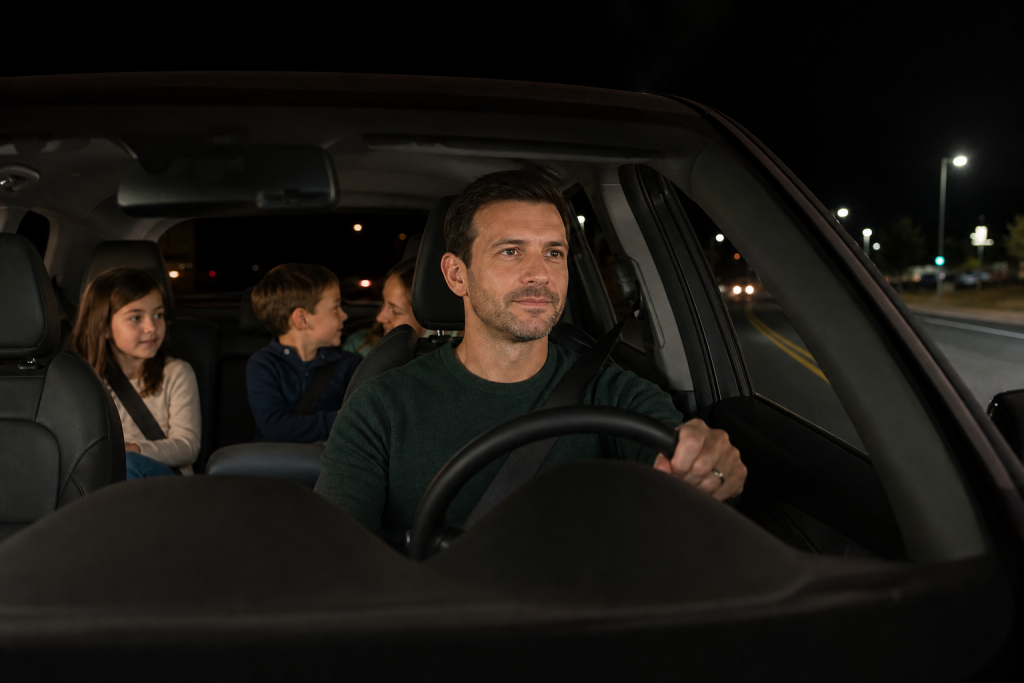
Driving after dark reduces the amount of useful visual information available to the driver. Road edges, pedestrians, animals, debris and unlit vehicles may be harder to distinguish until they are relatively close. Glare from approaching traffic can make the problem worse, particularly when the windshield is dirty or wet.
Family travel introduces additional demands. A child may need attention, passengers may turn on bright screens, and luggage can obstruct rearward visibility. During long trips, the driver may also be navigating an unfamiliar area while looking for fuel, food or accommodation.
These factors do not automatically make a journey unsafe, but they increase the need for preparation. A well-equipped vehicle can support a family car night driving safety strategy by improving visibility, warning of developing hazards and reducing avoidable distractions. It cannot compensate for excessive speed, fatigue or inattention.
Family Car Night Driving Safety Starts With Basic Visibility
Advanced technology is useful only when the car’s fundamental visibility equipment is working correctly. Every family car night driving safety check should begin with the headlights, windshield, wipers and exterior lights already fitted to the vehicle.
Keep Headlights Clean and Correctly Aimed
Headlight lenses collect dirt, road salt, insects and other residue. Even a thin layer can reduce usable light or scatter the beam. Clouded plastic lenses can create a similar problem and may require professional restoration or replacement.
Headlight aim matters as well. A beam set too low limits forward visibility, while one aimed too high can create glare for other road users without placing enough light on the road. Warning signs of poor alignment include uneven beam patterns, frequent flashes from oncoming drivers or limited illumination after suspension or collision repairs.
Some modern family cars use automatic high beams, adaptive headlights or matrix-style lighting where permitted. These systems can improve illumination, but they still depend on clean lenses, functioning sensors and correct calibration.
Maintain the Windshield and Wipers
A windshield that looks acceptable during the day can become distracting at night. Films from interior plastics, fingerprints and cleaning products may scatter light from streetlamps and oncoming vehicles. Cleaning both sides of the glass can noticeably reduce glare.
Wiper blades should clear water smoothly without leaving streaks. If they chatter, smear or leave unwiped areas, replacement may be due. Washer fluid should also be appropriate for seasonal conditions, especially in climates where freezing temperatures are common.
Cracks and chips within the driver’s field of view can refract light at night. Local inspection rules vary, but damage that interferes with visibility deserves prompt professional assessment regardless of the legal minimum.
Check Every Exterior Light
Brake lights, turn signals, side markers, license plate lights and rear lamps help other people understand where the vehicle is and what it is doing. Keeping every exterior lamp operational is a basic part of family car night driving safety, especially because a failed rear light may be difficult to notice from the driver’s seat.
A simple check against a wall can confirm whether many lights are operating, but periodic help from another person makes it easier to inspect brake lamps and turn signals. Vehicles with dashboard bulb warnings should not be assumed to identify every possible lighting fault.
Choose Features That Support Family Car Night Driving Safety
When buying a family vehicle, it is tempting to treat the length of the equipment list as a measure of safety. A better method is to consider which features address the roads and conditions the household actually encounters.
Effective Headlights Matter More Than Styling
Headlights differ in beam coverage, consistency and control even when they use similar technology. LED branding alone does not guarantee that a system will provide useful illumination in every situation.
During a nighttime test drive, look for:
- A broad, even beam without distracting dark patches
- Useful illumination on bends and road edges
- Clear low-beam reach at ordinary road speeds
- High-beam controls that are easy to operate
- Automatic functions that respond predictably
- Minimal glare reflected from the hood, dashboard or road signs
A test drive should include the types of roads the family uses, where practical. Urban streets may reveal reflections and pedestrian activity, while an unlit road provides a better indication of beam reach and corner visibility.
Automatic Emergency Braking Can Add Support
Automatic emergency braking, often called AEB, can warn the driver and may apply the brakes when a collision risk is detected. Some systems are designed to recognize pedestrians, cyclists or other road users, but capabilities vary by vehicle, model year, speed and environmental conditions. For family car night driving safety, buyers should verify whether pedestrian and cyclist detection operates after dark.
Families should read the owner’s manual rather than relying solely on a dealership description. Important questions include whether the system operates at night, how poor weather affects it and whether pedestrian detection has separate limitations.
AEB is a backup layer, not permission to shorten following distances or drive faster than the headlights allow. Cameras and radar can be affected by dirt, ice, heavy rain, fog, glare, road geometry or unusual movement.
Blind-Spot and Rear Cross-Traffic Warnings Reduce Workload
Blind-spot monitoring can support family car night driving safety on dark multilane roads where surrounding vehicles may be difficult to track. Rear cross-traffic alerts can improve awareness when reversing from a poorly lit parking space.
Neither system replaces mirror checks or a direct look over the shoulder. Small vehicles, bicycles, fast-moving traffic and objects outside the sensor’s coverage may not generate a warning. Drivers should also keep sensor areas clean and follow any calibration guidance after body repairs.
Lane and Driver-Monitoring Features Need Sensible Settings
Lane departure warnings and lane-keeping assistance can contribute to family car night driving safety during long evening journeys. Their performance may decline when markings are worn, covered by snow or obscured by water.
Driver-monitoring or fatigue-warning systems can also be helpful, but an alert is not a cure for tiredness. If the driver is struggling to keep their eyes open, missing signs or repeatedly drifting in the lane, the appropriate response is to stop in a safe place and rest or change drivers.
Families should configure alert volume and sensitivity before departure. Turning systems off because they feel intrusive can remove a useful layer of support, while excessively frequent alerts may encourage the driver to ignore meaningful warnings.
Manage the Interior for Family Car Night Driving Safety
The inside of the vehicle can either protect or undermine the driver’s night vision. Because family cars often contain several bright screens, illuminated controls and reflective surfaces, cabin management should be part of every family car night driving safety routine.
Reduce dashboard brightness until the controls remain readable without dominating the driver’s view. Use dark mode on navigation displays where available, and position screens so they do not reflect in the windshield or side windows.
Passengers should avoid shining phone flashlights toward the front of the cabin. Children’s tablets can be dimmed, fitted with glare-reducing settings and positioned where their reflections do not appear in the driver’s mirrors.
Loose objects should be secured before departure. A rolling bottle or falling bag can trigger an instinctive glance away from the road. Cargo should also stay below the rear-window line unless the vehicle has another reliable means of rearward visibility.
Correct seating position is equally important. The driver should have a clear view over the dashboard while maintaining safe control of the pedals and steering wheel. Mirrors should be adjusted before moving, not while joining traffic.
Use Technology to Improve Family Car Night Driving Safety
Most factory driver-assistance features interpret visible light, radar signals, ultrasound or a combination of sensor inputs. Thermal imaging takes a different approach by detecting heat patterns, which can provide additional information in darkness and some poor-visibility situations.
Families comparing systems should use an automotive thermal night vision system buying guide to assess detection range, display placement, installation and operating limitations. The right equipment can enhance family car night driving safety, but it must remain easy to interpret without distracting the driver.
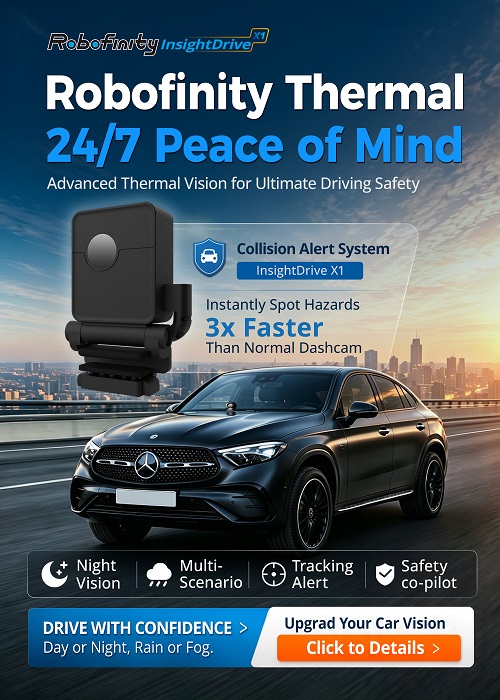
For families that regularly use unlit rural roads, an aftermarket system may be worth evaluating. Robofinity InsightDrive is a vehicle thermal imaging night vision system designed to support awareness of pedestrians, animals, vehicles and obstacles in low-light or poor-visibility conditions. As part of a family car night driving safety setup, it should be treated as an additional driver-assistance display, not as a replacement for headlights, mirrors, safe speed, braking distance or continuous attention.
Any auxiliary display must be mounted where it can be viewed briefly without blocking the driver’s sightline. The driver also needs time to learn how alerts are presented. A system that produces unfamiliar sounds or requires prolonged screen viewing may add workload instead of reducing it.
Before installing aftermarket safety equipment, owners should confirm that it is compatible with the vehicle and does not interfere with airbags, defroster vents, cameras or existing controls. Professional installation may be appropriate when wiring, camera alignment or permanent mounting is involved.
Adapt Family Car Night Driving Safety to Road Conditions
The posted speed limit does not guarantee that a particular speed is suitable at night. A practical rule is to drive slowly enough to identify a hazard and stop within the distance that is clearly visible ahead.
This distance changes with headlight performance, weather, road shape, surface condition, tire grip and driver alertness. It may be much shorter on a wet curve than on a straight, dry road.
Rural Roads
Unlit country roads may contain animals, pedestrians without reflective clothing, farm machinery, sharp bends or debris. A rural family car night driving safety plan should account for these hazards by allowing more reaction time and using high beams legally and courteously.
Look beyond the center of the lane. Movement near a verge, reflected light or an unusual shape at the road edge may provide the first indication of a hazard. Reducing speed before crests and blind bends preserves more time to react.
Highways
Highways often provide better lane markings, but higher speeds reduce decision time. Long, visually repetitive stretches can also contribute to fatigue, making planned breaks an important part of family car night driving safety.
Maintain a following distance that leaves room for gradual braking. Avoid fixing your gaze on the taillights immediately ahead; scan farther along the road while continuing to monitor nearby traffic. When another vehicle’s lights create glare in the mirrors, use the mirror’s night setting or automatic dimming function if fitted.
Cities and Suburbs
Street lighting can create a false sense of complete visibility. Pedestrians may emerge from between parked cars, cyclists can be hidden in shadows, and reflections from shop windows or wet roads may compete for attention. Effective family car night driving safety therefore requires active scanning even on well-lit streets.
At crossings and intersections, reduce speed before the conflict point rather than waiting for a person or bicycle to become obvious. Pay particular attention near schools, public transport stops, entertainment areas and residential streets where people may cross outside marked locations.
Rain, Fog and Snow
Poor weather changes both visibility and traction. Rain increases reflections and lengthens stopping distances. Fog can reflect high-beam light toward the driver, while snow may hide lane markings and road edges. These conditions reduce the margin available for family car night driving safety.
Use the vehicle’s appropriate lighting mode rather than assuming an automatic setting has selected the best option. Daytime running lights may not illuminate the rear of every vehicle, so drivers should understand how to activate full exterior lighting manually.
Slow down smoothly, leave more space and avoid abrupt steering or braking. No camera, thermal imaging system or warning feature can restore normal tire grip on a slippery surface.
Build a Family Car Night Driving Safety Routine
A repeatable family car night driving safety checklist removes small problems before they become distractions. It is particularly useful for holiday trips, airport runs and evening drives with young children.
Before leaving:
- Clean the windshield, headlights and exterior cameras
- Confirm that lights and wipers are working
- Check fuel or battery range and plan sensible stops
- Set the route and audio before moving
- Secure luggage, drinks, toys and electronic devices
- Adjust seats, mirrors and dashboard brightness
- Make sure children are correctly restrained
- Place essential items where a passenger can reach them
- Confirm that the driver is rested and comfortable
Families should also decide how passenger needs will be handled. When a child drops an item, feels ill or requires attention, the driver should stop somewhere safe rather than turning around or reaching into the rear seat.
On longer journeys, a front-seat passenger can assist with navigation, messages, cabin temperature and children’s needs. However, the passenger should provide concise directions and avoid introducing last-second decisions at junctions.
Treat Fatigue as a Family Car Night Driving Safety Risk
Fatigue is one of the most important limits on safe nighttime driving. Cabin comfort, coffee, loud music and open windows may make a driver feel temporarily more alert, but they do not replace sleep. The National Highway Traffic Safety Administration’s drowsy-driving guidance explains why adequate sleep and timely rest are essential.
Recognizing tiredness early is central to family car night driving safety. Warning signs include:
- Repeated yawning or heavy eyelids
- Difficulty remembering the last few miles or kilometers
- Missing signs, exits or navigation prompts
- Inconsistent speed
- Lane drift or repeated lane warnings
- Irritability and poor decision-making
- Trouble keeping a steady focus on the road
A driver experiencing these symptoms should stop at a suitable location. If another insured and qualified adult can drive, changing drivers may be appropriate. Otherwise, meaningful rest is safer than trying to push through to the destination.
Trip planning can reduce the pressure to continue. Allow extra time, identify likely rest locations and avoid scheduling arrival so tightly that stopping feels impossible.
Maintain Family Car Night Driving Safety Systems
Driver-assistance features need maintenance just as conventional components do. Windshield-mounted cameras require a clear view. Radar units and parking sensors may be blocked by dirt, snow, stickers, accessories or minor body damage.
Camera-based systems may need calibration after windshield replacement, collision repair, suspension work or changes to vehicle ride height. Following the manufacturer’s calibration requirements helps preserve family car night driving safety after repairs.
Tires also deserve attention because hazard detection is useful only if the car can respond predictably. Correct pressure, adequate tread and seasonally suitable tires support braking and steering in wet or cold conditions. Brakes, suspension and defrosters should be addressed promptly when warning signs appear.
Software updates may change how some factory systems operate. Owners should review update notes and confirm that preferred safety settings remain active afterward.
A Family Car Night Driving Safety Buying Framework
When assessing a vehicle or upgrade, use four questions to determine whether it will provide meaningful family car night driving safety benefits. Families weighing different vehicle priorities should also compare the practical roles of car safety and comfort.
1. What Conditions Do You Actually Drive In?
A household that mainly uses illuminated urban streets has different needs from one that regularly travels on rural roads. Consider darkness, weather, wildlife, pedestrian activity, highway mileage and the typical length of trips.
2. Does the Feature Help Without Creating Distraction?
Warnings should be clear, timely and easy to understand. Displays should not obstruct the road view or demand prolonged attention. Controls need to remain usable with the driver’s eyes mostly forward.
3. What Are the Limitations?
Check operating speeds, sensor coverage, weather restrictions and maintenance requirements. Be cautious of vague claims that do not explain when a feature may fail to detect a hazard.
4. Can the Household Use It Consistently?
A feature provides little value if drivers routinely disable it or do not understand its alerts. During a test drive, every regular driver should evaluate visibility, seating position, control layout and warning behavior.
Frequently Asked Questions
Which Feature Is Most Important for Family Car Night Driving Safety?
Effective, properly maintained headlights are the foundation of family car night driving safety. Automatic emergency braking, blind-spot monitoring and other assistance features can add support, but none replaces clear illumination and an attentive driver.
Are Automatic High Beams Useful for Family Travel?
They can reduce workload on dark roads by switching between beam settings, but their response is not perfect in every situation. Drivers must remain ready to control the high beams manually and avoid dazzling other road users.
Can Night Vision Replace Headlights?
No. Night vision and thermal imaging systems provide supplementary information. Legal, correctly aimed headlights remain necessary for seeing the road, communicating the vehicle’s presence and complying with traffic requirements.
How Can Passengers Make Night Driving Safer?
Passengers can manage navigation, reduce screen brightness, secure loose items and help children without distracting the driver. When a situation needs the driver’s attention inside the cabin, the vehicle should be stopped safely first.
Should Families Rely on Pedestrian Detection After Dark?
Pedestrian detection may provide an additional warning, but performance varies by system and conditions. Darkness, weather, sensor obstruction and a person’s position or movement can affect detection. Drivers must continue scanning crossings, sidewalks and road edges.
When Should a Tired Driver Stop?
The driver should stop as soon as warning signs appear, including heavy eyelids, repeated yawning, lane drift, missed signs or difficulty remembering the recent journey. Waiting until fatigue becomes overwhelming leaves less time to find a safe stopping place.
Conclusion: Strengthen Family Car Night Driving Safety
Reliable family car night driving safety comes from layers that work together: clean and effective lighting, an unobstructed windshield, maintained tires and brakes, sensible driver-assistance settings, controlled cabin distractions and a rested driver. Advanced detection technology may improve road awareness, but its value depends on proper installation, realistic expectations and disciplined use.
Before the next evening trip, perform a quick visibility check, set up the cabin and consider whether the planned speed and route suit the conditions. A consistent family car night driving safety routine often does more for the household than any single feature considered in isolation.