


SEO Title: Is a Car Night Vision System Useful for Driving Before Dawn or After Dark?
- The Short Answer: Who Benefits Most?
- Why Driving After Dark Is More Demanding
- How Automotive Night Vision Works
- Where Night Vision Provides the Most Practical Value
- Rural Roads With Wildlife
- Unlit Highways and Secondary Roads
- Early-Morning Commuting
- City Traffic
- Fog, Rain, Snow, and Glare
- An Aftermarket Example
- Benefits Beyond Simply “Seeing in the Dark”
- Earlier Hazard Awareness
- Better Contrast for People and Animals
- Support During Glare and Uneven Lighting
- Important Limitations to Understand
- The Driver Must Look at the Road
- Detection Is Not Identification
- Thermal Cameras Do Not Show Everything Drivers Need
- Weather and Installation Affect Performance
- How to Decide Whether It Is Worth the Cost
- Step 1: Audit Your Night Driving
- Step 2: Identify the Hazard You Want Help Detecting
- Step 3: Review the Whole System, Not One Specification
- Step 4: Compare Alternative Safety Improvements
- Using Night Vision Responsibly
- Frequently Asked Questions
- Can a car night vision system see farther than headlights?
- Does thermal night vision work in complete darkness?
- Can night vision detect pedestrians and animals?
- Is night vision useful in fog or heavy rain?
- Is factory-installed night vision better than an aftermarket system?
- Will night vision prevent a collision?
- Conclusion
Meta Description: Learn how car night vision systems improve hazard awareness after dark, where thermal imaging helps most, its limitations, and what to consider before buying.
Driving before sunrise or after sunset changes how quickly you can identify danger. Headlights illuminate the road, but their useful reach, beam pattern, and contrast have limits. A car night vision system can be useful because it gives drivers another way to notice pedestrians, animals, vehicles, and other hazards beyond or outside the clearest part of the headlight beam. Its value, however, depends on the technology, the roads you travel, and whether the display and alerts genuinely support your attention instead of distracting you.
The Short Answer: Who Benefits Most?
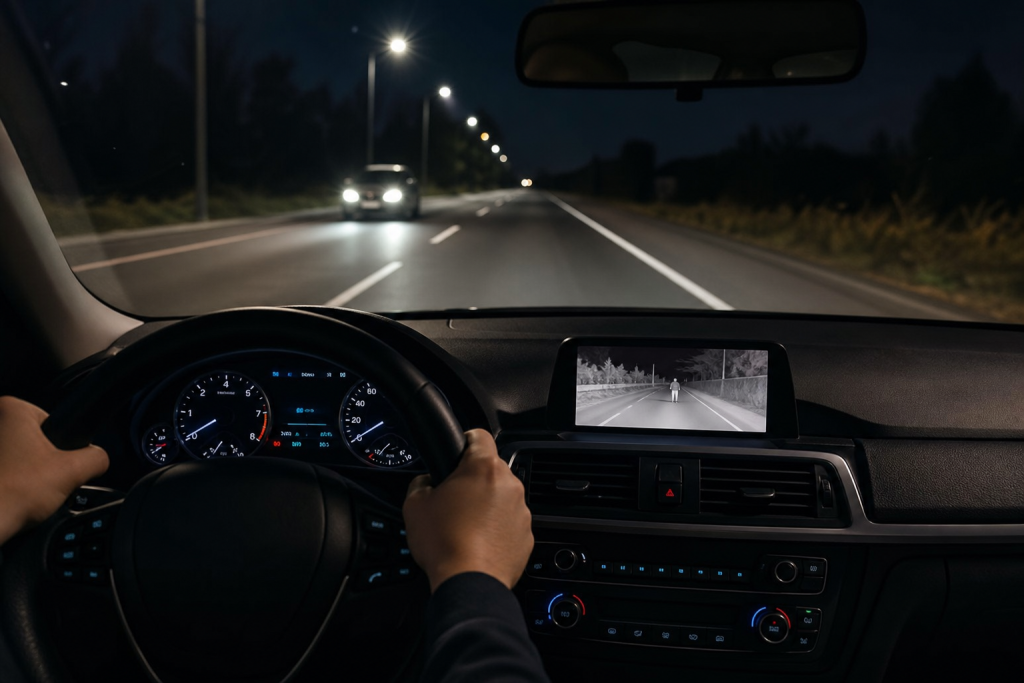
Night vision is most useful for people who frequently drive in conditions where hazards are difficult to see early. That often includes:
- Commuters who leave before dawn or return after dark
- Rural drivers on roads with wildlife and limited lighting
- Shift workers traveling when pedestrian visibility is poor
- Families making long overnight or early-morning trips
- Drivers using unlit highways or secondary roads
- People who regularly encounter fog, spray, glare, or uneven illumination
The benefit is generally smaller for someone who rarely drives at night, travels almost entirely on well-lit city streets, or already has a vehicle whose advanced lighting and driver-assistance systems cover the relevant risks well.
Even in favorable conditions, night vision should be treated as supplemental vehicle safety technology. It does not replace headlights, appropriate speed, clean windows, mirrors, safe following distance, or direct observation of the road.
Why Driving After Dark Is More Demanding
Darkness does more than reduce the distance a driver can see. It also reduces contrast and makes visual details harder to interpret. A dark-coated animal near vegetation may blend into the background. A pedestrian in non-reflective clothing can be difficult to distinguish from roadside objects. Glare from approaching traffic may temporarily obscure what lies ahead.
Before dawn presents additional challenges. Drivers may be less alert because their body expects sleep, while wildlife and pedestrians may still be active. Temperatures can also be lower, increasing the possibility of frost or localized ice.
After-dark driving creates a similar combination of risks:
- Headlight illumination covers only part of the scene.
- Curves, hills, and roadside vegetation hide hazards.
- Oncoming headlights can reduce contrast.
- Rain and road spray scatter visible light.
- Fatigue can slow recognition and decision-making.
- Faster roads reduce the time available to respond.
A night vision system cannot remove these conditions, but it may improve road awareness by revealing a heat signature or enhanced image before the same object becomes obvious through the windshield.
How Automotive Night Vision Works
Car night vision systems generally use either thermal imaging or near-infrared illumination. Although both are intended to improve low-light driving visibility, they do not create the same kind of image.
Thermal Imaging
A thermal imaging system detects differences in infrared energy emitted by objects. It can show people and animals as visually distinct from cooler surroundings, depending on environmental conditions. It does not depend on reflected visible light in the same way as a conventional camera.
This makes thermal imaging particularly relevant to pedestrian detection and animal detection on dark roads. A person near the shoulder or a deer near the tree line may stand out in the thermal image even when clothing, fur, or background colors make the subject difficult to see normally.
Thermal imaging still has limitations. Hot pavement, warm structures, exhaust, weather, and small temperature differences can affect scene interpretation. It also does not provide the familiar color and fine visual detail of a standard camera.
Near-Infrared Night Vision
Near-infrared systems typically illuminate the road with infrared light that is invisible to the human eye. A compatible camera then captures the reflected energy and presents a monochrome or enhanced image.
This approach can provide recognizable road detail, but performance depends on reflected infrared illumination. It can also respond differently to fog, precipitation, dirty lenses, reflective surfaces, and other environmental factors.
Passive Display Versus Active Recognition
A basic system presents an additional image for the driver to interpret. More advanced driver-assistance technology may analyze the camera feed, recognize certain road users or objects, and provide a visual or audible alert.
Recognition can reduce the need to continuously study a separate screen, but it is not infallible. Detection performance may vary with distance, object position, weather, road geometry, obstructions, and installation quality. An alert should prompt the driver to assess the road, not trigger an automatic assumption that the software has classified the situation correctly.
Where Night Vision Provides the Most Practical Value
The usefulness of the technology becomes clearer when considered in real driving scenarios.
Rural Roads With Wildlife
Dark rural roads are one of the strongest use cases for thermal night vision. Animals can enter from fields, drainage areas, or wooded shoulders with little warning. Standard headlights may not clearly reveal them until they are close to the travel lane.
A thermal view can potentially make a warm animal more noticeable against cooler vegetation or ground. Earlier awareness may give a driver more time to reduce speed smoothly and evaluate the situation.
The safe response is not always a sudden steering maneuver. Swerving can create a second hazard, especially at speed or on a narrow road. The system’s purpose is to support earlier recognition so the driver can brake progressively while maintaining control.
Unlit Highways and Secondary Roads
On a straight, dark road, a driver may feel able to see farther than the headlights actually provide useful detail. This can create an “overdriving the headlights” problem: at the chosen speed, the stopping distance may exceed the clearly visible road space.
Night vision may extend awareness beyond the most useful portion of the light beam. That can be valuable for identifying a stopped vehicle, person, animal, or obstruction ahead. Nevertheless, the driver must still choose a speed that allows a safe response within visible and predictable conditions.
Early-Morning Commuting
Before sunrise, a commuter may encounter runners, cyclists, workers, school traffic, or animals while still adjusting to low light. Street lighting may be inconsistent, particularly where suburbs meet rural areas.
In this setting, hazard detection can be useful at transitions: leaving a bright commercial area for a dark road, approaching an unlit crossing, or traveling through patches of glare and shadow. A well-designed alert may direct attention toward a potential hazard without requiring constant monitoring of the screen.
City Traffic
Urban areas contain more pedestrians and cyclists, but they also have signs, lights, parked vehicles, reflections, and frequent movement. Night vision may help in poorly lit side streets or at the edge of the roadway, yet the visual environment can make an additional display cognitively demanding.
In dense traffic, the quality of the warning interface matters as much as image quality. Repeated alerts for harmless or expected objects may encourage the driver to ignore the system. City-focused buyers should consider whether notifications are selective, understandable, and adjustable.
Fog, Rain, Snow, and Glare
Thermal imaging may preserve useful contrast in some poor-visibility conditions where visible-light cameras struggle, but it does not see perfectly through all weather. Dense fog, heavy rain, snow accumulation, road spray, and moisture or dirt on the sensor can reduce performance.
Headlight glare is another relevant scenario. Because thermal cameras do not form their image from visible light, they are not affected by glare in exactly the same way as human vision or conventional cameras. Even so, the driver must continue looking through the windshield and following the actual road. A thermal display cannot confirm lane markings, road surface grip, traffic signal colors, or every obstacle.
An Aftermarket Example
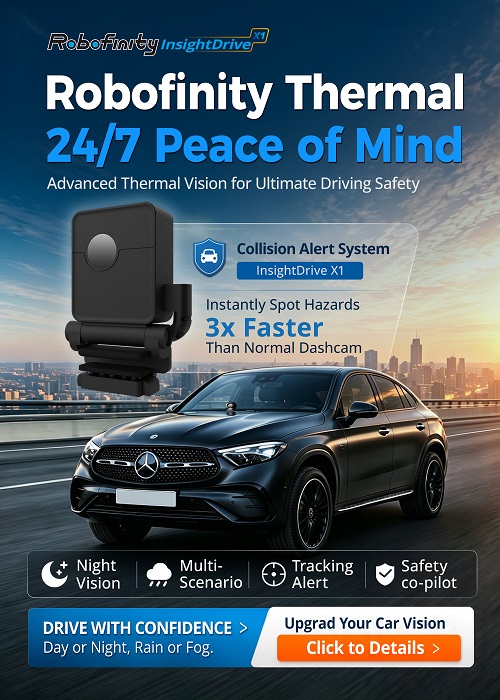
For drivers exploring a dedicated thermal upgrade, Robofinity InsightDrive is an example of a vehicle thermal imaging night vision system designed to support recognition of pedestrians, animals, and vehicles and provide real-time alerts. Those functions may improve awareness in low-light or poor-visibility driving, but the system remains an aid: the driver must verify hazards, maintain appropriate speed, and keep full attention on the road.
Benefits Beyond Simply “Seeing in the Dark”
The strongest case for night vision is not that it makes nighttime look like daytime. It is that it may change when the driver becomes aware of a hazard.
Earlier Hazard Awareness
Seeing a possible hazard sooner creates more decision space. A driver may be able to ease off the accelerator, increase following distance, prepare to brake, or scan the roadside more deliberately.
This distinction matters. Safety often depends less on dramatic emergency reactions and more on recognizing developing situations early enough to avoid them.
Better Contrast for People and Animals
Visible-light images depend heavily on color, lighting, and reflectivity. Thermal imaging uses temperature contrast, which can make living subjects easier to distinguish from some backgrounds.
That does not mean every person or animal will always be obvious. Partial obstruction, distance, weather, and environmental temperature can change the result. The practical benefit is an additional source of information rather than certainty.
Support During Glare and Uneven Lighting
Drivers frequently move between bright and dark areas. Examples include exiting a fuel station, passing an oncoming vehicle on an unlit road, entering a tunnel, or moving from streetlights into darkness. Human vision needs time to adapt.
A night vision feed can provide a more consistent supplemental view during some of these transitions. The driver still needs to reduce speed when visual adaptation or glare compromises direct sight.
Important Limitations to Understand
A buying decision should account for what night vision cannot do.
The Driver Must Look at the Road
A large, bright, or poorly positioned display can become a distraction. Looking down for more than a brief glance means looking away from the actual driving scene.
Systems that use clear, timely alerts may reduce this problem, but excessive warnings can create alert fatigue. Buyers should look for an interface that communicates urgency without competing constantly for attention.
Detection Is Not Identification
A thermal shape may indicate a person, animal, warm machine component, or another source of heat. Recognition software can assist, but classification errors and missed detections remain possible.
Drivers should respond by checking the road and adjusting cautiously. They should not make aggressive maneuvers solely because of an icon or highlighted shape.
Thermal Cameras Do Not Show Everything Drivers Need
Thermal imaging is useful for heat contrast, but driving decisions also depend on:
- Lane markings and traffic signs
- Signal colors
- Surface water, snow, and ice
- Road edges and construction layouts
- Vehicle indicators and brake lights
- Fine object details
- Instructions from police or road workers
The windshield view, headlights, mirrors, and conventional safety systems remain primary.
Weather and Installation Affect Performance
A sensor mounted outside the passenger compartment is exposed to grime, insects, water, snow, ice, and road salt. If the lens or protective window becomes contaminated, image quality may deteriorate.
Mounting position also matters. An incorrectly aligned camera can misrepresent where an object sits relative to the road. Poorly routed wiring or an unstable display mount can create reliability and distraction problems.
Professional installation may be appropriate where the system requires exterior mounting, electrical integration, calibration, or permanent interior hardware. Installation should also preserve the driver’s field of view and avoid interfering with airbags, controls, or legally required equipment.
How to Decide Whether It Is Worth the Cost
Rather than asking whether night vision is universally useful, assess how closely the technology matches your routine.
Step 1: Audit Your Night Driving
For two or three weeks, note when and where you drive in darkness. Record recurring conditions such as unlit roads, animal activity, pedestrians without reflective clothing, glare, poor weather, and long high-speed stretches.
Frequent exposure matters more than occasional inconvenience. Someone driving 40 minutes on rural roads every night has a different need than someone making a short, well-lit trip once a month.
Step 2: Identify the Hazard You Want Help Detecting
Choose the problem before choosing the product.
If wildlife is the main concern, thermal animal detection may be valuable. If reversing in dark parking areas is the issue, better reversing cameras and lighting may be more relevant. If fatigue is the concern, scheduling, rest, and driver-monitoring features may provide greater benefit. If headlights are weak because lenses are cloudy or bulbs are failing, maintenance should come first.
Step 3: Review the Whole System, Not One Specification
Long detection range sounds attractive, but usable performance depends on more than a maximum figure. Consider:
- Whether the system uses thermal or near-infrared imaging
- Which objects it is designed to recognize
- How alerts are presented
- Whether alert sensitivity can be adjusted
- Display size, brightness, and mounting location
- Camera weather protection and cleaning access
- Video smoothness and processing delay
- Installation requirements
- Recording and data-handling features, if included
- Support for the intended vehicle and electrical system
A sharp image is not enough if alerts arrive too late, the screen blocks part of the windshield, or routine operation requires too much driver interaction.
Step 4: Compare Alternative Safety Improvements
Night vision should not take priority over neglected fundamentals. Before adding an advanced system, inspect or address:
- Headlight condition, aim, and legal bulb compatibility
- Windshield cleanliness and damage
- Wiper blades and washer fluid
- Tires, tread depth, and pressure
- Brake condition
- Mirrors and seating position
- Existing forward-collision or pedestrian-warning settings
For some drivers, restoring cloudy headlamp lenses and replacing worn wipers will deliver a more immediate improvement. For others whose vehicle is already well maintained and whose route presents recurring nighttime hazards, thermal imaging may be a logical additional layer.
Using Night Vision Responsibly
The technology works best when it influences driving gently rather than encouraging dependence.
Keep the display dim enough to preserve dark adaptation. Mount it within an easy glance path without obstructing the road, instrument panel, or airbags. Learn alert symbols and settings while parked, not during a journey.
Clean the camera area during routine fuel or charging stops, especially after driving through rain, snow, insects, or road salt. Check alignment if the vehicle has been repaired, the mount has been disturbed, or the image no longer corresponds accurately with the road.
Most importantly, do not increase speed because the system appears to show a clear route. Detection range is not stopping distance, and a displayed object is not the only possible hazard. Road surface changes, unheated debris, sharp curves, and vehicles outside the camera’s field of view still require conventional defensive driving.
Frequently Asked Questions
Can a car night vision system see farther than headlights?
Some systems can detect or display certain hazards beyond the clearest useful area of the headlight beam. Actual performance varies with the technology, weather, road layout, object type, and installation. A longer detection range does not justify driving faster.
Does thermal night vision work in complete darkness?
Yes, thermal imaging does not require visible light to detect temperature differences. Its usefulness still depends on sufficient thermal contrast, a clean sensor, environmental conditions, and an unobstructed view.
Can night vision detect pedestrians and animals?
Thermal systems can make people and animals more visually distinct in many low-light situations, and some products add automated recognition and alerts. Detection is not guaranteed, particularly when a subject is distant, partly hidden, outside the viewing area, or affected by difficult weather conditions.
Is night vision useful in fog or heavy rain?
It may preserve useful information in some poor-visibility conditions, but it cannot see perfectly through dense fog, heavy precipitation, or road spray. Drivers must slow down, increase following distance, use appropriate lights, and be prepared to stop.
Is factory-installed night vision better than an aftermarket system?
Factory systems may offer closer integration with the vehicle’s instruments and existing driver-assistance features. Aftermarket systems can make thermal capability available to vehicles that were not built with it. Quality, compatibility, installation, display placement, and alert behavior matter more than whether the system is factory fitted or added later.
Will night vision prevent a collision?
No driver-assistance system can guarantee collision prevention. Night vision may support earlier hazard awareness, but avoiding a crash still depends on driver attention, speed, braking distance, road conditions, vehicle maintenance, and the behavior of other road users.
Conclusion
A car night vision system can be a worthwhile practical upgrade for drivers who regularly travel before dawn, after dark, on rural roads, or through areas with pedestrians and wildlife. Thermal imaging is especially relevant when the main challenge is identifying warm-bodied hazards against a dark or visually cluttered background.
Its usefulness should be judged by route, frequency, installation quality, alert design, and the specific hazard you need help recognizing. It is less compelling when nighttime travel is rare or when basic lighting, tires, brakes, or windshield maintenance still need attention.
Start by reviewing your normal routes and the situations that most often reduce your visibility. Address essential maintenance first, then compare night vision systems as an additional awareness tool rather than a substitute for defensive driving.