


Thermal Camera vs Dash Cam solutions are often compared for night driving, but they solve different problems. A thermal camera can help you spot heat-emitting hazards sooner in darkness, fog, rain, or glare—while a dash cam records visible-light video that can serve as evidence after an incident. In most cases, a thermal camera cannot fully replace a dash cam, though some systems combine both capabilities.
- What Does a Thermal Camera Do in a Car?
- What Does a Dash Cam Do?
- Thermal Camera vs Dash Cam. Dash Cam: The Main Differences
- Why Thermal Imaging Can Be Valuable at Night
- Why a Thermal Camera Cannot Fully Replace a Dash Cam
- It may not show the complete visual context
- It may not capture license plates clearly
- It may be focused on alerts rather than continuous recording
- It may not show what the driver could see
- Can One Device Offer Both Thermal Detection and Recording?
- Where a Thermal Camera Adds the Most Value
- Drivers who regularly travel at night
- Long-distance and rural driving
- Drivers in poor-visibility climates
- Larger vehicles and commercial use
- When a Dash Cam Is the Better Investment
- Important Buying Considerations
- Detection range
- Alert design
- Camera placement
- Weather and lens protection
- Recording and storage
- Power requirements
- Thermal Camera Limitations Drivers Should Understand
- It does not identify every hazard
- It does not predict movement perfectly
- It does not replace headlights
- It does not replace mirrors or direct observation
- It does not remove the need to slow down
- A Practical Decision Framework
- How to Use a Thermal Camera Safely
- Frequently Asked Questions
- Is a thermal camera better than a dash cam at night?
- Can a thermal camera record a collision?
- Can thermal imaging see through fog or rain?
- Does a thermal camera replace headlights?
- Is a dash cam enough for rural night driving?
- What should I buy first: a dash cam or thermal camera?
- Conclusion
- What Does a Thermal Camera Do in a Car?
- What Does a Dash Cam Do?
- Why Thermal Imaging Can Be Valuable at Night
- Why a Thermal Camera Cannot Fully Replace a Dash Cam
- Can One Device Offer Both Thermal Detection and Recording?
- Where a Thermal Camera Adds the Most Value
- Important Buying Considerations
- A Practical Decision Framework
- Frequently Asked Questions
- Conclusion
A thermal camera may help you notice a pedestrian, cyclist, animal, or vehicle sooner in poor visibility. A dash cam may document what happened before, during, and after a collision. Some advanced systems combine thermal imaging with real-time video recording, but even then, the camera’s primary purpose and capabilities matter.
What Does a Thermal Camera Do in a Car?

A vehicle thermal camera detects infrared energy, commonly understood as heat, rather than relying only on visible light. Warm objects such as people, animals, and running vehicles can appear as contrasting shapes even when the surrounding scene is dark.
This makes thermal imaging different from a standard camera. A conventional dash cam depends on available visible light, headlights, streetlights, and image processing. A thermal imaging system can identify heat differences even when an object is poorly illuminated.
In practical driving, thermal imaging may be useful when:
- A pedestrian is walking along an unlit road
- An animal is near the edge of a rural lane
- Fog reduces the visibility of road users
- Headlight glare makes it difficult to see beyond oncoming traffic
- Rain, snow, or darkness reduces contrast
- A cyclist or person wears dark clothing at night
A thermal camera does not necessarily produce a normal-looking road image. Instead, it highlights thermal differences. This can make living objects more noticeable, but it does not provide every detail a driver needs, such as road signs, lane markings, license plates, or traffic-light colors.

What Does a Dash Cam Do?
A dash cam is primarily a recording device. It captures visible-light video from the road ahead and, depending on the model and installation, may also record the cabin, rear traffic, speed, location, sound, or vehicle events.
Drivers commonly use dash cams to:
- Record traffic incidents
- Provide a visual account of a collision
- Document road conditions
- Capture unexpected events
- Support insurance discussions
- Review a journey or driving situation
- Monitor a parked vehicle when parking surveillance is supported
The value of a dash cam comes from its recorded evidence. After an incident, the footage may help show traffic movement, lane positions, signal changes, road conditions, and the actions of other vehicles. A thermal camera may alert you to a warm object ahead, but it may not record a conventional, detailed view of the event.
This distinction is central: a thermal camera is generally an awareness tool, while a dash cam is generally an evidence and documentation tool.
Thermal Camera vs Dash Cam. Dash Cam: The Main Differences
Although both devices use cameras and may be mounted inside or near the windshield, their roles differ significantly.
| Feature | Thermal camera | Dash cam |
|---|---|---|
| Main purpose | Detect heat-producing objects and improve awareness | Record visible-light road video |
| Best at | Finding people, animals, and vehicles in poor visibility | Documenting traffic events and road conditions |
| Image type | Infrared or heat-based image | Conventional color or low-light video |
| Works in total darkness | Often useful because it detects heat contrast | Requires some visible light, though night modes help |
| Shows road signs clearly | Usually limited | Usually better, depending on image quality |
| Records evidence | May, if recording is included | Core function |
| Identifies heat-producing objects | Strong capability | Not specifically |
| Captures license plates | Not usually its primary strength | More suitable, subject to distance and lighting |
| Replaces the other device | Generally no | Generally no |
The best choice depends on the problem you are trying to solve. If your concern is seeing hazards earlier on dark rural roads, thermal imaging may offer meaningful additional support. If your concern is documenting a collision or dealing with insurance evidence, a dash cam is usually more directly relevant.
Why Thermal Imaging Can Be Valuable at Night
Night driving is challenging because the human eye depends heavily on headlights and available ambient light. A driver may see the road surface within the headlight beam but have difficulty identifying objects outside that beam or against a dark background.
Thermal imaging can provide a different type of visual information. A warm pedestrian or animal may stand out against cooler surroundings even when clothing, fur, or the background produces little visible contrast.
Rural roads
Rural roads often have limited street lighting, narrow shoulders, bends, and unpredictable animal movement. A thermal camera may help draw attention to a deer, livestock, cyclist, or pedestrian before the object becomes obvious in the headlights.
However, detection is not the same as safe stopping. Once a hazard is identified, the driver still needs enough distance and time to reduce speed. Curves, hills, wet pavement, and following traffic can all reduce the available response time.
Fog, rain, and snow
Thermal imaging may remain useful in poor-visibility conditions because it detects infrared energy rather than depending entirely on reflected visible light. Warm objects can remain more noticeable when contrast is reduced by darkness or weather.
That does not mean thermal cameras see perfectly through every weather condition. Dense fog, heavy rain, snow, road spray, dirty lenses, and obstructions can reduce performance. Thermal images can also be less informative about the road itself, so the driver must continue using headlights and normal visual checks.
Headlight glare
Oncoming headlights can temporarily overwhelm normal vision. A thermal system may offer a separate view of heat-producing objects beyond or around the glare, helping the driver maintain broader road awareness.
It should not be treated as a way to drive through glare without slowing down. The safest response may still be to reduce speed, look toward the road edge, and allow vision to recover.
Why a Thermal Camera Cannot Fully Replace a Dash Cam
The limitations become clearer when considering what happens after a traffic incident.
It may not show the complete visual context
Thermal images emphasize heat differences rather than ordinary visual detail. A person may be easy to identify as a warm shape, but the image may not show the color of a traffic signal, the wording of a road sign, or the exact appearance of a vehicle.
A dash cam’s visible-light footage is often more useful for reconstructing the scene in familiar visual terms. It can show lane markings, vehicle colors, road signs, brake lights, turn signals, and changing traffic conditions when the image quality and lighting are adequate.
It may not capture license plates clearly
License plates are designed to be read using visible light and reflective materials. Thermal imaging is not generally the preferred technology for plate reading. Even if a thermal camera detects the vehicle, it may not preserve the identifying detail needed for documentation.
A dash cam also has limitations: plates can be blurred by motion, glare, rain, distance, or low resolution. Nevertheless, a conventional recording system is normally better suited to this task.
It may be focused on alerts rather than continuous recording
Some thermal systems provide real-time alerts or display a live thermal view without functioning as a full incident recorder. Others may include video recording, but storage, file format, recording duration, and camera coverage can vary.
Before assuming a thermal camera provides dash-cam functionality, check whether it supports:
- Continuous loop recording
- Automatic incident file protection
- Sufficient storage capacity
- Date and time stamping
- Audio recording, where appropriate and lawful
- Front and rear coverage
- Parking monitoring
- Easy file retrieval
- Reliable power management
A live thermal display alone does not create a complete record of a journey.
It may not show what the driver could see
For an incident review, the perspective and image type matter. A thermal camera may identify an object that was difficult to see with the naked eye, but it may not show the full visible scene from the driver’s perspective. This can make it less suitable as the only record for insurance or legal discussions.
Can One Device Offer Both Thermal Detection and Recording?
Some vehicle thermal imaging systems combine hazard detection, a display, and real-time video recording. Such a system may reduce the need for separate equipment, but buyers should evaluate the actual recording function rather than assuming that every thermal camera is a dash cam.
A combined system can be useful when it provides:
- Thermal hazard detection
- A visible or thermal display for the driver
- Real-time alerts
- Recorded footage
- A stable camera position
- Straightforward file storage and access
Even in a combined system, the thermal image and conventional dash-cam image serve different purposes. A recorded thermal view may show that a warm object was ahead, while a visible-light recording may better show road layout and traffic behavior.
If a product records only thermal video, it may still leave gaps in documentation. If it records only conventional video while using thermal data for alerts, the driver may receive the best of both functions, but the system’s design and settings should be checked carefully.
Where a Thermal Camera Adds the Most Value
A thermal camera is most useful when it addresses a genuine visibility problem that a normal dash cam cannot solve well.
If you’re comparing thermal imaging options and performance expectations, review Thermal Night Vision Technology for Night Driving for a clearer sense of how these systems work in real scenarios.
Drivers who regularly travel at night
People commuting before sunrise or after dark may benefit from additional hazard awareness, especially on roads with limited lighting. The value is greater when the route includes bends, wooded sections, open fields, or frequent wildlife movement.
Long-distance and rural driving
Long trips can involve changing weather, unfamiliar roads, and long periods without street lighting. Thermal imaging may help draw attention to objects outside the strongest part of the headlight beam.
Drivers in poor-visibility climates
Fog, snow, rain, and winter darkness can make conventional vision more difficult. A thermal system may provide another source of information, but it should supplement—not replace—appropriate speed and visibility management.
Larger vehicles and commercial use
Drivers of vans, trucks, recreational vehicles, and other larger vehicles may have more blind areas or longer stopping distances. Additional forward hazard awareness can be useful, although professional drivers should also follow workplace procedures, vehicle-specific guidance, and legal requirements.
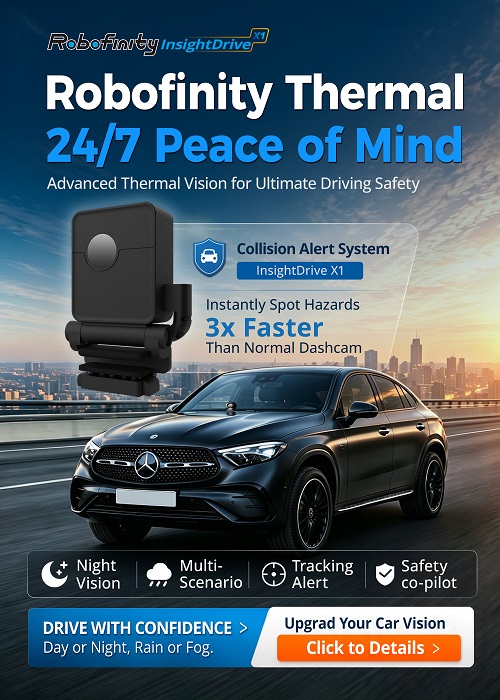
Advanced safety is not limited to factory-installed features. For drivers who frequently travel at night or on poorly lit rural roads, Robofinity InsightDrive is one example of a vehicle thermal imaging night vision system designed to support awareness of pedestrians, animals, vehicles, and obstacles in low-light conditions.
When a Dash Cam Is the Better Investment
A dash cam may be the more practical first purchase if your main concern is documentation rather than visibility.
Choose a dash cam first when you want to:
- Record collisions or near misses
- Protect yourself against disputed accounts of an incident
- Capture road signs and traffic signals
- Record changing lanes, braking, or unsafe maneuvers
- Monitor a vehicle while parked, if supported
- Review footage after a road event
- Add rear or cabin coverage
For many drivers, a dash cam provides broader everyday usefulness because it continuously documents normal road scenes. A thermal camera can be a more specialized upgrade for drivers whose routes and conditions create frequent low-light hazards.
Important Buying Considerations
If you are considering thermal imaging, do not judge the system only by its maximum detection distance or display appearance. Practical performance depends on installation, environment, and driver response.
Detection range
A longer range can provide more time to respond, but distance alone does not guarantee useful recognition. The system must present the alert clearly, and the driver must be able to understand whether the object is a pedestrian, animal, vehicle, or another heat source.
Ask whether the stated range refers to detection, recognition, or identification. These are different abilities. Detecting a warm shape is not the same as identifying its exact type or deciding how it will move.
Alert design
Alerts should support attention rather than create distraction. Consider whether warnings are visual, audible, or both, and whether they can become excessive in busy areas.
A system that alerts constantly may lead to warning fatigue. A system that provides no meaningful distinction between a nearby pedestrian and a distant object may also be difficult to use safely.
Camera placement
The camera should have a clear forward view without being blocked by wipers, trim, stickers, or a tinted area of the windshield. Poor placement can introduce reflections, vibration, or an obstructed field of view.
Installation should not interfere with airbags, driver visibility, vehicle controls, or the legal requirements that apply to windshield-mounted equipment in the relevant jurisdiction.
Weather and lens protection
An exterior camera may encounter water, dust, road salt, insects, and winter grime. Check the manufacturer’s stated protection information and plan for regular cleaning. A dirty lens can undermine both image quality and detection reliability.
Recording and storage
If recording matters, confirm how footage is stored and protected. Important factors include loop length, memory-card compatibility, event locking, overwrite behavior, and whether the files can be viewed on commonly available devices.
Power requirements
Some systems connect to a vehicle power outlet, while others may require hardwiring or a dedicated power-management arrangement. Installation should avoid draining the battery or creating unsafe wiring. Professional installation may be appropriate when the system connects to the vehicle’s electrical system.
For general background on how collision evidence is handled and why consistent documentation matters, see the U.S. NHTSA overview of crash investigation and research.
Thermal Camera Limitations Drivers Should Understand
Thermal imaging is powerful, but it is not a substitute for driving judgment.
It does not identify every hazard
Cold objects may be difficult for a thermal camera to distinguish from their surroundings. Road debris, potholes, low barriers, unoccupied bicycles, and some vehicles may not stand out in the same way as warm living objects.
It does not predict movement perfectly
A system may detect a pedestrian or animal, but it cannot guarantee that the driver will know what the object will do next. Wildlife can change direction suddenly, and pedestrians may step into the road without warning.
It does not replace headlights
Headlights illuminate the road, signs, markings, and objects ahead. Thermal imaging provides different information, not a replacement for proper lighting.
It does not replace mirrors or direct observation
A forward-facing thermal camera usually cannot cover every side or rear angle. Mirrors, shoulder checks, blind-spot awareness, and normal visual scanning remain essential.
It does not remove the need to slow down
If visibility is poor, speed should match the conditions. A warning is useful only if the driver has enough time and space to respond. Wet, icy, or crowded roads can make stopping difficult even when an object is detected early.
A Practical Decision Framework
Use the following questions to decide whether a thermal camera, dash cam, or combination system makes sense.
Choose a dash cam if:
- You primarily want incident evidence
- You drive mostly in well-lit urban areas
- You need visible road details such as signs and plates
- You want parking surveillance or rear-camera coverage
- Your budget allows only one device and documentation is the priority
Consider a thermal camera if:
- You regularly drive on dark rural roads
- Wildlife or pedestrians are difficult to see on your routes
- Fog, snow, rain, or glare frequently reduces visibility
- You want an additional hazard-awareness layer
- You understand that it complements, rather than replaces, normal driving practices
Consider a combined solution if:
- You need both early hazard awareness and recorded evidence
- You drive long distances in changing conditions
- You want one integrated display and camera arrangement
- The system clearly explains what it records and how files are stored
The right choice should reflect your actual driving environment, not simply the most advanced feature list. In a true thermal camera vs dash cam comparison, the deciding factor is usually whether you want early awareness, evidence recording, or both.
How to Use a Thermal Camera Safely
A thermal display should remain a support tool. Drivers should avoid staring at a secondary screen for extended periods or attempting to interpret complicated alerts while moving.
Before using the system on a regular journey:
- Position the camera and display so they do not obstruct the road view.
- Learn what different alerts and thermal shapes mean while parked.
- Adjust warning settings to reduce unnecessary distraction.
- Keep the lens clean.
- Continue using headlights, mirrors, and normal visual scanning.
- Reduce speed when visibility, road surface, or traffic conditions require it.
- Treat every alert as information that needs confirmation, not as an automatic instruction.
- Check local rules concerning windshield-mounted devices, recording, and audio.
Thermal camera night driving support can improve awareness, but the driver remains responsible for interpreting the road and controlling the vehicle.
Frequently Asked Questions
Is a thermal camera better than a dash cam at night?
It depends on the goal. A thermal camera may be better at highlighting warm pedestrians, animals, and vehicles in darkness or poor visibility. A dash cam is generally better at recording the visible road scene, including signs, lane markings, signals, and traffic events.
Can a thermal camera record a collision?
Some thermal imaging systems include video recording, but not all do. Even when recording is available, the footage may not provide the same visible detail as a conventional dash cam. Check the system’s recording mode, storage, time stamps, and file-protection features before relying on it for documentation.
Can thermal imaging see through fog or rain?
Thermal imaging may help maintain contrast in some foggy, rainy, or snowy conditions, particularly for warm objects. Performance varies with weather intensity, lens condition, distance, and the specific system. It does not provide perfect visibility through all weather.
Does a thermal camera replace headlights?
No. Headlights remain necessary for illuminating the road, signs, markings, and hazards. Thermal imaging supplies additional heat-based information and should not be used as a replacement for vehicle lighting.
Is a dash cam enough for rural night driving?
A dash cam can record rural night driving, but its low-light view may not highlight every pedestrian or animal early enough for comfortable hazard recognition. Drivers who frequently face unlit roads or wildlife may consider thermal imaging as an additional awareness tool.
What should I buy first: a dash cam or thermal camera?
For most drivers, a dash cam is the more broadly useful first purchase because it records incidents and ordinary traffic conditions. A thermal camera may be the better first choice when repeated night driving, rural roads, wildlife, or poor visibility create a specific hazard-awareness need.
Conclusion
A thermal camera generally cannot replace a dash cam because the two technologies perform different jobs. Thermal imaging can help reveal warm objects in darkness and poor visibility, while a dash cam provides conventional video evidence of the road and surrounding traffic.
For drivers who want incident documentation, a dash cam is usually the practical starting point. For those who regularly drive unlit rural roads, face wildlife hazards, or encounter fog and glare, a thermal camera may add valuable awareness. In a thermal camera vs dash cam decision, the best results often come from matching the device to your real driving risks—and, when possible, choosing a system that clearly documents events.
Whichever technology you choose, treat it as driver-assistance equipment rather than a substitute for headlights, mirrors, safe speed, braking distance, traffic laws, and attention. The best safety upgrade is the one that addresses your real driving conditions without encouraging overconfidence.