


SEO Title: Automotive Infrared Thermal Modules: How They Work and What Drivers Should Know
- What Is an Automotive Infrared Thermal Module?
- How Thermal Imaging Works in a Vehicle
- Thermal Imaging Versus Other Night-Vision Technologies
- Where a Thermal Module Can Help
- What a Thermal Module Cannot Do
- It does not replace headlights
- It does not see through every material
- It does not measure every object’s exact temperature
- It does not guarantee recognition
- It does not reduce braking distance
- Important Specifications to Evaluate
- Detection range and recognition range
- Resolution and field of view
- Frame rate and latency
- Operating environment
- Image processing and alerts
- Connectivity and compatibility
- Installation and Calibration Considerations
- Maintenance and Ownership Costs
- A Practical Buying Framework
- 1. Define the driving problem
- 2. Decide between a module and a complete system
- 3. Evaluate the whole information chain
- 4. Check installation feasibility
- 5. Review limitations and support
- Safe Use on the Road
- Frequently Asked Questions
- Can an automotive thermal camera see in complete darkness?
- Can a thermal module see through fog or heavy rain?
- Can it be mounted behind the windshield?
- Is thermal imaging better than a normal night-vision camera?
- Does thermal night vision automatically brake the vehicle?
- Is an aftermarket thermal system worthwhile?
- Conclusion
Meta Description: Learn how automotive infrared thermal modules detect heat, support nighttime road awareness, and identify pedestrians, animals, and vehicles, including their benefits, limitations, installation factors, and buying considerations.
An automotive infrared thermal module is a sensing unit that detects heat energy from people, animals, vehicles, and other objects, then converts that information into an image or data stream. In a vehicle, it can support driver awareness beyond the area clearly illuminated by the headlights. This makes the technology particularly relevant on dark rural roads, during low-light driving, and in some poor-visibility conditions.
For drivers, installers, and vehicle technology buyers, the important questions are practical: What can a thermal module actually detect? How is it different from a conventional night-vision camera? What components are needed for a usable system? And where are its limitations? Understanding those points is essential before choosing a factory-equipped vehicle, an aftermarket thermal imaging system, or an infrared module for a larger automotive project.
What Is an Automotive Infrared Thermal Module?
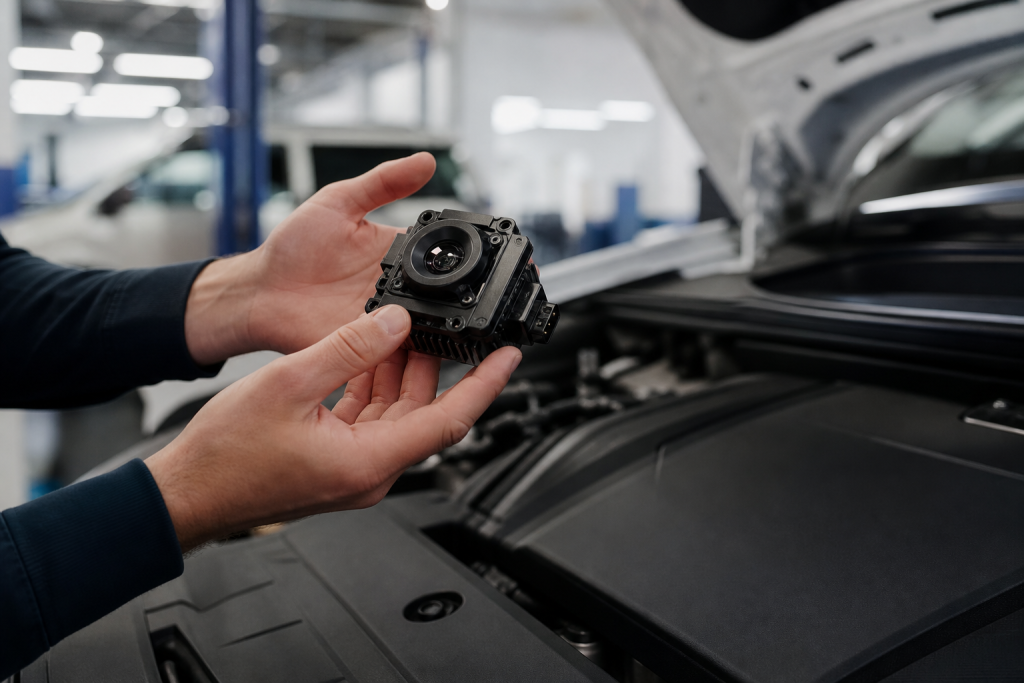
A thermal module is the core sensing and image-processing component of a vehicle thermal imaging system. Instead of depending primarily on visible light, it detects long-wave infrared energy emitted by objects according to their temperature and surface characteristics.
Warm subjects such as pedestrians and many animals may appear more distinct from a cooler background in the resulting thermal image. Engines, exhaust components, recently driven vehicles, road surfaces, buildings, and other objects can also produce recognizable heat patterns.
More EV News

The word “module” is important. A module may be only one part of a complete night-vision solution. Depending on the product, it can include:
- An infrared detector or sensor array
- A lens designed for the relevant infrared wavelength
- Image-processing electronics
- Video or digital data output
- A protective enclosure
- Calibration and temperature-compensation functions
- Software interfaces for detection or display integration
A complete driver-assistance system may add a dashboard screen, power supply, wiring, mounting hardware, recording capability, artificial intelligence, audible alerts, and recognition software. A bare module may not provide any of those user-facing features.
How Thermal Imaging Works in a Vehicle
Every object above absolute zero emits infrared radiation. An automotive thermal sensor measures differences in that emitted energy across a scene. Its processor converts those differences into an image that a person or machine-vision system can interpret.
This process does not produce an ordinary photograph. Thermal images represent temperature contrast rather than familiar colors, paint finishes, facial details, or road-sign lettering. Depending on the display mode, warmer areas may appear lighter, darker, or in false colors.
Passive thermal sensing
Most vehicle thermal imagers operate passively. They read infrared energy already emitted by the environment instead of projecting visible light onto the road. That allows them to function in darkness without relying on streetlights or headlight illumination.
Passive operation also means the image quality depends heavily on thermal contrast. A warm pedestrian against cool surroundings may be conspicuous. The same pedestrian can be harder to distinguish when the person, clothing, pavement, and background are at similar apparent temperatures.
From sensor data to a useful warning
The sensor’s raw output is only the beginning. Image processing may reduce noise, adjust contrast, compensate for detector variation, and sharpen relevant features. More advanced systems can analyze frames to classify pedestrians, animals, or vehicles and then issue visual or audible alerts.
Recognition is not infallible. A system may miss a partly hidden subject, classify an object incorrectly, or provide a warning later than expected. Thermal detection should therefore be understood as an additional layer of road awareness, not an automated guarantee that every hazard will be identified.
Thermal Imaging Versus Other Night-Vision Technologies
“Night vision” is a broad term. Automotive systems can use thermal infrared sensing, near-infrared illumination, visible-light cameras, or combinations of multiple sensors. Their capabilities are not interchangeable.
Thermal infrared cameras
Thermal cameras detect emitted heat energy. Their principal advantage is that they can reveal heat-producing subjects without visible illumination. They can be especially useful for distinguishing pedestrians or animals on an unlit road.
Their disadvantages include reduced visual detail, difficulty reading signs or lane markings, sensitivity to thermal conditions, and generally higher system complexity than a basic visible-light camera.
Near-infrared systems
Near-infrared systems commonly illuminate the scene with infrared light and capture the reflected energy using a compatible camera. They can provide an image that looks more like monochrome video, often with clearer road and object detail.
However, they rely on reflected illumination rather than the heat emitted by a subject. Their performance can be affected by range, reflectivity, glare, and environmental conditions.
Low-light visible cameras
A sensitive visible-light camera can produce a familiar view and may show signs, lane markings, and colors more naturally. It is often useful in twilight or areas with some ambient lighting.
In near-total darkness, however, a visible camera needs sufficient light from headlights, streetlights, or an auxiliary illuminator. Bright oncoming lights may also challenge exposure and dynamic range.
Sensor fusion
Some advanced vehicle systems combine thermal, visible-light, radar, lidar, or ultrasonic data. This approach can provide complementary information: a thermal sensor may highlight a warm road user, while a visible camera supplies contextual detail and radar estimates distance or relative motion.
Sensor fusion can improve the quality of a driver-assistance function, but it also raises cost, calibration demands, software complexity, and repair requirements. More sensors do not automatically make a system dependable unless the information is processed and presented effectively.
Where a Thermal Module Can Help
The clearest use case is detecting warm objects in situations where visible detail is limited. Its practical value depends on the road, weather, speed, mounting position, and display design.
Dark rural roads
Rural routes may have no street lighting, narrow shoulders, and frequent wildlife activity. Headlights illuminate only a defined portion of the road, and bends or elevation changes can reduce the useful sight line. A thermal imaging system may reveal a pedestrian or animal as a distinct heat signature, potentially supporting earlier awareness.
A detection on the display is useful only if the driver has enough time and distance to understand it and react safely. Speed should always be appropriate for the visible road, regardless of the sensor’s stated detection capability.
City streets at night
Urban environments contain more heat sources and visual clutter. Parked cars, ventilation outlets, buildings, buses, cyclists, pedestrians, and reflective surfaces can all appear in the scene.
Thermal imaging may still help identify a person near the roadway, particularly when dark clothing blends into a poorly lit background. At the same time, crowded scenes place greater demands on recognition software and alert design. Too many warnings can distract a driver or lead to alert fatigue.
Highways and long trips
On highways, thermal sensing may support awareness of stopped vehicles, people outside a disabled car, or animals near the carriageway. Yet highway speeds sharply reduce reaction time. A thermal display cannot justify driving faster than the headlights, road layout, traffic, and stopping distance safely allow.
For long-distance driving, fatigue is a separate and significant concern. An infrared system does not replace rest breaks, attentive driving, or responsible decisions about whether to continue a journey.
Fog, rain, and snow
Thermal imaging can sometimes retain useful contrast where a visible camera struggles with darkness or headlight glare. It should not be described as seeing perfectly through bad weather, however. Water droplets, snow, dense fog, spray, contamination on the lens, and temperature conditions can attenuate or obscure infrared information.
The practical question is not whether a system “works in fog,” but how much useful detection performance remains in the specific density, temperature, precipitation, and road environment encountered.
What a Thermal Module Cannot Do
A balanced buying decision starts with understanding what the technology does not replace.
It does not replace headlights
Thermal images generally do not show road color, markings, signs, surface damage, or debris with the same familiarity as a visible scene. Legal, correctly aimed, and properly maintained headlights remain essential.
It does not see through every material
Thermal cameras detect infrared energy reaching the sensor. Standard automotive glass typically obstructs the long-wave infrared wavelengths used by many thermal imagers, which is why external mounting is often necessary. Solid barriers, dense vegetation, walls, and vehicle body panels can also conceal a person or animal.
It does not measure every object’s exact temperature
A displayed thermal image can be affected by emissivity, reflections, distance, atmospheric conditions, sensor calibration, and surface properties. A driver-assistance module intended for detection is not necessarily a precision temperature-measurement instrument.
It does not guarantee recognition
A thermal shape can be ambiguous. Partial obstruction, unusual posture, small image size, background similarity, or rapid movement may make classification difficult. Even an AI-assisted system can produce false positives or false negatives.
It does not reduce braking distance
Seeing a possible hazard earlier can support decision-making, but the vehicle still needs adequate distance to slow or stop. Tire condition, road surface, weather, speed, brakes, vehicle load, and driver reaction all remain decisive.
Important Specifications to Evaluate
Specification sheets can be difficult to compare because manufacturers may describe performance under different conditions. Focus on characteristics that affect the complete driving experience rather than one headline number.
Detection range and recognition range
Detection, recognition, and identification are different concepts. A sensor may detect that something is present at a greater distance than it can classify that object as a pedestrian or animal. Confirm what a quoted distance means and under what conditions it applies.
Also consider whether the screen or warning interface makes a distant target usable. A technically detectable heat signature may be too small or unclear for a driver to interpret without software assistance.
Resolution and field of view
Higher sensor resolution can preserve more scene detail and provide more pixels on a distant target. Field of view determines how much of the road and roadside the camera captures.
A wide field of view helps cover shoulders, junctions, and nearby hazards but makes distant objects occupy fewer pixels. A narrower view can improve long-range detail while missing subjects approaching from the sides. The best balance depends on the intended road environment.
Frame rate and latency
Frame rate affects how smoothly motion appears. System latency includes sensor capture, processing, recognition, and display delay. For a moving vehicle, low latency is critical because the road scene changes continuously.
A high frame rate alone does not prove that alerts are timely. Buyers should consider the performance of the complete processing and display chain.
Operating environment
An external camera must tolerate temperature changes, vibration, road spray, dust, rain, snow, washing, and seasonal exposure. Review the stated operating-temperature range and enclosure protection, but do not assume an environmental rating covers every installation or cleaning method.
The position of the camera matters as much as its enclosure. A protected location may reduce direct impacts but could restrict the field of view or collect dirt.
Image processing and alerts
Contrast enhancement can make a thermal feed easier to read. Object recognition and real-time alerts may further reduce the need to study a secondary screen. The warning strategy should be noticeable without becoming intrusive.
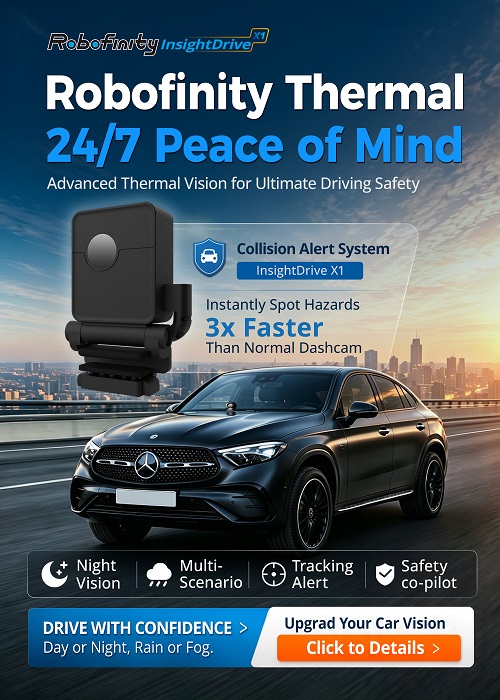
Robofinity InsightDrive is one example of a thermal night-vision system that combines AI-powered thermal imaging with recognition of pedestrians, animals, and vehicles. Such recognition can support awareness, but alerts should still be treated as driver-assistance information rather than confirmation that the road is clear.
Connectivity and compatibility
A module intended for engineering integration may output raw data through a specialized interface. A consumer system may use a dedicated screen and self-contained wiring. Before purchasing, establish whether the product is:
- A sensor core for developers
- A camera module with video output
- A complete aftermarket display system
- A component intended only for a specific vehicle platform
Electrical compatibility, software support, video format, power requirements, and mounting provisions all matter. A low-cost module can become an expensive project if it requires custom electronics and software to function.
Installation and Calibration Considerations
Installation quality can determine whether a capable sensor produces useful or misleading information.
Camera placement
The module needs a clear forward view with minimal obstruction. Mounting too low may increase contamination and road-spray exposure. Mounting too high or too far off-center can make the displayed perspective less intuitive.
Because long-wave thermal energy generally does not pass effectively through a normal windshield, placing a compatible thermal camera behind the glass may severely limit its function. The manufacturer’s mounting guidance should take priority.
Alignment
The thermal image should correspond predictably to the road ahead. If the system uses detection zones, tracking overlays, or warning boundaries, camera alignment can be essential. Changes to the bumper, grille, ride height, suspension, or mounting bracket may affect that alignment.
Some installations can be completed using product-specific instructions, while systems tied into vehicle electronics or requiring calibration are better handled by a qualified installer.
Screen placement
A dashboard display should be visible with minimal eye movement but must not block the driver’s view or interfere with controls and airbags. Brightness should be adjustable so the screen does not impair dark adaptation at night.
Local rules concerning windshield and dashboard-mounted devices vary. Owners should verify applicable requirements before selecting a mounting position.
Wiring and power
Wiring should be fused correctly, protected from abrasion and heat, and routed away from moving components. Exterior penetrations must be sealed appropriately. An installation should not compromise crash structures, airbag wiring, cooling airflow, or factory sensor operation.
Modern vehicles can have sensitive electrical architectures. Connecting an accessory without understanding the circuit may cause battery drain, electrical faults, or interference with other systems.
Maintenance and Ownership Costs
Thermal systems typically require less routine mechanical attention than moving components, but they are not maintenance-free.
Inspect and clean the camera window using the method approved for its material and coating. Mud, salt, insects, ice, road film, or water droplets can degrade the image. Avoid assuming that a household glass cleaner or abrasive cloth is safe for an infrared lens window.
Periodically check:
- Image clarity and contrast
- Camera alignment
- Mounting-bracket security
- Cable condition
- Warning and alert operation
- Condensation or water ingress
- Display brightness controls
- Software or firmware guidance from the manufacturer
Owners should also consider repairability. An exposed camera may be vulnerable to parking damage, stones, or minor impacts. Ask whether the camera, display, bracket, and cable can be replaced separately and whether recalibration is required after repair.
A Practical Buying Framework
A suitable system is not necessarily the one with the longest advertised range or the most features. Use a needs-based process.
1. Define the driving problem
Start with the conditions that create the most concern. A rural commuter may prioritize animal and pedestrian awareness. A city driver may need broad coverage and carefully managed alerts. A vehicle fleet may care about integration, durability, and serviceability.
If most travel occurs on well-lit urban roads, the practical benefit may be smaller than it would be for frequent overnight trips on unlit routes.
2. Decide between a module and a complete system
Choose a standalone module only if the project has the required expertise, processing hardware, display interface, software, enclosure, and calibration plan. Most drivers seeking an aftermarket safety upgrade will be better served by a complete automotive system designed for installation and regular road use.
3. Evaluate the whole information chain
Ask how the system progresses from sensing to action:
- What does the camera detect?
- How is the image processed?
- Can it classify relevant hazards?
- How does it notify the driver?
- Is the warning early and clear enough to be useful?
- What happens when visibility or thermal contrast deteriorates?
This method is more informative than comparing sensor resolution alone.
4. Check installation feasibility
Inspect the proposed camera and display locations before buying. Confirm vehicle compatibility, wiring access, power needs, bracket fit, and whether professional calibration is required.
For leased vehicles, warranty-sensitive modifications, or vehicles with dense factory sensor packages, clarify the implications of mounting and electrical changes first.
5. Review limitations and support
Reliable product information should explain operating boundaries rather than promise universal detection. Look for clear documentation, installation instructions, environmental limits, interface details, update procedures, and support options.
Avoid treating promotional footage as proof of performance in every season, road type, speed, or weather condition.
Safe Use on the Road
Thermal imaging works best as a supplementary channel of information. The driver’s primary attention should remain on the road, mirrors, traffic, and vehicle controls.
Avoid staring continuously at a secondary display. If the system provides alerts, learn their meaning while parked and set the display to an appropriate nighttime brightness. When an uncertain thermal object appears, reduce speed smoothly if conditions allow and prepare for a developing hazard rather than making an abrupt maneuver based only on the screen.
Continue to maintain the fundamentals:
- Use properly aimed headlights
- Keep the windshield, mirrors, lamps, and camera clean
- Maintain a safe following distance
- Match speed to the distance that is genuinely visible
- Allow more braking distance in rain, snow, or ice
- Take fatigue seriously
- Follow traffic laws and local equipment requirements
A thermal module can support road awareness, but it does not transfer responsibility from the driver to the technology.
Frequently Asked Questions
Can an automotive thermal camera see in complete darkness?
Yes, a passive thermal camera can produce an image without visible light because it detects emitted infrared energy. Its effectiveness still depends on thermal contrast, distance, weather, obstructions, sensor quality, and image processing.
Can a thermal module see through fog or heavy rain?
It may retain useful information in some poor-visibility conditions, but it cannot see perfectly through dense fog, heavy precipitation, road spray, or snow. Moisture in the atmosphere and on the camera window can reduce range and image clarity.
Can it be mounted behind the windshield?
Many long-wave infrared thermal cameras cannot operate effectively through standard automotive glass because the glass blocks the relevant infrared energy. An externally mounted camera with a suitable protective window is commonly required. Follow the specific manufacturer’s instructions.
Is thermal imaging better than a normal night-vision camera?
Neither is universally better. Thermal imaging is strong at revealing heat-producing subjects in darkness, while visible or near-infrared cameras may provide more familiar road, sign, and lane detail. The right choice depends on whether the priority is hazard detection, contextual detail, or a combination of both.
Does thermal night vision automatically brake the vehicle?
A thermal sensor does not automatically imply braking capability. Some factory systems may share information with broader driver-assistance functions, while many aftermarket systems only display video or provide alerts. Confirm the exact system behavior and never assume an alert device can control the vehicle.
Is an aftermarket thermal system worthwhile?
It can be a practical upgrade for drivers who frequently use dark rural roads, encounter wildlife, travel overnight, or operate in low-light environments. Its value depends on installation quality, detection performance, alert design, local conditions, and realistic expectations. Occasional daytime drivers may gain less benefit.
Conclusion
An automotive thermal module can extend a vehicle’s sensing capability beyond what visible-light cameras and headlights alone provide, particularly when a warm pedestrian, animal, or vehicle contrasts with dark surroundings. Its usefulness comes from earlier awareness, not from replacing the driver’s vision or judgment.
Before selecting a module or complete system, define the road conditions you need to address, distinguish detection from reliable recognition, check environmental durability, and evaluate the entire path from camera to warning. Installation position, calibration, display ergonomics, and maintenance deserve as much attention as sensor specifications.
Used responsibly, thermal imaging can be a valuable layer of vehicle safety technology. The sound decision is the system that fits the vehicle and driving environment while preserving the basics: attentive driving, appropriate speed, effective headlights, adequate braking distance, and clear understanding of the technology’s limits.