

- Table of Contents
- Long Road Trip Safety Starts With Fundamental Systems
- Tires Are the Foundation of Road-Trip Safety
- Brakes Need More Than a Warning-Light Check
- Visibility Features Matter in Every Season
- Driver-Assistance Features That Help on Long Journeys
- Automatic Emergency Braking
- Blind-Spot Monitoring
- Lane-Departure Warning and Lane-Keeping Assistance
- Adaptive Cruise Control
- Driver-Monitoring and Fatigue Alerts
- Improving Awareness During Night and Rural Driving
- Load Security Is a Frequently Overlooked Safety Feature
- Emergency Equipment for Delays and Breakdowns
- Build a Pre-Departure Safety Routine
- Match Features to the Trip You Are Taking
- Frequently Asked Questions
- What is the most important feature for long road trip safety?
- Should I have my car inspected before a long journey?
- Is adaptive cruise control safe to use on a road trip?
- How often should drivers stop on a long trip?
- What should I do if a dashboard warning light appears during the trip?
- Can driver-assistance systems replace careful driving at night?
- Long Road Trip Safety Requires a Prepared Vehicle and Driver
Long Road Trip Safety depends on more than airbags and seat belts. Reliable tires, effective brakes, stability control, clear lighting, driver-assistance technology, and emergency equipment all contribute to safer travel. Drivers also need to understand what these systems can and cannot do. A well-equipped vehicle supports good decisions, but it does not replace rest, attention, sensible speed, or adequate following distance.
This long road trip safety guide explains which features matter most, how to check them before departure, and how to prioritize practical upgrades for highway driving, rural roads, nighttime travel, and poor weather.
Table of Contents

Long Road Trip Safety Starts With Fundamental Systems
Modern convenience features are useful, but the most important long road trip safety protections are still the systems that help occupants survive a crash or help the driver maintain control.
Seat Belts and Airbags
Every seating position should have an accessible, functioning seat belt. As part of a long road trip safety check, confirm that each belt extends and retracts smoothly, locks when pulled sharply, and is not twisted or visibly damaged. Passengers should wear belts throughout the journey, including while sleeping.
Airbags work with seat belts rather than replacing them. Drivers and front passengers should sit upright with their belts properly positioned. Avoid placing feet on the dashboard, where an inflating airbag could cause severe injury.
Children need a restraint appropriate for their age, size, and the rules in the area where the vehicle is being used. The child seat must also be installed correctly. On a multi-country European journey or a trip across US state lines, check the applicable child-restraint requirements before departure rather than assuming the rules are identical everywhere.
More EV News

Do not place luggage, electronic devices, or accessories over airbag covers. Dashboard mounts and other additions should be positioned where they cannot interfere with airbag deployment or become dangerous projectiles.
Anti-Lock Brakes
An anti-lock braking system, commonly called ABS, helps prevent the wheels from locking during hard braking. This can allow the driver to retain steering control while slowing down, making a functioning ABS an important part of long road trip safety. Performance still depends on tire condition, road grip, and speed.
If the ABS warning light remains illuminated after the engine starts, the anti-lock function may be unavailable even if conventional braking still works. Have the fault diagnosed before a major trip. Drivers should not attempt to compensate for a warning light by assuming they can simply brake more carefully over hundreds of miles.
Electronic Stability Control
Electronic stability control can selectively brake individual wheels and reduce engine power when it detects that the vehicle is moving away from the driver’s intended path. For long road trip safety, it is particularly valuable during abrupt avoidance maneuvers, slippery cornering, and sudden lane changes.
The system cannot overcome the laws of physics. Entering a wet or icy bend too quickly can exceed the available tire grip regardless of the technology fitted. A stability-control warning light that stays on may indicate a fault requiring professional inspection.
Traction Control
Traction control reduces excessive wheelspin during acceleration. It can help when joining traffic on wet roads, climbing slippery gradients, or moving on loose surfaces.
Some vehicles allow the system to be temporarily disabled, which can occasionally help when trying to move out of deep snow or loose material. For normal road travel, however, it should generally remain active.
Tires Are the Foundation of Road-Trip Safety
Every braking, steering, and stability system ultimately depends on four small contact patches between the tires and the road. Long road trip safety therefore begins with tires that are correctly inflated and free from excessive wear or damage. Advanced electronics cannot restore grip that poor tires do not provide.
For better long road trip safety, check tire pressure when the tires are cold and use the vehicle manufacturer’s recommended figures. These are normally listed in the owner’s manual or on a label inside a door opening or fuel-filler area. Do not use the maximum pressure printed on the tire sidewall as the routine inflation target. The National Highway Traffic Safety Administration’s tire safety guidance provides additional information about pressure, tread, aging, and recalls.
Long trips often involve more passengers and luggage than everyday driving. Some manufacturers specify different pressures for a heavily loaded vehicle. Follow the relevant loaded-vehicle guidance, then adjust the pressures again after returning to normal use.
Inspect all tires for:
- Tread wear across the full width
- Cuts, cracks, bulges, or exposed material
- Embedded objects
- Uneven wear on the inner or outer edges
- Damage around the sidewall or wheel rim
- Age-related deterioration
- A missing or damaged valve cap
Tread must meet the legal minimum in every jurisdiction on the route, but legality is only a baseline. A tire close to its limit may provide noticeably less confidence in heavy rain because it cannot clear water as effectively as a tire with greater tread depth.
A complete long road trip safety inspection includes the spare tire. If the vehicle uses a puncture-repair kit, confirm that the sealant has not expired and that the compressor works. Repair kits may not fix sidewall damage, large punctures, or a tire that has been driven while flat. Make sure roadside-assistance contact details are available before entering remote areas.
A tire-pressure monitoring system can warn of significant pressure loss, but it is not a substitute for manual inspection. Some systems only alert the driver after pressure has fallen substantially, and they may not identify cuts, bulges, or tread problems.
Brakes Need More Than a Warning-Light Check
Reliable braking is central to long road trip safety. A pre-trip assessment should consider how the vehicle feels and sounds, not only whether a dashboard light is present.
Warning signs include:
- Grinding, scraping, or persistent squealing
- Vibration through the pedal or steering wheel
- A soft, unusually firm, or sinking brake pedal
- The vehicle pulling to one side under braking
- Increased stopping distance
- A brake or stability-control warning light
- Visible fluid beneath the vehicle
Mountain routes create an additional long road trip safety concern because repeated braking on descents can generate substantial heat. Select an appropriate lower gear where necessary so the engine helps control speed. Do not ride the brake pedal continuously. If braking performance changes, stop in a safe place and allow the system to cool, then seek assistance if the problem continues.
Brake fluid, pads, discs, drums, and related components should be inspected according to the manufacturer’s schedule. If the journey will include steep terrain, towing, or a heavily loaded vehicle, arranging an inspection before departure is sensible when the brakes are already due for service or showing symptoms.
Visibility Features Matter in Every Season
Clear vision is a basic long road trip safety requirement, not a comfort feature. A dirty windshield, worn wiper blades, weak headlights, or an ineffective demister can turn ordinary rain or darkness into a serious hazard.
Headlights, Taillights, and Signals
Include exterior lighting in every long road trip safety inspection. Walk around the vehicle and test low beams, high beams, brake lights, taillights, turn signals, hazard lights, reversing lights, and fog lights where fitted. Clean the lenses, cameras, radar covers, and reflectors without using products that may damage their surfaces.
Headlight aim also matters. Lamps set too low restrict the visible road ahead, while lamps set too high can dazzle other drivers. A heavily loaded rear cargo area can alter the vehicle’s angle and raise the apparent beam direction. Use the headlight-level control if the vehicle has one, or have the alignment checked professionally.
Automatic headlights are convenient, but drivers should understand their limitations. Some systems may not activate the full lighting required in rain, fog, or unusual daytime darkness. Confirm the actual light setting instead of relying entirely on the dashboard display.
Wipers, Washers, and Demisting
Working wipers and washers support long road trip safety in every season. Replace blades that smear, chatter, skip, or leave uncleared areas. Fill the washer reservoir with a suitable seasonal fluid, especially when freezing temperatures are possible. Plain water may freeze and can be ineffective against road film.
Test the front and rear demisting systems before departure. Air-conditioning can help remove moisture from cabin air even when heat is being used. Keep the inside of the glass clean because residue can worsen glare from oncoming headlights.
Mirrors and Camera Systems
Adjust mirrors after the driver’s seat has been set. Rear-view cameras and surround-view systems help at low speed, but their lenses can become obscured by rain, snow, mud, or road salt.
A camera also has a limited field of view and may distort distance. Continue using mirrors and direct observation rather than treating the display as a complete view of the surroundings.
Driver-Assistance Features That Help on Long Journeys
Driver-assistance technology can support long road trip safety by reducing workload and providing useful warnings, particularly during extended highway travel. Its value depends on correct use and a realistic understanding of its operating limits.
Automatic Emergency Braking
Automatic emergency braking may improve long road trip safety by warning the driver of an imminent conflict and, in some situations, applying the brakes if the driver does not respond in time. Detection capabilities vary by vehicle, speed, weather, lighting, object type, and system design.
The feature should be considered a backup layer. It does not justify following more closely, looking away from the road, or delaying a braking response. Cameras and sensors must also remain clean and unobstructed.
Blind-Spot Monitoring
Blind-spot monitoring adds useful information for long road trip safety, especially during repeated highway lane changes. It can alert the driver to a vehicle in an adjacent area that may be difficult to see in the mirrors, but it does not remove the need for a shoulder check.
Motorcycles, fast-approaching vehicles, narrow road users, and vehicles two lanes away can be difficult for some systems to interpret. Treat the warning indicator as additional information, not permission to move.
Lane-Departure Warning and Lane-Keeping Assistance
Lane-departure warning detects unintended movement toward lane markings, while lane-keeping assistance may apply steering input to help the vehicle remain in its lane. Both can contribute to long road trip safety when road markings and sensor conditions are suitable.
These systems can struggle with faded markings, roadworks, snow, standing water, sharp curves, or strong glare. They also do not determine whether a lane change is safe. The driver must remain in control and keep both attention and steering responsibility focused on the road.
Repeated lane warnings may indicate fatigue, distraction, or poor lane discipline. They should not be dismissed as an annoyance. If maintaining position becomes difficult, stop at a safe location and rest.
Adaptive Cruise Control
Adaptive cruise control can aid long road trip safety by maintaining a selected speed while adjusting the gap to traffic ahead. On open highways, it can reduce the need for frequent accelerator inputs.
It may not respond appropriately to every situation, including stationary traffic, vehicles cutting in closely, tight bends, toll areas, roadworks, or severe weather. The driver must be ready to brake and should increase the selected following gap in rain or other low-grip conditions.
Driver-Monitoring and Fatigue Alerts
Some vehicles analyze steering behavior, eye movement, or other indicators to identify possible fatigue or inattention. These alerts may support long road trip safety, but the absence of a warning does not mean the driver is fit to continue.
Drowsiness can develop before a system recognizes it. Heavy eyelids, repeated yawning, missed signs, wandering thoughts, poor lane position, and difficulty recalling the previous few miles are reasons to stop. Fresh air, loud music, or an open window is not a reliable remedy for fatigue.
Improving Awareness During Night and Rural Driving
Nighttime long road trip safety requires extra attention because darkness brings reduced contrast, glare, fewer visual reference points, and a greater chance of encountering animals or pedestrians on poorly lit roads. Reduce speed to match the area illuminated by the headlights and avoid driving so fast that stopping safely within the visible distance becomes impossible.
Keep instrument lighting low enough to preserve forward vision without making the controls difficult to read. Look toward the edge of your lane rather than directly into intense oncoming headlights while continuing to monitor road position. Review these additional night highway driving safety practices before a route that includes extended driving after dark.
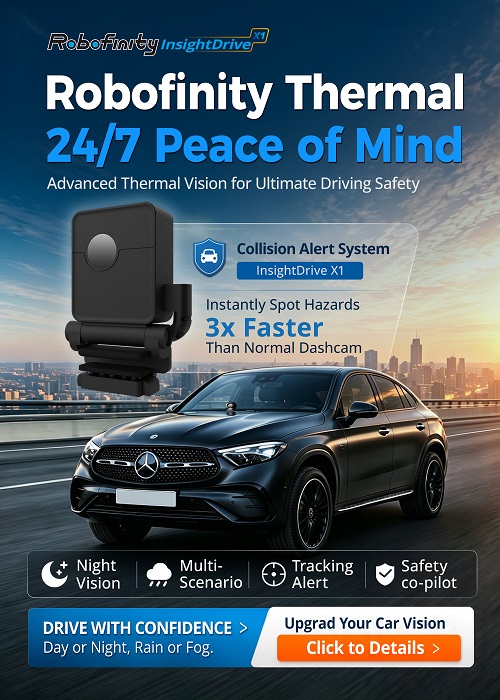
Drivers who frequently use dark rural roads may consider an aftermarket awareness aid. Robofinity InsightDrive is an example of a vehicle thermal night vision system that uses AI-powered thermal imaging to support awareness in low-light and poor-visibility conditions. For long road trip safety, this technology should supplement properly maintained headlights, mirrors, safe speed, adequate braking distance, and continuous driver attention.
No display should become a new source of distraction. Any aftermarket screen or device must be mounted securely, positioned without blocking the driver’s view, and used in accordance with applicable local rules.
Load Security Is a Frequently Overlooked Safety Feature
Secure cargo is essential to long road trip safety because loose items can change the vehicle’s handling or become hazardous during emergency braking. Place heavy items low and as far forward in the cargo area as practical. Use tie-down points for bulky objects, and do not stack luggage above the rear seatbacks unless a suitable barrier or restraint system is fitted.
Never exceed the vehicle’s payload, axle, roof-load, or towing limits. Payload includes people, luggage, accessories, and trailer nose or tongue weight where applicable. Excess weight can affect braking distance, steering response, tire temperature, and suspension behavior.
Roof boxes and racks should be installed according to their instructions. Confirm that all fasteners are secure after the first part of the journey. Remember that roof loads raise the vehicle’s center of gravity and may increase sensitivity to crosswinds.
Keep warning triangles, reflective clothing, a flashlight, first-aid supplies, and other emergency items accessible. Equipment buried under a full cargo area may be difficult to reach when it is most needed.
Emergency Equipment for Delays and Breakdowns
A suitable emergency kit strengthens long road trip safety when weather, traffic, or mechanical problems cause a delay. The exact contents should reflect the route, passengers, climate, and local requirements. A basic long-trip setup may include:
- First-aid supplies
- A charged flashlight and spare batteries
- Reflective vests or high-visibility clothing
- Warning triangles or other legally appropriate warning devices
- A phone charging cable and backup power bank
- Drinking water and nonperishable food
- A warm layer or blanket
- Essential medications
- Basic tools suitable for the vehicle
- Work gloves
- An ice scraper and seasonal supplies
- Roadside-assistance and insurance details
- A paper record of important phone numbers
Check the legal requirements for each country or region on the route. Required equipment can vary, particularly for warning devices, winter tires, snow chains, reflective clothing, and emergency-lane procedures.
If the vehicle breaks down, personal safety comes before repair attempts. Move away from live traffic when possible, use hazard lights and approved warning equipment, and follow local guidance about whether occupants should remain inside or leave the vehicle. On high-speed roads, call the relevant emergency or roadside service when the location is exposed.
Build a Pre-Departure Safety Routine
A consistent inspection is one of the most practical long road trip safety measures. Divide the work by timing so there is enough time to repair faults before departure.
One to Two Weeks Before Departure
Begin the long road trip safety inspection early enough to address discovered problems. Check the tires, brakes, battery condition, fluid levels, exterior lights, wipers, climate control, and spare-wheel or repair equipment. Verify that scheduled maintenance will not become due midway through the journey.
This is also the time to inspect child seats, roof racks, towing equipment, and trailer connections. Test the trailer lights and confirm that the combined load remains within the relevant limits.
The Day Before
Complete the final long road trip safety checks by filling the washer reservoir, checking cold tire pressures, cleaning the windows and lights, organizing emergency supplies, and securing the luggage. Download maps for areas with unreliable mobile coverage and review fuel or charging options along remote sections.
For an electric vehicle, plan charging stops with a reserve for weather, elevation, detours, and unavailable chargers. For any vehicle, avoid waiting until the range is nearly exhausted before looking for fuel or energy in unfamiliar areas.
During the Journey
Continue monitoring long road trip safety at each rest stop by walking around the vehicle. Look for a soft tire, loose cargo equipment, fluid leaks, unusual smells, or lights obstructed by dirt. After driving through snow, slush, mud, or heavy rain, inspect cameras and sensors when it is safe to do so.
Pay attention to changes in steering, vibration, braking, engine temperature, and warning lights. A small symptom is easier to address at a service area than after it becomes a breakdown on an isolated road.
Match Features to the Trip You Are Taking
Effective long road trip safety planning reflects the actual route rather than relying on the same checklist for every journey. Prioritize equipment and preparation according to the conditions you expect.
For predominantly high-speed motorway or interstate travel, adaptive cruise control, blind-spot monitoring, stable tire condition, and fatigue management are especially relevant.
For rural travel, reliable high and low beams, animal awareness, offline navigation, fuel planning, and communication backups deserve more attention.
For mountain roads, brake condition, appropriate tires, engine braking, coolant condition, and load control become critical.
For winter trips, suitable seasonal tires, functioning demisters, cold-weather washer fluid, warm clothing, a scraper, and route-specific traction equipment may matter more than convenience technology.
For family travel, correctly installed child restraints, accessible food and water, secured luggage, planned breaks, and control of cabin distractions should be part of the safety plan.
The best long road trip safety package is not simply the longest feature list. It combines sound mechanical condition, useful technology, appropriate equipment, and preparation for the actual conditions ahead.
Frequently Asked Questions
What is the most important feature for long road trip safety?
No single feature can address every long road trip safety risk. Properly used seat belts, sound tires, effective brakes, stability control, and an alert driver form the essential foundation. Driver-assistance systems add support but cannot compensate for poor maintenance or fatigue.
Should I have my car inspected before a long journey?
An inspection is advisable if the vehicle is due for service, has warning lights, shows unusual symptoms, has aging tires, or will face heavy loads, towing, mountains, or extreme weather. A well-maintained vehicle may only need the manufacturer’s recommended pre-trip checks.
Is adaptive cruise control safe to use on a road trip?
It can reduce workload on suitable roads, but the driver must remain attentive and ready to brake. It may be less appropriate in severe weather, complicated roadworks, dense merging traffic, or situations where sensors cannot operate reliably.
How often should drivers stop on a long trip?
Breaks should be frequent enough to prevent discomfort and loss of concentration, but no fixed interval is appropriate for every person. Stop sooner when drowsiness, stiffness, reduced attention, or poor lane control appears. Do not use a schedule as permission to continue while tired.
What should I do if a dashboard warning light appears during the trip?
Identify the light using the owner’s manual and respond according to its urgency. Red warnings commonly require prompt attention and may mean the vehicle should be stopped safely. Continuing to drive with an oil-pressure, overheating, brake, or other serious warning can create additional danger or damage.
Can driver-assistance systems replace careful driving at night?
No. Assistance systems may improve road awareness, but they do not replace clean and correctly aimed headlights, appropriate speed, clear windows, safe following distance, mirrors, traffic-law compliance, or an attentive driver.
Long Road Trip Safety Requires a Prepared Vehicle and Driver
A strong long road trip safety plan begins with healthy tires, dependable brakes, clear visibility, working restraints, secured cargo, and suitable emergency equipment. Driver-assistance features can provide valuable warnings and reduce workload, but only when their limits are understood.
Before departure, match long road trip safety preparations to the route, expected weather, passenger needs, and driving schedule. Resolve warning lights and mechanical symptoms early, plan realistic rest stops, and leave enough flexibility to slow down or pause when conditions deteriorate. That combination of maintenance, technology, and disciplined driving provides a stronger safety margin than any single feature can offer.