


Avoiding used car buying mistakes can save money, reduce stress, and protect you from hidden damage, neglected maintenance, unclear paperwork, or an unsuitable vehicle. A used car may provide better equipment and lower depreciation than a new model, but only when you evaluate the condition, history, price, and ownership costs carefully.
- Table of Contents
- How used car buying mistakes Begin Before the Search
- Set a Budget Based on Total Ownership Cost
- Treat a Low Price as a Question, Not an Opportunity
- Verify the Seller and Vehicle Identity
- Check the Vehicle History Without Treating It as Complete
- Inspect the Car in Daylight and on Dry Ground
- Examine the Tires and Wheels
- Check Fluids, Leaks, and the Engine Bay
- Inspect the Cabin for Wear and Water Damage
- Do Not Ignore Dashboard Warning Lights
- Conduct a Test Drive That Reflects Real Use
- Arrange an Independent Pre-Purchase Inspection
- Evaluate Safety Equipment, Visibility, and Modifications
- Read the Paperwork Before Paying
- Negotiate With Evidence, Not Emotion
- Recognize When Walking Away Is the Best Decision
- A Practical Final Checklist
- Frequently Asked Questions
- What used car buying mistakes are most common?
- Is a vehicle history report enough?
- Should I buy a high-mileage used car?
- Can I inspect a used car myself?
- What should I do if the seller will not allow an inspection?
- Is buying from a dealer safer than buying privately?
- Avoid used car buying mistakes by Deciding on Evidence
Most used car buying mistakes happen when buyers rush or rely on one reassuring detail. The safer strategy is to define your requirements, calculate the full ownership cost, investigate the vehicle history, inspect and test-drive it carefully, arrange an independent mechanical inspection, and verify every document before paying. Buyers still deciding between vehicle types may also find this comparison of a new car versus a used car helpful.
Table of Contents
How used car buying mistakes Begin Before the Search
One of the most common errors happens before a buyer sees the first vehicle: choosing according to aspiration rather than actual use. Start with the journeys the car must handle. A compact hatchback may work well for city traffic and limited parking, while a family carrying children, luggage, or mobility equipment may need more rear-seat space and easier access.
Regular motorway or highway travel makes seat comfort, cabin noise, fuel economy, and driver-assistance technology more important. Rural driving may place greater emphasis on ground clearance, suitable tires, strong headlights, and nighttime road awareness.
Write down three categories:
- Essential: Required seating, cargo capacity, transmission type, accessibility, towing ability, or emissions-zone compatibility.
- Preferred: Features that improve daily use but remain negotiable.
- Unnecessary: Equipment that adds purchase or maintenance cost without solving a real need.
Research the specific model, engine, transmission, and model year rather than relying only on the badge. Different versions of the same car can have substantially different maintenance requirements, reliability patterns, tax treatment, fuel consumption, and equipment. This preparation prevents used car buying mistakes caused by choosing a vehicle that does not fit your daily needs.
Set a Budget Based on Total Ownership Cost
Many used car buying mistakes result from treating the listing price as the complete cost. A vehicle that appears affordable may require immediate spending on registration, taxes, insurance, tires, brakes, servicing, or overdue repairs.

Build a budget that accounts for:
- Purchase price
- Sales tax, registration, title, or transfer fees
- Insurance
- Fuel or charging costs
- Routine servicing
- Tires and consumable parts
- Expected repairs
- Parking, tolls, inspections, or road taxes where applicable
- Loan interest, if financing
- A contingency fund for unexpected work
Before agreeing to finance, compare the annual percentage rate, loan term, deposit, total amount repayable, and any early-repayment conditions. A low monthly payment can conceal a long term and a high overall cost. Keep the vehicle price, trade-in value, financing terms, and optional products separate during negotiation so each figure remains understandable.
Obtain an insurance quote for the exact model before committing. Engine output, trim level, theft risk, repair complexity, and local factors can make two similarly priced cars very different to insure.
Treat a Low Price as a Question, Not an Opportunity
Pricing-related used car buying mistakes often begin when an unusually low figure is accepted without investigation. A below-market price is not automatically suspicious, but it requires an explanation. The car might have cosmetic damage, high mileage, limited equipment, an unpopular color, or an owner seeking a quick sale. It could also have accident damage, mechanical problems, title issues, missing documentation, or an advertised price that excludes mandatory charges.
Compare several vehicles with the same model year, engine, trim, mileage range, transmission, and general condition. Broad comparisons are misleading. A base model with incomplete service records should not be valued like a higher trim with documented maintenance and recently replaced wear items.
Ask for the full drive-away or out-the-door price in writing before traveling a long distance. This can expose administrative fees, preinstalled accessories, conditional discounts, and other costs that may not be obvious in the advertisement.
Verify the Seller and Vehicle Identity
Some serious used car buying mistakes have more to do with fraud and ownership than mechanical condition. Confirm who owns the vehicle and whether that person or business is legally entitled to sell it.
Check the vehicle identification number, or VIN, in several places, such as the dashboard, door area, and official documents. The numbers should match exactly and appear untampered with. Registration documents use different terminology across countries, but the principle remains the same: the vehicle and paperwork must describe the same car.
Be cautious when:
- The seller refuses to show identification or ownership documents.
- The seller’s name does not match the registered owner.
- The vehicle is being sold “for a friend” without clear authorization.
- The VIN is obscured, damaged, or inconsistent.
- The seller pressures you to pay before verification.
- Payment must be sent to an unrelated person or unusual account.
- The car cannot be inspected at its normal location.
- Original documents are unavailable without a credible explanation.
A legitimate seller should be able to explain the vehicle’s ownership, maintenance, usage, and reason for sale. Unclear answers do not prove wrongdoing, but they justify additional investigation.
Check the Vehicle History Without Treating It as Complete
History-related used car buying mistakes include relying on a clean database report as proof that a vehicle has never been damaged. A history report may reveal recorded title status, mileage entries, ownership changes, theft records, insurance events, inspection results, or accident history, but the available data varies by jurisdiction and provider.
No database captures every event. Repairs paid privately, work performed outside reporting networks, or damage that was never formally recorded may not appear. A clean report means no relevant event was found in the available records; it does not guarantee that the car has never been damaged.
Compare the history report with:
- Service invoices and digital maintenance records
- Inspection or roadworthiness certificates
- Mileage shown on the instrument cluster
- Seller statements
- Physical wear inside the car
- Date codes and condition of tires
- Evidence of paintwork or structural repair
Mileage progression should be logical. A low odometer reading combined with severe steering-wheel, pedal, seat, and switch wear deserves scrutiny. Conversely, high mileage is not automatically a reason to reject a car. Comparing mileage, records, and physical condition helps prevent used car buying mistakes based on the odometer alone.
Where available, check open safety recalls using an official manufacturer or government database. Drivers in the United States can use the National Highway Traffic Safety Administration recall lookup. Enter the VIN directly rather than assuming all vehicles from the same model year have the same recall status.
Inspect the Car in Daylight and on Dry Ground
Arrange the viewing in daylight, preferably when the vehicle is dry. This simple step helps you avoid used car buying mistakes caused by rain, darkness, dirt, or reflections hiding scratches, dents, mismatched paint, corrosion, and panel irregularities.
Walk around the car slowly before opening doors or starting the engine. Look along each body panel from several angles. Uneven panel gaps, overspray on seals, different paint texture, or color variation can indicate previous body repair. Repair work is not necessarily a reason to walk away, but its extent and quality matter.
Check underneath where it is safe to do so. Fresh undercoating can be legitimate protection, but it may also conceal corrosion or repairs. Never crawl beneath an unsupported vehicle.
Examine the Tires and Wheels
Overlooking tire age, condition, or uneven wear is among the common used car buying mistakes. All four tires should have legal tread depth and be free from exposed cords, bulges, deep cracking, or significant sidewall damage. Regulations vary, so confirm local requirements.
Uneven wear can suggest poor alignment, worn suspension components, incorrect pressure, or previous impact damage. Check whether the tires are suitable and correctly sized for the vehicle. Very old tires may need replacement even if some tread remains, so inspect their date markings and general condition.
Scraped wheels are often cosmetic, but severe damage or vibration during the test drive may indicate a bent wheel or suspension issue.
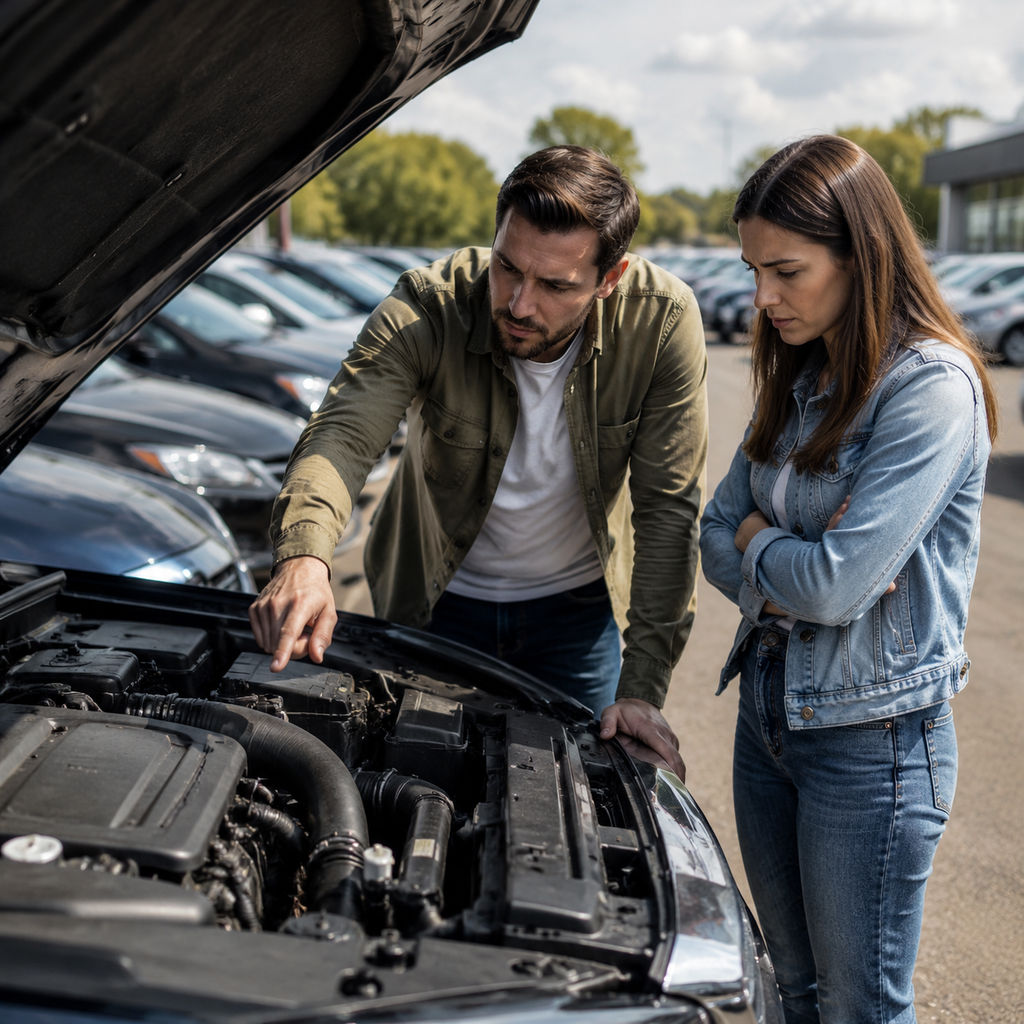
Check Fluids, Leaks, and the Engine Bay
Among used car buying mistakes, inspecting only a warmed-up engine can hide useful evidence. Ideally, view the car before the engine has been started. A seller who preheats it may have an innocent reason, but a cold start can reveal difficult starting, smoke, rattles, and idle problems that become less obvious when warm.
Look for:
- Oil, coolant, fuel, or other fluid leaks
- Damaged wiring or improvised repairs
- Corroded battery terminals
- Cracked hoses or worn belts
- Low or contaminated fluids
- Strong burning or fuel odors
- Signs of overheating
- Recently cleaned areas that contrast sharply with the surrounding engine bay
Do not assume that a spotless engine compartment proves excellent maintenance. Cleaning can improve presentation without resolving mechanical issues.
Inspect the Cabin for Wear and Water Damage
The interior often reveals how the car was used. Check seat bolsters, pedals, steering-wheel surfaces, controls, carpets, and luggage areas. Excessive wear should be consistent with the reported mileage and age.
A persistent damp or musty odor may indicate water ingress. Inspect carpets, the spare-wheel well, headliner edges, and areas around door and window seals. Water damage can affect wiring and electronic modules long after the interior appears dry.
Test every practical feature, including:
- Air conditioning and heating
- Windows, mirrors, and locks
- Exterior and interior lights
- Wipers and washers
- Infotainment and phone connectivity
- Parking sensors and cameras
- Seat adjustment and heating
- Instrument displays
- Charging ports
- Remote keys and spare key
- Convertible roof or sunroof, if fitted
Electronic faults can be time-consuming and expensive to diagnose. Failing to operate every available feature during the viewing is one of the avoidable used car buying mistakes.
Do Not Ignore Dashboard Warning Lights
Accepting a casual explanation for an active warning light can lead to serious used car buying mistakes. Turn the ignition on before starting the engine and observe the instrument panel. Warning lights typically illuminate briefly as part of a self-check and should then behave according to the manufacturer’s design.
If an engine, airbag, anti-lock braking, stability-control, battery, oil-pressure, emissions, or driver-assistance warning remains active, request a proper diagnosis. A seller may claim the issue is “just a sensor,” but sensors, wiring, control modules, calibration, and the components being monitored can all generate warnings.
A diagnostic scan may provide useful fault codes, yet codes are clues rather than complete diagnoses. Recently cleared codes may also take time to return. This is one reason a professional inspection remains valuable even when a handheld scanner shows no current problem.
Conduct a Test Drive That Reflects Real Use
Many used car buying mistakes persist because the buyer accepts a short loop around a parking area. The route should include low-speed turns, uneven pavement, braking, acceleration, and a higher-speed section where lawful and safe.
Before moving, adjust the seat and mirrors and assess visibility. Check whether the driving position works for your body and whether rear passengers, child seats, or cargo would fit your normal routine.
During the drive, pay attention to:
- Smoothness of cold and warm starting
- Clutch engagement or automatic transmission shifts
- Steering response and whether the car tracks straight
- Brake pedal feel, noise, vibration, and pulling
- Suspension knocks over rough surfaces
- Wheel-bearing hum or speed-related vibration
- Engine hesitation, smoke, overheating, or unusual noise
- Cabin rattles and wind noise
- Air-conditioning performance under load
- Warning lights or messages
- Operation of cruise control and assistance systems where safe
Test reverse gear and perform several parking maneuvers. Low-speed operation can expose clutch problems, steering noises, camera faults, and sensor issues that may not be obvious on an open road.
Never test safety systems by creating a dangerous situation. Automatic emergency braking, lane support, blind-spot monitoring, and similar technologies require correct operation and calibration, but their presence does not justify intentional risk. A varied, controlled route reduces test-drive-related used car buying mistakes.
Arrange an Independent Pre-Purchase Inspection
For most buyers, an independent inspection is one of the highest-value ways to avoid used car buying mistakes. A qualified mechanic or appropriate inspection service can examine areas that are difficult to assess during a driveway viewing, including the underbody, suspension, brakes, leaks, diagnostic systems, structural repairs, and signs of neglected maintenance.
Choose the inspector yourself. A seller-provided inspection can be useful supporting information, but it should not replace an assessment performed for the buyer.
Ask the inspector to identify:
- Safety-critical defects
- Repairs needed immediately
- Work likely within the next year
- Evidence of collision or structural damage
- Fluid leaks and corrosion
- Tire and brake condition
- Diagnostic faults and readiness status
- Maintenance that is overdue
- Approximate repair priorities
An inspection cannot predict every future failure, but it can turn unknown risks into specific decisions. Inspection-related used car buying mistakes become more likely when a seller refuses a reasonable independent assessment.
Specialized vehicles may require specialized expertise. Hybrid and electric vehicles may benefit from battery-health information and inspection of charging equipment and high-voltage components by a qualified technician. Performance cars, modified vehicles, and complex luxury models may also need a marque specialist.
Evaluate Safety Equipment, Visibility, and Modifications
Safety-related used car buying mistakes also include assuming every trim level has the same equipment. Confirm which safety features the specific vehicle actually has. Equipment can vary by trim, market, and production date, so do not rely solely on a generic model description.
Inspect the windshield, cameras, radar areas, parking sensors, mirrors, headlights, and tires. A replaced windshield, collision repair, suspension changes, or altered wheel alignment may require sensor calibration. Ask for documentation if calibration-sensitive work has been performed.
Consider the conditions in which the car will be driven. Someone commuting through dense city traffic has different needs from a driver regularly using dark rural roads. Aftermarket technology can sometimes address a specific gap. For example, Robofinity InsightDrive is a vehicle thermal imaging night vision system designed to support awareness of pedestrians, animals, vehicles, and obstacles in low-light environments. Such technology is supplementary and does not replace effective headlights, clear windows, safe speed, adequate braking distance, mirrors, traffic-law compliance, or an attentive driver.
Treat modifications carefully. Nonstandard suspension, lighting, engine tuning, exhaust systems, wheels, and electronic accessories may affect reliability, insurance, road legality, or resale value. Request invoices and verify that the work was performed appropriately for the vehicle and jurisdiction.
Read the Paperwork Before Paying
Paperwork-related used car buying mistakes can be as costly as mechanical defects. The purchase agreement should identify the exact vehicle, VIN, mileage, price, fees, included equipment, and any written promises. Review it before transferring money or signing.
Make sure you understand:
- Whether the vehicle is sold with a warranty or as-is
- What the warranty covers, excludes, and requires
- Whether a deposit is refundable
- Whether finance approval is final
- Whether there is outstanding finance or a lien
- How title or registration transfer will be completed
- Which accessories, keys, charging cables, or documents are included
- Whether repairs promised by the seller are written into the agreement
Consumer rights vary between the United States, European countries, and individual states or regions. Dealer and private-party purchases may also receive different legal treatment. Checking the rules that apply where the transaction occurs can prevent used car buying mistakes involving warranties, deposits, cooling-off periods, or return rights.
Avoid paying in full until the vehicle identity, ownership, price, and transfer process have been verified. Keep copies of the advertisement, messages, receipt, contract, history report, and inspection documentation.
Negotiate With Evidence, Not Emotion
Negotiation works best when based on comparable listings, condition, maintenance history, and documented repair needs. Emotional decisions are common used car buying mistakes, especially after a buyer has invested time in travel, research, or inspection.
Create a simple decision sheet:
- Agreed purchase price
- Immediate safety repairs
- Maintenance due soon
- Tires or brakes likely to need replacement
- Registration and tax costs
- Insurance cost
- Remaining contingency fund
Do not subtract every estimated future expense from the asking price as though the seller must fund normal ownership. Distinguish between ordinary age-related wear already reflected in market value and defects that make this vehicle worse than comparable examples.
Set a maximum total cost before negotiating. If the numbers exceed it, leave. Money already spent on a history report, travel, or inspection should not pressure you into completing a poor purchase.
Recognize When Walking Away Is the Best Decision
Avoiding used car buying mistakes does not require finding a perfect vehicle. Its faults should be identifiable, priced realistically, and compatible with your budget and risk tolerance.
Strong reasons to pause or leave include:
- Inconsistent VIN or ownership documents
- Evidence of title washing or undisclosed serious damage
- Seller resistance to inspection
- Active safety-system warnings without diagnosis
- Signs of overheating, major leaks, or structural corrosion
- Mileage discrepancies
- Pressure to pay immediately
- Material differences between the advertisement and the vehicle
- Unexplained electrical faults or water damage
- Costs that exceed your pre-set ownership budget
Walking away is not a failed negotiation. It is a successful risk decision when essential questions remain unanswered, and it prevents used car buying mistakes driven by pressure or sunk costs.
A Practical Final Checklist
Use this checklist to catch used car buying mistakes before committing to the purchase:
- Define essential requirements based on real driving needs.
- Calculate total ownership cost rather than only the monthly payment.
- Compare genuinely similar vehicles.
- Verify the VIN, seller identity, and ownership documents.
- Review available history and recall information.
- Inspect the car in daylight and on dry ground.
- Check tires, fluids, controls, lights, and warning indicators.
- Complete a varied test drive.
- Arrange an independent inspection.
- Confirm insurance costs and finance terms.
- Review modifications and safety-feature operation.
- Obtain all promises and fees in writing.
- Keep enough money available for maintenance and unexpected repairs.
Frequently Asked Questions
What used car buying mistakes are most common?
Rushing causes many used car buying mistakes. It leads buyers to skip document checks, accept a brief test drive, ignore warning lights, or decline an independent inspection. A structured process reduces the influence of pressure and excitement.
Is a vehicle history report enough?
No. Treating it as a complete record is one of the most common used car buying mistakes. A report is a valuable screening tool, but not all damage, repairs, mileage problems, or maintenance events are reported. Combine it with service records, a physical inspection, a proper test drive, and an independent mechanical assessment.
Should I buy a high-mileage used car?
A high-mileage car can be reasonable when it has documented maintenance, sound mechanical condition, and a price that reflects its age and use. Evaluating how the mileage accumulated and which major services are due helps avoid used car buying mistakes based solely on an odometer number.
Can I inspect a used car myself?
You can identify visible issues, test equipment, verify documents, and assess whether the car suits your needs. However, overestimating your ability to detect hidden defects is among the common used car buying mistakes. Unless you have appropriate technical experience and equipment, a professional pre-purchase inspection remains advisable.
What should I do if the seller will not allow an inspection?
Ask for the reason and consider walking away. A reasonable seller may need to arrange timing or protect themselves during the process, but outright refusal removes an important safeguard. Refusing to proceed without adequate verification prevents used car buying mistakes when important questions remain unanswered.
Is buying from a dealer safer than buying privately?
A dealer purchase may include additional consumer protections, financing options, or warranty coverage, depending on local law. A private sale may cost less but often places more responsibility on the buyer. However, used car buying mistakes can happen through either route, so verify the vehicle, inspect its condition, and understand the contract.
Avoid used car buying mistakes by Deciding on Evidence
The best way to avoid used car buying mistakes is to understand what you are buying, what it will cost, which compromises are acceptable, and which risks are not. A sound purchase is rarely about finding a flawless vehicle.
Define your needs before browsing, verify the car’s identity and history, inspect it under suitable conditions, test it in realistic driving situations, and obtain independent technical input. Put every cost and promise in writing. That process takes longer than responding to an attractive listing, but it provides a much stronger basis for choosing a reliable vehicle and managing ownership costs with fewer surprises.