

Automotive Thermal Night Vision: Best Must-Have Car Safety System
Automotive thermal night vision is quickly becoming one of the most valuable safety technologies available in modern vehicles. While features like blind-spot monitoring, lane-keeping assist, and automatic emergency braking get a lot of attention, thermal night vision adds a unique layer of protection that many drivers overlook. It helps detect pedestrians, animals, cyclists, and other hazards in low-light conditions long before they are visible with standard headlights.
- What Is Automotive Thermal Night Vision?
- How Automotive Thermal Night Vision Improves Safety
- Why Night Driving Is More Dangerous
- Key Features to Look for in Automotive Thermal Night Vision
- Detection Range
- Clear Display Integration
- Pedestrian and Animal Recognition
- Warning Alerts
- Compatibility With Driver Assistance Systems
- Who Benefits Most From This Technology?
- Is It Better Than Standard Night Vision?
- The Future of Smarter Vehicle Safety
- Final Thoughts
For anyone who regularly drives at night, in rural areas, on poorly lit roads, or in bad weather, this technology can make a meaningful difference. It is not just a luxury feature anymore. As vehicle safety systems continue to evolve, thermal imaging is becoming a practical tool for reducing risk and improving driver awareness.
What Is Automotive Thermal Night Vision?

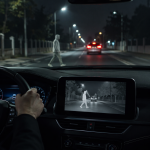
At its core, this system uses infrared technology to detect heat signatures rather than relying only on visible light. Everything with a temperature above absolute zero emits infrared radiation, including people, animals, and engines. A thermal camera mounted at the front of the vehicle captures this heat data and translates it into an image displayed on the dashboard, digital cluster, or head-up display.
Unlike conventional night vision systems that amplify available light, thermal systems are designed to “see” heat. That gives them a major advantage in total darkness. Even when the road ahead appears black to the human eye, the system may still identify a pedestrian crossing the road or a deer standing near the shoulder.
This is especially useful because many night-time accidents happen not because drivers are careless, but because hazards simply appear too late to react safely.
How Automotive Thermal Night Vision Improves Safety
One of the biggest benefits of automotive thermal night vision is earlier hazard detection. Headlights have limited range, and visibility often becomes worse in rain, fog, snow, or on winding roads. Thermal imaging can often detect warm objects farther ahead than headlights can illuminate.

This longer detection range gives drivers more time to respond. Even a few extra seconds can be critical when traveling at highway speeds. The system may help drivers:
– Spot pedestrians on dark roads
– Notice animals before they enter the lane
– Detect cyclists with limited reflectors
– Identify stalled vehicles or roadside activity
– Drive with more confidence in poorly lit environments
In many systems, advanced software is paired with the thermal camera to recognize specific objects. If the vehicle detects a person or animal in or near the driving path, it may highlight that object on the display or trigger a warning. In some premium vehicles, the warning may even work together with braking or driver assistance features.
Why Night Driving Is More Dangerous
Driving after sunset presents challenges that even experienced motorists cannot fully control. Human vision is naturally less effective in low light. Depth perception drops, peripheral vision becomes weaker, and reaction times can slow when hazards emerge unexpectedly.
Night driving also increases the likelihood of encountering difficult conditions such as:
– Glare from oncoming headlights
– Poorly marked roads
– Unlit pedestrians or cyclists
– Wildlife crossings
– Fatigue and reduced driver alertness
Because of these factors, accidents at night are often more severe. A technology that increases visibility beyond what the eyes and headlights can provide has clear safety value.
Key Features to Look for in Automotive Thermal Night Vision
Not all systems are the same. If you are considering a vehicle equipped with automotive thermal night vision, it helps to understand which features matter most.
Detection Range
A strong thermal system should identify heat signatures well beyond the reach of standard headlights. A longer range means more reaction time, especially on highways or rural roads.
Clear Display Integration
The image should be easy to interpret without distracting the driver. Some systems place the view in the digital instrument panel, while others use a head-up display or central infotainment screen.
Pedestrian and Animal Recognition
Modern systems may do more than show a thermal image. They can automatically identify likely hazards and mark them clearly, helping the driver focus on what matters most.
Warning Alerts
Audible, visual, or haptic alerts can add another level of safety. A highlighted figure on the display is useful, but a direct alert can be even more effective in a fast-moving situation.
Compatibility With Driver Assistance Systems
The best setups work alongside emergency braking, adaptive lighting, and forward collision warning. This connected approach creates a smarter and more responsive vehicle safety system.
Who Benefits Most From This Technology?
Thermal night vision can help almost any driver, but it is especially valuable for people in certain situations.
Drivers who often travel on rural roads benefit because wildlife is harder to spot at night. People who commute early in the morning or late in the evening may appreciate the extra awareness in dim conditions. Families, commercial drivers, and anyone who covers long distances can also gain peace of mind from improved visibility.
This feature is also useful in areas where street lighting is limited or weather conditions frequently reduce visibility. In such environments, relying on headlights alone may not be enough.
Is It Better Than Standard Night Vision?
There are different types of automotive night vision systems. Some use near-infrared technology, which depends on infrared illumination and reflected light. Others use thermal imaging, which detects heat directly.
Thermal systems are often considered more effective for identifying living beings such as pedestrians and animals because they stand out clearly against cooler surroundings. This makes automotive thermal night vision especially appealing as a safety feature rather than just a visibility aid.
That said, no system is perfect. Thermal imaging can be less detailed in certain scenarios and should never replace attentive driving. It works best as an enhancement to driver awareness, not a substitute for judgment.
The Future of Smarter Vehicle Safety
As car safety technology becomes more advanced, thermal night vision is likely to expand beyond luxury models and into a wider range of vehicles. With growing interest in accident prevention, automakers are investing in smarter sensors, better object recognition, and more integrated warning systems.
In the future, thermal imaging may play a bigger role in semi-autonomous and fully connected vehicle platforms. Combined with artificial intelligence and real-time sensor fusion, it could help vehicles understand night-time environments with much greater accuracy.
This shift reflects a larger trend in automotive safety: giving drivers more information before danger becomes unavoidable.
Final Thoughts
For drivers who want better protection after dark, automotive thermal night vision stands out as a smart and increasingly relevant upgrade. It improves awareness where human eyesight and headlights fall short, helping detect hazards earlier and making night driving less stressful.
As roads become busier and safety expectations continue to rise, technologies that offer real-world prevention will matter more than ever. Thermal night vision fits that role well. It is practical, innovative, and potentially life-saving—exactly the kind of system modern vehicles should embrace.