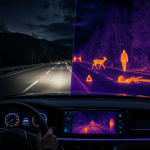


Autonomous vehicle thermal imaging helps future self-driving systems detect people, animals, and hazards in conditions where visible-light cameras struggle—like darkness, fog, rain, snow, and glare. As autonomy expands beyond demos into real streets, that extra perception channel becomes an important safety and reliability advantage.
- What Thermal Imaging Adds to Autonomous Vehicles
- Where Thermal Imaging Helps Most
- Night driving on unlit roads
- Fog, rain, snow, and glare
- City edges, parking areas, and mixed-use zones
- Why Redundancy Matters More Than More Data
- Sensor fusion is stronger than sensor dependence
- Detecting people and animals earlier
- What real-world reliability looks like
- Where Thermal Imaging Still Has Limits
- It does not make every object obvious
- It can be misread without good software
- Maintenance and calibration still matter
- Why This Matters for Buyers, Fleets, and Mobility Platforms
- Buyers should think in terms of driving environment
- Fleet operators need consistent road awareness
- Aftermarket and OEM systems serve different needs
- What Future Autonomous Vehicles Need from Thermal Imaging
- Fast, stable perception
- Good integration with other sensors
- Clear prioritization of vulnerable road users
- Honest limitations in the interface and software
- FAQ
- What is thermal imaging in autonomous vehicles?
- Why is thermal imaging useful at night?
- Does thermal imaging work in fog, rain, and snow?
- Can thermal imaging replace cameras or lidar?
- Is thermal imaging only useful for autonomous vehicles?
- What should buyers look for in a thermal imaging system?
- Conclusion
At a practical level, autonomous vehicle thermal imaging gives a car another way to see. Instead of depending on reflected visible light, it detects heat contrast. That makes it especially relevant for night driving, poor-visibility conditions, and scenarios where a person, animal, or object might be hard to identify in time. For future autonomous vehicles, that extra layer of awareness is not a luxury. It is a serious safety and reliability advantage.
What Thermal Imaging Adds to Autonomous Vehicles
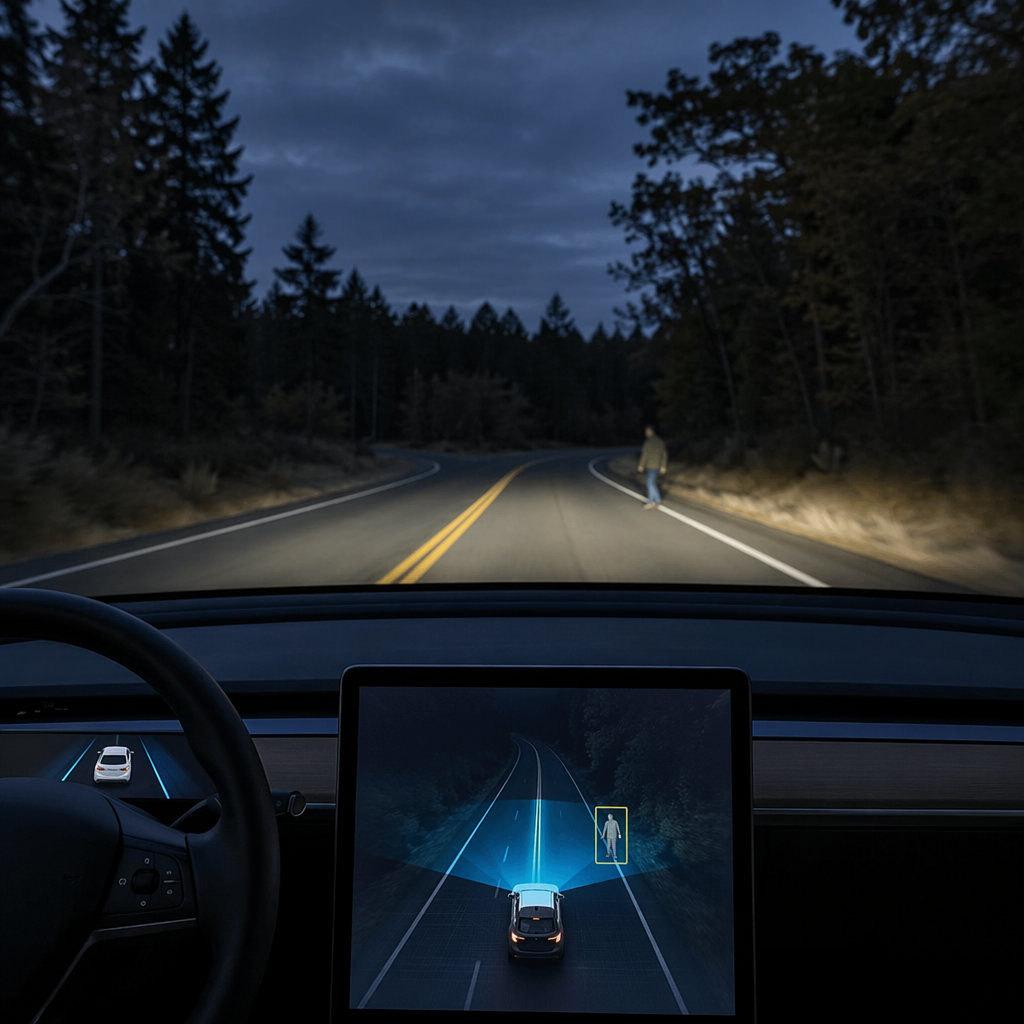
Autonomous vehicle thermal imaging does not replace other perception systems. It complements them. That distinction matters, because autonomous driving depends on more than raw detection. The vehicle must identify what something is, where it is, how it is moving, and how confident the system should be before making a decision.
Seeing heat instead of reflected light
Visible-light cameras work by capturing what is illuminated. They perform well in daylight and can still be useful at night when headlights, streetlights, or other lighting sources are present. Their weakness is obvious: if lighting is poor, uneven, blocked by glare, or distorted by weather, the image becomes harder to interpret.
Autonomous vehicle thermal imaging works differently. It picks up infrared radiation emitted by warm objects. People, animals, tires, engines, and other heat-producing elements stand out against cooler backgrounds. That can make a pedestrian on a dark shoulder, a deer near a tree line, or a vehicle stopped without much lighting more noticeable to the system.
For autonomous vehicles, this creates a different kind of perception channel. The car is no longer trying to infer everything from reflected light alone.
More EV News
Why cameras and lidar still need help
It is tempting to think that enough cameras and lidar points solve the problem. They do not, at least not in every environment.
Cameras can be blinded by headlight glare, washed out by sunrise or sunset, or limited by darkness. Lidar can be reduced by heavy rain, fog, snow, or surfaces that do not return clean data. Radar is valuable, but it is not designed to provide the same level of semantic detail as a thermal or visual image.
Autonomous vehicle thermal imaging helps fill the gap. It is not a universal fix, but it adds resilience when the environment becomes less cooperative. That is the central reason future autonomous vehicles need it.
Where Thermal Imaging Helps Most
Autonomous vehicle thermal imaging is most useful when the road is difficult to read. That usually means the same places and times where human drivers also struggle: nighttime, low visibility, and unpredictable roadside activity.
Night driving on unlit roads
Dark rural roads are one of the clearest use cases. A person walking without reflective clothing, a cyclist on a side road, or an animal near the verge can be difficult to see until a camera gets enough light or the headlights reveal the shape. Autonomous vehicle thermal imaging can help distinguish a warm body against a cooler background earlier.
This matters for autonomous systems because they need time, not just detection. A vehicle that notices a hazard too late may still be able to classify it, but it may no longer have enough space to respond smoothly.
Fog, rain, snow, and glare
Poor-visibility conditions are where autonomous vehicle thermal imaging shows its value most clearly.
Fog can flatten depth and hide objects. Rain and snow can reduce camera clarity. Low sun can create glare that overwhelms visible-light sensors. Even wet pavement and reflective surfaces can complicate perception. Thermal imaging does not make those conditions disappear, but it can remain useful when visual contrast becomes unreliable.
That is one reason it is being considered for advanced driver-assistance technology and future autonomy alike. The goal is not dramatic visibility. The goal is dependable awareness when the environment is actively reducing it.
City edges, parking areas, and mixed-use zones
Autonomous vehicles often face some of their hardest decisions in places that are not cleanly urban or rural. Think of parking lots, delivery zones, school-adjacent streets, industrial edges, and suburban roads where pedestrians, pets, bikes, and vehicles mix with little warning.
Autonomous vehicle thermal imaging can add value in these settings because it helps identify living beings and some vehicle-related heat sources in cluttered scenes. That can support hazard detection in areas where people may step out from behind obstructions or move in patterns that are difficult to anticipate.
Why Redundancy Matters More Than More Data
A future autonomous vehicle thermal imaging system should not depend on one sensor type to solve every problem. It needs redundancy. In safety engineering, redundancy is not about excess. It is about surviving sensor weaknesses without losing situational awareness.
Sensor fusion is stronger than sensor dependence
The most realistic path for autonomy is sensor fusion: combining cameras, radar, lidar, and autonomous vehicle thermal imaging so the vehicle can compare what each system sees. If one channel is degraded, another may still hold useful information.
This is especially important because autonomous systems must handle edge cases, not just ideal conditions. A car may be able to follow lanes in daylight on a clean highway with no trouble. The hard part is what happens when the lane markings fade, weather changes, or something warm moves into the roadway at night.
Autonomous vehicle thermal imaging helps by giving the system a second opinion that is not based on visible light. That makes the perception stack more robust. For readers exploring broader adoption, the Automotive Thermal Night Vision: Best Must-Have Car Safety System article expands on how this technology fits into modern safety design.
Detecting people and animals earlier
The case for autonomous vehicle thermal imaging becomes stronger when you think about vulnerable road users. Pedestrians are not always easy to separate from background clutter. Children can be partially hidden by parked cars. Cyclists may be poorly lit. Animals can appear suddenly near roads in ways that leave little reaction time.
For future autonomous vehicles, recognizing these road users early is critical. Thermal imaging can help highlight the presence of a heat-emitting body even when the visual image is weak. It may not identify every object perfectly, but it can give the driving system a better chance to slow, classify, and respond.
This is also where aftermarket solutions such as Robofinity InsightDrive fit into the wider conversation. It is an example of a vehicle thermal imaging night vision system that uses AI-powered thermal imaging with pedestrian, animal, and vehicle recognition plus real-time alerts, which illustrates how the technology is being applied to low-light awareness today.
What real-world reliability looks like
One reason buyers and engineers keep asking how reliable this technology is comes down to deployment. Autonomous vehicle thermal imaging has to work in motion, in changing weather, and around different road geometries. If you want a deeper technical look at performance tradeoffs, see How Reliable Are Car Thermal Cameras?
Reliability matters because autonomy is judged by edge cases, not the best-case demo. A system that performs well on a sunny test route but fails in fog or dusk is not ready for everyday use.
Where Thermal Imaging Still Has Limits
A serious discussion of autonomous vehicle thermal imaging technology has to include the limits. Thermal imaging is useful, but it is not magic.
It does not make every object obvious
Thermal cameras do well with heat contrast. They are less helpful when an object does not differ much from its surroundings, when the background is very hot, or when the scene contains confusing thermal patterns. A warm road surface after a hot day, for example, can reduce contrast. Similarly, certain objects may not stand out as cleanly as a person or animal.
Autonomous systems still need other sensors and strong software logic to make sense of the full environment.
It can be misread without good software
A thermal image is only useful if the vehicle can interpret it correctly. That means object detection, tracking, confidence scoring, and rule-based response logic all matter. A hot object on the shoulder is not automatically a threat. A warm road sign is not the same as a pedestrian. Good autonomy depends on software that can make those distinctions without overreacting.
This is where autonomous vehicle thermal imaging can be misunderstood. It improves perception, but it does not remove the need for careful decision-making.
Maintenance and calibration still matter
Like any camera-based system, thermal imaging hardware has to be protected, aligned, and integrated properly. Dirt, ice, damage, or poor mounting can reduce usefulness. In a real vehicle platform, sensors do not succeed just because they exist. They have to be maintained and validated along with the rest of the system.
For autonomous vehicles, this matters even more because the perception stack depends on consistency. A camera that drifts out of alignment or a sensor lens that becomes obstructed can degrade the entire chain of response.
Why This Matters for Buyers, Fleets, and Mobility Platforms
Not everyone reading about autonomous vehicle thermal imaging is building an autonomous robotaxi. Some are evaluating what safety technologies matter now, and what may matter in the next generation of vehicles.
Buyers should think in terms of driving environment
If most driving happens in bright, urban, well-lit conditions, thermal imaging may feel like a specialist feature. If the vehicle regularly operates on rural roads, in bad weather, or after dark, the value becomes easier to understand.
That is true for private drivers, fleet operators, and mobility services alike. Technology should be judged by the environments where it has to perform, not by the brochure description alone.
Fleet operators need consistent road awareness
Delivery fleets, late-night service vehicles, emergency support vehicles, and highway operators all face different visibility risks. A system that helps identify hazards earlier in darkness or fog can support better route decisions and fewer surprises. The business case is not just about convenience. It is about reducing uncertainty when road conditions are less forgiving.
If you’re evaluating safety improvements for night driving, pairing thermal awareness with proven driving practices can matter—see Night Vision Driving: 7 Powerful Safety Tips.
Aftermarket and OEM systems serve different needs
Factory-installed autonomy programs will likely use thermal imaging as part of a broader stack. Aftermarket systems can address older vehicles or drivers who want added awareness without replacing the car. The use case is different, but the safety logic is similar: give the driver or the vehicle more information in difficult conditions.
Robofinity InsightDrive is one example of this direction, showing how AI-powered thermal imaging can be paired with real-time alerts and recognition for pedestrians, animals, and vehicles in low-visibility driving scenarios. It does not replace careful driving, but it points to the kind of support many drivers may want before full autonomy becomes mainstream.
What Future Autonomous Vehicles Need from Thermal Imaging
Not every thermal camera setup will be equally useful. If this technology becomes a standard part of autonomous driving, the most valuable systems will likely share a few qualities.
Fast, stable perception
Autonomy needs timely input. A thermal image that arrives too late is less useful than a moderate-resolution image delivered consistently. The system has to track motion smoothly and avoid lag that could affect braking or steering decisions.
Good integration with other sensors
Autonomous vehicle thermal imaging works best when it is fused with camera, radar, and lidar data. The job is not to pick a winner. The job is to combine strengths so one sensor’s weakness does not become a critical failure.
Clear prioritization of vulnerable road users
Autonomous vehicle thermal imaging should help vehicles recognize people and animals quickly, especially in places where the cost of a delayed reaction is high. Future autonomy will be judged heavily on how well it handles those situations.
Honest limitations in the interface and software
A vehicle should not present thermal data as an all-seeing safety shield. It should treat it as one more source of input, with alert logic and fallback behavior that reflect uncertainty. That is how trust in autonomy is built.
For broader context on how thermal imaging supports safer perception in challenging conditions, readers can also review Far Infrared Automotive Night Vision: 7 Powerful Safety Benefits.
For additional background on how infrared thermal sensing is used in safety and instrumentation, see the U.S. National Institute of Standards and Technology overview on thermal radiation: NIST Thermal Radiation.
FAQ
What is thermal imaging in autonomous vehicles?
Thermal imaging is a sensor method that detects heat patterns instead of relying on visible light. In autonomous vehicles, it can help identify people, animals, vehicles, and other hazards in darkness or poor visibility.
Why is thermal imaging useful at night?
At night, visible-light cameras can struggle when there is little lighting or heavy glare. Thermal imaging can still highlight warm objects, which makes it easier for an autonomous system to notice a pedestrian or animal earlier.
Does thermal imaging work in fog, rain, and snow?
It can help in those conditions because it is less dependent on visible light, but it is not perfect. Heavy weather can still affect overall perception, so autonomous vehicle thermal imaging should be part of a broader sensor system.
Can thermal imaging replace cameras or lidar?
No. It is best used as a complementary sensor. Cameras, radar, lidar, and thermal imaging each cover different weaknesses, and autonomous vehicles need that redundancy.
Is thermal imaging only useful for autonomous vehicles?
No. It is also relevant for driver-assistance systems, night driving safety, fleet operations, and aftermarket awareness upgrades in low-light or poor-visibility conditions. For a practical driver-focused perspective, see Night Vision Driving: 7 Powerful Safety Tips.
What should buyers look for in a thermal imaging system?
Buyers should focus on how well the system integrates with other sensors, how quickly it detects hazards, whether it supports pedestrian and animal recognition, and how it performs in the environments they actually drive in.
Conclusion
Future autonomous vehicles need thermal imaging because the road does not become simple just because the car is more automated. Darkness, fog, rain, snow, glare, and roadside movement all create perception gaps that visible-light cameras alone cannot solve reliably. Autonomous vehicle thermal imaging helps close those gaps by adding a separate channel of awareness that is especially useful for pedestrians, animals, and other hazards in poor-visibility conditions.
The practical lesson is straightforward: autonomy becomes stronger when it sees the world in more than one way. Thermal imaging will not replace other sensors or careful system design, but it can make future autonomous vehicles more capable in the situations that matter most. For drivers, fleets, and manufacturers, that makes autonomous vehicle thermal imaging one of the more important safety technologies to watch.