


SEO Title: Automotive Thermal Night Vision Buying Guide: Features That Matter
- What Is an Automotive Thermal Night Vision System?
- Who Benefits Most From Thermal Night Vision?
- Rural and Suburban Night Drivers
- Commuters Driving Before Dawn or After Dark
- Long-Distance and Highway Drivers
- Family Drivers
- City Drivers
- The Buying Framework: Detection, Interpretation, and Driver Response
- Features That Matter Most
- Useful Detection Range
- Pedestrian, Animal, and Vehicle Recognition
- Real-Time Alerts and Warning Quality
- Display Size, Placement, and Legibility
- Frame Rate and Image Responsiveness
- Camera Resolution and Image Processing
- Weather Resistance and Camera Protection
- Recording and Data Handling
- Startup Time and Everyday Reliability
- An Editorial Example of the Feature Set
- Installation Questions to Resolve Before Buying
- How Thermal Imaging Compares With Other Night-Driving Technology
- Thermal Imaging Versus Low-Light Cameras
- Thermal Imaging Versus Better Headlights
- Thermal Imaging Versus Factory ADAS
- Performance in Fog, Rain, Snow, and Glare
- A Practical Pre-Purchase Checklist
- Budget for the Whole Ownership Experience
- Red Flags When Comparing Products
- Using Thermal Night Vision Responsibly
- Frequently Asked Questions
- Can thermal night vision see through fog?
- Can it detect pedestrians wearing dark clothing?
- Does a thermal system replace headlights?
- Is professional installation necessary?
- Is a longer detection range always better?
- Will thermal night vision detect every animal or obstacle?
- Conclusion
Meta Description: Learn how to choose an automotive thermal night vision system by comparing detection, alerts, display quality, installation, recording, and real-world limitations.
Driving after dark reduces the time available to identify and respond to pedestrians, animals, stopped vehicles, and debris. Headlights remain essential, but they only reveal what their beam reaches. This automotive thermal night vision system buying guide explains what everyday drivers should examine before purchasing an aftermarket system, including detection performance, alert quality, display design, installation, durability, and long-term ownership costs.
The best choice is not necessarily the model with the longest feature list. It is the system that presents useful information early, clearly, and without distracting the driver. Buyers also need realistic expectations: thermal imaging can support road awareness, but it cannot replace attentive driving, appropriate speed, working headlights, mirrors, safe following distance, or sound judgment.
What Is an Automotive Thermal Night Vision System?
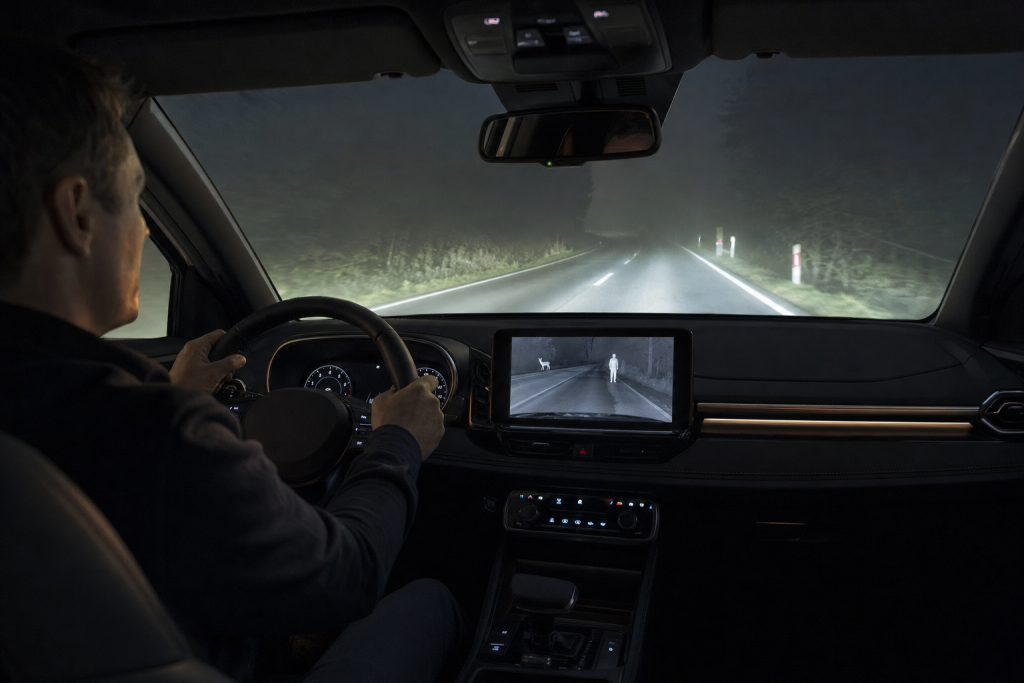
An automotive thermal night vision system uses a thermal camera to detect differences in heat emitted by people, animals, vehicles, and surrounding objects. Software converts that information into a visible image on an in-cabin display.
Unlike an ordinary low-light camera, a thermal imaging system does not depend entirely on visible light to form an image. That makes it potentially useful on unlit roads, around headlight glare, and in some poor-visibility conditions where a conventional camera may struggle.
The important distinction is that a thermal display does not reproduce the road exactly as the driver sees it. It presents a heat-based interpretation. Warm objects may stand out clearly, but lane markings, road signs, potholes, cold debris, and other details may be less obvious. Thermal imaging should therefore complement the windshield view rather than become the driver’s primary view of the road.
Some systems add software that identifies likely pedestrians, animals, or vehicles and issues real-time alerts. This can reduce the mental effort required to interpret a thermal image, but detection labels are still machine-generated assessments. Drivers must confirm hazards visually whenever possible and remain prepared for missed or incorrect classifications.
Who Benefits Most From Thermal Night Vision?
A thermal camera is not equally valuable to every motorist. Its practical worth depends on where, when, and how often the vehicle is driven.
Rural and Suburban Night Drivers
Poorly illuminated roads often provide little advance warning of pedestrians or animals near the carriageway. A person in dark clothing or an animal emerging from vegetation may become visible in the headlights only after the driver has covered much of the available stopping distance.
A well-designed thermal system may reveal a heat signature sooner, giving the driver more time to ease off the accelerator, increase space, or prepare to brake. It cannot predict movement, however. An animal detected beside the road may remain still, cross suddenly, or change direction.
Commuters Driving Before Dawn or After Dark
Winter commuting in the United States and Europe often means regular travel in darkness. Drivers may encounter cyclists, pedestrians, delivery vehicles, and road workers during these hours. A thermal night vision system can provide an additional source of awareness, particularly on familiar roads where routine may otherwise encourage complacency.
Long-Distance and Highway Drivers
On a dark highway, a thermal view may help distinguish vehicles or warm hazards farther ahead. Yet speed changes the calculation. Even early detection has limited value if the driver is traveling too fast for the conditions, following closely, or looking continuously at the display instead of through the windshield.
Fatigue is another critical issue on long trips. Thermal imaging is not a fatigue-management system and must never be used to justify continuing when the driver needs rest.
Family Drivers
Parents may value additional awareness when traveling at night with children, especially on rural trips or in areas with frequent pedestrian and animal activity. The most suitable family-oriented setup is usually one that works automatically, gives restrained alerts, and requires minimal interaction.
A bright display, frequent false alarms, or complicated controls can add distraction instead of reducing risk. Ease of use should carry as much weight as raw detection capability.
City Drivers
Dense city traffic creates a different challenge. Pedestrians, cyclists, parked cars, buses, and roadside heat sources can fill the thermal scene. Detection technology may still help, but excessive warnings can make a system tiring or easy to ignore.
Urban buyers should prioritize accurate classification, adjustable alert sensitivity, and a display that can be read at a glance. More detections are not necessarily better if the alerts do not identify meaningful risk.
The Buying Framework: Detection, Interpretation, and Driver Response
A useful way to compare systems is to divide performance into three stages:
- Detection: Can the camera capture the relevant object early enough?
- Interpretation: Can the system or driver understand what the image represents?
- Response: Is the warning clear and timely without causing distraction?
Marketing material often emphasizes the first stage, particularly maximum detection range. Everyday safety depends on all three. A distant heat source is not very useful if the display is unclear, the software labels it incorrectly, or the warning arrives so often that the driver tunes it out.
When comparing products, ask how the complete chain works in realistic traffic rather than focusing on one headline specification.
Features That Matter Most
Useful Detection Range
Detection range describes how far ahead a system may perceive a thermal object under suitable conditions. It should not be confused with recognition range or guaranteed warning distance.
A camera may detect a small heat source without determining whether it is a pedestrian, animal, exhaust component, or another object. Weather, object size, temperature contrast, road shape, camera position, and obstructions can all affect usable range.
Consider range in relation to driving environment:
- City drivers need reliable awareness at lower speeds and amid visual clutter.
- Rural drivers benefit from earlier identification of pedestrians and animals.
- Highway drivers need enough advance information to respond at higher speeds.
- Drivers on winding or hilly roads should remember that no camera can see through bends, hills, buildings, or vegetation.
A long advertised range is valuable only when the image and alerts remain meaningful at that distance.
Pedestrian, Animal, and Vehicle Recognition
Object recognition can make a thermal feed easier to understand. A highlighted pedestrian or animal requires less interpretation than an unmarked group of bright shapes.
Ask what categories the software recognizes and how those categories are communicated. The distinction matters because each hazard calls for a different response. A vehicle moving in the same direction is not the same type of risk as an animal near the shoulder.
No recognition system should be treated as infallible. A partially obscured pedestrian, small animal, unusual vehicle profile, or low thermal contrast may not be classified correctly. Detection boxes and warning symbols are prompts to investigate, not proof that the road is clear when no alert appears.
Real-Time Alerts and Warning Quality
Effective warnings should direct attention without startling or overwhelming the driver. Useful buyer questions include:
- Are alerts visual, audible, or both?
- Can warning volume and sensitivity be adjusted?
- Does the system distinguish between a detected object and an immediate threat?
- Are alerts understandable without reading small text?
- Can repeated low-priority warnings be reduced?
- Does the system restore preferred settings after restart?
Alert timing matters as much as alert type. A warning that arrives too late offers little benefit, while constant early warnings may cause alert fatigue. Look for controls that allow the system to suit city streets, open highways, and rural roads.
Display Size, Placement, and Legibility
The screen should be large enough to interpret quickly but small enough to avoid blocking the windshield. Placement is especially important in compact vehicles, where a dashboard-mounted display can interfere with the driver’s forward view.
Check whether the display offers:
- Automatic or convenient brightness adjustment
- Sufficient dimming for dark roads
- Clear hazard markers and uncomplicated graphics
- Good viewing angles from the driver’s seat
- Stable mounting over rough pavement
- Readable information without prolonged glances
Display brightness deserves particular attention. A screen that looks impressive indoors may be uncomfortable at night and can impair adaptation to darkness. Evaluate the lowest brightness setting, not just maximum brightness.
The safest viewing pattern is a quick glance followed by immediate attention back to the road. A system that demands continuous monitoring is poorly suited to ordinary driving.
Frame Rate and Image Responsiveness
Frame rate indicates how frequently the displayed image updates. A sufficiently fluid feed makes movement easier to interpret and reduces the laggy appearance that can complicate judgment.
However, frame rate alone does not guarantee a responsive system. Processing delay, display latency, detection software, and alert timing also matter. Buyers should look for clear information about real-time operation and examine demonstrations involving moving vehicles, pedestrians, or animals rather than only static thermal scenes.
Camera Resolution and Image Processing
Higher thermal resolution can improve detail, but it should not be considered in isolation. Lens design, sensor sensitivity, field of view, image processing, display quality, and detection software all influence what the driver actually sees.
A wide field of view can capture more roadside activity but may make distant objects appear smaller. A narrower view may reveal more forward detail while missing hazards approaching from the sides. The appropriate balance depends on whether most driving occurs on straight highways, winding rural roads, or crowded urban streets.
Weather Resistance and Camera Protection
An externally mounted camera faces rain, snow, road spray, salt, dust, stones, vibration, and repeated temperature changes. Look for a clearly stated environmental protection rating and installation instructions appropriate to automotive use.
Protection ratings are useful comparison tools, but they do not make a camera maintenance-free. A lens covered by mud, slush, ice, or salt film cannot provide a dependable image. Buyers in snowy regions should check how accessible the camera is for cleaning and whether its mounting position encourages contamination.
Recording and Data Handling
Some thermal systems can record real-time video. Recording may be useful for reviewing unusual road events, but it introduces practical questions:
- Is storage included or purchased separately?
- Does recording loop automatically when storage is full?
- How are files exported and viewed?
- Does the system record continuously or only after an event?
- Is the time and date information maintained correctly?
- What privacy and data-handling considerations apply locally?
Recording does not improve detection by itself. If budget is limited, prioritize image quality, warning clarity, durability, and installation before secondary recording features.
Startup Time and Everyday Reliability
A safety accessory is most useful when it becomes available quickly and consistently. Check whether the system starts automatically with the vehicle, how long it takes to show a usable image, and whether it retains brightness and warning preferences.
Controls should also work with gloves and be understandable without searching through deep menus. Features used while parked can be more complex; essential nighttime controls should be simple.
An Editorial Example of the Feature Set
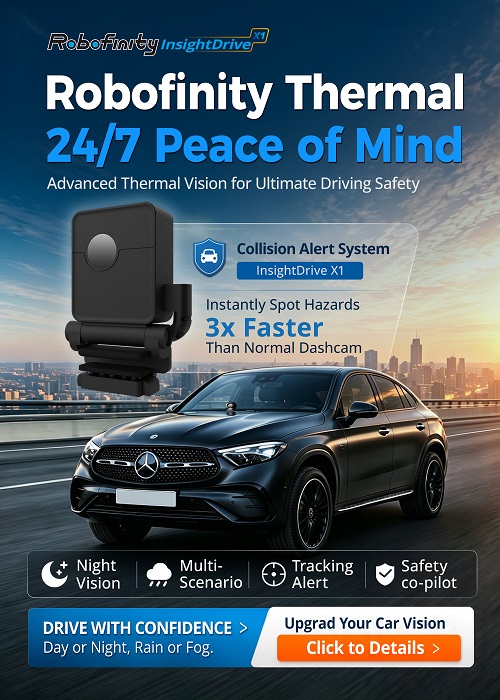
One relevant aftermarket example is Robofinity InsightDrive, which combines AI-powered thermal imaging with recognition for pedestrians, animals, and vehicles. Its specified detection range is up to 200 meters, or 656 feet, and it provides real-time alerts; as with any such figure, actual useful detection and recognition will depend on the road, weather, mounting, object, and temperature contrast.
InsightDrive illustrates why buyers should assess the complete system rather than the camera alone. Thermal reach, object recognition, and warnings need to work together, and none of them removes the driver’s responsibility to verify conditions and respond appropriately.
Installation Questions to Resolve Before Buying
A strong product can perform poorly if its camera is misaligned, obstructed, or mounted where the lens becomes dirty immediately.
Camera Position and Alignment
The camera generally needs a forward-facing location with an unobstructed view. Vehicle-specific factors such as grille design, active shutters, bumper shape, license plate position, ground clearance, and parking sensors can complicate mounting.
Confirm that the proposed location will not interfere with:
- Airflow or cooling components
- Radar, ultrasonic sensors, or factory cameras
- Active grille shutters
- License plates or required lighting
- Ground clearance and approach angle
- Routine washing and servicing
Alignment matters because detection zones and warning logic depend on where the camera is pointed. A camera aimed too high may waste part of its view on the sky; one aimed too low may reduce useful forward range.
Wiring and Power
Find out how the system receives power and how the wiring passes from the exterior camera into the cabin. Loose cables near pedals, steering components, airbags, hot engine parts, or moving panels are unacceptable.
A professional installer may be appropriate when the work requires trim removal, permanent cable routing, drilling, or connection to vehicle electrical circuits. Modern cars can have complex electrical architectures, and careless installation may create faults or interfere with other systems.
Display Mounting
Before final installation, sit in the normal driving position and check the proposed display location. It should not block the road, mirrors, instruments, airbag deployment areas, or frequently used controls.
Local rules governing windshield and dashboard obstructions vary. Buyers should verify current requirements in their jurisdiction rather than assuming that a mounting position permitted elsewhere is acceptable.
Compatibility With Factory Systems
An aftermarket thermal system is usually a separate source of information, not a replacement for factory automatic emergency braking, lane assistance, adaptive lighting, or head-up displays. Confirm whether it operates independently and whether installation could obstruct or interfere with original equipment.
Do not assume integration with a factory screen, speakers, or vehicle controls unless that compatibility is explicitly documented for the exact model and model year.
How Thermal Imaging Compares With Other Night-Driving Technology
Thermal Imaging Versus Low-Light Cameras
A low-light or near-infrared camera aims to create a scene that resembles ordinary video. It may show road edges, signs, lane markings, and objects in a familiar way, but its performance can depend more heavily on illumination and may be affected by glare.
Thermal imaging emphasizes heat differences. People and many animals may stand out against cooler surroundings, but road text, lane markings, and cold objects may be harder to identify. Neither technology is universally superior; each reveals different information.
Thermal Imaging Versus Better Headlights
Properly functioning headlights are the first priority. Clouded lenses, failed bulbs, poor alignment, and incorrect beam patterns directly affect ordinary driving visibility and should be corrected before adding a display-based system.
Thermal imaging can extend awareness beyond what visible light reveals, but it does not illuminate road signs, markings, or cold hazards. It should supplement compliant, well-maintained headlights rather than compensate for neglected lighting.
Thermal Imaging Versus Factory ADAS
Factory advanced driver-assistance systems may combine visible-light cameras, radar, ultrasonic sensors, and other inputs. Their functions can include collision warnings and automatic braking, depending on the vehicle.
An aftermarket thermal device can add a different kind of sensor input for the driver, but it may not control the brakes or steering. That independence can make installation simpler, yet it means the driver remains solely responsible for acting on an alert. Understand whether a product provides information, warnings, active intervention, or some combination of these functions.
Performance in Fog, Rain, Snow, and Glare
Thermal imaging is often associated with poor-visibility driving, but buyers should avoid treating it as all-weather vision.
In light rain or some forms of haze, thermal contrast may remain useful when visible imagery is degraded. Heavy precipitation, dense fog, road spray, accumulated snow, or a contaminated lens can reduce image quality and detection reliability. Water and ice on the camera surface may be more important than the conditions farther down the road.
Headlight glare from oncoming traffic can make ordinary viewing difficult. Because a thermal camera forms images from heat rather than visible brightness, it may provide additional information in such moments. The driver must still look ahead, maintain lane position, reduce speed when needed, and avoid shifting attention to the display for too long.
Weather performance should be viewed as variable, not absolute. No sensor can reveal an object hidden behind terrain, vehicles, walls, or dense physical obstructions.
A Practical Pre-Purchase Checklist
Before choosing a system, work through these questions:
- What proportion of your driving occurs after dark?
- Are your usual roads urban, rural, suburban, or high-speed?
- Which hazards are most relevant: pedestrians, animals, vehicles, or roadside obstacles?
- Does the system distinguish detection from recognition?
- Are audible and visual alerts adjustable?
- Can the screen dim enough for comfortable nighttime use?
- Will the display obstruct any part of the driver’s view?
- Is the camera protected against weather and road contamination?
- Can the lens be cleaned easily?
- Is installation suitable for your exact vehicle?
- Will the mounting affect factory sensors or active grille components?
- Does the system start automatically and retain settings?
- What storage, accessories, or installation work are additional expenses?
- Are software or firmware updates available, and how are they applied?
- Is support documentation clear enough to resolve mounting and operating issues?
- What warranty and return terms are actually documented by the seller?
This checklist helps separate practical ownership value from impressive specifications that may have little relevance to daily driving.
Budget for the Whole Ownership Experience
Purchase price is only one part of the cost. Include mounting hardware, professional installation, storage media, replacement accessories, and the time needed to keep the camera clean and correctly aligned.
A lower-priced unit can become expensive if it requires custom fabrication or has poor support. A more capable system may still be poor value if the driver rarely travels after dark. The right question is not simply, “Which system has the most features?” It is, “Which system addresses my regular driving conditions without creating new distraction or maintenance problems?”
Also consider transferability. If the vehicle may be replaced soon, determine whether the system can be removed without damage and whether its mounts and wiring can be adapted to another car.
Red Flags When Comparing Products
Be cautious when product information relies on vague safety promises or dramatic footage without explaining the test conditions.
Warning signs include:
- Claims that imply accidents can be prevented or safety guaranteed
- A detection range presented as though every object will be recognized at that distance
- No distinction between sensor resolution and display resolution
- No information about weather protection
- Demonstrations showing only ideal, static scenes
- A display that cannot be dimmed adequately
- Missing installation guidance
- Unclear descriptions of alert behavior
- No explanation of storage or data handling for recording
- Claims of universal compatibility without vehicle-specific limitations
Trustworthy product information acknowledges operating boundaries. A seller should be able to explain what the system does, what it does not do, and what the driver must continue doing.
Using Thermal Night Vision Responsibly
The system should be configured while parked. Brightness, volume, sensitivity, recording, and display position should not be adjusted during demanding traffic situations.
Once underway, treat the screen like an instrument display: glance briefly, interpret the information, and return attention to the road. Do not drive by watching the thermal feed.
When an alert appears:
- Look through the windshield and scan the relevant road area.
- Ease off the accelerator if the hazard is uncertain.
- Increase space from surrounding traffic where possible.
- Prepare to brake without making an abrupt maneuver that creates another danger.
- Account for vehicles behind and beside you before changing direction.
If the system frequently issues false or irrelevant alerts, adjust its settings while parked or have the installation checked. Repeatedly ignoring alarms defeats the purpose of the upgrade.
Routine care is straightforward but important. Inspect the camera for dirt, salt, ice, damage, or misalignment. Recheck its view after bumper work, minor impacts, accessory installation, or maintenance near the mounting location.
Frequently Asked Questions
Can thermal night vision see through fog?
Thermal imaging may preserve useful contrast in some foggy or hazy conditions, but it cannot reliably see through every type or density of fog. Moisture, temperature contrast, lens contamination, and object distance all affect performance. Slow down and use the vehicle’s appropriate lights.
Can it detect pedestrians wearing dark clothing?
Potentially, because thermal cameras detect emitted heat rather than clothing color. Detection can still be affected by distance, obstruction, weather, temperature contrast, and how much of the person is visible.
Does a thermal system replace headlights?
No. Headlights illuminate the road, signs, markings, and many objects that may not stand out thermally. Thermal night vision is supplementary driver-assistance technology and should only be used with properly functioning, legally compliant vehicle lighting.
Is professional installation necessary?
Not always, but it is often sensible when installation involves permanent wiring, trim removal, difficult camera alignment, or routing near airbags and vehicle sensors. The correct choice depends on the product design, vehicle, and installer’s competence.
Is a longer detection range always better?
Not by itself. The system must also present enough detail to recognize or classify the object and issue a useful warning. Field of view, processing delay, display quality, software, weather, and mounting can matter as much as the maximum stated range.
Will thermal night vision detect every animal or obstacle?
No. Recognition depends on object size, heat signature, distance, visibility, orientation, and software capability. Cold debris, road damage, and partially hidden animals may be difficult to detect. Drivers must continue scanning the road and controlling speed for the conditions.
Conclusion
Choosing a thermal night vision system requires more than comparing range figures. Everyday drivers should evaluate how well the camera, recognition software, alerts, display, and installation work as one complete driver-assistance tool.
Start with your actual use case. Rural night drivers may prioritize animal and pedestrian recognition at distance, while city drivers may need better alert filtering. Long-distance drivers should focus on simple operation and low distraction, and drivers in wet or snowy regions should pay close attention to camera protection and cleaning access.
Above all, select a system with clearly documented capabilities and limitations. Install it so that it does not interfere with the vehicle or the driver’s view, learn its display while parked, and use its warnings as additional information. Thermal imaging can strengthen nighttime road awareness, but safe speed, working lights, adequate following distance, and sustained driver attention remain the foundation of safer driving.