


SEO Title: Best Car Thermal Night Vision System 2026: A Practical Buyer’s Guide
- What Is a Car Thermal Night Vision System?
- Why Thermal Imaging Can Help at Night
- Thermal Imaging Versus Other Night Vision Technologies
- The Most Important Buying Criteria
- 1. Detection Range and Recognition Range
- 2. Pedestrian, Animal, and Vehicle Recognition
- 3. Alert Design
- 4. Display Position and Legibility
- 5. Image Smoothness and Delay
- 6. Camera Resolution and Field of View
- 7. Weather Resistance and Operating Conditions
- 8. Installation and Vehicle Compatibility
- 9. Recording and Data Handling
- 10. Support, Updates, and Long-Term Ownership
- A Practical Decision Framework
- For Frequent Rural Driving
- For Urban and Suburban Driving
- For Motorway and Long-Distance Travel
- For Family Vehicles
- For Harsh Winters or Wet Climates
- Evaluating a Real Product Without Relying on Hype
- Warning Signs to Avoid When Shopping
- Installation, Maintenance, and Responsible Use
- How Much Should You Spend?
- Buyer Checklist for 2026
- Frequently Asked Questions
- Can thermal night vision see through fog or heavy rain?
- Does thermal night vision work through a car windscreen?
- Is a higher thermal resolution always better?
- Is thermal night vision legal in the United States and Europe?
- Can a thermal camera replace high beams?
- Is factory night vision better than an aftermarket system?
- Making the Final Choice
Meta Description: Learn how to choose the best car thermal night vision system in 2026 by comparing detection, alerts, displays, installation, reliability, and real-world usability.
Night driving presents a difficult combination of limited sight distance, glare, fatigue, and hazards that may not become visible until they enter the headlight beam. For drivers searching for the best car thermal night vision system 2026, the right choice is not necessarily the model with the longest feature list. It is the system that detects relevant hazards early, presents information clearly, fits the vehicle correctly, and supports the driver without creating distraction.
This guide explains how automotive thermal imaging works, which specifications matter, what limitations to expect, and how to evaluate a system for everyday driving in cities, on highways, and along rural roads.
What Is a Car Thermal Night Vision System?
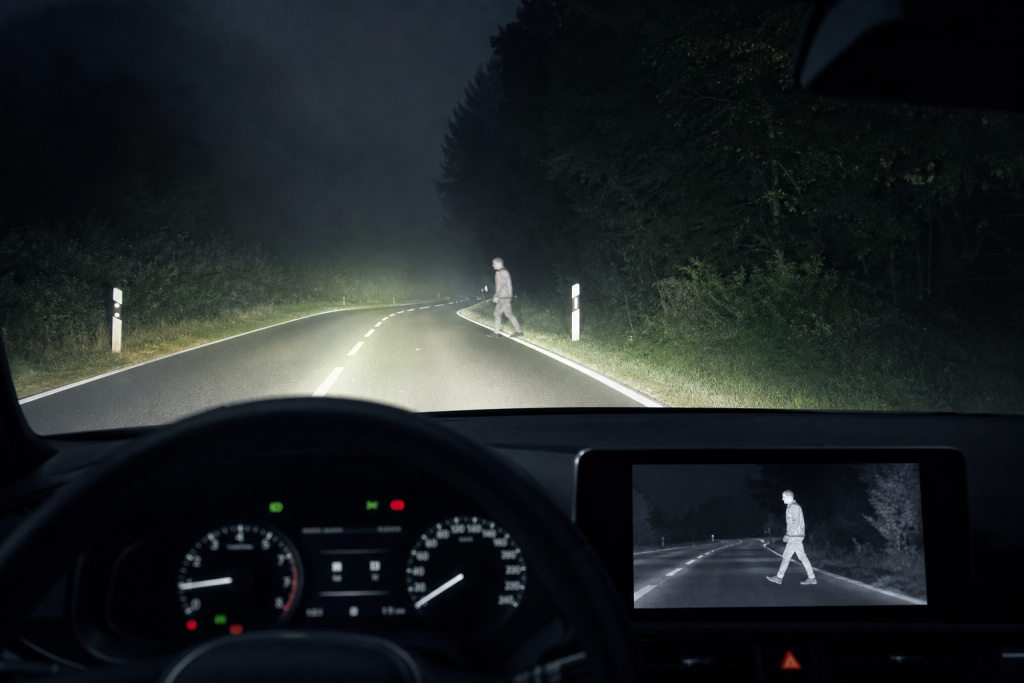
A car thermal night vision system uses an infrared camera to detect differences in heat emitted by people, animals, vehicles, road surfaces, and other objects. Software processes that thermal information and displays it as an image, often with visual markers or alerts for recognized hazards.
That makes thermal imaging fundamentally different from a conventional camera. A standard low-light or infrared-illuminated camera primarily depends on reflected light. A thermal camera senses emitted heat, allowing warm objects to stand out even when they are difficult to see with headlights alone.
For everyday drivers, a typical aftermarket system includes:
- A forward-facing thermal camera
- A processor or control unit
- An in-cabin display or compatible video output
- Power and data wiring
- Recognition software, depending on the product
- Visual or audible hazard alerts on more advanced systems
The practical goal is earlier awareness. A thermal display may help a driver notice a person near the shoulder, an animal approaching the road, or a stopped vehicle beyond a dark bend. It does not identify every hazard, determine road conditions perfectly, or make driving decisions for the driver.
Why Thermal Imaging Can Help at Night
Headlights remain essential, but their useful range and direction are limited. Low beams illuminate a defined area ahead, while high beams cannot always be used around other traffic. Curves, crests, roadside vegetation, rain, dirty windshields, and oncoming glare can reduce what the driver can distinguish.
Thermal imaging adds another source of information. Rather than trying to make the entire scene look brighter, it emphasizes temperature differences.
This can be particularly useful in several situations.
Rural and Forested Roads
Animals near an unlit roadside may blend into vegetation until they move into the headlight beam. A thermal system can make a warm animal more visually distinct from its surroundings, potentially giving the driver more time to recognize the developing situation.
Detection does not guarantee correct identification, however. Size, posture, partial obstruction, distance, and environmental conditions can all influence what the system sees.
Pedestrians and Cyclists
People wearing dark clothing can be difficult to distinguish on poorly lit roads. A thermal camera may reveal body heat before clothing color or reflective details become visible through the windshield.
Cyclists present a more complex target because the bicycle itself may not have the same thermal signature as its rider. The system’s recognition software, image quality, and alert design therefore matter as much as the sensor.
Highway Driving
On motorways and interstates, thermal imaging may help identify people, animals, or stopped vehicles beyond the most clearly illuminated area. At highway speed, though, long detection range is only useful when paired with prompt alerts and enough time to respond smoothly.
A distant object that appears as an unrecognizable dot offers less practical value than a nearer object that the system identifies reliably.
Glare and Uneven Lighting
Oncoming headlights, illuminated signs, and transitions between bright and dark areas can make visual adaptation difficult. Thermal imaging is not affected by visible-light glare in the same way as the human eye or a conventional camera.
It still has limitations. A thermal camera cannot see through every obstruction, and its image may be affected by weather, installation position, contamination, and temperature conditions.
Thermal Imaging Versus Other Night Vision Technologies
“Night vision” is a broad product category. Understanding the main technologies helps prevent an expensive mismatch.
Thermal Cameras
Thermal systems sense heat differences. Their major strength is making warm road users and animals stand out in darkness, even when visible contrast is poor.
Their disadvantages include a less familiar image, reduced visual detail compared with a normal camera, and difficulty interpreting objects with similar temperatures. Thermal imaging also cannot reliably show all road markings, sign text, potholes, debris, or cold obstacles.
Near-Infrared Systems
Near-infrared systems use an infrared-sensitive camera, often with an infrared illuminator. The resulting image resembles monochrome video and may show recognizable road details.
However, these systems still rely on reflected infrared energy. Their performance can be affected by range, weather, glare, and the illuminator’s coverage.
Low-Light Cameras
A sensitive visible-light camera amplifies available light and provides a familiar road image. It can be useful under streetlights or in twilight, but performance falls when almost no usable light is present. Bright headlights may also challenge exposure control.
For drivers primarily concerned about pedestrians and animals on dark roads, thermal imaging often has the most relevant detection advantage. Drivers seeking a brighter general road view may prefer near-infrared or low-light technology. Some integrated products combine technologies, but complexity and cost usually increase.
The Most Important Buying Criteria
Product pages often emphasize range or resolution. Those figures matter, but they do not fully describe how a system behaves from the driver’s seat.
1. Detection Range and Recognition Range
Manufacturers may use terms such as “detection,” “recognition,” and “identification” differently. Ask what the quoted distance actually means.
A camera may detect that a heat source exists at a long distance without determining whether it is a pedestrian, animal, exhaust component, or roadside object. Recognition range is generally more useful because it relates to the system’s ability to classify a target.
Also consider stopping distance. The faster the vehicle is moving, the more valuable early, reliable information becomes. Detection should provide time to assess the road and respond progressively, not encourage abrupt maneuvers.
2. Pedestrian, Animal, and Vehicle Recognition
Basic thermal cameras display an image and leave interpretation entirely to the driver. Driver-assistance models use software to recognize certain object categories and highlight them on the screen.
Recognition can reduce the effort needed to interpret the image, but it is not infallible. Before buying, determine:
- Which object categories are supported
- Whether recognition works throughout the stated operating range
- How the system marks multiple hazards
- Whether alerts change according to distance or risk
- How often the software may generate nuisance alerts
- Whether recognition requires an ongoing service or update
Reliable classification is more useful than a long list of detectable objects that rarely matter on the road.
3. Alert Design
An alert should be noticeable without startling the driver. Visual indicators need sufficient contrast and should identify the relevant area of the image. Audible warnings should be distinct but not so frequent that the driver begins ignoring them.
Look for adjustable volume, warning sensitivity, or alert categories where available. A useful system should also make it clear whether an alert indicates detection, proximity, or a more immediate hazard.
Frequent false or low-value warnings can undermine trust. Conversely, a display-only camera may require too much attention during demanding driving.
4. Display Position and Legibility
The display is a safety-critical part of the system. A large screen is not automatically better if it blocks the windscreen or requires a long downward glance.
Evaluate:
- Daytime and nighttime brightness
- Automatic or convenient dimming
- Image contrast
- Text and icon size
- Viewing angle
- Mount stability
- Glance distance from the road
- Whether warning colors remain clear to the user
A dedicated display can offer consistent performance and avoid phone notifications or overheating. A smartphone-based interface may reduce dashboard clutter but introduces dependency on an app, wireless connection, battery management, and phone placement.
The screen should sit close to the forward line of sight while remaining outside critical visibility areas and airbag deployment zones.
5. Image Smoothness and Delay
A thermal image must update smoothly enough to show movement naturally. A low or unstable frame rate can make pedestrians, animals, and vehicles appear to jump between positions.
Latency is equally important. Delay between camera capture and display can make the image less representative of the current road scene. This becomes more consequential at higher speeds.
Frame rate alone does not guarantee responsiveness. Processing, object recognition, video transmission, and display hardware all contribute to total delay.
6. Camera Resolution and Field of View
More resolution can improve object definition, but it is only one part of image quality. Sensor sensitivity, lens quality, image processing, display resolution, and calibration all contribute.
Field of view creates a significant trade-off:
- A wide field of view covers more roadside area but makes distant objects smaller.
- A narrow field of view gives more detail ahead but may miss hazards approaching from the sides.
Urban drivers may value wider coverage around crossings and parked vehicles. Highway and rural-road drivers may place greater emphasis on forward range. The best design balances both for the intended use.
7. Weather Resistance and Operating Conditions
The exterior camera must tolerate water, road spray, dust, vibration, temperature changes, and routine cleaning. Check for a stated environmental protection rating and an operating temperature range suitable for the local climate.
Also investigate how the camera performs in:
- Heavy rain
- Fog
- Snowfall
- Road spray
- Hot summer conditions
- Freezing weather
- Scenes where the background and target have similar temperatures
Thermal imaging may support awareness in some poor-visibility conditions, but it does not see through dense fog, heavy precipitation, walls, vegetation, or other solid obstructions. Marketing language suggesting unrestricted all-weather vision should be treated cautiously.
8. Installation and Vehicle Compatibility
Correct installation affects image quality, reliability, and recognition accuracy. The camera needs an unobstructed view and stable alignment. Mounting it behind ordinary windscreen glass is generally problematic because common automotive glass can block the infrared wavelengths used by long-wave thermal cameras.
Before purchasing, confirm:
- Suitable exterior mounting locations
- Camera dimensions and mounting method
- Cable-routing requirements
- Power supply and fuse requirements
- Display mounting options
- Compatibility with the vehicle’s electrical architecture
- Whether calibration is required after installation
- Whether bodywork drilling or trim removal is necessary
Professional installation may be sensible when wiring must pass through the firewall, exterior components need modification, or the vehicle has a complex electrical system. Poor wiring can introduce reliability problems and may affect other vehicle systems.
9. Recording and Data Handling
Some systems can record thermal video. This may be useful for reviewing an incident or understanding an alert, but it creates practical questions about storage, file access, overwriting, privacy, and local rules.
Check whether recording is continuous or event-based, whether timestamps are accurate, and how files are exported. Also determine whether a phone app or cloud service collects location, account, or video data. Thermal footage may still reveal people’s movements and should be handled responsibly.
10. Support, Updates, and Long-Term Ownership
A vehicle accessory may remain installed for years. Assess the support behind it, not only its launch features.
Look for clear documentation, replacement mounting parts, software update procedures, camera cleaning instructions, and accessible technical support. Verify warranty terms directly with the seller or manufacturer because coverage can vary by region and installation method.
For connected products, find out whether essential functions continue to work if an app, account, or online service changes. Core visibility and alerts should not become unreliable because a phone is replaced.
A Practical Decision Framework
The best system is the one that addresses the driver’s actual exposure. Start with where, when, and how the vehicle is used.
For Frequent Rural Driving
Prioritize pedestrian and animal recognition, useful forward range, reliable alerts, and a field of view that covers both the lane and roadside approaches. Weather protection and easy lens cleaning also matter because rural roads can expose the camera to mud and spray.
For Urban and Suburban Driving
A wide field of view, restrained warning behavior, and accurate pedestrian recognition are more important than extreme range. Dense traffic creates many warm objects, so an overly sensitive system may become distracting.
The display must also fit without blocking visibility in a cabin already occupied by navigation, infotainment, and instrument screens.
For Motorway and Long-Distance Travel
Prioritize stable imaging, low processing delay, long-range recognition, and alerts that are clear at a glance. The system should remain readable without producing excessive warnings from adjacent lanes, roadside activity, or traffic barriers.
Night vision can support awareness, but fatigue management remains essential. It cannot compensate for driving while drowsy.
For Family Vehicles
Ease of use matters because more than one person may drive the vehicle. Controls should be straightforward, display brightness should adjust easily, and alerts should not require complicated profiles.
Installation must avoid airbags, child-facing sightlines, frequently used controls, and loose cables. If the system is moved between vehicles, repeatable alignment and secure mounting become important.
For Harsh Winters or Wet Climates
Focus on the camera’s environmental protection, operating temperature, mounting location, and cleaning access. Snow, salt, road film, and ice can obscure the lens. A weather-resistant camera cannot provide a clear image when its viewing surface is covered.
Thermal imaging may reveal heat signatures in some challenging conditions, but reduced grip and longer braking distances still determine how safely the vehicle can respond.
Evaluating a Real Product Without Relying on Hype
A useful product comparison should separate verified features from marketing interpretations. Build a short scorecard and use the same questions for every candidate:
- What hazards does it recognize, not merely display?
- At what distance are those hazards recognizable?
- How quickly and clearly are warnings presented?
- Can the display be positioned without obstructing the road?
- Is the camera suitable for exterior automotive use?
- What installation and calibration are required?
- Which functions work without a phone or subscription?
- What support is available after installation?
- Are limitations explained clearly?
- Can the system be returned if it does not suit the vehicle?
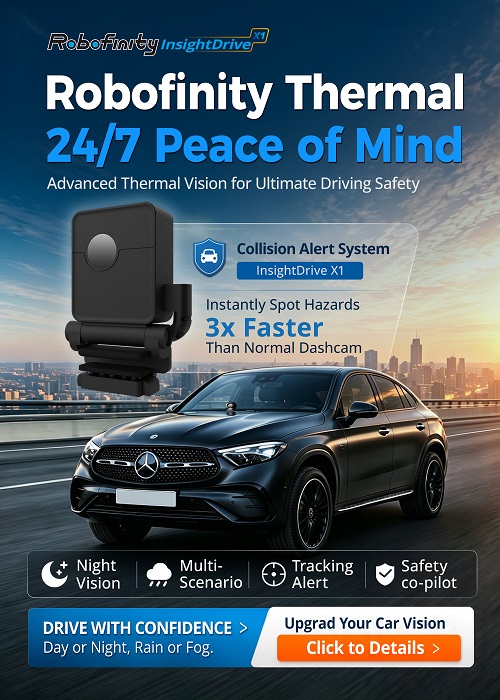
Robofinity InsightDrive is one relevant example in this category. It combines vehicle thermal imaging with recognition for pedestrians, animals, and vehicles, and provides real-time alerts. Those capabilities illustrate what buyers should examine in any current system: not simply whether it produces a thermal picture, but whether it turns that picture into timely, understandable information without making exaggerated promises about safety.
Specifications should still be checked against current product documentation. Installation suitability, local availability, software support, and the driver’s normal routes may matter more than any single headline feature.
Warning Signs to Avoid When Shopping
Thermal imaging is a specialized technology, and vague product listings deserve scrutiny.
Be cautious when a seller:
- Promises accident prevention or guaranteed safety
- Quotes one long range without defining detection or recognition
- Provides no operating temperature or weather-resistance information
- Omits frame rate, latency, field of view, or installation requirements
- Shows only edited promotional footage
- Provides no manual before purchase
- Treats thermal imaging as a replacement for headlights
- Uses “military grade” or similar language without meaningful specifications
- Makes software claims without explaining supported object categories
- Offers no clear update, warranty, or support process
Independent demonstration footage can be informative when it shows the full display in varied environments, but video alone cannot prove detection reliability. Pay attention to missed targets, alert timing, image delay, and nuisance warnings, not just dramatic moments.
Installation, Maintenance, and Responsible Use
Once installed, the camera should be checked periodically for movement, damage, dirt, water intrusion, or an obstructed view. Clean the protective surface using methods recommended by the manufacturer. Abrasive products can damage coatings or scratch the window.
Inspect visible wiring and mounting hardware after severe weather, minor impacts, or service work near the installation area. If recognition zones appear misaligned or alerts become inconsistent, have the mounting and calibration checked.
The driver should learn how the system behaves on familiar roads before depending on its alerts in more demanding conditions. Practice glancing at the display briefly while keeping primary attention on the road. Do not stare at the thermal image or use it as a substitute for looking through the windscreen.
Most importantly, treat thermal night vision as supplemental driver-assistance technology. It does not replace:
- Properly maintained headlights
- Clean windows and mirrors
- Safe speed for the available visibility
- Adequate following and braking distance
- Direct observation of the road
- Compliance with traffic laws
- Driver alertness and judgment
A driver who sees a thermal target should respond to the road situation, not make an abrupt maneuver based solely on an icon. Check surrounding traffic, reduce speed progressively when appropriate, and remain prepared for the possibility of a false or incomplete detection.
How Much Should You Spend?
Price alone does not reveal whether a system is suitable. A lower-cost thermal camera may provide a usable image but no object recognition, while a more sophisticated product may add hazard classification, alerts, recording, better environmental protection, and a dedicated display.
Think in terms of total ownership cost:
- Hardware
- Professional installation
- Mounting accessories
- Replacement cables or camera protection
- Software or connectivity fees
- Removal or transfer to another vehicle
- Potential repair after exterior damage
Spend first on reliable imaging, safe installation, a readable display, and clear documentation. Features such as recording or extensive customization should come after those fundamentals.
For a vehicle that is rarely driven after dark, improved headlight performance, corrected headlamp aim, fresh wiper blades, clean glazing, and an eye examination may offer more immediate value. A thermal system makes greater practical sense when night driving is frequent and the routes regularly involve unlit roads, wildlife, pedestrians, glare, or variable visibility.
Buyer Checklist for 2026
Before committing to a system, confirm the following:
- The technology is genuinely thermal rather than simply a low-light camera.
- Detection and recognition ranges are defined separately.
- Relevant road users can be recognized, not just shown as heat spots.
- Alerts are clear, adjustable, and unlikely to overwhelm the driver.
- The image is smooth and has acceptably low delay.
- The field of view matches the intended routes.
- The display can be mounted safely and read quickly.
- The camera has documented protection for exterior use.
- Installation is compatible with the vehicle.
- Calibration and alignment requirements are understood.
- Recording and data practices are acceptable.
- Manuals, updates, spare parts, and support are available.
- The seller makes realistic claims about limitations.
- The total cost includes installation and long-term ownership.
No single specification should decide the purchase. A balanced system with dependable recognition and a well-designed interface can be more useful than one with a longer theoretical detection distance but poor alerts or awkward installation.
Frequently Asked Questions
Can thermal night vision see through fog or heavy rain?
Not completely. Thermal imaging may preserve useful contrast in some low-light and poor-visibility situations, but dense fog, heavy rain, snow, spray, and obstructions can reduce detection and image quality. It should not be treated as unrestricted vision through weather.
Does thermal night vision work through a car windscreen?
Typical automotive glass blocks much of the long-wave infrared energy used by thermal cameras. That is why many vehicle systems use an externally mounted sensor rather than placing a thermal camera behind the windscreen. Follow the product’s installation instructions.
Is a higher thermal resolution always better?
Higher resolution can improve object definition, but overall usefulness also depends on sensor sensitivity, lens quality, field of view, software, frame rate, latency, display quality, and recognition performance. Resolution should be evaluated as part of the complete system.
Is thermal night vision legal in the United States and Europe?
Equipment and mounting rules vary by country, state, and local jurisdiction. Display placement, windscreen obstruction, recording, and vehicle modifications may be regulated differently. Check current local requirements and use a qualified installer when necessary.
Can a thermal camera replace high beams?
No. Thermal imaging does not illuminate the road and may not show lane markings, signs, debris, surface damage, or cold objects clearly. Legal, properly aimed headlights remain essential.
Is factory night vision better than an aftermarket system?
Factory integration can provide cleaner packaging and coordination with vehicle controls, but it is available only on certain models and trims. Aftermarket systems can add thermal awareness to a wider range of vehicles. Installation quality, recognition capability, support, and interface design determine whether a particular system is useful.
Making the Final Choice
Choosing a thermal night vision system in 2026 requires more than comparing sensor numbers. Begin with the routes and hazards that matter in daily life, then assess recognition performance, warning quality, display placement, weather resistance, installation, and long-term support.
For most everyday drivers, the strongest choice will be a system that provides timely hazard awareness with minimal distraction and clearly explains where its capabilities end. Compare current documentation carefully, confirm that the installation suits the vehicle, and consider professional fitting when alignment or electrical integration is involved.
Thermal imaging can add a valuable layer of nighttime road awareness, particularly on dark rural roads and routes shared with pedestrians or wildlife. Its proper role is to help an attentive driver notice more, earlier, while headlights, safe speed, braking distance, and sound judgment remain firmly in control.