


Knowing whether a vehicle offers enough car interior space takes more than checking a specification sheet or sitting behind the wheel for a few minutes. A vehicle can look large outside yet feel cramped inside, while a smaller model with efficient packaging may comfortably accommodate passengers and luggage.
- Start With Your Real Space Requirements
- Do Not Judge Interior Room by Exterior Size
- How to Evaluate Car Interior Space Measurements
- Perform a Proper Driver Fit Test
- Test Every Seat That Will Be Used Regularly
- Bring Child Seats to the Fit Test
- Recreate Your Normal Cargo Load
- Evaluate Storage Inside the Cabin
- Take a Longer Test Drive
- Leave a Sensible Space Margin
- Balance Interior Space With Safety and Visibility
- Use a Practical Interior-Space Checklist
- Frequently Asked Questions
- How much rear legroom is enough for a family car?
- Can I rely on manufacturer cargo-capacity figures?
- How can I tell whether three child seats will fit across the back?
- Is a larger SUV always more spacious than a smaller car?
- Should I choose more passenger space or more cargo space?
- How long should an interior fit test take?
- Make the Decision With Real-World Evidence
The right amount of room depends on who will use the car, what they will carry, and how often they travel. Evaluating car interior space works best when you define those needs before visiting a dealership, then perform a realistic fit test using the actual people, child seats, mobility equipment, and cargo the vehicle will need to accommodate.
Table of Contents
- Start With Your Real Space Requirements
- Understand the Most Useful Interior Measurements
- Perform a Proper Driver Fit Test
- Test Every Seat That Will Be Used Regularly
- Bring Child Seats to the Fit Test
- Recreate Your Normal Cargo Load
- Use a Practical Interior-Space Checklist
- Make the Decision With Real-World Evidence
Start With Your Real Space Requirements
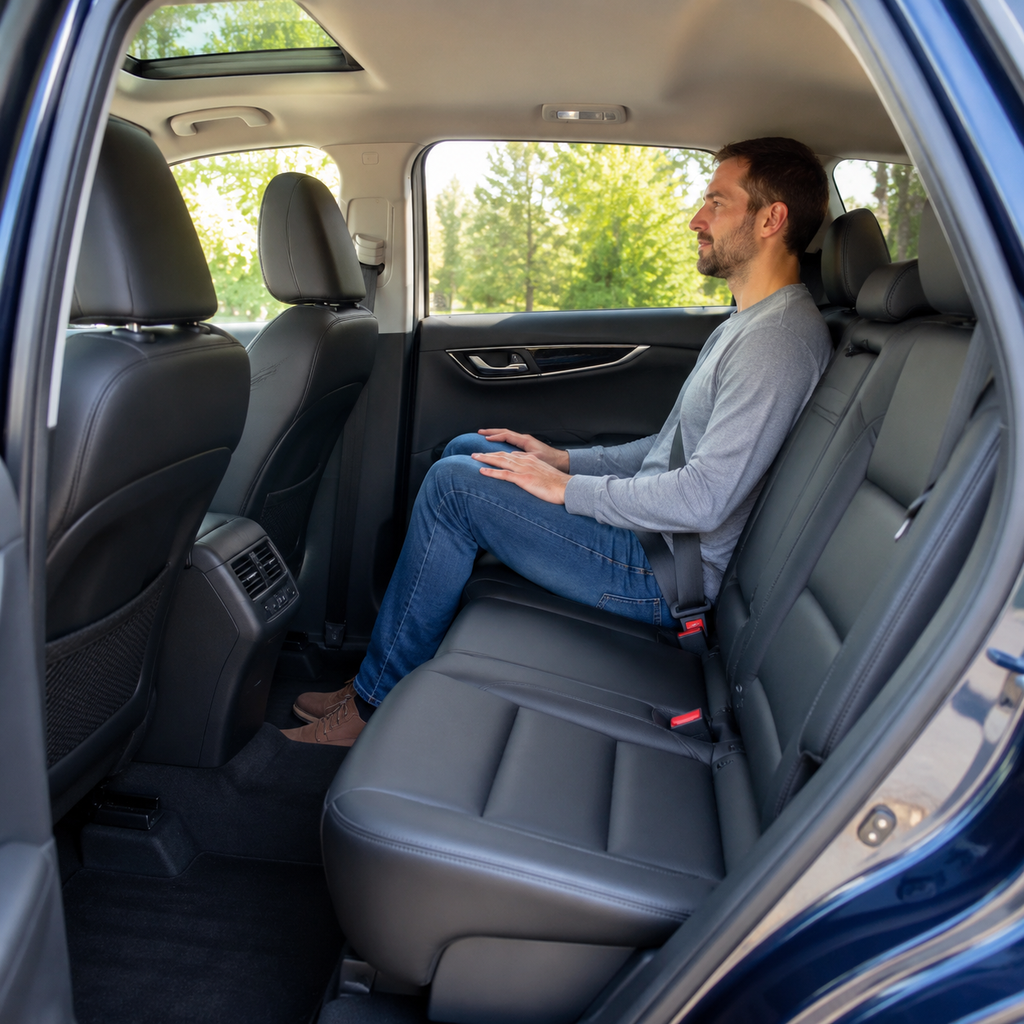
“Enough space” is personal. A compact hatchback may work well for one commuter but become impractical for a family carrying two child seats, a stroller, and weekly groceries. Before comparing vehicles, identify the situations that will place the greatest demand on the cabin and whether the available car interior space supports them.
Consider these questions:
- How many adults regularly travel in the vehicle?
- How tall are the tallest drivers and passengers?
- Will children use rear-facing or forward-facing safety seats?
- Does anyone need extra room because of limited mobility?
- Will the car carry a stroller, wheelchair, sports equipment, tools, or pet carrier?
- How much luggage do you take on long trips?
- Do you expect to add another child or regularly transport relatives?
- Will rear seats need to remain available while carrying bulky cargo?
Base the decision on regular use rather than a rare, extreme situation. You do not necessarily need a large SUV because you move furniture once every few years. However, a vehicle that barely meets your weekly needs is likely to become frustrating quickly, especially when its car interior space leaves no practical reserve.
A useful rule is to test the car in its most demanding normal configuration. For a family, that might mean every child seat installed with the cargo area loaded for a weekend trip. For a business owner, it may mean carrying work equipment without folding the seats used by employees or clients. This test shows whether the car interior space works in real life.
More EV News

Do Not Judge Interior Room by Exterior Size
Vehicle length and width do not directly determine usable cabin space. Styling, roof shape, powertrain layout, suspension components, dashboard depth, and body structure all affect how much room remains for occupants. These packaging choices can make car interior space feel very different between vehicles with similar exterior dimensions.
A vehicle with a long hood and sloping roof may offer less passenger space than a shorter, more upright model. Thick doors can reduce shoulder room, while a wide center console can make the front seats feel restricted. Large wheels may also intrude into the rear cabin or cargo floor through prominent wheel arches.
Electric vehicles can sometimes use their platforms differently because they do not require the same engine and transmission layout as a conventional car. Even so, battery placement, floor height, roofline, and seat mounting can still affect leg position and headroom. The presence of a flat floor does not automatically mean the rear seat will be comfortable or that the car interior space is well used.
Treat exterior dimensions as an initial guide, not proof of interior usability. The actual car interior space should be verified at the dealership.
How to Evaluate Car Interior Space Measurements
Headroom
Headroom measures the available vertical space around a seated occupant. It matters most for tall people, passengers with upright seating preferences, and anyone who regularly wears a helmet or bulky head covering. Adequate car interior space includes enough headroom for a natural posture.
Check more than the distance between your hair and the roof. Sit naturally, place your head against the head restraint, and make sure your line of sight is not pushed into the top of the windshield. In the rear, inspect how the roof tapers toward the doors.
Panoramic glass roofs can alter available headroom because their frames, shades, and mechanisms occupy space. Compare the exact trim level you intend to buy, since a sunroof-equipped version may fit differently from the base model listed in a brochure. Trim differences can change usable car interior space.
Legroom and Knee Room
Published legroom figures are useful for rough comparisons, but they do not capture every aspect of comfort. Seat-cushion length, dashboard shape, footwell width, floor height, and the position of the seat rails all affect how spacious the car feels. Together, these details determine usable car interior space.
A rear passenger may have adequate knee clearance but nowhere comfortable to place their feet under the front seat. A high floor can also force the knees upward, placing more pressure on the passenger’s thighs during a long journey.
Always test rear legroom after setting the front seat for a real driver. Sliding the front seat forward to make the second row look spacious produces an unrealistic result and gives a misleading impression of car interior space.
Shoulder, Hip, and Elbow Room
Width becomes especially important when three people use the rear bench. A specification may show generous overall cabin width while the center seat remains narrow, raised, or obstructed by seat-belt anchors. Good car interior space must work for the people who will sit beside one another.
Sit three intended passengers across the rear when possible. Check whether shoulders overlap, whether the outer passengers are pressed against the doors, and whether everyone can fasten a seat belt without reaching underneath another person.
A center armrest or wide transmission tunnel may also make the middle position less useful. If three-across seating is a regular requirement, it should be tested directly rather than inferred from the vehicle’s width or advertised car interior space.
Cargo Volume
Cargo capacity may be published in cubic feet in the United States or liters in Europe. These figures are helpful, but different measurement methods and load-height assumptions can make direct comparisons misleading. Cargo is part of practical car interior space.
Shape often matters more than total volume. A tall but narrow cargo area may struggle with a wide stroller. A sharply sloped rear window can limit the height of stacked luggage. Wheel-arch intrusions, a high loading lip, or a raised cargo floor may further reduce practical capacity and usable car interior space.
Inspect the following:
- Width between the wheel arches
- Floor length with the seats upright
- Opening height and width
- Height beneath the cargo cover
- Loading-lip height
- Space occupied by charging cables or a spare wheel
- Floor shape when the rear seats are folded
- Availability of underfloor storage
- Whether the hatch can close over your normal cargo
When comparing published figures, confirm that the numbers were calculated with similar seating and loading configurations. That makes claims about car interior space more meaningful.
Perform a Proper Driver Fit Test
A comfortable cabin starts with a safe driving position. Adjust the seat as you would for daily use rather than accepting the dealership’s existing settings. This is the first practical test of car interior space for the driver.
Your hips should be supported, and you should be able to press the pedals fully without straightening or stretching the leg. With your shoulders against the seatback, you should reach the steering wheel while keeping a slight bend in your elbows.
Then check whether you can:
- See the road and dashboard clearly
- Use the pedals without your knees contacting the steering column
- Reach essential controls without leaning forward
- Enter and exit without striking your head or knees
- Use the armrests without lifting or dropping your shoulders
- Adjust the mirrors to reduce blind areas
- Wear a winter coat without feeling restricted
- Maintain a comfortable position for more than a short demonstration
Seat travel alone does not determine fit. The relationship among the pedals, steering wheel, seat base, and windshield is what matters. Drivers with long legs and shorter arms may need generous steering-wheel reach adjustment, while shorter drivers may need seat-height adjustment that preserves a clear forward view. These relationships define useful car interior space.
Make sure the steering wheel does not obscure important instrument information in your preferred position.
Test Every Seat That Will Be Used Regularly
After setting the driver’s seat, leave it in place. Move directly behind it and assess the second row. Repeat the process behind the front passenger seat. This approach reveals whether the car interior space suits the whole household.
Check knee clearance, foot space, headroom, seat-cushion support, and the angle of the backrest. A short showroom test may not reveal a cushion that is too low or too short, but that issue can become uncomfortable during a two-hour drive.
For older passengers or people with limited mobility, ease of entry may matter more than maximum legroom. Look for:
- A door opening wide enough for easy access
- A roofline that does not require excessive ducking
- A seat that is neither very low nor excessively high
- Stable grab handles
- A sill that is easy to step over
- Enough room to turn and bring both legs into the cabin
- Doors that can be opened comfortably in a normal parking space
Third-row seating deserves particular scrutiny. Some third rows are suitable mainly for children or occasional short trips. Test access with the second row in its normal position, and verify that passengers have adequate headroom, foot space, ventilation, and a practical way to exit. Do not assume a third row adds useful car interior space for adults.
If the third row will be used regularly, do not evaluate it as an emergency seat.
Bring Child Seats to the Fit Test
Child-seat compatibility is one of the clearest examples of why published dimensions are not enough. A rear-facing seat can require substantial front-to-back space, potentially forcing the front passenger too far forward. The actual car interior space must accommodate both the restraint and the occupant.
Install your actual seats according to the child-seat and vehicle instructions. Check that you can achieve a secure installation without relying on assumptions about compatibility. Confirm that the front occupants can still sit safely and comfortably. For installation guidance, consult the National Highway Traffic Safety Administration’s car-seat guidance.
Also examine:
- Access to lower anchors or ISOFIX points
- Visibility and labeling of the anchor locations
- Top-tether access where applicable
- Clearance between multiple child seats
- Ability to reach and buckle each child
- Space for rotating seats, if used
- Whether doors open far enough for lifting a child
- Remaining cargo room after loading a stroller
- Access to a third row with child seats installed
Three child seats may not fit safely across a bench even when three seating positions are present. Seat contouring, buckle placement, and the width of each child restraint all influence the result. A vehicle’s advertised car interior space cannot confirm this fit.
Do not assume that a larger vehicle automatically solves the problem. Some compact multi-purpose vehicles use their width efficiently, while certain larger SUVs have heavily sculpted rear seats or narrow center positions.
Recreate Your Normal Cargo Load
A tape measure can help, but bringing real items is better. Dealerships will often allow prospective buyers to test a folded stroller, wheelchair, suitcase, golf bag, pet carrier, or work case if the items are clean. This is the most reliable way to judge cargo-related car interior space.
Load the cargo area with the seats in the position you expect to use. The goal is not merely to make everything fit. It should fit without blocking rear visibility, damaging trim, crushing soft bags, or creating unsecured objects that could move during braking.
For a family-road-trip test, try the following arrangement:
- Install every child seat.
- Set the front seats for the actual occupants.
- Place the stroller or mobility equipment in the cargo area first.
- Add the usual number of suitcases or travel bags.
- Confirm that the hatch closes without forcing it.
- Check whether frequently needed items remain accessible.
- Verify that cargo can be secured.
Folding seats can make a vehicle highly versatile, but that capacity may not help when every passenger seat is occupied. Focus on the cargo volume available in the configuration you will actually use, since folded-seat figures can exaggerate practical car interior space.
Evaluate Storage Inside the Cabin
Interior space is not limited to seats and the trunk. Everyday comfort also depends on where occupants can place small items, so storage contributes to practical car interior space.
Check the door pockets, cupholders, center console, glove compartment, phone tray, seatback pockets, and storage beneath the armrest. Bring a reusable water bottle if you commonly carry one, as some cupholders do not accommodate wider containers.
For family use, consider where you will store wipes, charging cables, snacks, toys, sunglasses, and travel documents. Loose items should not need to occupy passenger footwells.
Storage must also be usable. A deep console can hold plenty but make small objects difficult to retrieve. A wireless charging tray may consume the only practical location for a second phone. Open storage near the windshield can create reflections or expose valuables.
Take a Longer Test Drive
A static inspection identifies obvious space problems, but a road test reveals whether the cabin remains comfortable in motion. Try to drive for at least long enough to settle into the seat and encounter normal traffic, turns, braking, and rough surfaces. This shows how car interior space feels beyond the showroom.
Pay attention to:
- Pressure beneath the thighs or around the hips
- Knee contact with the console or door
- Visibility at intersections
- Ease of checking mirrors and blind areas
- Whether rear passengers feel confined
- Head movement over bumps
- Cabin noise that affects conversation
- Climate-control airflow reaching rear occupants
- Ease of using controls while maintaining your driving position
Bring regular passengers when practical. A driver may consider the cabin spacious while a tall rear passenger experiences poor foot room or a child cannot see comfortably through a high window line. Their feedback makes the assessment of car interior space more complete.
Parking is part of the test as well. A wider cabin can improve shoulder room but make the vehicle more difficult to use in narrow urban garages or European parking spaces. Open every door after parking and confirm that occupants can enter, exit, and load children without requiring excessive clearance.
Leave a Sensible Space Margin
A car that only just accommodates your current needs may not remain suitable throughout the ownership period. Children grow, rear-facing seats are replaced, work requirements change, and family members may need more accessible seating. Leave some reserve in the car interior space you choose.
That does not mean buying the largest vehicle available. Additional size can increase purchase cost, energy or fuel consumption, tire expense, and parking difficulty. The better goal is a modest reserve of usable room in the areas most likely to change.
Prioritize margin where it matters:
- Front-seat adjustment for multiple drivers
- Rear legroom for growing children
- Cargo room with all required seats occupied
- Child-seat clearance
- Door-opening access
- Payload capacity for passengers and cargo
Remember that cargo volume and payload are different. A vehicle may have enough physical space for people and luggage but still have a limited allowable carrying weight. Check the vehicle’s documentation and weight label when carrying several adults, heavy equipment, roof cargo, or a trailer load.
Balance Interior Space With Safety and Visibility
A roomy cabin should not distract from other parts of the buying decision. Compare outward visibility, crash-safety information from recognized regional testing organizations, braking performance, tire condition, and the driver-assistance features fitted to the exact trim. Useful car interior space must still support safe driving.
Large pillars, small rear windows, and high beltlines can make an open cabin feel difficult to see out of. Cameras and sensors may support maneuvering, but they do not eliminate the need for direct observation and correctly adjusted mirrors.
Drivers who frequently use dark rural roads may also explore aftermarket awareness technology. Robofinity InsightDrive is an example that uses AI-powered thermal imaging to support low-light road awareness. As with any driver-assistance technology, it should supplement rather than replace effective headlights, safe speed, adequate braking distance, traffic-law compliance, and attentive driving.
Space can affect safety in less obvious ways, too. Luggage stacked above the seatbacks may obstruct the rear view or move forward during sudden braking. Heavy objects should be placed low and secured where possible. Do not allow the desire to maximize capacity to compromise visibility, restraint use, or vehicle weight limits.
Use a Practical Interior-Space Checklist
Before making a final decision, complete the following checks using the exact model and trim you plan to buy. This checklist turns impressions of car interior space into evidence:
- Set the driver’s seat and steering wheel correctly.
- Confirm clear access to pedals, controls, displays, and mirrors.
- Sit behind the adjusted driver’s seat.
- Test every regularly used seating position.
- Install actual child seats where applicable.
- Check third-row access with the second row configured normally.
- Load a realistic selection of luggage or equipment.
- Close the hatch without pressing cargo against the glass.
- Confirm that rear visibility remains adequate.
- Open doors in a representative parking space.
- Test climate-control airflow in the rear.
- Inspect cabin storage for everyday items.
- Compare payload limits as well as cargo volume.
- Drive long enough to identify seat-support or visibility problems.
- Repeat the test with regular passengers present.
Photographing the final seating and cargo configuration can make it easier to compare several vehicles later. Record specific issues such as “rear-facing seat leaves insufficient front-passenger legroom” instead of relying on a general impression that the cabin felt small.
Frequently Asked Questions
How much rear legroom is enough for a family car?
There is no universal minimum because occupant height, seat design, and child-seat use all matter. Set the front seats for the regular driver and passenger, then test the rear with the people and restraints that will actually use it. Comfortable foot placement and thigh support are as important as knee clearance.
Can I rely on manufacturer cargo-capacity figures?
Use them to create a shortlist, but not as the final answer. Measurement standards and configurations can differ, and a large number does not reveal the shape of the opening, wheel-arch intrusion, loading height, or space beneath a cargo cover. Test representative items in person.
How can I tell whether three child seats will fit across the back?
Install the specific child-seat models in the vehicle according to their instructions and the vehicle manual. Overall bench width alone cannot confirm compatibility because seat contours, anchor positions, and buckle locations vary. Seek guidance from a qualified child-passenger-safety professional if you are uncertain about an installation.
Is a larger SUV always more spacious than a smaller car?
No. Exterior size does not guarantee efficient interior packaging. Roof shape, seat design, wheel arches, dashboard depth, and mechanical components all affect usable room. Compare the actual seating and cargo configurations rather than vehicle categories alone.
Should I choose more passenger space or more cargo space?
Prioritize the configuration you use most often. Passenger comfort and correct restraint use should not be sacrificed to carry routine cargo. Look for flexible seating if your needs change frequently, but remember that maximum cargo figures usually assume some passenger seats are folded.
How long should an interior fit test take?
Allow enough time to adjust the driving position, sit in every relevant seat, install child restraints, load representative cargo, and complete a meaningful road test. A quick showroom sit is unlikely to reveal long-distance seat discomfort, access problems, or conflicts between passenger and luggage space.
Make the Decision With Real-World Evidence
The best vehicle is not necessarily the one with the largest published dimensions. It is the one that accommodates your occupants, restraints, luggage, and daily routines without forcing unsafe or inconvenient compromises. Real-world testing gives a more dependable view of car interior space.
Create a shortlist from specifications, then verify each candidate with a realistic fit test. Set the front seats correctly, evaluate every occupied row, install your own child seats, load normal cargo, and drive the vehicle in conditions similar to everyday use. That practical process provides a far more dependable answer than exterior size, cargo figures, or a brief first impression. Confirming car interior space in the exact trim you plan to buy helps prevent expensive surprises after purchase.
For a structured buying-day process, use this test drive checklist alongside your space measurements and cargo test. It can help you document whether the car interior space meets your everyday requirements.