

Honda Civic vs Mazda 3 is one of the closest compact-car safety matchups for 2026, because both models combine strong crash protection, advanced driver assistance, and everyday usability. If your main question is which 2026 compact car is safer, the answer depends on whether you value broad, easy-to-use protection or a more refined, confidence-inspiring driving feel. Either way, this Honda Civic vs Mazda 3 comparison shows two cars that are serious about keeping drivers and passengers protected.
- Safety at a Glance
- Honda Civic vs Mazda 3: Broad, Accessible Protection
- Standard Driver Assistance
- Crash Protection and Cabin Design
- Strengths for Families and New Drivers
- What Makes It Easy to Live With
- Mazda 3: Premium Feel, Strong Safety Tuning
- Driver-Centered Safety Philosophy
- Handling as a Safety Feature
- Visibility and Cabin Layout
- How It Feels in Daily Driving
- Head-to-Head: Which One Is Safer?
- Where the Civic Has an Edge
- Where the Mazda 3 Has an Edge
- Crash Avoidance Versus Crash Protection
- Which One May Suit Different Types of Drivers?
- What Matters Most in Real-World Safety
- Consider These Everyday Factors
- Look Beyond the Spec Sheet
- Check the Lighting and Bad-Weather Behavior
- Safety and Long-Term Ownership
- How Safety Tech Helps in the Real World
- Verdict: Civic or Mazda 3 for 2026?
Table of Contents
Safety at a Glance
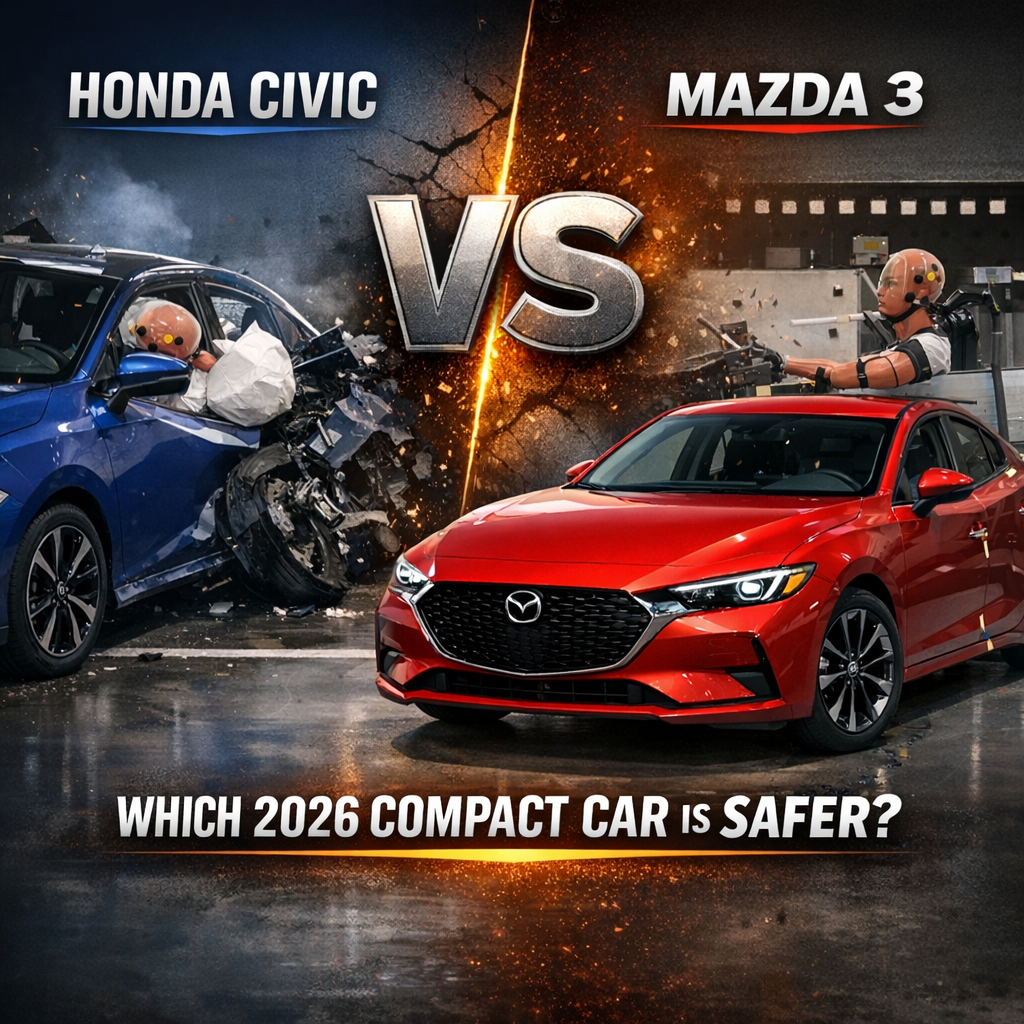
The Honda Civic vs Mazda 3 comparison is expected to stay close in 2026 because both cars are built around the same core priorities: strong structure, modern restraint systems, and driver-assistance features that help prevent accidents before they happen. The biggest difference usually comes down to tuning and emphasis. The Civic tends to focus on broad, accessible protection, while the Mazda 3 often leans into a more premium driving experience that still feels secure and composed.
For a broader look at how manufacturers build long-term confidence into their lineups, you can also read Car Brand Reliability: What Car Brand Has the Least Problems?.
It is also worth checking authoritative safety guidance from the National Highway Traffic Safety Administration, which explains how crashworthiness and driver-assistance systems contribute to real-world protection. That kind of source can help buyers understand why two compact cars with similar feature lists can still feel different on the road.
Why Safety Is Hard to Compare in Compact Cars
Safety is more than crash-test results. A compact car can score well in a lab and still feel less reassuring in daily driving if visibility is poor or the driver-assistance systems are awkward to use. That is why a useful Honda Civic vs Mazda 3 comparison has to consider more than one measure of protection.
When shoppers compare cars like the Civic and Mazda 3, they are usually weighing:
More EV News

- Automatic emergency braking
- Lane keeping support
- Blind-spot monitoring
- Visibility and driver awareness
- Headlight performance
- Rear-seat and child-safety considerations
- Crash structure and restraint design
A car that performs well in one category may not be the best in another, so the safest choice depends on real-world use.
Crash-Test Thinking Matters Too
Buyers often focus on features first, but verified testing matters just as much. In practice, crash tests help show how a vehicle protects occupants in severe impacts, while everyday safety tech helps prevent many of those impacts from happening at all. That is why the Honda Civic vs Mazda 3 conversation should include both passive and active safety.
In a compact-car segment, even small differences in seating position, restraint tuning, or side-impact protection can shape how secure a vehicle feels. For families, commuters, and newer drivers, those details can be as important as horsepower or fuel economy.
Honda Civic vs Mazda 3: Broad, Accessible Protection
The Honda Civic vs Mazda 3 matchup has long favored the Civic when the goal is to make safety technology easy to access. That matters because a safety feature helps most when it is standard or available on the trim buyers are most likely to choose. For 2026, the Civic is expected to continue offering a strong suite of driver-assistance features across much of the lineup.
Standard Driver Assistance
Honda typically equips the Civic with a generous set of standard safety technologies, often including:
- Forward collision warning
- Automatic emergency braking
- Lane departure mitigation
- Lane keeping assist
- Adaptive cruise control
- Traffic sign recognition on some trims
These systems are designed to reduce driver error, which is especially important in daily commuting and stop-and-go traffic. In a Honda Civic vs Mazda 3 decision, that practical approach gives the Civic a strong appeal for drivers who want help without a steep learning curve.
Crash Protection and Cabin Design
The Civic’s structure has generally performed well in crash testing, with careful attention to energy absorption and passenger compartment integrity. Honda also tends to build its cabins with predictable controls and good outward visibility, both of which support safer driving. A car that is easy to see out of and easy to operate can lower stress and improve reaction times in traffic.
That is one reason the Honda Civic vs Mazda 3 comparison often breaks in the Civic’s favor for shoppers who want a car that feels reassuring right away rather than one that takes time to get used to.
Strengths for Families and New Drivers
The Civic is often a smart pick for:
- First-time car buyers
- Commuters who want dependable assistance tech
- Small families needing straightforward safety features
- Drivers who want a low learning curve
Its safety systems are usually calibrated to be helpful without feeling overly aggressive, which can make the car more comfortable for a wide range of drivers.
What Makes It Easy to Live With
The Civic’s daily-driving advantages matter because safety is not only about avoiding a serious crash. It is also about reducing small mistakes, late reactions, and stress in routine traffic. In that sense, the Honda Civic vs Mazda 3 comparison is partly about how quickly a driver can build trust in the vehicle’s behavior. The Civic tends to feel familiar fast, which can be valuable for commuters, parents, and younger drivers.
There is also a practical ownership angle. When controls are intuitive and warning systems are easy to understand, drivers are more likely to leave those features turned on and use them correctly. That can make a meaningful difference over time.
Mazda 3: Premium Feel, Strong Safety Tuning
The Mazda 3 takes a more refined approach. Rather than simply loading up features, Mazda often focuses on how the car feels and responds. That can be a safety advantage, because stable handling, strong braking feel, and clear driver feedback help avoid dangerous situations before they happen.
Driver-Centered Safety Philosophy
Mazda’s safety technology tends to be integrated in a way that feels natural rather than intrusive. The Mazda 3 commonly includes features such as:
- Automatic emergency braking
- Lane departure warning and lane keep assist
- Blind-spot monitoring
- Rear cross-traffic alert
- Adaptive cruise control
- Driver attention monitoring on some trims
These tools support alertness without taking over the driving experience. In the Honda Civic vs Mazda 3 debate, that balance is a major reason many buyers are drawn to Mazda.
Handling as a Safety Feature
One reason the Mazda 3 stands out is its composed chassis and responsive steering. Good handling contributes to safety in everyday situations, from quick lane changes to wet-road confidence. A car that feels stable and predictable can help drivers avoid hazards more effectively than one that simply relies on electronics.
If you spend a lot of time on winding roads or want a compact car that feels secure at speed, this part of the Honda Civic vs Mazda 3 comparison may matter more than raw feature counts.
Visibility and Cabin Layout
The Mazda 3 has a more upscale interior, but its design can feel a little less open than the Civic’s in some trims, especially depending on body style and roofline. That does not make it unsafe, but it does mean drivers should pay attention to sightlines during a test drive. Safety includes how easily you can monitor your surroundings, park, and merge with confidence.
Cabin layout also matters for comfort during longer drives. A seat that supports your posture, a steering wheel that adjusts well, and controls that fall naturally to hand can reduce fatigue. Less fatigue generally means better attention, which is a real safety benefit even if it is hard to measure on a specification sheet.
How It Feels in Daily Driving
For many buyers, the Mazda 3’s biggest safety strength is confidence. The car feels tied down, deliberate, and polished. In a Honda Civic vs Mazda 3 comparison, that can translate into a real advantage if you prefer a vehicle that communicates clearly through the steering wheel, brake pedal, and chassis balance.
The Mazda 3 can also feel especially reassuring in traffic because it seems to encourage smoother inputs. When a car responds predictably to steering and braking, drivers may be less likely to overcorrect in a stressful moment.
Head-to-Head: Which One Is Safer?
If the question is which vehicle is safer overall, the answer is not a simple winner-takes-all. The Civic and Mazda 3 are both highly competitive, but they excel in slightly different areas. The right answer in a Honda Civic vs Mazda 3 comparison depends on how you drive and what kind of safety experience you want every day.
Where the Civic Has an Edge
The Honda Civic vs Mazda 3 may be the better choice if you want:
- More mainstream, widely available safety equipment
- Very user-friendly driver assistance
- Strong everyday visibility
- A practical balance of comfort and protection
The Civic often feels easier for a wide variety of drivers to trust quickly. That can matter just as much as a long feature list.
Where the Mazda 3 Has an Edge
The Mazda 3 may be the better pick if you value:
- A more premium, composed driving feel
- Sharp handling that can improve hazard avoidance
- Safety systems that work smoothly in the background
- A solid, confidence-inspiring ride
For some drivers, the Mazda 3’s more connected feel translates into greater control and confidence in emergency situations.
Crash Avoidance Versus Crash Protection
A complete Honda Civic vs Mazda 3 evaluation should separate two important kinds of safety. Crash avoidance is about the tools and tuning that help you prevent a collision. Crash protection is about what happens if impact becomes unavoidable. The Civic often wins on ease of use, while the Mazda 3 can feel especially reassuring through its chassis behavior and steering precision.
That distinction matters because the safer compact car is not always the one with the flashiest specification sheet. Sometimes the better choice is the one that keeps the driver calm, alert, and in control.
Which One May Suit Different Types of Drivers?
If you are choosing between these two cars for a specific use case, the answer becomes clearer:
- Daily commuter: The Civic may be easier to live with because its safety aids are broad and straightforward.
- Weekend highway driver: The Mazda 3 may feel more stable and confidence-inspiring at speed.
- New driver: The Civic’s simplicity can make it easier to adapt to quickly.
- Driving enthusiast who still wants safety: The Mazda 3 has the edge in connected feel and chassis control.
Those differences do not change the fact that both cars are strong safety choices, but they do help explain why the Honda Civic vs Mazda 3 debate remains so close.
What Matters Most in Real-World Safety
A compact car’s safety rating is important, but daily habits and conditions matter too. The safer car is often the one that matches your routine and helps you stay alert.
Consider These Everyday Factors
When comparing the Civic and Mazda 3, pay attention to:
- How well you can see out of the car
- Whether the active safety systems feel intuitive
- How stable the car feels in turns and on highways
- Seat comfort and driving position
- Rear-seat use if you carry passengers often
- Night driving and headlight performance
The safest compact car is not just the one with the best brochure. It is the one that supports safe driving in the real world. If you test-drive both, the Honda Civic vs Mazda 3 decision often becomes clearer within a few miles.
Look Beyond the Spec Sheet
It helps to spend time in traffic, on side streets, and on the highway before deciding. A car with excellent equipment can still feel less secure if the seating position is awkward or the warning systems are too sensitive. In contrast, a car that feels natural and predictable can reduce fatigue and help prevent mistakes. That is why the Honda Civic vs Mazda 3 conversation should include comfort, visibility, and control, not just features.
Also try to evaluate how each car behaves when parking, reversing, and merging into traffic. Those small daily moments are where many safety features do their most useful work.
Check the Lighting and Bad-Weather Behavior
Headlights, wipers, and traction behavior matter more than many buyers expect. A car that handles rain, glare, and nighttime commutes well can feel safer even if its headline specs are similar to its rival’s. If possible, inspect both cars at dusk or during a rainy test drive. Seeing how they handle poor visibility can tell you a lot about which one will fit your routine.
Safety and Long-Term Ownership
Ownership confidence also plays into safety. Drivers often keep a car longer when it stays reliable and easy to maintain, which helps preserve the safety systems they depend on over time. For broader ownership context, see Car Brand Lasts Longest: Top Reliable Picks.
If you are choosing between these two compact cars for a long-term purchase, the Honda Civic vs Mazda 3 decision may also hinge on which brand’s interior ergonomics, warning logic, and everyday reliability feel most dependable to you. A car that remains easy to trust after years of use can be safer in a practical sense than one that only feels impressive on day one.
How Safety Tech Helps in the Real World
Systems like automatic emergency braking and lane keeping assist are designed to reduce the impact of momentary distraction. That matters because even careful drivers can miss a hazard or drift slightly when tired. The best system is one you understand, trust, and leave active. If a driver disables a feature because it feels annoying, its safety value disappears.
That is another reason the Honda Civic vs Mazda 3 comparison should include user experience, not just equipment. Straightforward systems often deliver more benefit than overly complex ones.
Verdict: Civic or Mazda 3 for 2026?
For most buyers, the Honda Civic is likely the safer all-around choice because it tends to deliver broad, accessible safety tech and excellent everyday usability. It is the kind of car that makes safety easy to live with, which is a major advantage for commuters, families, and newer drivers.
That said, the Mazda 3 is no afterthought. Its strong structure, refined handling, and well-integrated driver aids make it an excellent safety contender. If you prefer a more controlled, premium-feeling compact car and value driving dynamics as part of safety, the Mazda 3 is hard to dismiss.
In the end, the better choice comes down to your priorities. If you want the most universally reassuring compact car, the Civic has the edge. If you want safety wrapped in a more engaging driving experience, the Mazda 3 deserves a close look. Both should remain among the safest compact cars to consider in 2026, and both deserve serious attention in any Honda Civic vs Mazda 3 shopping shortlist.
Before you decide, compare each trim level carefully. In this segment, the safest version is not always the one with the longest option list; it is the one that gives you the right mix of visibility, restraint, active aids, and confidence behind the wheel.