

Car Night Vision Systems can work in fog, but they don’t behave the same way in every situation. Some technologies can improve early awareness—especially thermal imaging—but fog still reduces effective detection range and detail. Understanding what Car Night Vision Systems can and cannot do helps you avoid overconfidence and drive more safely in low-visibility conditions.
- The Short Answer: Yes, But With Limits
- Why Fog Is So Difficult for Driving Technology
- How Car Night Vision Systems Work
- What Night Vision Can Still Help You See in Fog
- Where Night Vision Starts to Lose Effectiveness
- Thermal Imaging vs. Headlights in Fog
- When Car Night Vision Is Most Useful in Fog
- How to Read a Night Vision Display in Fog
- Safety Habits Still Matter More Than the Screen
- How to Get the Best Results From Thermal Night Vision in Fog
- 1) Keep the sensing area clean
- 2) Use the system as part of a scan, not a replacement
- 3) Adjust speed earlier than you think you need to
- Where Robofinity Fits Into This Conversation
- What to Look For If You Are Considering a Night Vision System
- Common Mistakes Drivers Make in Fog
- Driving too fast because the road still looks visible
- Relying on the display instead of scanning the road
- Forgetting that contrast matters more than brightness
- Ignoring windshield and sensor maintenance
- Related Systems You Might Also Consider
- FAQ
- Do car night vision systems work in fog at all?
- Is thermal imaging better than regular night vision in fog?
- Can night vision replace fog lights or headlights?
- Does fog affect thermal cameras?
- Is night vision useful on highways in fog?
- Should I buy a night vision system mainly for fog?
- Conclusion
- The Short Answer: Yes, But With Limits
- Why Fog Is So Difficult for Driving Technology
- How Car Night Vision Systems Work
- What Night Vision Can Still Help You See in Fog
- Where Night Vision Starts to Lose Effectiveness
- Thermal Imaging vs. Headlights in Fog
- When Car Night Vision Is Most Useful in Fog
- How to Read a Night Vision Display in Fog
- Safety Habits Still Matter More Than the Screen
- FAQ
The Short Answer: Yes, But With Limits
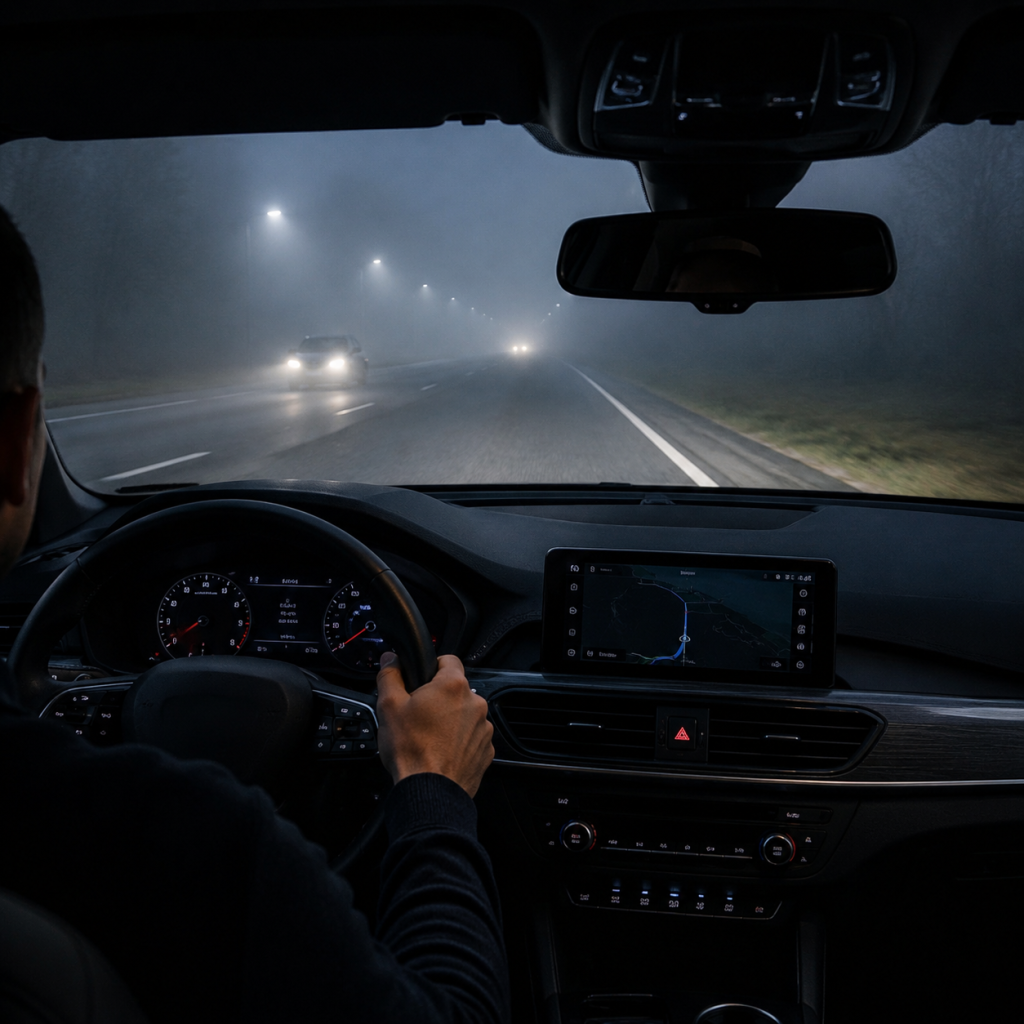
Car Night Vision Systems work in fog, especially if they use thermal imaging rather than regular low-light video. Thermal systems detect heat signatures instead of relying on visible light, which can be a major advantage when headlights produce glare or when mist scatters illumination.
Even so, fog is not a clean environment for any driver-assistance technology. Heavy fog reduces contrast and can weaken detection range, particularly for smaller or colder objects. A system may highlight a pedestrian, deer, or vehicle shape, but the image can appear less sharp and alerts may arrive later than they would on a clear night.
In practice, night vision in fog should be treated as an awareness aid, not a visibility replacement.
Why Fog Is So Difficult for Driving Technology
Fog is made of tiny water droplets suspended in the air. Those droplets scatter light, which is why headlights often seem to bounce back and form a bright wall of haze. That same scattering can also reduce the usefulness of many camera-based systems because contrast drops quickly as distance increases.
What fog does to your view
Fog can make it harder to judge:
- Where lane markings end
- How far away a vehicle actually is
- Whether an object is stationary or moving
- The shape of a pedestrian, cyclist, or animal
- The true depth of a curve, shoulder, or intersection
This is why poor visibility affects more than just sight—it impacts perception, reaction time, and braking decisions all at once.
Why standard cameras struggle
A regular camera depends on usable light and contrast. In fog, light from headlights, streetlights, and other vehicles can reflect off moisture in the air and reduce image detail. The result is often washed-out footage with glare and limited separation between objects and the background.
That is one reason some drivers look toward thermal imaging and other vehicle safety technology for foggy conditions.
How Car Night Vision Systems Work
Not all night vision systems are the same. When people ask how well car night vision systems work in fog, the answer depends on the sensing method inside the system.
Thermal imaging night vision
Thermal imaging detects infrared energy related to heat. Warm objects—such as people, animals, engines, and certain vehicle parts—often stand out because they emit more heat than the surrounding environment.
This approach can be useful in darkness and poor visibility because it does not rely on headlights or ambient light in the same way a visible-light camera does.
In fog, thermal imaging may still show a heat source even when a normal camera loses detail. However, thick moisture in the air can still reduce clarity and effective range. The system may detect an object, but fine details may remain limited.
Low-light camera systems
Some night vision systems rely on enhanced visible-light sensors. These can improve a dark scene, but they remain dependent on light and can struggle when fog reflects illumination back into the lens.
In fog, these camera-based systems often perform less consistently than thermal imaging.
Infrared illumination systems
Some systems use infrared illumination to help the camera see in darkness. That can work well on clear nights, but fog can scatter infrared light too. If the fog is dense, the image can flatten quickly.
What Night Vision Can Still Help You See in Fog
Even though fog is challenging, car night vision systems can still provide useful awareness. The goal is earlier recognition, not perfect visibility.
Pedestrians and cyclists
People are often difficult to see in fog, especially if they wear dark clothing or are near the road edge. Thermal systems can sometimes make a person stand out more clearly than the surrounding background.
When car night vision systems work well in fog, they may help you spot a moving figure sooner—giving you more time to slow down smoothly.
Animals near rural roads
Fog and rural roads create a difficult combination. A deer, stray dog, or other animal may not be visible until the last moment with headlights alone. Thermal detection may give earlier notice that something warm is near or entering the roadway.
For drivers who frequently encounter animals in low-visibility conditions, car night vision systems can be a valuable add-on—particularly when the system is designed to highlight warm bodies against cooler surroundings.
Vehicles ahead
A stopped car, a slow-moving vehicle, or something disabled on the shoulder may be hard to pick out in a gray wall of mist. Some systems can help identify a vehicle shape earlier, supporting safer following distance and smoother speed adjustments.
Roadside obstacles
Fallen debris, construction equipment, and other hazards may be easier to notice when the system highlights contrast between an object and the road environment. This is not guaranteed, but it can help in some situations.
Where Night Vision Starts to Lose Effectiveness
Night vision is helpful, but there are conditions where it becomes much less reliable, even if car night vision systems are designed for low visibility.
Dense fog
As fog gets thicker, any system loses range and contrast. Thermal imaging may still identify a person or animal, but at shorter distances and with less detail.
In the worst density, car night vision systems may show less separation between targets and the background, which can delay recognition.
Heavy rain mixed with fog
Rain adds its own visibility challenges. Water on the windshield, spray from other vehicles, and stronger reflections can reduce how useful the image is to you.
In these mixed conditions, car night vision systems may still detect heat signatures, but driving risk often increases faster than the display can compensate for.
Dirty lenses or blocked sensors
Any camera system is only as good as its lens and sensing window. Road grime, salt, ice, or condensation can reduce clarity. A thermal system with a dirty protective window will not perform as intended.
False confidence from alerts
One of the bigger risks is psychological, not technical. If you start trusting the screen too much, you may follow too closely or drive too fast for the conditions. That is the wrong way to use any driver-assistance tool.
Remember: car night vision systems are meant to support attention, not replace it.
Thermal Imaging vs. Headlights in Fog
A common misunderstanding is that more light automatically means better visibility. In fog, that is not always true.
Why high beams can be worse
High beams can reflect off fog droplets and create intense glare directly in front of the vehicle. That bright reflection can make it harder to see beyond the haze.
Why low beams are usually better
Low beams aim light downward and often reduce glare compared with high beams. They are generally the better choice in fog, though they still have limits.
Why thermal imaging can add value
Thermal imaging does not depend on shining visible light into fog in the same way headlights do. That means it can sometimes reveal heat sources and shapes that are otherwise hard to distinguish. Still, it is an awareness layer, not a replacement for attentive driving.
When car night vision systems work in fog, the biggest benefit is often earlier detection—while headlight glare and reduced contrast can limit what you see in the distance.
When Car Night Vision Is Most Useful in Fog
Car Night Vision Systems tend to help most when fog is moderate rather than extreme. The best results often show up when there’s enough contrast for the sensor to detect heat differences.
Good use cases
- Rural roads with occasional fog patches
- Highway driving at night in light mist
- Early morning commuting in damp conditions
- Mountain roads with changing visibility
- Dark roads with no street lighting
Less useful use cases
- Very dense fog where visibility is already extremely limited
- Windshield or sensor surfaces covered in water, dirt, or frost
- Situations where the vehicle is already traveling too fast for conditions
- Environments where road markings are nearly invisible and attention must stay fully manual
A useful way to think about it: night vision can extend awareness, but it cannot restore normal visibility.
How to Read a Night Vision Display in Fog
A night vision screen is not meant to be interpreted like a normal daytime camera feed. Use it to find shape, motion, and contrast, not to expect perfect clarity.
What to look for
- Highlighted heat signatures
- Motion near the road edge
- A silhouette crossing or entering your lane
- Unusual shapes ahead where the road should be open
- Alerts suggesting a person, animal, or vehicle may be present
What not to assume
- A faint object is definitely harmless
- A highlighted shape is always stationary
- No alert means no hazard
- The system can judge braking distance for you
The display should help you scan sooner, not replace normal driving judgment.
Safety Habits Still Matter More Than the Screen
This part matters because technology can create overconfidence in poor weather. Even when car night vision systems work well in fog, the driver remains responsible for speed, spacing, lane position, and braking.
Practical fog-driving habits
- Slow down before visibility becomes severe
- Use low beams rather than high beams unless local rules or vehicle guidance suggest otherwise
- Increase following distance
- Avoid sudden lane changes
- Use road markings and reflective signs as reference points
- Keep the windshield and mirrors clean
- Defog the windshield before the view becomes a problem
- Stay alert for vehicles that may stop or brake unexpectedly
Driver-assistance technology can help you notice risk sooner, but it does not replace safe driving habits.
If you want additional guidance, review Night Driving Safety in Fog: Key Tips.
How to Get the Best Results From Thermal Night Vision in Fog
If you use car night vision systems in fog regularly, small habits can have a big impact on what you actually see. Start with readiness, then focus on consistent setup and maintenance.
1) Keep the sensing area clean
Road salt, bug residue, and condensation can degrade the view. Clean the windshield and any camera or sensor windows according to the vehicle or system guidance. If the protective cover is smudged, car night vision systems may lose contrast faster in fog.
2) Use the system as part of a scan, not a replacement
In fog, hazards can appear suddenly after being invisible for seconds. A good routine is to keep your eyes moving between the road, mirrors, and the forward scan area—using the display to confirm what your eyes may not fully resolve.
3) Adjust speed earlier than you think you need to
Even with thermal awareness, braking distance in fog can be longer than expected. If you wait for the screen to react, you may still be late. Slower speed makes the biggest difference to real-world safety.
Where Robofinity Fits Into This Conversation
For drivers who want an aftermarket example of this kind of technology, Robofinity InsightDrive is a vehicle thermal night vision system designed to support awareness in low-light and poor-visibility conditions. It uses AI-powered thermal imaging to help detect pedestrians, animals, vehicles, and obstacles, with real-time collision risk alerts and up to 200 meters of detection range in the right conditions.
That kind of system can be relevant for foggy commutes, rural roads, and nighttime highway driving, but it should still be treated as driver assistance—not a substitute for careful driving.
What to Look For If You Are Considering a Night Vision System
If fog is your main concern, compare systems based on practical performance rather than marketing language.
Important factors
- Whether the system uses thermal imaging or visible-light enhancement
- How it handles contrast in poor visibility
- Whether it provides alerts as well as video
- How readable the screen is at a glance
- Whether the camera is protected against weather exposure
- How well the system integrates with your driving position and dashboard layout
Good questions to ask
- Does the system help in fog, or only in darkness?
- Does it detect pedestrians and animals, or only show a video feed?
- Can you use it without taking attention from the road?
- Is the display easy to read in real driving conditions?
- How easy is it to keep the camera lens clean?
If fog is your main concern, a system that focuses on thermal awareness is usually more relevant than one that only brightens a dark image.
Common Mistakes Drivers Make in Fog
A night vision system can only help if you use it correctly. These are the mistakes that matter most.
Driving too fast because the road still looks visible
Fog can hide hazards without fully hiding the road itself. That can feel reassuring, but the road may still require much longer stopping distance than it appears to.
Relying on the display instead of scanning the road
The screen should supplement your vision, not absorb it. Keep looking ahead, around the mirrors, and at lane position.
Forgetting that contrast matters more than brightness
A bright screen is not necessarily a better one. In fog, separating shapes and heat sources from the background can matter more than raw image brightness.
Ignoring windshield and sensor maintenance
Foggy conditions often come with damp glass, grime, and condensation. Cleaning the windshield and camera lens is basic but essential for both visible-light and thermal performance.
Related Systems You Might Also Consider
Different vehicle platforms offer different safety options. For example, you can compare how thermal awareness is described in other guides such as Vehicle thermal imaging: How It Helps Drivers See Pedestrians and Animals at Night.
FAQ
Do car night vision systems work in fog at all?
Yes, many can help in fog, especially thermal imaging systems. Their effectiveness still drops as fog gets thicker, but they can provide earlier awareness than headlights alone.
Is thermal imaging better than regular night vision in fog?
Usually yes. Thermal imaging does not rely on visible light in the same way, so it often holds up better in darkness and moderate fog. It still has limits in dense fog.
Can night vision replace fog lights or headlights?
No. Night vision is an additional awareness tool. You still need proper headlights, safe speed, lane discipline, and full driver attention.
Does fog affect thermal cameras?
Yes. Fog can reduce contrast and range, especially in heavy conditions. Thermal sensors may still detect heat signatures, but poor visibility is still a factor.
Is night vision useful on highways in fog?
It can be, particularly for spotting vehicles, debris, or roadside movement earlier than you might otherwise. Use it to support cautious driving—not to drive faster.
Should I buy a night vision system mainly for fog?
Only if fog, darkness, and other poor-visibility conditions are common in your driving. If you rarely face those environments, the benefit may be limited.
Conclusion
Car Night Vision Systems work in fog, but the real answer is nuanced: they can improve awareness and help you detect hazards sooner, yet they cannot cut through thick fog like a clear day. Thermal imaging tends to offer the most useful performance because it can detect heat signatures without relying on visible light, but it still loses effectiveness as fog becomes denser and visibility range shrinks.
The practical takeaway is simple. Treat Car Night Vision Systems as support for low-light and poor-visibility driving—not a substitute for judgment, speed control, and proper vehicle lighting. For reliable guidance on driving in these conditions, use it alongside safe habits like lower speed, longer following distance, and clean lenses.
For general safety context on driver visibility, see the U.S. National Highway Traffic Safety Administration guidance on vehicle safety.