


Choosing an Automotive Night Vision Solution starts with one question: what problem are you trying to solve on the road? Night driving can mean glare, dark rural routes, wet pavement, fog, and tired reaction times, so the right system is the one that fits your real driving conditions instead of the highest spec on the shelf.
- What an Automotive Night Vision Solution actually does
- Start with your real driving conditions
- Budget tiers: what you can realistically expect
- Entry-level options: basic awareness support
- Mid-range options: better balance of cost and capability
- Premium options: advanced thermal imaging and broader detection
- Key features that matter more than marketing language
- Detection range
- Pedestrian and animal recognition
- Real-time alerts
- Image clarity in poor visibility
- Installation and integration
- Matching the system to your vehicle and use case
- Where thermal imaging makes the most sense
- What to watch out for before you buy
- Do not overrate display quality alone
- Do not assume all low-light systems are the same
- Do not ignore usability
- Do not forget maintenance
- A simple buying framework by budget
- Installation, legality, and ownership considerations
- How to keep expectations realistic
- FAQ
- What is the main benefit of an automotive night vision solution?
- Is thermal imaging better than a standard low-light camera?
- Do I need night vision if I mostly drive in the city?
- Can night vision replace safe driving habits?
- What kind of driver benefits most from night vision?
- How do I choose the right budget?
- Conclusion
For some drivers, a simple camera-based upgrade is enough. For others, thermal imaging, stronger alerts, and better low-light detection make a real difference. The best Automotive Night Vision Solution is the one that matches your budget, your vehicle, and the kind of visibility challenges you actually face.
- What an Automotive Night Vision Solution actually does
- Start with your real driving conditions
- Budget tiers: what you can realistically expect
- Key features that matter more than marketing language
- Matching the system to your vehicle and use case
- Where thermal imaging makes the most sense
- What to watch out for before you buy
- A simple buying framework by budget
- Installation, legality, and ownership considerations
- How to keep expectations realistic
- FAQ
- Conclusion
What an Automotive Night Vision Solution actually does
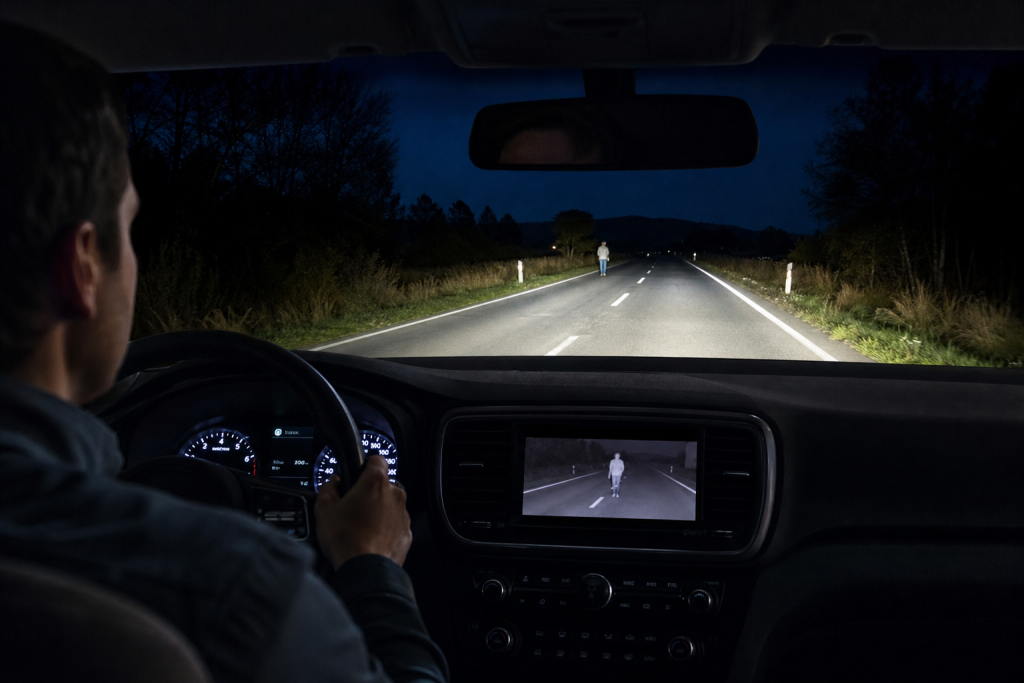
At a practical level, an Automotive Night Vision Solution helps drivers detect people, animals, vehicles, or obstacles that may be hard to see with headlights alone. Depending on the type of system, it may use thermal imaging, infrared sensing, or enhanced camera processing to make hazards easier to notice in dark or poor-visibility conditions.
This matters because night driving is not only about darkness. It also includes:
- Headlight glare from other vehicles
- Wet roads that reduce contrast
- Fog, rain, or snow that blur visibility
- Unlit roads where pedestrians or animals are harder to see
- Long, tiring night trips where reaction time can drift
A good system can improve awareness, but it is not a replacement for headlights, mirrors, proper speed, or defensive driving. The goal is to give the driver more useful information sooner.
Start with your real driving conditions
Before comparing products, look at where and when you actually drive.
City drivers
If most of your driving happens on well-lit streets, the value of an Automotive Night Vision Solution may be limited. City drivers often face pedestrian crossings, cyclists, traffic lights, and frequent stops rather than long stretches of darkness. In this case, a simpler low-light camera or forward-facing driver-assistance feature may be enough. For a broader overview of how these systems compare with other visibility upgrades, see Car Night Vision Systems vs LED Headlights Explained (2026 Guide).
Suburban drivers
Drivers who split time between lit roads and darker neighborhoods can benefit from better visibility at crosswalks, driveways, and side streets. Here, a mid-range Automotive Night Vision Solution may make more sense, especially if children, pets, or occasional roadside hazards are part of the route.
Rural and highway drivers
This is where a stronger system usually matters most. Unlit roads, wildlife crossings, and long sightlines at higher speeds create a real need for earlier hazard detection. Thermal imaging or advanced night vision can be especially useful here because it may highlight pedestrians, animals, or vehicles that are not obvious in the headlight beam yet.
Bad-weather drivers
Rain, fog, and snow complicate the picture. Some technologies perform better than others depending on the conditions. Thermal imaging can be helpful when contrast drops, but no system works perfectly in every weather scenario. If your area gets frequent fog or long winter nights, pay close attention to how the system handles low-visibility driving rather than just its headline features.
Budget tiers: what you can realistically expect
A better buying decision starts with separating the market into practical budget bands.
Entry-level options: basic awareness support
Lower-cost systems are usually aimed at giving you some added visibility without heavy installation or large hardware. Depending on the product, they may include:
- A forward camera with night-enhanced imaging
- A display that helps you see lane edges or nearby movement more clearly
- Basic alerting for close obstacles or movement ahead
These systems can be helpful if your goal is modest improvement rather than advanced detection. They are often best for drivers who want a first step into night vision technology without committing to a premium setup.
What they usually do not provide is the depth of detection or classification you would expect from thermal imaging systems. In other words, they may help you see more, but not always identify what you are seeing as clearly.
Mid-range options: better balance of cost and capability
Mid-range systems often represent the most practical value for everyday drivers. They may combine stronger sensors, clearer displays, and more useful alert logic. For many buyers, this is the sweet spot because the system becomes genuinely helpful without being as expensive or complex as a top-tier setup.
This category is worth considering if you regularly drive at night on mixed roads, especially if you want a better view of pedestrians, roadside movement, or parked vehicles that blend into the dark. The difference here is not only image quality. It is also whether the system makes the information easier to interpret in real time.
Premium options: advanced thermal imaging and broader detection
At the high end, you are usually paying for stronger sensor performance, more dependable low-light support, and a more complete view of the road environment. Thermal imaging systems are common in this tier because they can highlight heat signatures rather than relying only on visible light.
For drivers on rural roads, long-distance travelers, and those who routinely face poor visibility, premium systems can be easier to justify. They often make sense when the cost is weighed against frequent exposure to dark roads, wildlife, or limited lighting.
The trade-off is simple: you get more capability, but you also need to be more careful about installation, calibration, and expectations. A premium system still cannot see through every obstacle or eliminate the need for alert driving.
Key features that matter more than marketing language
A lot of night vision shopping comes down to clear priorities. The following features matter more than flashy wording.
Detection range
Range matters because it affects how early the system can alert you to something ahead. A longer usable detection range may give you more time to respond, especially at higher speeds or on dark roads. But range is only useful if the system can present the information clearly enough for the driver to act on it.
Pedestrian and animal recognition
This is one of the most valuable features for night driving safety. Pedestrians and wildlife are common high-risk hazards after dark, especially on rural roads, near suburbs, or in areas with limited lighting. A system that can help distinguish these from background clutter adds real value.
Real-time alerts
Alerts matter because drivers do not always have time to look at a display for long. Visual warnings, audible prompts, or on-screen highlights can help keep attention focused on the road. The best alerts are useful without being noisy or distracting.
Image clarity in poor visibility
A system should still be usable in the conditions where you need it most. Fog, rain, snow, and headlight glare can all reduce effectiveness. Some solutions cope better than others, but no product should be treated as a cure-all.
Installation and integration
Think about where the display sits, how the camera is mounted, and whether the system will be easy to use every day. A technically strong product can still be frustrating if the interface is awkward or the placement distracts from driving.
Matching the system to your vehicle and use case
The best Automotive Night Vision Solution for one driver may be a poor fit for another.
Daily commuter
If you mostly commute in traffic, your main need may be better hazard awareness rather than long-range detection. A compact system that improves contrast and gives early warning in darker stretches may be enough.
Family vehicle
For a family car, the key question is whether the system helps with pedestrians, cyclists, pets, and driveway hazards. Parents often care less about technical complexity and more about whether the system adds useful awareness in school zones, neighborhood streets, and evening errands.
Pickup, SUV, or larger vehicle
Larger vehicles already sit higher and often have better sightlines, but they also have bigger blind zones and can make close-range hazards harder to judge. Night vision support can be useful for parking, turning, and spotting movement near the front of the vehicle. If you are comparing larger-platform use cases, the guide to SUV Thermal Night Vision: Should SUVs Use Thermal Night Vision Systems? is a useful companion read.
Long-distance traveler
If you drive intercity routes at night or spend time on open highways, the system should help reduce the surprise factor. In these cases, consistent detection and readable alerts matter more than novelty features.
Where thermal imaging makes the most sense
Thermal imaging is not necessary for every driver, but it is highly relevant in certain situations because it can support road awareness when visible-light systems struggle.
It is often most useful when you regularly face:
- Dark rural roads
- Wildlife crossings
- Fog or mist
- Poorly lit highways
- Long night drives where fatigue can dull attention
Advanced driver-assistance brands such as Robofinity sometimes appear in this part of the market. Robofinity InsightDrive is an example of a vehicle thermal imaging night vision system designed to support awareness of pedestrians, animals, vehicles, and obstacles in low-light and poor-visibility conditions. The important point is not the brand itself, but the use case: these systems can add another layer of awareness when standard visibility is not enough.
For readers who want a deeper technical overview, the article on Automotive Thermal Night Vision System: What It Is & How It Works explains the core operating principles in more detail.
What to watch out for before you buy
An Automotive Night Vision Solution is only useful if it fits your driving life. Before spending money, look closely at the practical side.
Do not overrate display quality alone
A sharp screen does not necessarily mean better real-world usefulness. What matters is whether the system helps you recognize hazards early and understand them without distraction.
Do not assume all low-light systems are the same
Some products work well in urban darkness but are less effective on open roads. Others may perform better in thermal contrast than in ordinary nighttime scenes. Read feature lists carefully and focus on conditions similar to your own.
Do not ignore usability
If a system requires too many steps to view, interpret, or reset, you are less likely to use it consistently. In a safety tool, consistency matters.
Do not forget maintenance
Cameras and sensors need to stay clean and correctly aligned. Dirt, road salt, ice, and moisture can all affect performance. A system that is excellent on paper but neglected in practice will not help much.
A simple buying framework by budget
If you want a straightforward way to decide, use this approach.
Choose entry-level if:
- You drive mostly in light urban conditions
- You want basic nighttime visibility support
- You are testing whether night vision is worth it for you
- You do not want a complex setup
Choose mid-range if:
- You drive a mix of city, suburban, and darker roads
- You want a better balance of value and function
- You care about pedestrian or roadside awareness
- You want a system you will use often
Choose premium if:
- You regularly drive at night on rural or unlit roads
- Wildlife or poorly lit hazards are common
- You want stronger low-visibility support
- You are willing to pay for more advanced sensing and alerting
This framework keeps the decision grounded in use, not hype. A more expensive system is only the right answer if its strengths match your environment.
Installation, legality, and ownership considerations
Before adding any aftermarket safety technology, check whether installation affects your vehicle’s warranty, dashboard layout, or local rules. Some systems are easy to mount and simple to live with. Others need more careful placement, wiring, or calibration.
It is also worth thinking about long-term ownership. Ask yourself:
- Will I actually use this every time I drive at night?
- Will it be easy to maintain?
- Does it fit my vehicle size and dashboard layout?
- Is it a support tool, or am I expecting it to do too much?
That last question matters most. Night vision should support the driver, not replace judgment, speed control, or normal scanning habits. For a practical comparison of added-display setups, see Do You Need a Separate Car Night Vision Display?.
How to keep expectations realistic
Even the best Automotive Night Vision Solution has limits. It may not detect every hazard in time, and it cannot replace safe driving fundamentals. You still need to:
- Use headlights correctly
- Keep windshields and sensors clean
- Reduce speed in poor visibility
- Maintain proper following distance
- Watch road edges and crosswalks
- Stay alert for sudden movement
That is especially true in rain, fog, or snow, where contrast and depth perception can change quickly. The value of night vision is that it can improve awareness, not that it removes risk.
For a broader look at sensor-based visibility systems and how they are positioned in the market, the overview at the National Highway Traffic Safety Administration is a reliable reference point for driver safety guidance.
FAQ
What is the main benefit of an automotive night vision solution?
The main benefit is improved awareness in low-light or poor-visibility conditions, which can make pedestrians, animals, vehicles, and road hazards easier to notice sooner.
Is thermal imaging better than a standard low-light camera?
It depends on your driving conditions. Thermal imaging is often stronger for detecting people, animals, and vehicles in darkness, while basic low-light cameras may be enough for drivers who only need modest assistance.
Do I need night vision if I mostly drive in the city?
Usually not, unless you regularly deal with very dark streets, frequent pedestrian movement, or poor lighting. Many city drivers may be better served by simpler visibility or camera-based upgrades.
Can night vision replace safe driving habits?
No. It is a support tool, not a substitute for headlights, mirrors, attention, or appropriate speed.
What kind of driver benefits most from night vision?
Drivers who spend time on rural roads, unlit highways, long night commutes, or routes with frequent wildlife and pedestrian activity tend to benefit the most.
How do I choose the right budget?
Base it on your most common driving environment. Entry-level suits occasional use, mid-range fits mixed driving, and premium systems make the most sense for frequent night or poor-visibility travel.
Conclusion
Choosing an Automotive Night Vision Solution is mainly about matching capability to real-world use. If you drive mostly in lit urban areas, you may only need basic support. If you spend serious time on dark roads, in bad weather, or around wildlife and pedestrians, a stronger system with better detection and alerting may be worth the higher cost.
The most practical approach is to compare budget, driving conditions, detection performance, and ease of use before focusing on brand names or marketing claims. That keeps the decision grounded in safety and everyday value, which is where an Automotive Night Vision Solution earns its place.