

Night driving puts pressure on the one thing every driver relies on most: clear visibility. Even on familiar roads, darkness reduces the time you have to notice hazards, judge distance, and react to sudden changes. That is why thermal night vision technology belongs in the conversation about modern vehicle safety. It is not a replacement for careful driving, but it can add another layer of awareness when headlights, mirrors, and human vision are not enough.
- Night Driving Creates a Visibility Problem, Not Just a Lighting Problem
- Why Headlights Alone Are Not Enough
- They illuminate what is directly ahead
- They struggle with contrast
- They can be affected by weather and glare
- They do not identify heat signatures
- How Thermal Night Vision Technology Works in Practice
- Where Thermal Night Vision Technology Helps Most
- What Thermal Night Vision Technology Can Detect Better Than the Human Eye
- What Drivers Should Understand About the Limits
- It does not replace safe driving habits
- It does not guarantee hazard detection
- It does not eliminate braking distance
- It should not encourage faster driving at night
- Thermal Night Vision vs. Visible-Light Cameras
- A Realistic Example of Where It Makes a Difference
- Who Is Most Likely to Benefit
- What to Look for in a Thermal Night Vision System
- Why This Technology Matters Beyond Comfort
- Common Questions Drivers Ask Before Buying
- FAQ
- What is thermal night vision in a car?
- Is thermal night vision the same as a regular night camera?
- Does thermal night vision replace headlights?
- Can thermal imaging help in fog or rain?
- Is thermal night vision useful in cities?
- Who should consider this technology most seriously?
- Conclusion
This matters especially on rural roads, highways, mountain routes, and poorly lit streets where pedestrians, animals, and debris can appear with very little warning. Thermal imaging offers a different way of seeing the road ahead, and that difference is exactly why it has become relevant in driver-assistance technology. For a broader overview, see our guide to automotive thermal night vision systems.
- Night Driving Creates a Visibility Problem
- Why Headlights Alone Are Not Enough
- How Thermal Night Vision Works in Practice
- Where Thermal Night Vision Helps Most
- What Thermal Night Vision Can Detect Better Than the Human Eye
- What Drivers Should Understand About the Limits
- Thermal Night Vision vs. Visible-Light Cameras
- What to Look for in a Thermal Night Vision System
- FAQ
- Conclusion
Night Driving Creates a Visibility Problem, Not Just a Lighting Problem
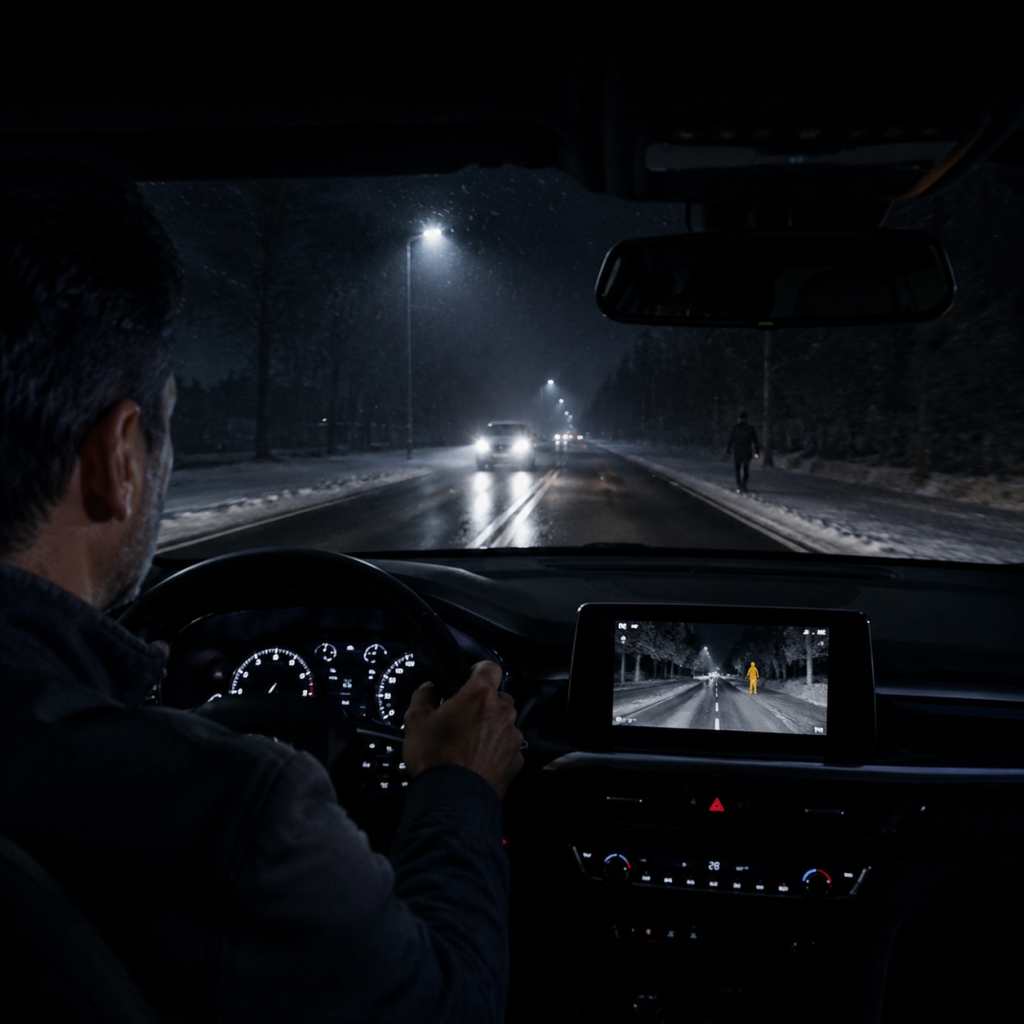
A lot of drivers think night driving is mainly about having brighter headlights. In reality, the problem is more complicated. Darkness changes how people perceive motion, distance, contrast, and shape. It also limits peripheral awareness, which is where many unexpected hazards first appear.
At night, the road can seem clear until the last moment. A person in dark clothing near the shoulder, a deer stepping onto the edge of the pavement, or a stopped vehicle without strong reflectors can be difficult to identify quickly. Even with good headlights, the usable field of vision is still limited by beam pattern, curve geometry, weather, and glare from other traffic.
That is why night driving risk is not only about seeing farther. It is about recognizing hazards sooner. In that sense, thermal night vision technology is less about comfort and more about giving the driver more time to react.
Why Headlights Alone Are Not Enough
Headlights are essential, but they have built-in limits.
They illuminate what is directly ahead
Most headlights do a good job lighting the road in front of the car, but they do not fully solve side visibility or early hazard detection. Objects outside the beam can stay hidden until you are already close.
They struggle with contrast
A reflective sign may stand out clearly, while a pedestrian or animal with little reflective material may blend into the background. Bright illumination does not automatically make a hazard obvious, which is why thermal night vision technology can add value.
They can be affected by weather and glare
Rain, fog, snow, and oncoming headlights all reduce how effectively visible light helps the driver. Light can scatter, reflect, or create washout, making it harder to distinguish shapes and movement. That is one reason drivers compare visible-light systems with thermal night vision technology when visibility drops.
They do not identify heat signatures
Traditional lighting shows surfaces. Thermal night vision detects heat differences, which can reveal living beings and warm objects that are hard to spot through visible light alone.
How Thermal Night Vision Technology Works in Practice
Thermal Night Vision Technology detects infrared energy, which is emitted as heat rather than reflected light. In practical terms, that means the system can display objects based on temperature contrast rather than brightness.
This is useful because the road at night often has poor visual contrast. A pedestrian, cyclist, animal, or stalled vehicle can be difficult to distinguish if the background is dark or cluttered. Thermal imaging helps separate those objects from the surroundings by making heat differences visible.
For the driver, the value is not abstract technology. It is earlier recognition. If a hazard becomes visible sooner, the driver has more time to slow down, adjust lane position, or prepare to stop. That practical benefit is the reason many people researching thermal night vision technology want to understand how it performs in real driving conditions.
One way to think about it is this: visible-light systems show what is illuminated, while thermal imaging helps reveal what is still there even when the scene is hard to read. That can be especially helpful when road edges, clothing, or background shadows make a hazard blend in.
Where Thermal Night Vision Technology Helps Most
Thermal Night Vision Technology is most valuable in driving situations where visibility is unstable or unpredictable.
Rural roads
Rural roads often have no street lighting, more curves, and more wildlife movement. A thermal system can help drivers spot animals or pedestrians at the roadside before they are visible in headlights.
Highways
At highway speed, reaction time is short. Thermal imaging can help identify stopped vehicles, people near the road edge, or large animals before they come into the brightest part of the headlight beam.
Fog, rain, and snow
Bad weather can reduce visible contrast and make regular cameras less useful. Thermal imaging does not eliminate the challenges of weather, but it can improve awareness when visible-light systems are being degraded.
Headlight glare
Oncoming glare and reflected light can temporarily limit what the driver sees. Because thermal imaging is based on heat, it is less dependent on visible-light conditions.
Poorly lit urban streets
City driving at night is often assumed to be safer than rural driving, but poorly lit crossings, parked cars, and pedestrians stepping between vehicles can still create sudden hazards. Thermal awareness can add a useful margin of time, especially when thermal night vision technology is paired with attentive driving.
For more context on weather-related visibility challenges, read Night Driving Safety in Fog: Key Tips.
What Thermal Night Vision Technology Can Detect Better Than the Human Eye
Thermal systems are especially useful for recognizing living things and warm objects that may be hard to identify visually.
They can help drivers detect:
- Pedestrians crossing or standing near the roadway
- Animals near roadsides or in open areas
- Vehicles or obstacles in low-visibility conditions
- Objects that blend into dark pavement or background shadows
This does not mean the system sees everything. It means it can make certain risks more obvious earlier than the driver might otherwise notice them. In many situations, thermal night vision technology is most helpful because it turns subtle heat contrast into a visible warning.
Drivers often notice the biggest difference when a hazard is not in the brightest part of the headlight beam yet. A thermal display can help draw attention to movement or warmth at the road edge, giving the driver a better chance to respond before the situation becomes urgent.
What Drivers Should Understand About the Limits
Thermal Night Vision Technology is helpful, but it is not magic. The most important limitation is simple: it supports driver awareness, but it does not drive the vehicle.
It does not replace safe driving habits
Drivers still need to use headlights, mirrors, lane discipline, and safe following distance. A thermal system is an extra layer of information, not a substitute for attentiveness.
It does not guarantee hazard detection
Some objects may not stand out clearly, especially if they are small, far away, or not much warmer than the background. No sensing system should be treated as flawless.
It does not eliminate braking distance
Even if a hazard appears earlier on a screen, the car still needs time and space to slow down safely. That is why thermal night vision technology works best when paired with cautious driving.
It should not encourage faster driving at night
Some drivers may be tempted to drive more aggressively if a technology appears to improve visibility. That is the wrong takeaway. Better awareness should lead to more informed decisions, not riskier ones.
A practical mindset is the best one: use the system to notice more, then continue driving as if the unexpected could still happen at any moment.
Thermal Night Vision vs. Visible-Light Cameras
Drivers often compare thermal night vision technology with dash cams or standard cameras. They are useful for different reasons.
Visible-light cameras
These can provide detailed imagery in good lighting and are often useful for recording incidents or reviewing what happened after the fact. But they depend heavily on light and contrast.
Thermal imaging
Thermal systems are more focused on detection in darkness and poor visibility. They are not necessarily about visual detail in the usual sense. Their advantage is in making certain hazards easier to notice when the scene is dark, foggy, or cluttered.
A practical way to think about it: visible-light cameras help you document what is seen; thermal imaging helps you notice what would otherwise be easy to miss. That distinction is one reason thermal night vision technology is becoming a serious driver-assistance topic.
For readers who want to compare system types in more depth, the article on vehicle thermal imaging explains how this approach helps drivers see pedestrians and animals at night.
A Realistic Example of Where It Makes a Difference
Consider a driver returning home on a dark rural road after work. The headlights reach the lane ahead, but the shoulder is unlit. A deer steps near the edge of the road, or a pedestrian in dark clothing is walking where the beam does not fully reach.
In that kind of situation, thermal imaging can help make the hazard visible sooner. That does not eliminate the need to slow down or brake carefully, but it can create the extra seconds that matter.
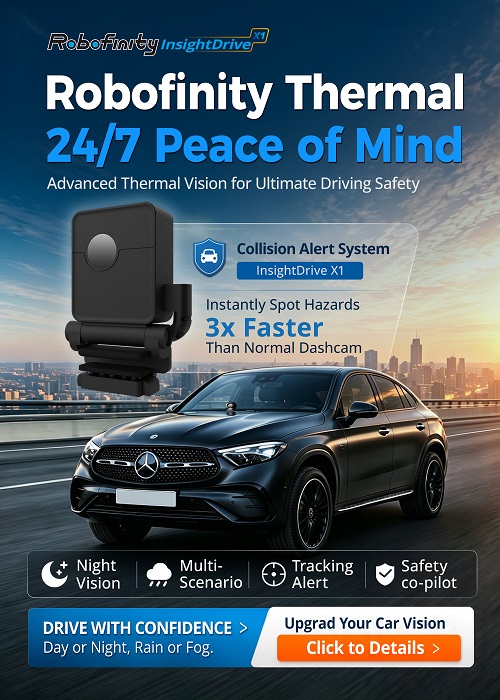
That is why some drivers who spend a lot of time on dark roads look at aftermarket driver-assistance tools such as Robofinity InsightDrive, which uses AI-powered thermal imaging to support awareness of pedestrians, animals, vehicles, and obstacles in low-light conditions.
In a similar way, many drivers researching thermal night vision technology are really asking one question: will it give me enough advance notice to avoid a dangerous surprise? In the right conditions, that extra notice can be the difference between a close call and a collision.
Who Is Most Likely to Benefit
Thermal Night Vision Technology is not necessary for every driver. It tends to make the most sense for people who regularly face difficult visibility.
This includes:
- Drivers on rural or mountain roads
- Commuters with late-night travel routes
- Highway drivers who often travel after dark
- Families driving in areas with frequent wildlife crossings
- Long-distance drivers who cover unfamiliar roads at night
- Commercial drivers who spend many hours in low-light conditions
If most of your driving happens in well-lit urban areas during the day, the benefit may be smaller. But if darkness and poor visibility are a regular part of your routine, thermal night vision technology becomes more relevant.
It is also worth considering how often you drive in mixed conditions. A route that is clear in daylight can feel very different after sunset, especially when road markings fade, weather changes, or fatigue sets in.
What to Look for in a Thermal Night Vision System
If you are evaluating this technology, focus on how well it supports real driving rather than on marketing language.
Detection clarity
A system should make hazards easy to understand quickly, not just produce a dramatic-looking image.
Alert behavior
Real-time alerts can be useful if they are timely and not overly noisy. A system that warns too often may become distracting.
Screen readability
The display should be easy to glance at without pulling too much attention from the road.
Weather resilience
A vehicle-mounted camera exposed to the elements needs practical protection for everyday use.
Integration with driving habits
The best system is the one that supports careful driving without encouraging overconfidence.
Robofinity InsightDrive is an example of this category, with features such as up to 200 meters / 656 feet of detection range, thermal recognition of pedestrians and animals, and real-time alerts designed for poor-visibility driving. In the same way, many drivers evaluating thermal night vision technology want a system that improves awareness without adding distraction.
Another helpful reference point is whether the system fits naturally into a driver’s routine. If the display is difficult to read, or the alerts are too aggressive, the technology may end up being ignored instead of used.
Why This Technology Matters Beyond Comfort
Some safety features are mostly about convenience. Thermal night vision technology is more closely tied to hazard awareness. That is important because nighttime crashes are often made worse by delayed recognition, limited contrast, and the short time drivers have to respond.
In other words, the value is not that the road feels less dark. The value is that the driver may have a better chance of noticing what is ahead sooner.
That can matter on a family trip, a late shift drive home, or a long highway journey where fatigue and reduced visibility already make the job harder. It is also why drivers researching thermal night vision technology often compare systems that can identify pedestrians, animals, and vehicles in time to support better decisions.
For buyers comparing options in 2026, our roundup of the best automotive thermal night vision systems can help narrow the field.
Common Questions Drivers Ask Before Buying
Many drivers want to know whether this technology is practical or just impressive on paper. That is a fair question, because the best safety tools are the ones that make real-world driving easier to manage.
Typical concerns include whether the display is clear at a glance, whether the alerts are distracting, and whether the system truly adds value in conditions such as fog or darkness. Those concerns are reasonable because the goal is not to create another screen to watch. The goal is to give the driver a better chance of noticing a hazard before it becomes urgent.
For that reason, thermal night vision technology should be judged by usability, detection value, and how naturally it supports safer decisions behind the wheel.
FAQ
What is thermal night vision in a car?
It is a driver-assistance technology that uses heat detection to help make pedestrians, animals, vehicles, and other obstacles easier to notice in dark or poor-visibility conditions.
Is thermal night vision the same as a regular night camera?
No. Regular night cameras depend on visible light or infrared illumination, while thermal systems detect heat patterns. They serve different purposes.
Does thermal night vision replace headlights?
No. Headlights are still essential, and drivers must continue to use them normally. Thermal night vision technology is an added awareness tool, not a replacement.
Can thermal imaging help in fog or rain?
It can help in some poor-visibility conditions because it is not dependent on visible light in the same way as standard cameras, but it does not remove the risks created by weather.
Is thermal night vision useful in cities?
Yes, especially on poorly lit streets, near crosswalks, or where pedestrians may step into the road unexpectedly. The benefit is usually strongest where lighting is inconsistent.
Who should consider this technology most seriously?
Drivers who frequently travel at night on rural roads, highways, or other low-visibility routes are the most likely to benefit from it.
For a trusted reference on vehicle safety and nighttime visibility, the National Highway Traffic Safety Administration provides research and guidance on road safety topics that affect night driving.
Conclusion
Night driving is difficult because the road presents fewer visual clues and more moments where hazards appear too late. Thermal night vision technology helps address that problem by making heat-based contrast visible when darkness, glare, fog, rain, or snow limit what the eye can see. It is not a substitute for careful driving, but it can support faster recognition of people, animals, vehicles, and obstacles when visibility matters most.
For drivers who routinely travel after dark, especially on rural roads or in poor weather, learning more about vehicle thermal imaging systems such as Robofinity InsightDrive can help put this technology in the right context: as a practical driver-assistance upgrade that improves awareness without replacing safe driving habits.